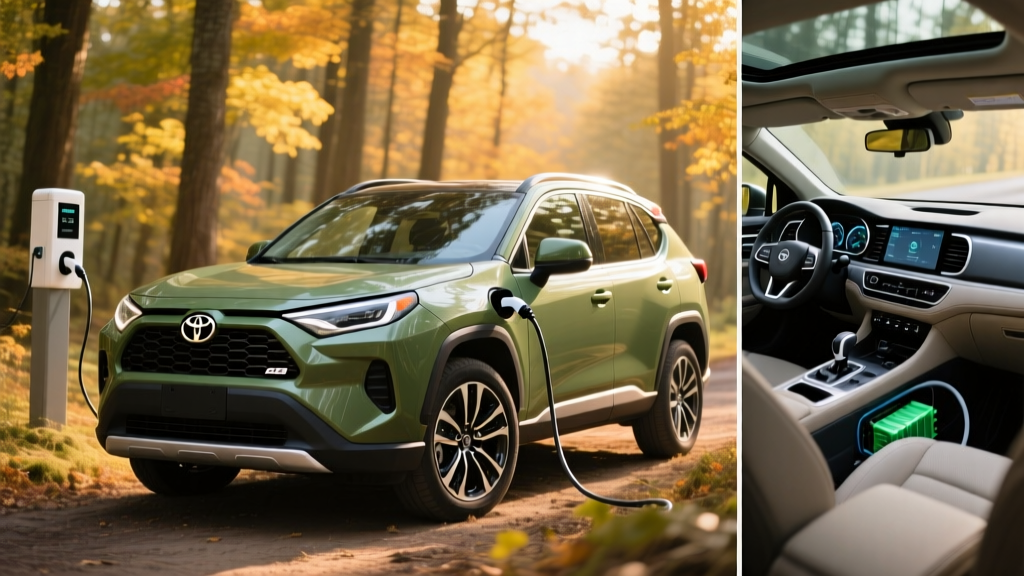
The 2025 Toyota RAV4 Hybrid Woodland Edition occupies a narrow but compelling lane: a rugged-styled conventional hybrid crossover that sips fuel while offering trail-tuned suspension and standard all-wheel drive. It is not a plug-in hybrid, it is not a body-on-frame off-roader, and it does not qualify for the federal §30D EV tax credit. What it is — a 219-horsepower, 37-MPG combined AWD hybrid starting near $36,000 — makes it one of the most practical daily drivers for buyers who want efficiency without plugging in.
This guide breaks down every spec that matters to a hybrid buyer: EPA and real-world fuel economy, the powertrain, battery warranty, pricing, and how the Woodland Edition stacks up against the RAV4 Prime PHEV, a full EV, and a gas-only RAV4.
2025 RAV4 Hybrid Woodland Edition: Quick Specs
| Spec | Value |
|---|---|
| Powertrain Type | Conventional Hybrid (HEV) — no plug-in required |
| Combined Horsepower | 219 hp |
| Engine | 2.5L 4-cylinder + front & rear electric motors |
| Drivetrain | Electronic On-Demand AWD |
| EPA MPG (City / Hwy / Combined) | 38 / 35 / 37 |
| Fuel Tank Capacity | 14.5 gallons |
| Total Driving Range | ~536 miles (EPA est.) |
| Hybrid Battery | ~1.6 kWh NiMH (sealed, self-charging) |
| 0–60 mph | ~7.4 seconds |
| Towing Capacity | 1,750 lbs |
| Cargo Volume (rear seats up / down) | 37.6 / 69.8 cu ft |
| Base MSRP | ~$36,075 (incl. destination) |
| Federal §30D Tax Credit | Not eligible (HEV, not PHEV/BEV) |
| Hybrid Battery Warranty | 10 years / 150,000 miles |
Fuel Economy: EPA Numbers vs Real-World MPG
The EPA rates the 2025 RAV4 Hybrid AWD at 38 city / 35 highway / 37 combined MPG (fueleconomy.gov). The Woodland Edition shares the same hybrid powertrain and EPA rating as other RAV4 Hybrid AWD trims.
| Driving Cycle | EPA MPG |
|---|---|
| City | 38 |
| Highway | 35 |
| Combined | 37 |
Real-World MPG: What Owners Actually See
Toyota's hybrid system excels in stop-and-go city driving, where the electric motor handles low-speed propulsion and regenerative braking recaptures energy. Many RAV4 Hybrid owners report 38–42 MPG in mixed city driving, occasionally exceeding the EPA city estimate. Highway cruising at 75+ mph, however, tends to drop fuel economy to 32–34 MPG, as the gasoline engine carries more of the load without regenerative assistance.
Cold weather (below 30°F) typically costs 2–4 MPG as the engine runs longer to heat the cabin and bring the catalytic converter to operating temperature. Expect 33–35 MPG combined in winter for most northern-climate drivers.
Powertrain & Performance
The RAV4 Hybrid pairs a 2.5-liter Dynamic Force 4-cylinder engine (176 hp, 163 lb-ft) with two electric motors — one driving the front axle and a smaller one powering the rear axle for electronic on-demand AWD. Combined system output is 219 horsepower.
A continuously variable transmission (eCVT) manages power delivery. The eCVT is not a belt-driven CVT; it uses a planetary gearset to blend engine and motor torque, which eliminates the rubber-band feel some drivers associate with traditional CVTs. Acceleration to 60 mph takes approximately 7.4 seconds — adequate for merging and passing, though not sporty.
The Woodland Edition distinguishes itself with a TRD-tuned suspension featuring revised shock valving for improved compliance on rough roads and light trails. Ground clearance remains 8.1 inches, and the AWD system includes Multi-Terrain Select with Mud/Sand and Rock/Dirt modes. This is not a hardcore off-roader — it lacks a locking rear differential or low-range gearing — but it handles forest service roads, snowy driveways, and gravel camping access with confidence.
HEV vs PHEV: RAV4 Hybrid vs RAV4 Prime
Toyota offers the RAV4 in two electrified flavors: the conventional Hybrid (HEV) and the RAV4 Prime plug-in hybrid (PHEV). The Woodland Edition is only available as an HEV. Understanding the difference is critical before you buy.
Conventional Hybrid (HEV): Charges itself via the engine and regenerative braking. You never plug it in. The battery is small (~1.6 kWh) and assists the gas engine for better MPG.
Plug-in Hybrid (PHEV): Has a much larger battery (~18.1 kWh in the RAV4 Prime) that you charge by plugging in. It can drive on electric-only power for a set range before the gas engine takes over.
| Attribute | RAV4 Hybrid AWD (HEV) | RAV4 Prime (PHEV) |
|---|---|---|
| Plug-in Required? | No — self-charging | Yes — plug in for EV range |
| Electric-Only Range | ~0.5 mi at low speed | 42 miles (EPA est.) |
| Combined Horsepower | 219 hp | 302 hp |
| EPA Combined MPG / MPGe | 37 MPG | 94 MPGe (elec+gas) / 38 MPG (gas only) |
| Hybrid Battery Size | ~1.6 kWh NiMH | ~18.1 kWh lithium-ion |
| DC Fast Charging | N/A | No (Level 2 only, ~2.5 hrs) |
| 0–60 mph | ~7.4 sec | ~5.7 sec |
| Starting MSRP | ~$33,575 (LE AWD) | ~$44,990 (SE) |
| Federal §30D Tax Credit | Not eligible | Not eligible (battery sourcing) |
| Total Range (gas + electric) | ~536 mi | ~600 mi |
The RAV4 Prime offers dramatically more power and 42 miles of electric-only commuting — enough to cover most daily round trips without burning gas. However, it costs roughly $8,000–$10,000 more, and as of the current IRS §30D rules, it does not qualify for the federal tax credit due to battery-component and critical-mineral sourcing requirements (IRS.gov). The Hybrid, meanwhile, is simpler: fill it with gas, drive it, and enjoy 37 MPG with no lifestyle changes.
Pricing, Trims & Tax Credit Eligibility
The 2025 RAV4 Hybrid Woodland Edition starts at approximately $36,075 including destination charges. This places it between the XLE Premium (~$35,000) and the Limited (~$39,000) in the RAV4 Hybrid lineup.
Federal Tax Credit: Does It Qualify?
No. The RAV4 Hybrid is a conventional HEV, not a plug-in vehicle. The federal §30D Clean Vehicle Credit applies only to battery electric vehicles (BEVs) and plug-in hybrids (PHEVs) that meet battery-sourcing, MSRP, and buyer income requirements. Conventional hybrids are excluded entirely.
Some states offer their own incentives for hybrids, though these are increasingly rare as state programs shift focus to zero-emission vehicles. Check your state energy office or department of environmental quality for current programs.
Value Proposition
At ~$36,075, the Woodland Edition commands roughly a $2,500 premium over the RAV4 Hybrid XLE AWD. For that, you get the TRD-tuned suspension, unique 18-inch matte-black TRD wheels, a larger 10.5-inch infotainment screen, weather package (heated front seats, heated steering wheel), and exclusive badging. It is competitively priced against the Honda CR-V Hybrid Sport-L (~$37,000) and the Subaru Outback Wilderness (~$40,000, though the Outback is larger and less efficient).
Battery Warranty, Reliability & Replacement Cost
Hybrid battery longevity is consistently the top concern among first-time hybrid buyers. Toyota addresses this with one of the strongest warranties in the industry.
How Long Do Toyota Hybrid Batteries Actually Last?
Toyota's hybrid batteries — particularly the nickel-metal hydride (NiMH) pack in the RAV4 Hybrid — have a strong track record for longevity. Data from fleet operators and long-term owners suggests most Toyota hybrid batteries last 150,000–200,000+ miles before significant degradation. The RAV4 Hybrid's battery is relatively small (~1.6 kWh) and is never deeply discharged or fully charged during normal operation, which minimizes stress and extends lifespan.
If replacement is eventually needed outside warranty, a new OEM hybrid battery for the RAV4 Hybrid typically costs $2,000–$3,500 installed. Refurbished/remanufactured packs are available for $1,000–$2,000. This is dramatically less expensive than a BEV traction battery replacement, which can exceed $10,000.
Overall Reliability
Toyota consistently ranks at or near the top of J.D. Power and Consumer Reports reliability surveys, and the RAV4 Hybrid is one of the brand's most dependable models. The hybrid system adds complexity (two electric motors, an inverter, a planetary gearset), but Toyota has been refining this architecture since the 2001 Prius. The eCVT has no belts, clutches, or bands to wear out. There is no traditional starter motor or alternator to fail. Regenerative braking reduces wear on the friction brake pads — many owners report 60,000+ miles on original brake pads.
Who Should Choose the RAV4 Hybrid Woodland Edition?
The RAV4 Hybrid Woodland Edition is the right call if:
- You want 35+ MPG without changing your refueling habits (no plugs, no charging apps, no range planning)
- You live in an area with limited public charging infrastructure and cannot install a home Level 2 charger
- You need AWD for snow, rain, or light off-pavement driving
- You want a proven, reliable powertrain with a 10-year battery warranty
- You tow occasionally (1,750-lb capacity handles a small utility trailer or a pair of dirt bikes)
Consider a plug-in hybrid (RAV4 Prime) instead if you have home charging and a short commute — you could drive months without visiting a gas station on weekdays. Consider a full EV (Tesla Model Y, Hyundai Ioniq 5, Ford Mustang Mach-E) if you have reliable home charging, want zero tailpipe emissions, and are ready to plan longer road trips around DC fast charging.
Choose the RAV4 Hybrid if: You want maximum simplicity, 37 MPG, AWD, and a sub-$37,000 price with no plug-in lifestyle changes.
Choose the RAV4 Prime PHEV if: You can charge at home, commute under 40 miles round-trip, and want 302 hp with electric weekday driving.
Choose a full EV if: You have Level 2 home charging, want the lowest per-mile fuel cost, and don't mind planning road-trip charging stops.
Pros and Cons
- 37 MPG combined (38 city) — excellent for an AWD crossover
- No plug-in charging required — fill up at any gas station
- 10-year / 150,000-mile hybrid battery warranty
- TRD-tuned suspension handles rough roads and light trails
- Strong resale value and proven Toyota reliability
- Spacious cargo area (69.8 cu ft with rear seats folded)
- No federal tax credit eligibility (HEV, not PHEV/BEV)
- Woodland Edition only available in limited colors (Cavalry Blue, Wind Chill Pearl)
- 1,750-lb towing capacity is modest for the segment
- eCVT drone under hard acceleration
- No DC fast charging (not applicable — HEV doesn't plug in)
- Interior materials are functional but not premium at this price
Frequently Asked Questions
How many MPG does the 2025 RAV4 Hybrid Woodland Edition get?
The EPA rates it at 38 city / 35 highway / 37 combined MPG. In real-world mixed driving, most owners see 35–40 MPG, with city driving often yielding the best results. Cold weather and sustained highway speeds above 75 mph reduce fuel economy to the low-to-mid 30s.
Does the RAV4 Hybrid need to be plugged in?
No. The RAV4 Hybrid is a conventional hybrid (HEV). Its small battery charges itself through the gasoline engine and regenerative braking. You simply fill it with gasoline like any other car. This is fundamentally different from the RAV4 Prime, which is a plug-in hybrid (PHEV) that benefits from being plugged in for electric-only range.
Is the RAV4 Hybrid reliable, and what does a battery replacement cost?
Toyota's hybrid system is among the most proven in the industry, with over two decades of refinement. The hybrid battery is warranted for 10 years / 150,000 miles and typically lasts 150,000–200,000+ miles. Out-of-pocket replacement, if ever needed, runs $2,000–$3,500 for an OEM pack — a fraction of BEV battery replacement costs.
Does the 2025 RAV4 Hybrid qualify for any tax credit?
It does not qualify for the federal §30D Clean Vehicle Credit, which is limited to plug-in vehicles (BEVs and PHEVs). Some states or local utilities may offer minor incentives for hybrids, but these are uncommon and vary by jurisdiction. Check your state's energy office for current programs.
Hybrid vs PHEV vs EV — which is right for me?
A conventional hybrid (HEV) like the RAV4 Hybrid is best for drivers who want better fuel economy with zero lifestyle changes — no plugs, no charging, no range planning. A plug-in hybrid (PHEV) like the RAV4 Prime is ideal if you can charge at home and want electric-only commuting with a gas backup for road trips. A full EV (BEV) suits those with home charging who want the lowest operating cost, zero tailpipe emissions, and are comfortable planning longer trips around DC fast chargers. The RAV4 Hybrid Woodland Edition nails the HEV use case: simple, efficient, and ready for any road without a second thought.
What's the difference between the Woodland Edition and other RAV4 Hybrid trims?
The Woodland Edition adds TRD-tuned shocks, unique 18-inch matte-black TRD wheels, a 10.5-inch touchscreen (vs. 8-inch on lower trims), a weather package with heated front seats and steering wheel, and exclusive exterior badging. It is mechanically identical to other RAV4 Hybrid AWD trims — same 219 hp, same 37 MPG — but offers a more rugged appearance and slightly improved ride quality on rough surfaces.