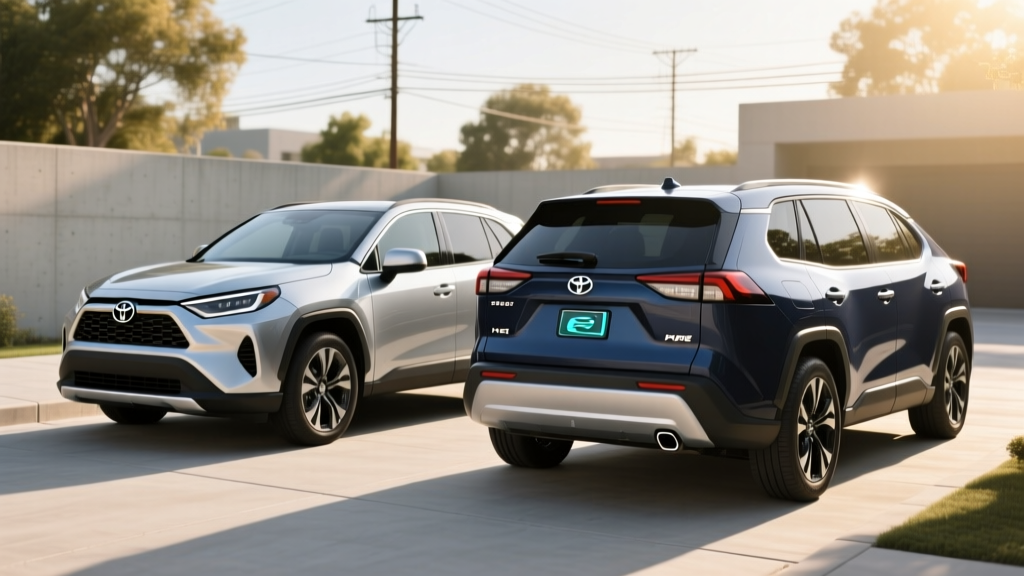
The Toyota RAV4 Hybrid remains one of the best-selling electrified vehicles in America, and for 2025 it continues to offer two distinct paths: the conventional hybrid (HEV) that never needs plugging in, and the RAV4 Prime plug-in hybrid (PHEV) that delivers genuine electric-only commuting range. Understanding the differences between these 2025 Toyota RAV4 Hybrid configurations is critical — they share a nameplate but serve very different ownership patterns, budgets, and daily driving needs.
This guide breaks down every powertrain variant, trim, and specification you need to make an informed decision, including real-world MPG observations, battery longevity data, and current federal tax credit eligibility under IRS §30D rules.
HEV vs PHEV: Understanding the Two RAV4 Hybrid Paths
Before comparing trims, it is essential to understand the fundamental difference between the two RAV4 Hybrid configurations Toyota offers for 2025.
RAV4 Hybrid (HEV)
- How it works: A 2.5L four-cylinder engine pairs with electric motors and a small (~1.6 kWh) nickel-metal hydride or lithium-ion battery. The battery recharges through regenerative braking and the engine — you never plug it in.
- Best for: Drivers who want better fuel economy without changing their fueling habits. No home charging required.
- Electric-only driving: Very limited — brief low-speed EV mode only, typically under 1 mile.
RAV4 Prime (PHEV)
- How it works: A larger 18.1 kWh lithium-ion battery and more powerful electric motors pair with the same 2.5L engine. You plug it in to charge, gaining up to 42 miles of electric-only range before the gas engine engages.
- Best for: Drivers with home charging access and commutes under 42 miles who want EV-like daily driving with gas-engine road-trip flexibility.
- Electric-only driving: EPA-rated 42 miles at full charge, enough for most daily commutes without using gas.
The key distinction: the standard RAV4 Hybrid is a self-charging vehicle — it operates like a traditional gas car at the pump but uses hybrid technology to dramatically improve efficiency. The RAV4 Prime is a plug-in vehicle that functions as a short-range EV most days and a hybrid on longer trips.
2025 RAV4 Hybrid (HEV): Powertrain, Trims, and EPA MPG
The 2025 RAV4 Hybrid uses Toyota's fourth-generation hybrid system (THS II) with a 2.5-liter Dynamic Force four-cylinder engine and two electric motors (one front, one rear for AWD models). Combined system output is 219 horsepower. All trims come with electronic on-demand all-wheel drive as standard — there is no front-wheel-drive option for the hybrid.
| Specification | Value |
|---|---|
| Engine | 2.5L inline-4 + 2 electric motors |
| Combined Horsepower | 219 hp |
| Drivetrain | AWD (electronic on-demand, standard) |
| Battery Type | Lithium-ion (hybrid buffer, ~1.6 kWh) |
| EPA City MPG | 41 mpg |
| EPA Highway MPG | 38 mpg |
| EPA Combined MPG | 39 mpg |
| 0–60 mph | ~7.4 seconds |
| Towing Capacity | 1,750 lbs |
Source: fueleconomy.gov
Trim Lineup and Pricing
The 2025 RAV4 Hybrid is available across multiple trims. Pricing below reflects MSRP before destination charges:
- LE: ~$33,425 — well-equipped base with Toyota Safety Sense 2.5, 8-inch touchscreen, wireless Apple CarPlay/Android Auto
- XLE: ~$34,925 — adds blind-spot monitoring, dual-zone climate, Smart Key
- XLE Premium: ~$36,425 — SofTex seats, moonroof, upgraded interior
- Woodland Edition: ~$37,075 — TRD-tuned suspension, all-terrain tires, rugged styling
- SE: ~$37,625 — sport-tuned suspension, 19-inch wheels, paddle shifters
- XSE: ~$39,125 — sport appearance with premium features
- Limited: ~$42,025 — navigation, JBL audio, heated/ventilated front seats, panoramic roof
Real-World MPG: What Owners Actually See
Toyota hybrids consistently deliver strong real-world results, particularly in city driving where regenerative braking and electric-motor assist do the heavy lifting. Based on aggregated owner data and independent testing:
- City driving: Many owners report 42–45 mpg — exceeding the EPA's 41 mpg city estimate. Stop-and-go traffic maximizes regen and electric-motor use.
- Highway driving: Expect 35–38 mpg at sustained 70–75 mph. The engine carries more of the load at highway speeds, and aerodynamic drag reduces efficiency.
- Cold weather penalty: In temperatures below 35°F, expect a 5–10% reduction in MPG as the engine runs more frequently to provide cabin heat and maintain battery temperature.
For a driver covering 15,000 miles per year at a blended 39 mpg combined, annual fuel consumption is roughly 385 gallons — compared to approximately 556 gallons for a comparable gas-only compact SUV at 27 mpg combined. At $3.50/gallon, that translates to roughly $600 in annual fuel savings over the non-hybrid RAV4.
2025 RAV4 Prime (PHEV): Electric Range, Power, and Charging
The RAV4 Prime is not merely a RAV4 Hybrid with a bigger battery — it is a substantially more powerful and capable vehicle. With 302 combined horsepower, it is the quickest RAV4 Toyota sells (short of the discontinued TRD off-road variants), hitting 0–60 mph in approximately 5.7 seconds.
| Specification | Value |
|---|---|
| Engine | 2.5L inline-4 + front/rear electric motors |
| Combined Horsepower | 302 hp |
| Drivetrain | AWD (electronic on-demand, standard) |
| Battery Capacity | 18.1 kWh (lithium-ion) |
| EPA Electric-Only Range | 42 miles |
| Total Combined Range | ~600 miles (electric + gas) |
| EPA MPGe (EV mode) | 94 MPGe |
| EPA MPG (hybrid mode, battery depleted) | 38 combined (36 city / 38 hwy) |
| 0–60 mph | ~5.7 seconds |
| Level 1 Charging (120V) | ~12 hours (full charge) |
| Level 2 Charging (240V, 3.3 kW) | ~4.5 hours (full charge) |
| Level 2 Charging (240V, 6.6 kW)* | ~2.5 hours (full charge) |
| DC Fast Charging | Not available |
| Towing Capacity | 1,750 lbs |
*6.6 kW onboard charger available on Premium trim; SE trim includes 3.3 kW charger. Source: Toyota Motor Corporation
RAV4 Prime Trim Lineup and Pricing
- SE: ~$44,525 — sport-tuned suspension, 18-inch wheels, 3.3 kW onboard charger, SofTex seats
- XSE: ~$48,025 — 6.6 kW onboard charger, 9-inch touchscreen, panoramic roof, JBL audio available
- XSE Premium (with Advanced Package): ~$51,000+ — includes head-up display, 360-degree camera, heated rear seats, bird's-eye view camera
Electric-Only Range: Real-World Expectations
The EPA rates the RAV4 Prime at 42 miles of electric-only range. In practice, this figure is reasonably achievable under moderate conditions, but several factors influence actual results:
- Optimal conditions (55–70°F, city/suburban, under 55 mph): 40–44 miles is typical. The RAV4 Prime's EV range is among the more honest EPA estimates in the PHEV segment.
- Highway-heavy driving (sustained 70+ mph): Expect 30–35 miles of electric range. Higher speeds drain the battery faster.
- Cold weather (below 32°F): Range drops to approximately 28–35 miles. The battery's usable capacity shrinks, and cabin heating draws significant energy. The RAV4 Prime uses a heat pump on higher trims, which partially mitigates this loss.
For commuters with round trips under 40 miles and home charging, the RAV4 Prime can operate months between fill-ups. Owners with short commutes commonly report using fewer than 10 tanks of gas per year.
Charging the RAV4 Prime
The RAV4 Prime charges via a standard J1772 connector (AC charging only). It does not support DC fast charging — this is common among PHEVs due to their smaller battery sizes and cost/complexity trade-offs.
| Charging Level | Power (kW) | Time to Full (0–100%) | Availability |
|---|---|---|---|
| Level 1 (120V household outlet) | ~1.4 kW | ~12 hours | Any standard outlet |
| Level 2 (240V, 16A) | 3.3 kW | ~4.5 hours | SE trim; home Level 2 station |
| Level 2 (240V, 32A) | 6.6 kW | ~2.5 hours | XSE trim and above; home Level 2 station |
For most owners, overnight Level 1 charging from a standard 120V outlet is sufficient to replenish 42 miles of range by morning. However, a Level 2 home charger provides faster turnaround if you make multiple short trips throughout the day or want flexibility.
Federal Tax Credit and Incentive Eligibility
Tax credit eligibility is one of the most frequently misunderstood aspects of PHEV ownership. Here is the current status for 2025 under IRS §30D rules:
RAV4 Hybrid (HEV)
No federal tax credit. Conventional hybrids do not qualify for the §30D Clean Vehicle Credit. The HEV is ineligible regardless of buyer income or MSRP.
RAV4 Prime (PHEV)
The RAV4 Prime may qualify for up to $7,500 in federal tax credits, but eligibility depends on multiple factors that change frequently:
- Battery sourcing requirements: A percentage of critical minerals and battery components must be sourced from the U.S. or free-trade-agreement countries. Toyota's supply chain compliance varies by model year and production batch — verify current status on IRS.gov's qualified vehicle list.
- MSRP cap: SUVs must have an MSRP at or below $80,000. All RAV4 Prime trims fall under this cap.
- Buyer income cap: Adjusted gross income must not exceed $150,000 (single), $225,000 (head of household), or $300,000 (joint filing).
- Point-of-sale transfer: As of 2024, eligible buyers can transfer the credit to the dealer at purchase, reducing the purchase price directly rather than waiting for a tax refund.
Critical caveat: Battery sourcing rules tighten annually. A vehicle that qualifies in January may not qualify in July. Always confirm eligibility on IRS.gov before purchase and consult a tax professional for your specific situation.
Some states offer additional rebates or HOV lane access for PHEVs (notably California, Colorado, and New York). Check your state's energy office or DMV for current programs. Conventional hybrids generally do not receive state EV incentives.
Battery Warranty, Reliability, and Replacement Cost
Toyota Hybrid Battery Warranty
Toyota covers the hybrid battery in both the RAV4 Hybrid and RAV4 Prime with a 10-year / 150,000-mile warranty (whichever comes first) in all 50 states. This warranty covers battery capacity below a defined threshold and defects.
The standard powertrain warranty is 5 years / 60,000 miles, and the basic vehicle warranty is 3 years / 36,000 miles.
Long-Term Reliability
Toyota's hybrid system has an exceptional reliability track record spanning over two decades since the original Prius. The RAV4 Hybrid's battery is far smaller than a full EV battery and operates within a narrow state-of-charge window (roughly 40–80% SoC), which significantly reduces degradation stress. Many Toyota hybrid owners report 200,000+ miles on original batteries.
The RAV4 Prime's larger 18.1 kWh battery also benefits from Toyota's conservative battery management. Real-world degradation reports are minimal at current model ages, though long-term (10+ year) data for the Prime specifically is still accumulating.
Battery Replacement Cost
If a hybrid battery does fail outside of warranty:
- RAV4 Hybrid (HEV): Replacement battery packs typically cost $2,500–$4,000 including labor at a Toyota dealer. Refurbished or third-party options may be available for $1,500–$2,500.
- RAV4 Prime (PHEV): The larger battery pack is more expensive — estimated at $6,000–$9,000 for replacement. Given the 10-year/150,000-mile warranty, most original owners will never face this cost.
Toyota also offers a Hybrid Battery Protection Program in some regions, providing prorated replacement coverage beyond the standard warranty period.
Side-by-Side: RAV4 Hybrid vs RAV4 Prime vs Full EV
Choosing between the HEV, the PHEV, and a full battery-electric vehicle (BEV) depends on your driving pattern, charging access, and budget. This decision framework should clarify the right path:
Choose the RAV4 Hybrid (HEV) if:
- You cannot install a home charger (apartment, street parking, no garage)
- You want improved fuel economy without changing any habits
- Your budget is under $40,000
- You drive 12,000–15,000 miles/year and want lower fuel costs
- You want proven, low-maintenance hybrid reliability
Choose the RAV4 Prime (PHEV) if:
- You have reliable home charging (even a 120V outlet works)
- Your daily commute is under 42 miles round trip
- You want EV-like daily driving but need gas flexibility for road trips
- You want the fastest, most powerful RAV4 available (302 hp)
- You may qualify for the $7,500 federal tax credit, significantly narrowing the price gap with the HEV
Choose a Full EV (e.g., Tesla Model Y, Hyundai Ioniq 5) if:
- You have Level 2 home charging and access to DC fast-charging networks
- Your daily driving rarely exceeds 250 miles
- You want zero tailpipe emissions and minimal maintenance (no oil changes, no gas engine)
- You want to eliminate gas station visits entirely
- You are comfortable planning charging stops on road trips
| Attribute | RAV4 Hybrid (HEV) | RAV4 Prime (PHEV) | Typical EV SUV (e.g., Ioniq 5) |
|---|---|---|---|
| Starting MSRP | ~$33,425 | ~$44,525 | ~$42,000 |
| EPA MPG / MPGe | 39 combined | 94 MPGe (EV) / 38 mpg (hybrid) | 110+ MPGe |
| Electric-Only Range | N/A | 42 miles | 250–310 miles |
| Total Range | ~580 miles | ~600 miles | 250–310 miles |
| Horsepower | 219 hp | 302 hp | 168–320 hp |
| Home Charging Needed? | No | Recommended | Essential |
| Federal Tax Credit | None | Up to $7,500* | Up to $7,500* |
| Maintenance Cost | Low (hybrid) | Low (hybrid) | Very low (no engine) |
*Tax credit eligibility depends on IRS §30D sourcing, income, and MSRP requirements. Verify at IRS.gov.
Pros and Cons at a Glance
RAV4 Hybrid (HEV) — Pros
- 41 mpg city without plugging in
- AWD standard on all trims
- Strong reliability track record
- Wide trim selection from $33K–$42K
- No charging infrastructure needed
RAV4 Prime (PHEV) — Pros
- 42 miles electric-only range
- 302 hp — quickest RAV4 available
- Potential $7,500 federal tax credit
- 600+ mile total range
- 6.6 kW Level 2 charging (XSE+)
RAV4 Hybrid (HEV) — Cons
- No federal tax credit
- Modest 219 hp — adequate, not quick
- Engine noise under hard acceleration
- No electric-only commuting capability
RAV4 Prime (PHEV) — Cons
- $11,000+ premium over base HEV
- No DC fast charging
- Limited trim availability (high demand)
- Tax credit eligibility uncertain — verify before purchase
- Heavier — slightly less cargo space due to battery
Frequently Asked Questions
How many MPG does the 2025 RAV4 Hybrid get?
The EPA rates the 2025 RAV4 Hybrid at 41 mpg city, 38 mpg highway, and 39 mpg combined. Real-world city driving often exceeds the EPA estimate, with many owners reporting 42–45 mpg in stop-and-go traffic. Highway fuel economy at sustained speeds above 70 mph typically falls to 35–38 mpg.
How far can the RAV4 Prime go on electric only?
The EPA rates the RAV4 Prime at 42 miles of electric-only range. In real-world moderate-temperature city driving, 40–44 miles is achievable. Cold weather and sustained highway speeds reduce this to 28–35 miles. Once the battery is depleted, the Prime operates as a conventional hybrid at 38 mpg combined.
Does the RAV4 Hybrid or Prime qualify for a tax credit?
The standard RAV4 Hybrid (HEV) does not qualify for any federal tax credit. The RAV4 Prime (PHEV) may qualify for up to $7,500 under IRS §30D, but eligibility depends on battery sourcing requirements, buyer income limits ($150K single / $300K joint), and MSRP caps. Always verify current eligibility on IRS.gov before purchasing, as sourcing rules change frequently.
Is the RAV4 Hybrid reliable and what does a battery replacement cost?
Toyota's hybrid system has over 25 years of proven reliability. The hybrid battery is covered by a 10-year / 150,000-mile warranty. If replacement is needed out of warranty, the RAV4 Hybrid battery costs approximately $2,500–$4,000 and the Prime battery approximately $6,000–$9,000. Many owners exceed 200,000 miles on original batteries.
Do I need to plug in the RAV4 Hybrid?
No. The standard RAV4 Hybrid (HEV) is a self-charging vehicle. You fuel it with gas like any conventional car. The hybrid battery charges through regenerative braking and the engine. Only the RAV4 Prime (PHEV) benefits from plugging in.
Can the RAV4 Prime DC fast charge?
No. The RAV4 Prime supports only AC charging — Level 1 (120V) and Level 2 (240V). There is no DC fast-charging capability. This is typical for PHEVs, whose smaller batteries (18.1 kWh) make the cost and complexity of DC fast-charging hardware impractical. Level 2 charging fully replenishes the battery in 2.5–4.5 hours depending on trim.
Which is better: RAV4 Hybrid or a full EV like the Tesla Model Y?
It depends entirely on your situation. If you have home charging, drive under 250 miles daily, and want zero gas usage, a full EV offers lower running costs and less maintenance. If you lack reliable charging, take frequent road trips over 300 miles, or want to eliminate range planning, the RAV4 Hybrid or Prime provides flexibility a full EV cannot match in 2025. The RAV4 Prime sits in the middle — EV-like commuting with gas-engine backup.