Quick Verdict: The 2025 Porsche Cayenne E-Hybrid at a Glance
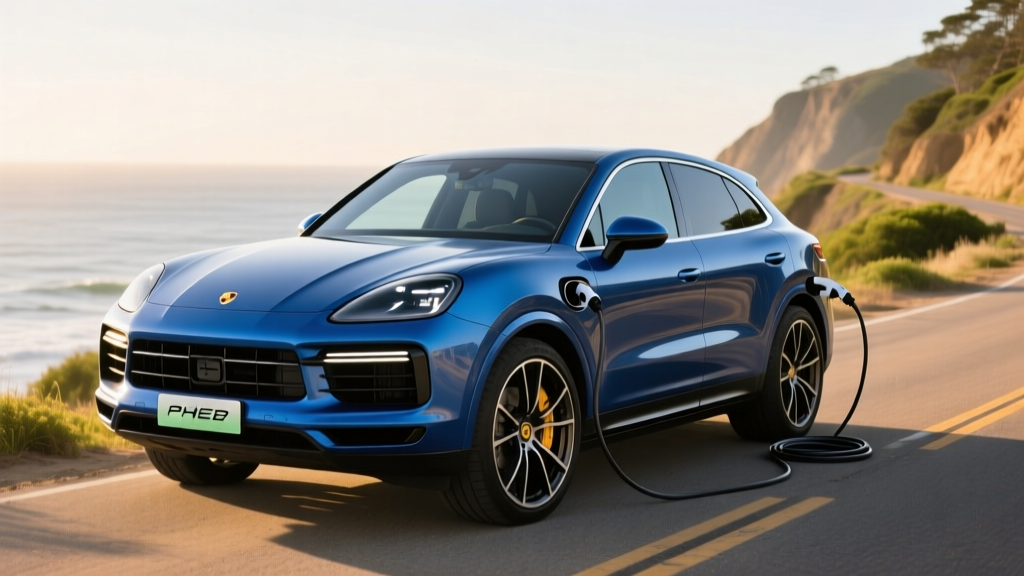
The 2025 Porsche Cayenne E-Hybrid occupies a narrow but compelling lane: it is a luxury performance SUV that lets you commute on electricity alone while preserving the flat-six and turbocharged thrust Porsche buyers expect on weekends. For the 2025 model year, Porsche expanded the E-Hybrid lineup with the more powerful S E-Hybrid variant, giving buyers a choice between a 389-hp base plug-in hybrid and a 512-hp S model — both using a revised 25.9 kWh (gross) lithium-ion battery pack mounted beneath the cargo floor.
This is a plug-in hybrid (PHEV), not a conventional hybrid (HEV). That distinction matters: you will need access to a Level 2 charger at home or work to extract the full efficiency and electric-only driving benefit. If you cannot plug in regularly, the Cayenne E-Hybrid still functions as a hybrid once the battery depletes, but you are carrying 200+ pounds of battery you never charged — and paying a premium for it.
| Spec | Cayenne E-Hybrid | Cayenne S E-Hybrid |
|---|---|---|
| Powertrain | 2.0L turbo I-4 + electric motor | 3.0L turbo V-6 + electric motor |
| Combined Horsepower | 389 hp | 512 hp |
| Combined Torque | 479 lb-ft | 553 lb-ft |
| 0–60 mph | 5.2 sec | 4.5 sec |
| Battery (gross / usable) | 25.9 kWh / ~21.8 kWh | 25.9 kWh / ~21.8 kWh |
| EPA Electric Range | ~27 mi | ~26 mi |
| EPA Combined MPGe | ~46 MPGe | ~44 MPGe |
| EPA Combined MPG (gas only) | ~21 MPG | ~20 MPG |
| Max AC Charging (Level 2) | 7.2 kW | 7.2 kW |
| DC Fast Charging | Not available | Not available |
| Base MSRP | $91,700 | $104,400 |
HEV vs PHEV: Why the Cayenne E-Hybrid Requires a Plug
A common source of confusion in the hybrid space is the difference between a conventional hybrid (HEV) and a plug-in hybrid (PHEV). The Cayenne E-Hybrid is strictly a PHEV.
Conventional Hybrid (HEV)
- Small battery (1–2 kWh), charged only by regenerative braking and the engine
- Never plugs in — refuels exclusively at a gas station
- Electric motor assists the engine; electric-only driving limited to low-speed creep
- Examples: Toyota RAV4 Hybrid, Honda CR-V Hybrid
Plug-in Hybrid (PHEV)
- Larger battery (15–30+ kWh), charges via plug (Level 1 or Level 2 AC)
- Delivers meaningful electric-only range at highway-capable speeds
- Once battery depletes, operates as a conventional hybrid using the engine
- Examples: 2025 Porsche Cayenne E-Hybrid, BMW X5 xDrive50e, Toyota RAV4 Prime
The practical implication: if you install a Level 2 home charger and plug in nightly, a 20-mile round-trip commute could be completed entirely on electricity, with the gasoline engine never engaging. If you skip charging, you are driving a heavy, slightly less efficient hybrid.
Electric-Only Range and Total Range
The 2025 Cayenne E-Hybrid's 25.9 kWh gross battery pack yields approximately 27 miles of EPA-rated electric-only range in the base model and 26 miles in the S E-Hybrid (the extra power and weight trim a mile). This range is sufficient for many daily commutes, school runs, and errand loops — but it is not generous by 2025 PHEV standards. The BMW X5 xDrive50e, for comparison, achieves roughly 38 miles electric.
Real-World Electric Range Expectation: The EPA's 27-mile figure assumes moderate temperatures and mixed driving. In practice:
- Summer, city/suburban: 28–32 miles (regen braking extends range)
- Highway at 70 mph: 20–23 miles (aerodynamic drag at speed drains the pack faster)
- Winter, below 32°F: 18–22 miles (cabin heating and battery cold-soak reduce usable capacity by 20–30%)
Once the battery depletes, the Cayenne E-Hybrid reverts to hybrid mode. Total combined range (electric + full gas tank) is approximately 410–430 miles, depending on trim and driving style.
Fuel Economy: EPA MPG and Real-World Expectations
Porsche's PHEV powertrain is tuned for performance, not hypermiling. The EPA rates the base E-Hybrid at approximately 46 MPGe (miles per gallon equivalent) when combining electric and gasoline operation, and around 21 MPG combined once the battery is depleted and the vehicle operates solely as a hybrid.
| Mode | City | Highway | Combined |
|---|---|---|---|
| E-Hybrid (MPGe, with charge) | — | — | ~46 MPGe |
| E-Hybrid (MPG, charge-depleted) | ~19 | ~23 | ~21 |
| S E-Hybrid (MPGe, with charge) | — | — | ~44 MPGe |
| S E-Hybrid (MPG, charge-depleted) | ~18 | ~22 | ~20 |
Real-world MPG vs. EPA: Plug-in hybrids are uniquely sensitive to how often you charge. Owners who plug in daily and drive within the electric range may use almost no gasoline for weeks, achieving an effective 80–100+ MPGe over a month. Owners who never plug in will see 18–22 MPG in mixed driving — roughly what the gas-only Cayenne achieves, since the PHEV carries additional battery weight. For authoritative EPA data, consult fueleconomy.gov.
Powertrain Deep Dive: Engine, Motor, and Combined Output
The base Cayenne E-Hybrid pairs a 2.0-liter turbocharged inline-four (261 hp, 273 lb-ft) with an electric motor integrated into the eight-speed Tiptronic automatic transmission (174 hp). Combined system output is 389 hp and 479 lb-ft of torque. The electric motor can propel the vehicle to 84 mph on its own in E-Power mode.
The S E-Hybrid steps up to a 3.0-liter turbocharged V-6 (348 hp) mated to the same electric motor, producing a combined 512 hp and 553 lb-ft. This is the variant for buyers who want Porsche sports-car acceleration in a 5,200-pound SUV. Both models use Porsche's all-wheel-drive system and a Sport Chrono package that adds launch control and drive-mode selectors.
The eight-speed automatic is a torque-converter design (not a dual-clutch), chosen for smoothness in electric-only mode and towing capability. Maximum towing capacity is rated at 7,700 lbs when properly equipped — competitive with the segment.
Charging: Level 2 Speed, Times, and the DC Fast-Charge Gap
The 2025 Cayenne E-Hybrid charges exclusively via AC power. Its onboard charger accepts up to 7.2 kW on a Level 2 (240V) connection. There is no DC fast-charging capability — a notable omission in a vehicle at this price point, though common among PHEVs (the RAV4 Prime also lacks DC fast charge).
| Charging Method | Power | 0–100% Time |
|---|---|---|
| Level 1 (120V household outlet) | ~1.4 kW | ~16–18 hours |
| Level 2 (240V, 32A home charger) | 7.2 kW | ~3.5–4 hours |
| DC Fast Charging | N/A | Not supported |
Practical charging advice: A Level 2 home charger is essentially mandatory for this vehicle. A 3.5-hour charge time means you can plug in when you arrive home at 6 PM and wake up to a full battery at 6 AM — even if you arrive at 20% state of charge. Level 1 trickle charging is viable only as an emergency backup or for occasional top-offs; a full charge from empty on a standard outlet takes overnight and then some.
The charge port is located on the driver-side rear quarter panel. The Cayenne E-Hybrid uses a standard J1772 connector for AC charging. Porsche's Mobile Charger Connect is included and can be configured for 240V operation with the appropriate NEMA adapter.
Pricing, Trims, and Federal Tax Credit Eligibility
The 2025 Cayenne E-Hybrid starts at $91,700 (base MSRP, including destination). The S E-Hybrid begins at $104,400. Porsche's options catalog is famously expansive — expect well-equipped examples to land between $100,000 and $125,000 after packages like Premium Plus, Adaptive Air Suspension, and the Sport Chrono upgrade.
Federal Tax Credit (§30D) — Current Rules
Under current IRS rules (irs.gov), the Cayenne E-Hybrid's eligibility for the up-to-$7,500 federal clean vehicle credit depends on several factors:
- MSRP cap: SUVs must be at or below $80,000 MSRP. The Cayenne E-Hybrid's base price of $91,700 exceeds this cap, making it ineligible for the new-vehicle §30D credit.
- Buyer income limits: Even if MSRP qualified, AGI caps apply ($150K single / $300K joint).
- Battery sourcing & critical minerals: Components must meet phased-in domestic-content thresholds.
- Point-of-sale transfer: Eligible credits can be transferred to the dealer as a down-payment reduction — but only if the vehicle qualifies.
Bottom line: The 2025 Cayenne E-Hybrid does not qualify for the federal §30D credit due to its MSRP exceeding the $80,000 SUV cap. Some state-level incentives (e.g., California's CVRP, New York's Drive Clean Rebate) may offer partial rebates — check your state's energy office for current programs. Consult a tax professional for personalized guidance.
Battery Warranty, Reliability, and Replacement Cost
Porsche covers the Cayenne E-Hybrid's high-voltage battery with a warranty of 8 years or 100,000 miles (whichever comes first), with a capacity-retention threshold of 70%. If the battery degrades below 70% of its original capacity within the warranty period, Porsche will repair or replace it at no cost.
Hybrid Battery Warranty Summary:
- Coverage: 8 years / 100,000 miles
- Capacity threshold: 70% state of health
- Limited warranty (vehicle): 4 years / 50,000 miles
- Estimated out-of-warranty replacement: $12,000–$18,000 (battery pack + labor, based on comparable Porsche PHEV service data)
Reliability outlook: Porsche's PHEV powertrain has been in production since the Panamera E-Hybrid (2017) and the first Cayenne E-Hybrid (2019). The 2.0L turbo four-cylinder and 3.0L V-6 are well-proven VW Group engines shared across Audi and Bentley applications. The primary reliability concern for PHEVs is not the battery itself (degradation is slow at this pack size with active thermal management) but the complexity of integrating two powertrains — additional cooling circuits, clutch packs, and power electronics add service points compared to a pure EV or gas-only vehicle.
For safety ratings and crash-test data, refer to NHTSA.gov and IIHS.org once testing is complete for the 2025 model year.
Who Should Buy the Cayenne E-Hybrid — and Who Shouldn't
Choose the Cayenne E-Hybrid if:
- You have Level 2 home charging and a daily commute under 25 miles
- You want a luxury performance SUV that can run errands on electricity but still tow a boat or tackle a mountain pass on gas
- You value Porsche build quality, driving dynamics, and badge prestige
- You are not ready to commit to a full BEV due to road-trip frequency or charging-infrastructure concerns in your area
Choose a Full EV (BEV) instead if:
- You want zero gasoline stops, zero oil changes, and maximum efficiency
- Your daily driving exceeds 30 miles and you want more electric range (consider the Tesla Model X or BMW iX)
- You want DC fast charging for road trips (PHEVs universally lack this)
Choose the Gas-Only Cayenne if:
- You cannot install a Level 2 charger at home or work
- You want lower upfront cost and fewer powertrain components to maintain long-term
Pros
- 389–512 hp from a plug-in hybrid powertrain with seamless electric-to-gas transitions
- ~27 miles of electric-only range covers most daily commutes
- 7,700-lb towing capacity — best in PHEV SUV class
- Porsche driving dynamics and Sport Chrono integration
- 8-year/100,000-mile high-voltage battery warranty
Cons
- $91,700+ base price with no federal tax credit eligibility (MSRP cap)
- No DC fast charging — a limitation on road trips
- 27-mile electric range trails competitors like the BMW X5 xDrive50e (~38 mi)
- Charge-depleted MPG (~21) is unremarkable for a hybrid
- Level 1 charging is impractically slow for daily use
Frequently Asked Questions
How many MPG does the 2025 Porsche Cayenne E-Hybrid get?
The EPA rates the base Cayenne E-Hybrid at approximately 46 MPGe when combining electric and gasoline operation, and about 21 MPG combined once the battery is depleted (19 city / 23 highway). Real-world fuel economy depends heavily on charging habits — plug in daily and you may use almost no gasoline for short commutes.
How far can the Cayenne E-Hybrid go on electric only?
The EPA rates it at approximately 27 miles of electric-only range (26 miles for the S E-Hybrid). In real-world conditions, expect 20–23 miles at highway speeds and 28–32 miles in suburban driving during warm weather. Cold weather reduces this to roughly 18–22 miles.
Does the Cayenne E-Hybrid qualify for a federal tax credit?
No. Under current IRS §30D rules, new SUVs must have an MSRP at or below $80,000 to qualify. The Cayenne E-Hybrid starts at $91,700, exceeding this cap. Some state-level incentives may apply — check your local energy agency. Always consult a tax professional for eligibility confirmation.
Is the Cayenne E-Hybrid reliable, and what does battery replacement cost?
Porsche's PHEV system has been in production since 2017–2019 and uses proven VW Group engines. The high-voltage battery is warranted for 8 years or 100,000 miles at 70% capacity retention. Out-of-warranty replacement is estimated at $12,000–$18,000 based on comparable Porsche PHEV service data. Long-term reliability of the dual-powertrain system is the primary concern versus simpler BEV or gas-only layouts.
Can the Cayenne E-Hybrid DC fast charge?
No. The Cayenne E-Hybrid supports only AC charging at up to 7.2 kW (Level 2). A full charge takes approximately 3.5–4 hours on a 240V Level 2 charger. DC fast charging is not available on any current Porsche PHEV — if you need rapid public charging, a full BEV like the Porsche Taycan or Macan Electric is required.
Hybrid vs PHEV vs EV — which powertrain fits me?
A conventional hybrid (HEV) is best if you cannot plug in and want simple fuel savings. A plug-in hybrid (PHEV) like the Cayenne E-Hybrid suits drivers with home charging who want electric commuting plus gas-engine flexibility for road trips. A full EV (BEV) is ideal if you want zero gasoline use, lower running costs, and have reliable charging access. The PHEV is a bridge solution — excellent if your lifestyle matches its ~27-mile electric envelope.