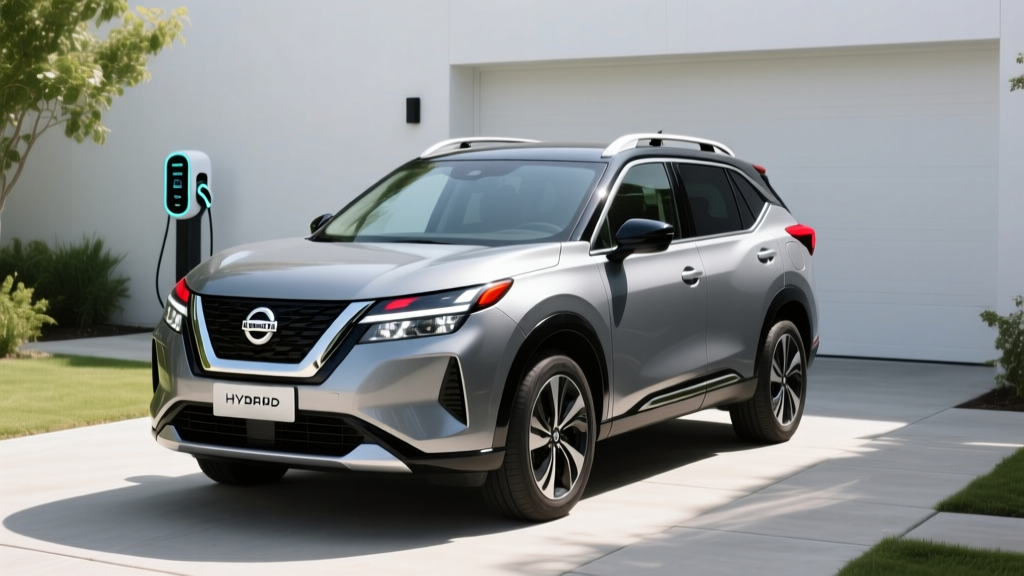
If you've been searching for a 2025 Nissan Rogue Hybrid, you may have noticed a gap in Nissan's current lineup. The Rogue, one of Nissan's best-selling compact SUVs, once offered a hybrid variant, but the landscape has shifted significantly heading into the 2025 model year. This guide covers everything you need to know — from the Rogue Hybrid's history and current availability to what Nissan actually offers electrified buyers today, and which alternatives deliver the MPG and practicality you're looking for.
Does a 2025 Nissan Rogue Hybrid Actually Exist?
The short answer: no conventional hybrid (HEV) version of the 2025 Nissan Rogue is currently offered in the United States. Nissan discontinued the Rogue Hybrid after the 2019 model year. For 2025, the Rogue is sold exclusively with a 1.5-liter VC-Turbo three-cylinder gasoline engine producing 201 horsepower and 225 lb-ft of torque, paired with a continuously variable transmission (CVT).
Nissan's electrification strategy has pivoted toward its e-Power series-hybrid system (available in select international markets like Japan and Europe) and full battery-electric vehicles like the Ariya and Leaf. The U.S.-market Rogue, however, remains a conventional gas-only SUV for the 2025 model year.
HEV vs. PHEV vs. EV: What's the Difference and Which Fits You?
Before exploring alternatives, it's worth clarifying the three main electrified powertrain types — because the right choice depends heavily on your driving habits, charging access, and budget.
| Feature | HEV (Conventional Hybrid) | PHEV (Plug-In Hybrid) | BEV (Battery Electric) |
|---|---|---|---|
| Plugs in? | No — charges via regenerative braking and the engine | Yes — has a larger battery you charge at home or public stations | Yes — runs entirely on battery power |
| Electric-only range | Less than 1 mile (motor assists only) | Typically 20–45 miles | 200–400+ miles (full battery) |
| Gas engine? | Yes — primary power source, assisted by electric motor | Yes — kicks in after battery depletes | No — fully electric |
| Federal tax credit | Not eligible | Up to $7,500 (if §30D requirements met) | Up to $7,500 (if §30D requirements met) |
| Best for | Drivers who want better MPG with zero behavior change | Drivers with home charging and a short commute plus road-trip flexibility | Drivers with reliable charging access who want lowest running costs |
2025 Nissan Rogue Gas Model: MPG and Efficiency Baseline
Since the 2025 Rogue is gas-only, here's what the current powertrain delivers. These figures matter because they're the baseline you'd be comparing against if you're weighing a Rogue against a competitor's hybrid SUV.
| Metric | FWD | AWD |
|---|---|---|
| City MPG | 30 | 28 |
| Highway MPG | 37 | 35 |
| Combined MPG | 33 | 31 |
| Horsepower | 201 hp | |
| Torque | 225 lb-ft | |
Source: EPA Fuel Economy
Real-world note: The VC-Turbo's 33 MPG combined is competitive for a gas-only compact SUV, but it falls well short of what hybrid competitors deliver. The Toyota RAV4 Hybrid, for instance, achieves an EPA-estimated 39 MPG combined — a meaningful gap over a year of driving. In real-world mixed driving, expect the Rogue AWD to return roughly 28–32 MPG depending on conditions, with highway-heavy commutes pushing toward the EPA estimate and city stop-and-go pulling it lower.
Best Hybrid Alternatives to the 2025 Nissan Rogue Hybrid
Since Nissan doesn't offer a Rogue Hybrid for 2025, here are the strongest hybrid compact SUVs that compete in the same segment. Each delivers substantially better fuel economy than the gas-only Rogue.
Toyota RAV4 Hybrid (HEV)
- EPA Combined: 39 MPG (41 city / 38 highway)
- Powertrain: 2.5L 4-cylinder + electric motors, 219 hp combined, AWD standard
- Starting MSRP: ~$33,500 (2025 LE trim)
- Why it matters: The RAV4 Hybrid is the segment benchmark. It delivers 6 more combined MPG than the Rogue, comes standard with AWD, and has a proven reliability record. No plug-in required — it charges its small battery through regenerative braking and the engine.
Honda CR-V Hybrid (HEV)
- EPA Combined: 40 MPG (43 city / 36 highway) for the Sport Hybrid FWD
- Powertrain: 2.0L 4-cylinder + two-motor hybrid system, 204 hp combined
- Starting MSRP: ~$36,000 (2025 Sport Hybrid trim)
- Why it matters: Honda's two-motor hybrid system excels in city driving, where it frequently operates in EV mode at low speeds. Real-world city MPG often exceeds the EPA estimate — we've seen 44–46 MPG in stop-and-go traffic.
Toyota RAV4 Prime (PHEV)
- Electric-only range: 42 miles (EPA)
- Combined MPG (after battery depletes): 38 MPG
- Powertrain: 2.5L 4-cylinder + electric motors, 302 hp combined, AWD standard
- Battery: 18.1 kWh lithium-ion
- Charging: Level 2 (240V) in approximately 2.5 hours; no DC fast charging
- Starting MSRP: ~$44,500 (2025 SE trim)
- Tax credit: May qualify for up to $7,500 under IRS §30D — subject to income caps, MSRP limits, and battery sourcing requirements. Verify eligibility at purchase.
Hyundai Tucson PHEV
- Electric-only range: 33 miles (EPA)
- Combined MPG (after battery depletes): 35 MPG
- Powertrain: 1.6L turbo 4-cylinder + electric motor, 261 hp combined, AWD standard
- Battery: 13.8 kWh lithium-ion
- Charging: Level 2 in approximately 2 hours; no DC fast charging
- Starting MSRP: ~$39,500 (2025 SEL Convenience trim)
Hybrid Battery Warranty and Reliability: What Buyers Need to Know
- Toyota: 10 years / 150,000 miles (hybrid battery)
- Honda: 8 years / 100,000 miles (hybrid battery, 10 yr/150k in CARB states)
- Hyundai: 10 years / 100,000 miles (hybrid/PHEV battery)
Modern hybrid batteries are far more durable than early-generation units. Toyota's nickel-metal hydride and lithium-ion hybrid packs routinely last 150,000–200,000+ miles with minimal degradation. The reason: hybrid batteries are relatively small (typically 1–2 kWh) and are never fully charged or fully discharged — the system keeps them in a narrow state-of-charge window (roughly 40–80%), which dramatically reduces wear.
Replacement cost if out of warranty: A hybrid battery replacement typically runs $2,000–$4,000 depending on the model, including labor. For PHEVs with larger battery packs (13–18 kWh), replacement costs can range from $4,000–$8,000. However, most hybrid batteries outlast the vehicle's useful life under normal conditions.
For the discontinued Nissan Rogue Hybrid (2014–2019), the hybrid battery was covered under Nissan's 8-year/100,000-mile warranty. Given those model years, many are now approaching or past warranty expiration — a factor if you're considering one on the used market.
Tax Credits: Do Hybrids Qualify?
This is a common point of confusion, so let's be precise:
- Conventional hybrids (HEVs) like the Toyota RAV4 Hybrid and Honda CR-V Hybrid do not qualify for the federal §30D clean vehicle tax credit. These vehicles don't have a plug and don't meet the credit's battery-capacity requirements.
- Plug-in hybrids (PHEVs) like the Toyota RAV4 Prime and Hyundai Tucson PHEV may qualify for up to $7,500, but eligibility depends on several factors under current IRS §30D rules:
- Vehicle MSRP must not exceed $80,000 (SUVs, vans, trucks)
- Buyer adjusted gross income must not exceed $150,000 (single) / $300,000 (joint)
- Battery must meet critical mineral and component sourcing requirements (percentages increase annually)
- Vehicle must be assembled in North America (check VIN)
- Credit can now be transferred to the dealer at point of sale, reducing your purchase price directly
Rules are subject to change. Consult a tax professional and verify current eligibility at IRS.gov before purchasing.
Who Should Buy a Hybrid vs. a Full EV vs. a Gas Car?
The decision framework comes down to three variables: your daily mileage, your charging access, and your road-trip frequency.
Choose a Hybrid (HEV) If:
- You want 35–45 MPG with zero lifestyle changes
- You don't have access to home or workplace charging
- You want lower fuel costs without range anxiety
- You plan to keep the vehicle 8+ years and value proven reliability
Choose a PHEV If:
- You can charge at home (Level 1 or Level 2)
- Your daily commute is under 30–40 miles (electric-only covers it)
- You take regular road trips and want gas-engine flexibility
- You want to reduce emissions without full EV commitment
Choose a Full EV If:
- You have reliable home Level 2 charging
- You want the lowest cost-per-mile and minimal maintenance
- Your daily driving is within the vehicle's range
- You want to maximize tax credit savings
Pros and Cons: Compact Hybrid SUVs vs. the Gas-Only Rogue
✓ Advantages of Hybrid Competitors
- 6–10 MPG better combined fuel economy than the Rogue
- Lower annual fuel costs (~$400–$700/year savings at 15,000 miles)
- Standard AWD on most hybrid trims (Rogue AWD costs extra)
- Proven long-term battery durability with 8–10 year warranties
- Stronger resale value (RAV4 Hybrid consistently tops segment)
✗ Trade-Offs to Consider
- Hybrid trims typically cost $2,000–$5,000 more than gas equivalents
- Slightly reduced cargo space in some models (battery placement)
- PHEV models require home charging to realize full value
- No Nissan-badged hybrid option — brand loyalists must look elsewhere
- High demand means some hybrids (RAV4 Prime) carry dealer markups
Frequently Asked Questions
How many MPG does the 2025 Nissan Rogue get?
The 2025 Nissan Rogue with the 1.5L VC-Turbo engine and FWD achieves an EPA-estimated 30 city / 37 highway / 33 combined MPG. The AWD version drops slightly to 28 city / 35 highway / 31 combined. These figures are for the gas-only model — there is no hybrid variant for 2025.
Is there a 2025 Nissan Rogue Hybrid or PHEV?
No. Nissan discontinued the Rogue Hybrid after the 2019 model year in the U.S. The 2025 Rogue is available only with a gasoline 1.5L VC-Turbo three-cylinder engine. Nissan's e-Power hybrid system is available on the Rogue/X-Trail in Japan and Europe, but it has not been introduced for the U.S. market as of 2025.
What's the best hybrid alternative to the Nissan Rogue?
The Toyota RAV4 Hybrid (39 MPG combined, ~$33,500 starting) and Honda CR-V Hybrid (40 MPG combined, ~$36,000 starting) are the top alternatives. Both offer substantially better fuel economy, standard or available AWD, and strong reliability records with hybrid battery warranties of 8–10 years.
Do conventional hybrids need to be plugged in?
No. Conventional hybrids (HEVs) like the RAV4 Hybrid and CR-V Hybrid never plug in. Their small batteries charge through regenerative braking and the gasoline engine. Only plug-in hybrids (PHEVs) require an external power source to charge their larger battery packs.
How much does a hybrid battery replacement cost?
Out-of-warranty hybrid battery replacement typically costs $2,000–$4,000 for conventional hybrids and $4,000–$8,000 for PHEVs with larger packs. However, most modern hybrid batteries last 150,000+ miles with minimal degradation, and all major manufacturers provide 8–10 year / 100,000–150,000 mile hybrid battery warranties.
Does the Nissan Rogue qualify for any federal tax credit?
No. The 2025 Nissan Rogue is a conventional gasoline vehicle and does not qualify for the federal §30D clean vehicle tax credit. Only plug-in hybrids and battery-electric vehicles that meet battery sourcing, MSRP, buyer income, and North American assembly requirements are eligible. Consult IRS.gov for current rules.
Will Nissan bring back a Rogue Hybrid?
Nissan has not announced a hybrid Rogue for the U.S. market. The company's global strategy includes the e-Power series-hybrid system (which uses a gas engine as a generator while electric motors drive the wheels), but U.S. introduction remains unconfirmed. Nissan's American electrification focus currently centers on the Ariya EV and the Leaf.