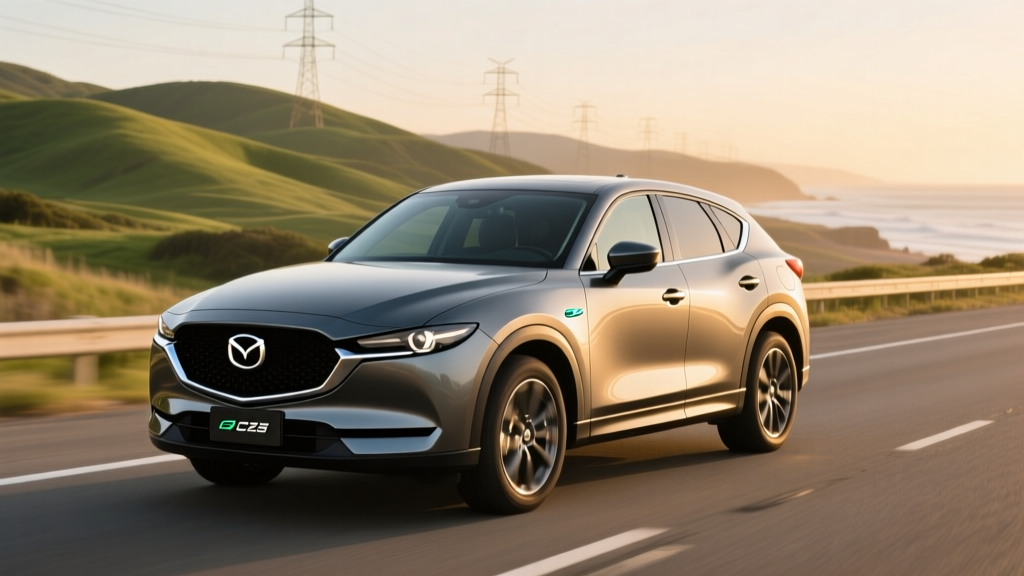
The 2025 Mazda CX-50 Hybrid occupies a specific niche: a compact crossover that pairs Mazda's premium interior and driving dynamics with Toyota's battle-tested hybrid powertrain. Unlike Mazda's turbocharged CX-50 models, the hybrid variant prioritizes fuel efficiency over acceleration, targeting buyers who want SUV practicality without plugging in. Here's every spec, MPG figure, and ownership detail you need to decide if it fits your garage.
2025 Mazda CX-50 Hybrid: Quick Verdict
Mazda borrows the 2.5-liter four-cylinder hybrid system directly from the Toyota RAV4 Hybrid, producing a combined 219 horsepower. The result is a crossover that achieves an EPA-estimated 38 MPG combined — roughly 40% better fuel economy than the standard 2.5T CX-50 while retaining all-wheel drive as standard equipment. Pricing starts around $35,395 including destination, positioning it against the RAV4 Hybrid, Honda CR-V Hybrid, and Ford Escape Hybrid. The trade-off: less cargo space than rivals and no plug-in hybrid variant with electric-only driving.
EPA MPG and Real-World Fuel Economy
The 2025 CX-50 Hybrid carries the following EPA fuel-economy ratings, as listed on fueleconomy.gov:
| Metric | Rating |
|---|---|
| City MPG | 39 |
| Highway MPG | 37 |
| Combined MPG | 38 |
| CO2 Emissions (g/mi) | ~233 |
Real-world expectation: Toyota-sourced hybrid systems typically overperform their EPA city estimates in stop-and-go traffic, where regenerative braking recaptures the most energy. Expect 40–42 MPG in urban driving. Highway cruising at 75+ mph tends to drop to 33–35 MPG, since the system relies more on the gasoline engine at sustained speeds. In cold weather (below 30°F), a 5–8% reduction is typical as the engine runs longer to warm the cabin and catalytic converter. Owners averaging mixed commutes report 36–39 MPG over thousands of miles — closely matching the combined sticker.
Powertrain: Toyota Hybrid Muscle in a Mazda Suit
The CX-50 Hybrid uses Toyota's 2.5-liter Dynamic Force inline-four paired with two electric motor-generators and an electronically controlled continuously variable transmission (eCVT). The system is virtually identical to the RAV4 Hybrid's, though Mazda tunes the throttle mapping and steering for its own character.
| Specification | Detail |
|---|---|
| Engine | 2.5L inline-4 Atkinson-cycle |
| Engine Output | 176 hp / 163 lb-ft |
| Electric Motors | Front MG + Rear MG (AWD) |
| Combined System Output | 219 hp |
| Transmission | eCVT (planetary gearset) |
| Drivetrain | AWD (electronic rear axle) |
| 0–60 mph | ~7.4 seconds (est.) |
| Towing Capacity | 1,500 lbs |
The rear axle is driven entirely by a dedicated electric motor — no mechanical driveshaft connects it to the engine. This "e-AWD" system engages the rear wheels when slip is detected or under hard acceleration, then decouples during steady cruising to minimize drag. The trade-off versus the 2.5T CX-50 (256 hp on premium fuel) is a softer acceleration feel, though the electric torque fill makes the hybrid surprisingly responsive off the line.
HEV vs. PHEV vs. EV: Which CX-50 Buyer Are You?
The CX-50 is offered only as a conventional hybrid (HEV) or a turbocharged gasoline model. There is no plug-in hybrid (PHEV) variant and no battery-electric version in the 2025 lineup.
Conventional Hybrid (HEV) vs. Plug-In Hybrid (PHEV)
HEV (CX-50 Hybrid): Charges its small ~1.6 kWh battery entirely through regenerative braking and engine power. You never plug it in. The battery assists the engine and enables brief low-speed electric driving, but cannot sustain electric-only travel beyond about 1 mile at low speed.
PHEV (e.g., Toyota RAV4 Prime): Carries a larger ~18 kWh battery that you plug into a Level 1 or Level 2 charger. Delivers 25–42 miles of electric-only range before the engine engages. After the battery depletes, it operates as a conventional hybrid.
BEV (e.g., Tesla Model Y): Runs entirely on electricity with 250–330 miles of range. Requires regular plug-in charging at home or public stations.
| Factor | HEV (CX-50 Hybrid) | PHEV | BEV |
|---|---|---|---|
| Plug in required? | No | Recommended | Yes |
| Electric-only range | ~0.5 mi | 25–42 mi | 250–330 mi |
| Home charging needed | No | Yes (120V min) | Yes (240V ideal) |
| Fuel/energy cost per mile | ~$0.11 | ~$0.04 (elec) / $0.11 (gas) | ~$0.04 |
| Federal tax credit (§30D) | No | Up to $7,500* | Up to $7,500* |
| Best for | No plug access, long trips | Home charging + short commute | Home charging, most commutes |
*PHEV and BEV §30D credit eligibility depends on MSRP caps, buyer income limits, battery sourcing requirements, and point-of-sale transfer rules. See current-year rules on IRS.gov. The CX-50 Hybrid (HEV) does not qualify for the §30D new clean vehicle credit.
Pricing, Trims, and Tax Credit Eligibility
The 2025 CX-50 Hybrid is available across multiple trim levels. Approximate MSRP by trim (including $1,495 destination):
| Trim | MSRP (est.) |
|---|---|
| Select Hybrid | $35,395 |
| Preferred Hybrid | $37,395 |
| Premium Hybrid | $40,095 |
| Premium Plus Hybrid | $42,395 |
Reliability, Battery Warranty, and Replacement Cost
The hybrid powertrain in the CX-50 is sourced from Toyota, which has produced millions of hybrid systems since the 1997 Prius. The 2.5L Dynamic Force hybrid architecture specifically has been in the RAV4 Hybrid since 2019 and the Camry Hybrid since 2018, with strong reliability records across both models.
Hybrid Battery Warranty
Mazda Hybrid Battery Warranty: 8 years / 100,000 miles (whichever comes first) for the hybrid battery pack and hybrid system components. This matches Toyota's warranty and complies with California Air Resources Board (CARB) requirements, which extend to 10 years / 150,000 miles in CARB-adopting states (CA, CO, CT, ME, MD, MA, NJ, NY, OR, RI, VT, WA).
Hybrid Battery Replacement Cost: If the battery fails outside warranty, replacement typically runs $2,000–$4,000 for a Toyota-sourced hybrid pack (refurbished units are less). However, hybrid battery failures before 150,000 miles are statistically rare — most degradation manifests as a gradual 10–15% capacity loss over 10+ years, which slightly reduces electric-assist time but does not disable the vehicle.
General Powertrain Warranty: 5 years / 60,000 miles (Mazda's standard powertrain coverage).
For context, the hybrid battery in the CX-50 is a sealed nickel-metal hydride (NiMH) pack — not the larger, more expensive lithium-ion packs found in PHEVs and BEVs. NiMH packs are well-understood, less sensitive to temperature extremes, and cheaper to replace if needed.
Driving Impressions and Practicality
The CX-50 Hybrid rides on Mazda's longer, wider CX-50 platform with a more rugged design than the CX-5. Ground clearance is 8.3 inches, and the hybrid adds minimal weight penalty over the standard 2.5L model. Cargo volume behind the second row is approximately 31.4 cubic feet — competitive with the segment but slightly less than the RAV4 Hybrid (37.6 cu ft).
On the road, the eCVT eliminates shift shock entirely, and the electric motor provides immediate torque from a stop. The engine can drone under hard acceleration (a CVT characteristic), but Mazda's sound insulation keeps it more muted than in the RAV4 Hybrid. Steering is weighted heavier than Toyota's, and the chassis tuning is firmer, giving the CX-50 Hybrid a more engaging feel on winding roads — a Mazda hallmark.
Standard safety technology includes Mazda's i-Activsense suite: adaptive cruise control, lane-keeping assist, blind-spot monitoring, and automatic emergency braking. The CX-50 has earned strong crash-test scores from both IIHS and NHTSA.
Pros, Cons, and Who Should Buy
Pros
- 38 MPG combined EPA — excellent for a compact AWD SUV
- Toyota-sourced hybrid powertrain with proven reliability
- Standard AWD with no fuel-economy penalty vs. FWD
- Premium interior materials and Mazda driving dynamics
- No plug-in charging required — works anywhere gas is sold
- Strong 8yr/100k hybrid battery warranty
Cons
- Less cargo space than RAV4 Hybrid and CR-V Hybrid
- No PHEV option with electric-only commuting range
- Does not qualify for federal §30D tax credit
- CVT drone under hard acceleration
- Towing limited to 1,500 lbs (2.5T model tows 3,500 lbs)
- Rear-seat legroom is tighter than segment leaders
Choose the CX-50 Hybrid If:
- You want a fuel-efficient AWD crossover but cannot charge a PHEV or EV at home
- You value interior quality and driving feel over maximum cargo volume
- You frequently take long road trips and want no charging logistics
- You trust Toyota's hybrid track record but prefer Mazda's design
Look Elsewhere If:
- You have a short commute and home charging — a PHEV like the RAV4 Prime (94 MPGe, 42 mi electric) would save more on fuel
- You need maximum cargo space — the RAV4 Hybrid and CR-V Hybrid offer more
- You want to maximize tax incentives — only PHEVs and BEVs qualify for the §30D credit
Frequently Asked Questions
How many MPG does the 2025 Mazda CX-50 Hybrid get?
The EPA rates it at 39 city / 37 highway / 38 combined MPG. Real-world mixed driving typically yields 36–39 MPG. City-heavy routes can push above 40 MPG thanks to regenerative braking. Highway driving above 75 mph drops to roughly 33–35 MPG.
Does the CX-50 Hybrid need to be plugged in?
No. The CX-50 Hybrid is a conventional hybrid (HEV). Its battery charges through regenerative braking and the gasoline engine. You simply fill it with regular unleaded fuel like any other car.
Is there a plug-in hybrid (PHEV) version of the CX-50?
Not for 2025. Mazda has not announced a CX-50 PHEV. If you want a Mazda plug-in, the CX-90 PHEV is available with roughly 26 miles of electric-only range. For a compact PHEV, the Toyota RAV4 Prime and Ford Escape PHEV are direct alternatives.
Does the 2025 CX-50 Hybrid qualify for a federal tax credit?
No. The IRS §30D clean vehicle credit applies only to plug-in electric vehicles (PHEVs and BEVs) that meet MSRP, income, and battery-sourcing requirements. Conventional hybrids like the CX-50 Hybrid are not eligible. Check your state's energy office for any local hybrid incentives.
How long will the CX-50 Hybrid battery last?
Toyota-sourced hybrid NiMH batteries routinely last 150,000–200,000+ miles with gradual capacity loss. Mazda covers the hybrid battery for 8 years / 100,000 miles (10 years / 150,000 miles in CARB states). Out-of-warranty replacement runs approximately $2,000–$4,000.
Is the CX-50 Hybrid reliable?
The Toyota 2.5L hybrid system has been in production since 2018 across the Camry Hybrid and RAV4 Hybrid, with strong long-term reliability data. Mazda's own build quality and interior materials are well-regarded. The primary reliability considerations are standard: brake wear (reduced by regen), tire rotation, and routine engine maintenance.
How does the CX-50 Hybrid compare to the RAV4 Hybrid?
Both use the same Toyota hybrid powertrain and achieve similar MPG (RAV4 Hybrid: 39 combined EPA). The CX-50 Hybrid offers a more premium interior and sportier driving dynamics but less cargo space (31.4 vs. 37.6 cu ft). Pricing is comparable at similarly equipped trims. The RAV4 Prime PHEV adds plug-in capability if you want electric-only commuting.