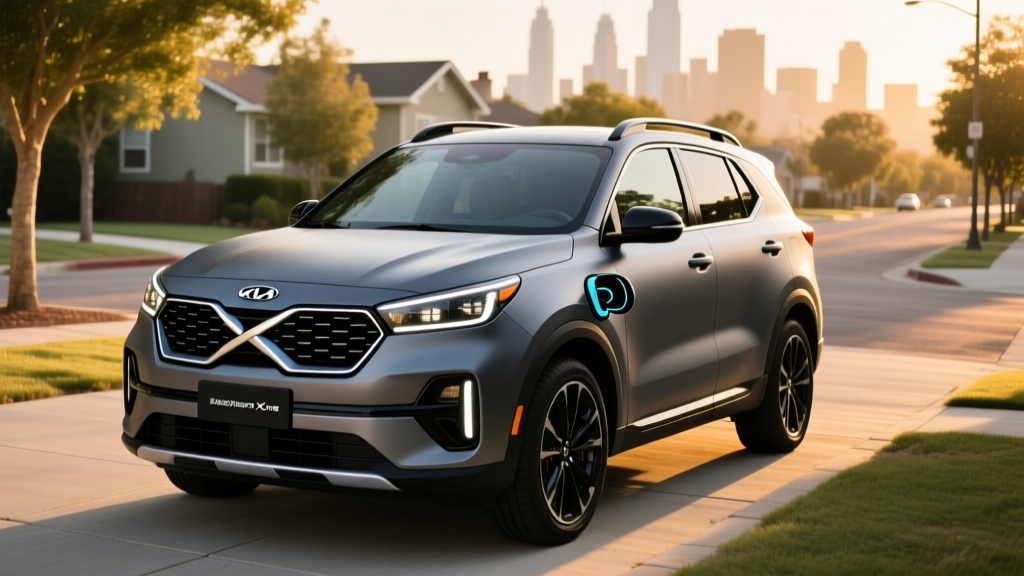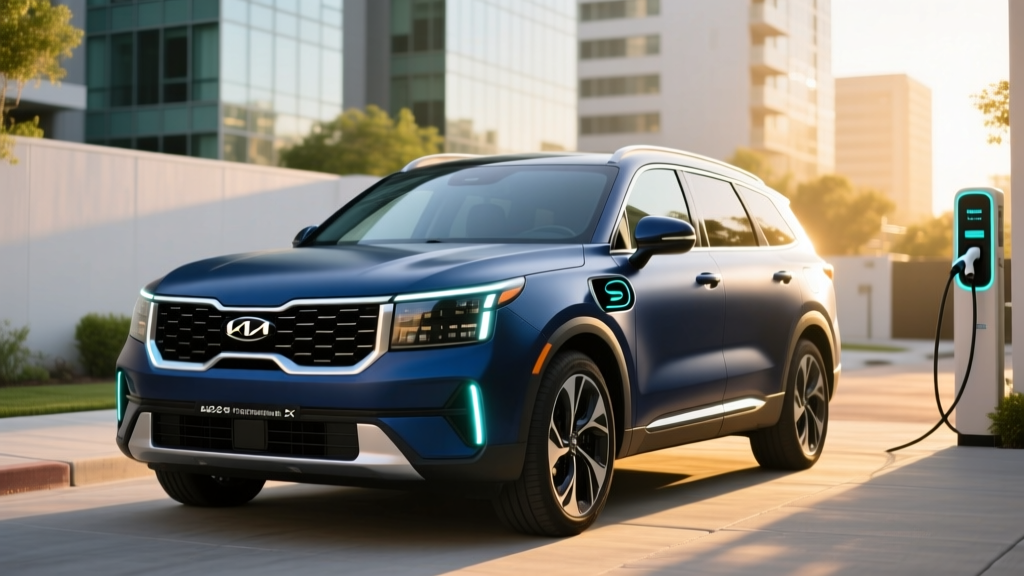
The 2025 Kia Sorento Plug-In Hybrid EX occupies a narrow but practical lane in the midsize SUV segment: a three-row family hauler that can handle daily commutes on electricity alone, then switch to hybrid mode for weekend road trips without range anxiety. With a refreshed design for 2025 and Kia's proven turbo-hybrid powertrain, the Sorento PHEV EX is aimed at buyers who want electric driving without committing to a full battery-electric vehicle.
But does the math work? Between its 32-mile electric range, 79 MPGe rating, and a starting MSRP near $50,590, the Sorento Plug-In Hybrid EX demands a careful look at your driving habits, charging access, and tax-credit eligibility. Here's the data-driven breakdown.
2025 Kia Sorento PHEV EX: Key Specifications
| Spec | 2025 Sorento PHEV EX |
|---|---|
| EPA Electric-Only Range | 32 miles |
| EPA Combined MPGe (Electric + Gas) | 79 MPGe |
| EPA Combined MPG (Hybrid Mode, Gas Only) | 34 MPG |
| Battery Capacity | 13.8 kWh (usable ~11.5 kWh) |
| Battery Chemistry | NMC (Nickel Manganese Cobalt) |
| Combined System Output | 261 hp / 258 lb-ft torque |
| Engine | 1.6L turbocharged 4-cylinder |
| Electric Motor | 66.9 kW (90 hp) |
| Transmission | 6-speed automatic |
| Drivetrain | AWD (standard) |
| 0–60 mph | ~7.7 seconds |
| Level 2 Charging (0–100%) | ~3 hours 25 minutes (at 3.3 kW onboard charger) |
| DC Fast Charging | Not supported |
| Seating | 6 passengers (captain's chairs standard) |
| Cargo Volume (behind 2nd row) | 30.7 cu ft |
| Base MSRP (EX trim) | $50,590 |
| Powertrain Warranty | 10 years / 100,000 miles |
| Hybrid Battery Warranty | 10 years / 100,000 miles |
HEV vs. PHEV: Which Sorento Are You Looking At?
Before diving deeper, it's critical to distinguish between the Sorento's two hybrid variants, because they serve very different use cases:
- Sorento Hybrid (HEV): A conventional hybrid that recharges its small battery through regenerative braking and the gasoline engine. You never plug it in. EPA-rated at 34–37 MPG combined depending on trim. The HEV is simpler, lighter, and starts around $38,000 — but offers no electric-only driving.
- Sorento Plug-In Hybrid (PHEV): This is the vehicle in this review. It carries a much larger 13.8 kWh battery and a more powerful electric motor. You plug it in to charge (Level 1 or Level 2). It delivers 32 miles of electric-only range before the gas engine seamlessly takes over, operating as a conventional hybrid from that point. The PHEV starts at $50,590 for the EX trim.
The bottom line: If you can charge at home and your commute is under 30 miles round-trip, the PHEV lets you drive on electricity most weekdays while keeping the gas engine for longer trips. If you can't charge at home, the conventional HEV is the smarter buy — you'll still get excellent MPG without needing a plug.
Fuel Economy: EPA Ratings and Real-World MPG
| Mode | City | Highway | Combined |
|---|---|---|---|
| Charge-Depleting (Electric + Gas, MPGe) | 82 MPGe | 75 MPGe | 79 MPGe |
| Charge-Sustaining (Hybrid, Gas Only, MPG) | 35 MPG | 33 MPG | 34 MPG |
The EPA rates the 2025 Sorento PHEV EX at 79 MPGe combined when operating with a charged battery, blending electric and gasoline driving. MPGe (miles per gallon equivalent) converts electricity consumption into a gasoline-equivalent figure for comparison purposes — one gallon of gasoline contains roughly 33.7 kWh of energy.
Once the battery is depleted, the Sorento PHEV operates as a conventional hybrid, returning an EPA-estimated 34 MPG combined (35 city / 33 highway). That's competitive with the Sorento HEV and notably better than the non-hybrid turbo Sorento, which returns around 23 MPG combined.
Real-World MPG vs. EPA
In real-world mixed driving, PHEV owners who charge nightly typically report 35–40+ MPG equivalent over a month, since many short trips are completed entirely on electricity without the engine ever starting. On long highway road trips with a depleted battery, expect 31–33 MPG at 70–75 mph — slightly below the EPA highway figure, as is common with most hybrids at sustained speed.
In city driving with regular charging, the Sorento PHEV can significantly exceed its EPA rating. Regenerative braking is highly effective in stop-and-go traffic, and the electric motor handles low-speed acceleration where gasoline engines are least efficient. Owners who charge daily and drive under 30 miles may go weeks without visiting a gas station.
Electric-Only Range, Charging, and Total Range
The 2025 Sorento PHEV EX delivers an EPA-rated 32 miles of electric-only range. In real-world conditions, expect 28–30 miles in mild weather and 22–26 miles in cold weather (below 30°F), as cabin heating and battery thermal losses reduce usable capacity.
Once the battery depletes, the 15.8-gallon fuel tank provides approximately 530 additional miles in hybrid mode, giving a total combined range of roughly 560 miles — more than enough for any road trip without range anxiety.
Charging Times and Limitations
The Sorento PHEV uses a standard J1772 connector and has a 3.3 kW onboard charger. This is an important limitation to understand:
- Level 1 (120V household outlet, ~1.4 kW): Full charge in approximately 8–9 hours. Adequate for overnight charging if you drive less than 30 miles daily.
- Level 2 (240V, at 3.3 kW max): Full charge in approximately 3 hours 25 minutes. Even if you install a 7.2 kW or 11.5 kW Level 2 home charger, the Sorento PHEV can only accept 3.3 kW — so charging won't be any faster than on a dedicated 16-amp Level 2 unit.
- DC Fast Charging: Not available. The Sorento PHEV does not support DC fast charging, which is typical for PHEVs in this class. You won't be able to top up at Electrify America or Tesla Supercharger stations.
For most PHEV owners, overnight Level 1 or Level 2 charging at home is the primary refueling method. Public charging infrastructure is largely irrelevant for this vehicle — and that's by design.
Powertrain: 261 Horsepower, Turbo Meets Electric
The Sorento PHEV pairs a 1.6-liter turbocharged inline-four (producing 178 hp and 195 lb-ft on its own) with a 66.9 kW (90 hp) electric motor integrated into the transmission housing. Combined system output is 261 hp and 258 lb-ft of torque, routed to all four wheels through a 6-speed automatic transmission.
The result is a 0–60 mph time of approximately 7.7 seconds — brisk enough for confident highway merging and passing. The electric motor provides instant torque from a standstill, making the Sorento PHEV feel noticeably quicker off the line than the conventional hybrid or turbo gas variants. In EV mode, acceleration is quiet and smooth; when the turbo engine kicks in under heavy throttle, the transition is generally seamless, though you'll hear the engine note through the firewall during hard acceleration.
Standard all-wheel drive is a meaningful advantage for buyers in snow-belt states. The electric motor powers the rear axle in certain conditions, providing torque-vectoring capability without a mechanical driveshaft connection.
Pricing, Tax Credits, and Total Cost
The 2025 Kia Sorento Plug-In Hybrid EX carries a base MSRP of $50,590 (including destination). Add-ons like the EX Premium package push the price toward $54,000–$56,000.
Federal Tax Credit Eligibility (§30D)
Under the current IRS §30D rules, the Sorento PHEV may qualify for a partial or full $7,500 federal tax credit, but eligibility depends on several factors that change periodically:
- MSRP Cap: SUVs must have an MSRP at or below $80,000. The Sorento PHEV clears this threshold.
- Buyer Income Cap: Modified adjusted gross income must not exceed $150,000 (single), $225,000 (head of household), or $300,000 (joint filing).
- Battery Component Sourcing: The credit is split into two halves — $3,750 for meeting battery-component requirements and $3,750 for critical-minerals sourcing. Kia's supply chain sourcing determines how much of the credit applies in any given model year. Check the latest fueleconomy.gov tax credit listing for the current Sorento PHEV credit amount.
- Point-of-Sale Transfer: As of 2024, eligible buyers can transfer the credit to the dealer at purchase, reducing the purchase price directly rather than waiting to claim it on a tax return.
Important: Tax credit rules are subject to change. Always verify current eligibility on IRS.gov or consult a tax professional before making a purchase decision based on credit assumptions.
State and Local Incentives
Several states offer additional rebates or tax credits for PHEVs. California's CVRP program, Colorado's state tax credit, and various utility company rebates can stack on top of the federal credit. These vary by jurisdiction and are subject to funding availability — check your state's energy office or utility provider for current programs.
Battery Warranty, Reliability, and Replacement Cost
Kia's Hybrid Battery Warranty: 10 years / 100,000 miles (whichever comes first). This covers the high-voltage traction battery against defects and excessive capacity loss. Kia defines excessive loss as falling below approximately 70% of original capacity during the warranty period.
Powertrain Warranty: 10 years / 100,000 miles — covering the engine, electric motor, transmission, and related hybrid-system components.
Limited Vehicle Warranty: 5 years / 60,000 miles bumper-to-bumper.
Kia's 10-year/100,000-mile powertrain and hybrid battery warranty is among the best in the industry, providing long-term peace of mind that addresses the top concern of hybrid buyers: battery longevity.
Real-World Battery Degradation
PHEV batteries experience less stress than full EV batteries because they operate in a narrower state-of-charge window — the vehicle's software maintains a buffer at both the top and bottom of the battery to prevent deep cycling. Based on data from Kia's Niro PHEV and Optima PHEV (which share similar battery architecture), most owners report minimal degradation (5–10%) over 8–10 years of typical use.
Battery Replacement Cost
If the high-voltage battery fails outside of warranty, replacement costs for the Sorento PHEV battery pack are estimated at $4,000–$6,500 (parts and labor), based on comparable Kia PHEV service pricing. This is significantly less than full EV battery replacements, which can exceed $10,000–$20,000, because the PHEV battery is much smaller. However, with Kia's 10-year warranty and the conservative charge-management strategy, out-of-pocket replacement is uncommon in the vehicle's first decade.
Reliability Track Record
Kia's 1.6L turbo-hybrid powertrain has been in production since 2019 across multiple models (Sorento, Niro, Tucson/Kia Sportage PHEV via Hyundai-Kia platform sharing). The powertrain has demonstrated solid reliability in JD Power and Consumer Reports assessments. The NHTSA vehicle listing provides up-to-date safety recall and complaint data — always check this before purchasing.
Who Should Buy the Sorento PHEV EX — And Who Shouldn't?
Pros
- 32-mile electric range covers most daily commutes gas-free
- 261 hp provides confident acceleration for a midsize SUV
- Standard AWD and three-row seating (6 passengers)
- 10-year/100,000-mile hybrid battery and powertrain warranty
- No range anxiety — gas engine covers long road trips
- Potential federal tax credit up to $7,500
Cons
- 3.3 kW onboard charger limits Level 2 charging speed
- No DC fast charging capability
- $50,590 starting MSRP is steep vs. conventional Sorento HEV ($38K)
- Third row is tight for adults on longer trips
- Electric range drops to ~22–26 miles in cold weather
- Tax credit eligibility depends on sourcing rules that shift annually
Decision Framework
Choose the Sorento PHEV EX if:
- Your daily round-trip commute is under 30 miles and you can charge at home (Level 1 or Level 2)
- You need three rows and AWD but aren't ready to go fully electric
- You take 3+ road trips per year where charging infrastructure is uncertain
- You qualify for the federal tax credit, bringing effective price below ~$43,000
Choose the Sorento HEV (conventional hybrid) if:
- You can't charge at home (apartment, no garage outlet)
- You want hybrid efficiency without the $12,000+ price premium of the PHEV
- Your daily driving exceeds 40 miles — the PHEV's electric range won't cover it
Consider a full EV (e.g., Kia EV9, Hyundai Ioniq 5) if:
- You have reliable home Level 2 charging and want zero gas use
- Your longest regular trip is under 250 miles or you're comfortable with DC fast charging stops
- You want lower long-term fuel and maintenance costs
Frequently Asked Questions
How many MPG does the 2025 Kia Sorento Plug-In Hybrid EX get?
The EPA rates the Sorento PHEV EX at 79 MPGe combined when operating with a charged battery (blending electric and gas). Once the battery is depleted, it returns 34 MPG combined as a conventional hybrid (35 city / 33 highway). Real-world city driving with daily charging can yield significantly better effective economy.
How far can the Sorento PHEV go on electric only?
The EPA rates it at 32 miles of electric-only range. In real-world mild conditions, expect 28–30 miles. In cold weather (below 30°F), range drops to approximately 22–26 miles due to cabin heating demand and reduced battery efficiency.
Does the Sorento PHEV qualify for a tax credit?
It may qualify for up to $7,500 under the federal §30D clean vehicle credit, depending on battery-component and critical-minerals sourcing requirements, your income level, and the vehicle's MSRP (which is under the $80,000 SUV cap). The credit amount can change as Kia's supply chain evolves. Verify current eligibility on fueleconomy.gov and IRS.gov. Point-of-sale transfer is available for eligible buyers.
Can I charge the Sorento PHEV at a DC fast charger?
No. The Sorento PHEV only supports Level 1 (120V) and Level 2 (240V) AC charging via a J1772 connector. It does not have a DC fast-charging port. The onboard charger maxes out at 3.3 kW, so a full charge takes about 3 hours 25 minutes on Level 2.
Is the Sorento PHEV reliable, and what does battery replacement cost?
Kia's 1.6L turbo-hybrid powertrain has been in use since 2019 across multiple models with generally positive reliability data. The hybrid battery is covered by a 10-year/100,000-mile warranty. Out-of-warranty battery replacement is estimated at $4,000–$6,500, though real-world data from similar Kia PHEVs shows minimal degradation (5–10%) over the first decade.
Hybrid vs. PHEV vs. EV — which should I choose?
If you can charge at home and drive under 30 miles daily, the PHEV gives you electric commuting with gas-engine backup — the best of both worlds. If you can't charge at home, a conventional HEV (like the Sorento Hybrid) is more practical and affordable. If you have home charging, drive under 250 miles regularly, and want the lowest operating cost, a full EV like the Kia EV9 may be a better long-term bet. The PHEV is the bridge option for buyers who want electric driving but aren't ready to rely solely on charging infrastructure.
Does the Sorento PHEV have three rows?
Yes. The 2025 Sorento PHEV EX seats six passengers with second-row captain's chairs and a third-row bench. The third row is best suited for children or short-trip adult passengers — legroom is tight for adults on longer journeys.
What is the total range of the Sorento PHEV?
Combined electric and gasoline range is approximately 560 miles — 32 miles on electricity plus roughly 530 miles on the 15.8-gallon fuel tank in hybrid mode. This eliminates range anxiety entirely for road trips.