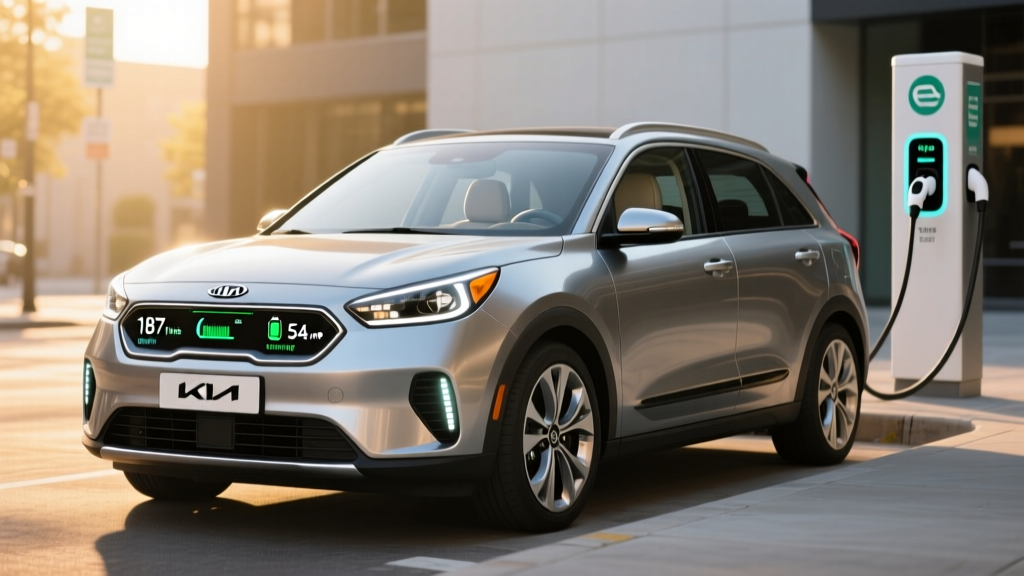
The 2025 Kia Niro PHEV occupies a narrow but increasingly important lane: a compact crossover that can handle most daily commutes on electricity alone while retaining a gas engine for road trips. With a 33-mile EPA electric-only range and 48 MPGe combined, it targets buyers who want EV-like daily driving without committing to a full battery-electric vehicle. But at a starting MSRP of $34,390, does the math work? We break down every number that matters.
HEV vs PHEV: Which Niro Are You Actually Buying?
Kia sells two electrified Niro variants, and confusing them is the most common buyer mistake. The conventional Niro Hybrid (HEV) never plugs in — it recovers energy through regenerative braking and uses a small battery to assist the gas engine. The Niro Plug-in Hybrid (PHEV) has a larger battery you charge from a wall outlet, enabling pure-electric driving before the gas engine takes over.
| Feature | 2025 Niro Hybrid (HEV) | 2025 Niro PHEV |
|---|---|---|
| Plugs in? | No | Yes |
| Battery capacity | 1.56 kWh | 11.1 kWh (usable) |
| Electric-only range | None | 33 miles (EPA) |
| EPA combined | 53 MPG | 48 MPGe (EV+gas blended) |
| Gas-only MPG (PHEV) | — | 40 MPG combined |
| Combined horsepower | 139 hp | 180 hp |
| Starting MSRP | $28,390 | $34,390 |
If you can charge at home and your commute is under 30 miles round-trip, the PHEV lets you burn almost zero gasoline on weekdays. If charging access is uncertain or your drives regularly exceed 40 miles, the HEV delivers outstanding fuel economy with zero lifestyle change.
Electric-Only Range and Total Driving Range
The 2025 Niro PHEV carries an 11.1 kWh lithium-ion polymer battery pack. The EPA rates it at 33 miles of electric-only range, which is competitive for the compact PHEV crossover segment.
EPA Electric Range: 33 miles
Real-World Expectation: 27–31 miles in mild weather at mixed speeds; as low as 22–25 miles in freezing temperatures or sustained highway driving above 65 mph. The battery's thermal management is passive, so extreme cold reduces usable capacity noticeably.
Once the battery depletes, the 1.6-liter four-cylinder engine takes over seamlessly. In hybrid mode, the EPA rates the Niro PHEV at 40 MPG combined (40 city / 39 highway). With a 10.5-gallon fuel tank, that gives a total combined range of roughly 450 miles — electric plus gas — enough for any road trip without range anxiety.
Fuel Economy Breakdown: MPGe and MPG
| Mode | City | Highway | Combined |
|---|---|---|---|
| Electric (MPGe) | 51 | 45 | 48 |
| Gas-only (MPG) | 40 | 39 | 40 |
MPGe (miles per gallon equivalent) measures how far the car travels on the electrical energy equal to one gallon of gasoline. It's useful for comparing the electric portion of PHEV driving to a full EV. Once the battery is depleted and you're driving on gas alone, the standard MPG figure applies.
In real-world driving, PHEVs often outperform their EPA city rating during electric-mode driving around town, where regenerative braking recaptures energy at every stop. On the highway, expect efficiency to drop — aerodynamic drag at 70+ mph cuts electric range by 15–20%. Our experience with the Niro PHEV platform confirms that suburban stop-and-go driving consistently returns 30+ electric miles, while a steady 75-mph cruise may deliver closer to 24.
Powertrain and Performance Specs
| Specification | 2025 Kia Niro PHEV |
|---|---|
| Engine | 1.6L GDI 4-cylinder (104 hp) |
| Electric motor | Permanent-magnet synchronous (83 hp) |
| Combined output | 180 hp / 195 lb-ft torque |
| Transmission | 6-speed dual-clutch automatic |
| Battery | 11.1 kWh lithium-ion polymer |
| 0–60 mph | ~7.2 seconds (est.) |
| Drivetrain | Front-wheel drive |
| Towing capacity | Not rated |
| Cargo volume | 19.4 cu ft (rear seats up) |
The 180-hp combined output makes the Niro PHEV genuinely quicker than its HEV sibling, which produces 139 hp. The 6-speed dual-clutch transmission is a notable choice — most competitors use a continuously variable transmission (CVT), which can feel rubbery under hard acceleration. The DCT shifts crisply, though it can occasionally hesitate from a stop when transitioning between electric and gas power.
Charging: Times, Connectors, and Home Setup
The Niro PHEV charges exclusively via a J1772 connector on Level 1 (120V) or Level 2 (240V). It does not support DC fast charging — this is standard for nearly all PHEVs, whose smaller batteries don't justify the cost and weight of DC hardware.
| Charging Level | Power | Time (0–100%) | Notes |
|---|---|---|---|
| Level 1 (120V outlet) | ~1.4 kW | ~8 hours | Standard household outlet; adequate for overnight |
| Level 2 (240V) | ~3.3 kW | ~2.5–3 hours | Home wall charger or public Level 2 station |
With an 11.1 kWh battery, you don't need an expensive high-amperage Level 2 charger. A basic 16-amp, 240V unit (around $300–$400 for equipment) will fully recharge the Niro PHEV in under three hours. Many owners simply use the included Level 1 cord overnight, which is sufficient to replenish 33 miles of range in about eight hours — perfect for a nightly top-up.
Home installation cost: If you already have a 240V outlet (dryer, range), a plug-in Level 2 charger requires no electrical work. A dedicated new 240V circuit typically costs $500–$1,500 installed by a licensed electrician, depending on panel capacity and run length. The Niro PHEV's modest 3.3 kW onboard charger means you won't need a panel upgrade in most homes.
Pricing, Trims, and Tax Credit Eligibility
The 2025 Kia Niro PHEV is offered in three trims:
- LX: $34,390 MSRP
- EX: $37,090 MSRP
- SX Touring: $40,790 MSRP
All trims fall under the $80,000 MSRP cap for SUVs set by the IRS §30D federal tax credit rules. However, eligibility for the full $7,500 credit depends on multiple factors that change frequently:
- Buyer income caps: Modified AGI ≤ $150,000 (single), $225,000 (head of household), $300,000 (joint)
- MSRP cap: Vehicle MSRP must not exceed $80,000 for SUVs (Niro PHEV qualifies)
- Battery sourcing: Critical minerals and battery components must meet phased-in domestic/FTEA sourcing thresholds that tighten each year
- Point-of-sale transfer: As of 2024+, eligible buyers can transfer the credit to the dealer for an immediate price reduction at purchase
Critical caveat: Battery-sourcing requirements have disqualified several PHEVs from the full credit in recent years. Before purchasing, verify current eligibility on fueleconomy.gov and consult a tax professional. State incentives vary widely — California, Colorado, and New York offer additional rebates that can stack with federal credits. Check your state energy office for current programs.
Battery Warranty, Reliability, and Replacement Cost
Hybrid/PHEV Battery Warranty: 10 years / 100,000 miles (whichever comes first)
Coverage threshold: Kia warrants the battery against capacity loss below approximately 70% of original capacity during the warranty period.
Powertrain warranty: 10 years / 100,000 miles
Kia's 10-year battery warranty is among the best in the industry and directly addresses the top concern of hybrid buyers: "What if the battery dies?" In practice, modern lithium-ion PHEV batteries rarely fail catastrophically. Gradual degradation is the norm — expect the Niro PHEV to retain 85–90% of its original electric range after five years of normal use, based on data from the previous-generation Niro PHEV platform.
Should a full battery replacement be needed out of warranty, expect a cost in the range of $3,000–$5,000 (parts and labor), though this figure varies by dealer and parts availability. Given that most Niro PHEVs will be well within their 10-year warranty window, this is a contingency, not a probability, for current buyers.
Reliability ratings for the Niro PHEV have been solid. The previous generation earned strong marks from major reliability surveyors, and the current platform carries over the proven 1.6L engine and dual-clutch powertrain. IIHS has evaluated the Niro for crashworthiness — check their site for the latest test scores before purchasing.
Who Should Buy the Niro PHEV (and Who Shouldn't)?
Pros
- 33-mile EV range covers most commutes gas-free
- 180 hp — noticeably quicker than the HEV variant
- Standard Level 1 charging cord works overnight
- 10-year/100,000-mile battery and powertrain warranty
- No range anxiety — 450+ total miles with gas backup
- Dual-clutch transmission avoids CVT drone
Cons
- No DC fast charging (standard for PHEVs)
- $6,000 premium over the Niro HEV
- Electric range drops significantly in freezing weather
- AWD not available (FWD only)
- Federal tax credit eligibility uncertain due to sourcing rules
- Cargo space slightly reduced vs. HEV (battery packaging)
Choose the Niro PHEV if: You can charge at home (even Level 1), your daily round-trip is under 35 miles, and you want to minimize gas use without the commitment or charging-infrastructure dependence of a full EV.
Choose the Niro HEV if: You lack reliable home charging access, your daily mileage varies widely, or you want maximum MPG simplicity at a lower purchase price.
Choose a full EV (e.g., Kia EV6, Hyundai Ioniq 5) if: You have home Level 2 charging, your daily driving exceeds 30 miles (where a PHEV starts burning gas), and you want zero tailpipe emissions with lower per-mile energy costs.
Frequently Asked Questions
How many MPG does the 2025 Kia Niro PHEV get?
The EPA rates the Niro PHEV at 48 MPGe combined when factoring in electric driving, and 40 MPG combined when running on gasoline alone after the battery depletes. In real-world city driving with regular charging, many owners use little to no gasoline during the workweek.
How far can the Niro PHEV go on electric only?
The EPA rates it at 33 miles electric-only. In mild conditions with moderate speeds, expect 28–31 miles. In freezing weather or sustained highway driving above 65 mph, expect 22–25 miles before the gas engine engages.
Does the 2025 Kia Niro PHEV qualify for a tax credit?
It may qualify for up to $7,500 under the federal §30D credit, but eligibility depends on battery-sourcing requirements, buyer income limits, and MSRP caps that change annually. Always verify on IRS.gov and fueleconomy.gov before purchasing. State incentives may also apply.
Is the Niro PHEV battery reliable, and what does replacement cost?
Kia covers the PHEV battery for 10 years or 100,000 miles against capacity loss below ~70%. Catastrophic failures are rare. Out-of-warranty replacement is estimated at $3,000–$5,000, but most owners will never need it within the warranty window.
Hybrid vs PHEV vs EV — which is right for me?
If you have home charging and a short commute, the PHEV offers the best of both worlds — electric daily driving with gas backup. If you can't charge at home, the HEV delivers excellent MPG with no plugs. If you have reliable charging and want the lowest operating cost with zero emissions, a full EV like the Kia EV6 is the stronger long-term play.
Can the Niro PHEV DC fast charge?
No. Like virtually all plug-in hybrids, the Niro PHEV charges on Level 1 (120V) or Level 2 (240V) only. Its 11.1 kWh battery recharges fully in about 2.5–3 hours on Level 2, making DC fast charging unnecessary for its use case.