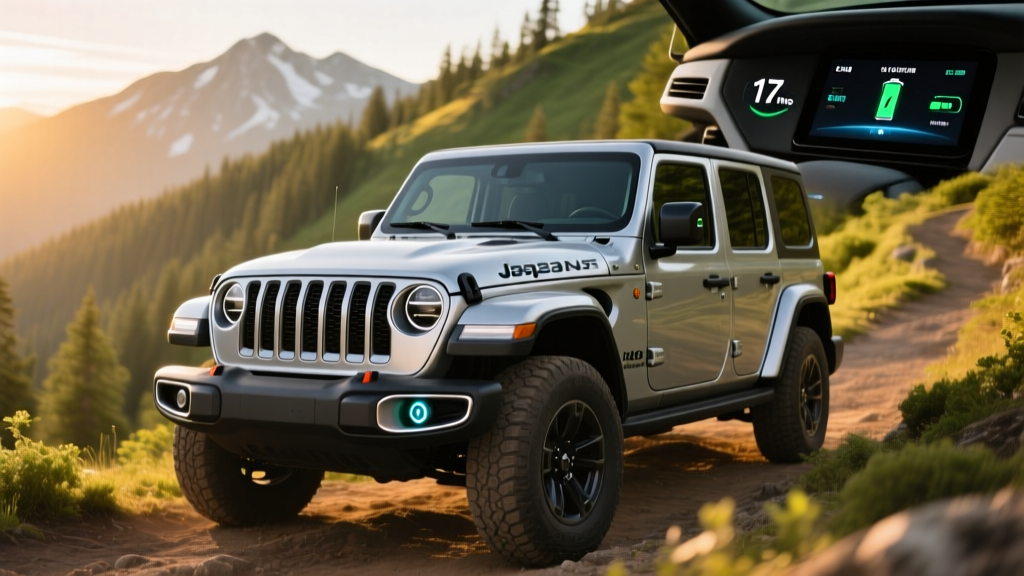
The 2025 Jeep Wrangler 4xe is not your typical plug-in hybrid. It's a body-on-frame off-roader that pairs a turbocharged four-cylinder with a 17 kWh battery pack, delivering 375 combined horsepower and the ability to crawl trails in near-silence on electric power alone. For buyers searching for a 2025 Jeep Wrangler hybrid, the 4xe remains the only electrified option in the Wrangler lineup—and one of the most capable PHEVs on the market when pavement ends.
But how does it perform as a daily driver? What's the real-world fuel economy versus the EPA sticker? And does it still qualify for federal tax incentives in 2025? This guide breaks down every spec that matters.
HEV vs PHEV: What the Wrangler 4xe Actually Is
Before diving into specs, it's critical to understand what you're buying. The Wrangler 4xe is a plug-in hybrid electric vehicle (PHEV), not a conventional hybrid (HEV). There is no self-charging, non-plug Wrangler hybrid available for 2025.
HEV vs PHEV — Key Differences
| Feature | Conventional Hybrid (HEV) | Plug-In Hybrid (PHEV) — Wrangler 4xe |
|---|---|---|
| Plugs in to charge? | No | Yes (Level 1/Level 2) |
| Electric-only driving? | No (assist only) | Yes — 22 miles EPA |
| Battery size | ~1-2 kWh | 17 kWh (usable ~14 kWh) |
| Federal tax credit? | No | Eligibility varies by sourcing rules |
| Regen braking | Mild | Strong, adjustable |
The 4xe's larger battery means you can complete short commutes entirely on electricity, then rely on the gas engine for longer trips. If you never plug it in, it functions as a heavy, less-efficient hybrid—but you're leaving its best feature on the table.
2025 Wrangler 4xe Powertrain and Performance Specs
| Specification | 2025 Jeep Wrangler 4xe |
|---|---|
| Engine | 2.0L turbocharged I-4 |
| Electric Motors | Two integrated motors (one in transmission bell housing, one engine-mounted) |
| Combined Horsepower | 375 hp |
| Combined Torque | 470 lb-ft |
| Transmission | 8-speed automatic (TorqueFlite) |
| Battery Capacity | 17 kWh total (~14 kWh usable), NMC lithium-ion |
| Drivetrain | 4WD (Selec-Trac or Rock-Trac depending on trim) |
| 0-60 mph | ~6.0 seconds |
| Towing Capacity | 3,500 lbs |
| Water Fording | 31.6 inches (Rubicon) |
The twin-motor setup is what gives the 4xe its trail manners. The engine-mounted motor smooths start-stop operation, while the transmission-integrated motor provides direct torque to the drivetrain. In Electric mode, the 4xe delivers instantaneous torque at the wheels—genuinely useful for low-speed rock crawling where throttle precision matters.
Fuel Economy: EPA Ratings vs Real-World MPG
| Driving Mode | City | Highway | Combined |
|---|---|---|---|
| Charge-Depleting (EV mode) | — | — | 49 MPGe |
| Charge-Sustaining (Hybrid mode, battery depleted) | 20 MPG | 20 MPG | 20 MPG |
Source: EPA Fuel Economy
Real-World MPG Reality Check
The EPA's 49 MPGe figure applies only when you start with a full battery and drive within the electric range. Once the battery depletes to its hold threshold, you're looking at 20 MPG combined—and real-world testing on highway loops often yields 17-19 MPG at 75+ mph. This is a 5,000+ lb aerodynamic brick with all-terrain tires. If your commute exceeds 22 miles and you can't charge at your destination, expect fuel costs closer to a conventional Wrangler than a Prius.
City driving advantage: Hybrids and PHEVs typically beat EPA city estimates in stop-and-go traffic thanks to regenerative braking. The 4xe can recapture meaningful energy in urban crawling, but its weight limits gains compared to lighter crossovers.
Electric-Only Range and Charging Details
The 2025 Wrangler 4xe provides an EPA-estimated 22 miles of electric-only range. In practice, expect 18-20 miles in mixed driving and as little as 14-16 miles at sustained highway speeds or in cold weather (below 40°F), where battery efficiency drops and cabin heating draws additional power.
The total combined range (electric + full 17.2-gallon fuel tank) is approximately 370 miles.
| Charging Method | Power | 0-100% Time | Notes |
|---|---|---|---|
| Level 1 (120V household outlet) | ~1.4 kW | ~12 hours | Overnight from standard outlet |
| Level 2 (240V home/public) | ~6.6 kW | ~2.5 hours | Recommended for daily use |
| DC Fast Charging | Not supported | N/A | J1772 connector only |
The lack of DC fast charging is a notable limitation. You won't top up at Electrify America or Tesla Supercharger stations (even with an adapter, the 4xe hardware doesn't support DC input). For a 22-mile electric range, though, Level 2 home charging is sufficient—you plug in at night and wake up full.
Pricing, Trims, and Federal Tax Credit Eligibility
The 2025 Jeep Wrangler 4xe starts at approximately $49,995 MSRP (Sport S trim, including destination) and climbs to $63,000+ for a fully loaded Rubicon or High Altitude. Key trims include:
- Sport S 4xe: ~$49,995
- Willys 4xe: ~$53,590
- Sahara 4xe: ~$57,490
- Rubicon 4xe: ~$58,990
- High Altitude 4xe: ~$63,490
Federal §30D Tax Credit — Does the 2025 Wrangler 4xe Qualify?
Under current IRS rules, the Wrangler 4xe's eligibility for the up to $7,500 federal tax credit depends on battery component and critical mineral sourcing requirements that shift annually. As of 2025, the Wrangler 4xe qualifies for $3,750 (meeting critical minerals requirements but not full battery component thresholds).
- MSRP cap: Wrangler qualifies (SUV cap is $80,000)
- Buyer income cap: $150K single / $225K head of household / $300K joint filers
- Point-of-sale transfer: Available — you can apply the credit as a down payment reduction at the dealer
Always verify current eligibility at IRS.gov and confirm with a tax professional. Rules and sourcing thresholds change.
Battery Warranty, Reliability, and Replacement Cost
Wrangler 4xe Battery Warranty
Stellantis covers the 4xe high-voltage battery for 8 years or 100,000 miles (whichever comes first), with a capacity retention threshold of 70%. If the battery degrades below 70% of original capacity within that window, Stellantis will repair or replace it at no cost.
The conventional powertrain (engine, transmission) carries a 5-year / 60,000-mile warranty.
Regarding reliability: the 4xe powertrain has been in production since the 2021 model year, giving it a multi-year track record. The 2.0L turbo engine is shared across several Stellantis models. Common owner-reported issues center on electrical gremlins (infrastructure software glitches, 12V battery drain) rather than catastrophic hybrid system failures.
If the high-voltage battery requires out-of-warranty replacement, expect a cost between $8,000 and $12,000 including labor, based on current dealer pricing for the 17 kWh pack. Module-level repair (replacing individual cell groups rather than the full pack) may reduce costs, though availability varies by dealer.
Who Should Buy the Wrangler 4xe vs a Full EV or Gas Wrangler?
✓ Pros
- Silent electric trail crawling — precise low-speed torque
- 375 hp / 470 lb-ft makes it the quickest Wrangler
- 22-mile EV range covers many daily commutes
- No range anxiety — gas engine for long trips
- Full Wrangler capability (removable doors/roof, solid axles)
- Partial federal tax credit reduces effective price
✗ Cons
- 20 MPG once battery depletes — no better than gas Wrangler
- No DC fast charging
- Added weight (~5,500 lbs) affects handling and tire wear
- Premium price over equivalent gas trims ($8,000-$12,000 more)
- Cargo space slightly reduced by battery placement
- Real-world EV range drops significantly in cold/highway driving
Decision Framework: Which Wrangler Is Right for You?
Choose the 4xe PHEV if: You have home Level 2 charging, your daily commute is under 25 miles round-trip, you want maximum torque for off-roading, and you still need to drive 300+ miles on weekends without charging stops.
Choose the gas Wrangler (3.6L V6 or 2.0T) if: You can't charge at home, you primarily drive highway miles, you want the lowest purchase price, or you don't need the extra torque.
Consider a full EV (Rivian R1S, upcoming electric SUVs) if: You want zero tailpipe emissions, have reliable home and destination charging, and don't need removable doors/roof or solid-axle articulation.
Frequently Asked Questions
How many MPG does the 2025 Jeep Wrangler 4xe hybrid get?
The EPA rates the 4xe at 49 MPGe when combining electric and gas operation from a full charge. Once the battery depletes, it returns 20 MPG combined (gas-only hybrid mode). Real-world highway driving at speed often yields 17-19 MPG in charge-sustaining mode.
How far can the Wrangler 4xe go on electric only?
The EPA estimates 22 miles of electric-only range. Expect 18-20 miles in mixed real-world driving and 14-16 miles at sustained highway speeds or in cold weather.
Does the 2025 Wrangler 4xe qualify for a federal tax credit?
As of 2025, the Wrangler 4xe qualifies for $3,750 of the potential $7,500 §30D federal tax credit, meeting critical mineral sourcing requirements. Buyer income limits and MSRP caps apply. Verify current status at IRS.gov before purchasing.
Is the Wrangler 4xe reliable, and what does battery replacement cost?
The 4xe system has been in production since 2021 with no widespread hybrid-system failure patterns. The battery is warranted for 8 years/100,000 miles at 70% capacity retention. Out-of-warranty replacement runs $8,000-$12,000. Most owners report higher reliability concern with 12V electrical systems than the high-voltage pack.
Can the Wrangler 4xe DC fast charge?
No. The 4xe only accepts AC charging via a J1772 connector—Level 1 (120V, ~12 hours) or Level 2 (240V, ~2.5 hours). DC fast charging hardware is not included.
Do I have to plug in the Wrangler 4xe?
You don't have to, but you should. If you never plug in, the 4xe operates as a heavy conventional hybrid returning about 20 MPG—worse than the gas-only Wrangler's efficiency in some scenarios. The value proposition depends on regular plug-in charging to capture that 22-mile electric window.
Hybrid vs PHEV vs full EV — which fits my lifestyle?
A conventional hybrid (HEV) needs no plug and offers modest MPG gains. A PHEV like the 4xe offers short electric-only range plus a gas engine—ideal if you can charge at home but take long road trips. A full EV (BEV) has 200-400 miles of range, zero tailpipe emissions, and the lowest per-mile fuel cost, but requires charging infrastructure planning. The 4xe PHEV is the bridge choice for off-road enthusiasts who aren't ready to commit to a fully electric rig.