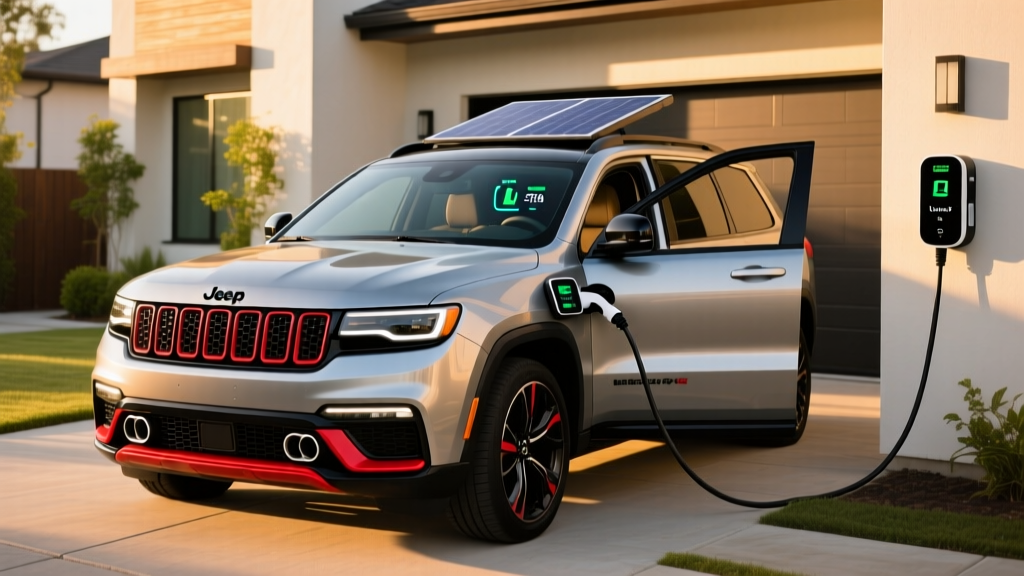
If you want three-row Jeep capability with some electric-only commuting, the 2025 Jeep Grand Cherokee 4xe plug-in hybrid is one of the few options that threads the needle. It is not a conventional hybrid (HEV) that simply sips fuel — it is a plug-in hybrid (PHEV) with a usable electric-only range, a sizable battery, and the ability to run on electricity alone for short trips before the gas engine kicks in. For 2025, the Grand Cherokee 4xe continues with the proven 2.0L turbocharged inline-four paired with two electric motors, delivering 375 combined horsepower and a manufacturer-estimated 25 miles of electric-only range.
But does the 4xe powertrain make sense for your daily driving, and what do real-world MPG, charging logistics, and federal tax credit eligibility actually look like? This guide breaks down every number that matters.
HEV vs PHEV: What the Grand Cherokee 4xe Actually Is
A common point of confusion: the Grand Cherokee 4xe is a plug-in hybrid electric vehicle (PHEV), not a conventional hybrid (HEV) like a Toyota RAV4 Hybrid. Here is why the distinction matters for your wallet and your routine.
| Feature | Conventional Hybrid (HEV) | Plug-In Hybrid (PHEV) — Grand Cherokee 4xe |
|---|---|---|
| Plugs in to charge? | No — charges via regenerative braking and engine | Yes — Level 1 (120V) or Level 2 (240V) |
| Electric-only range | 0–2 miles at low speed | ~25 miles (EPA est.) |
| Battery size | 1–2 kWh | 17.3 kWh (usable ~14.5 kWh) |
| Federal tax credit eligible | No | Yes — up to $3,750 (§30D, subject to sourcing/income rules) |
| Best for | Drivers who cannot plug in at home | Drivers with home/work charging and short commutes |
If you cannot install a charger at home or at work, the 4xe still functions as a hybrid once the battery is depleted — but you are paying a premium for a battery you are not using to its advantage. If you can plug in nightly, the 4xe lets most commuters handle a 20–25 mile round trip without burning a drop of gas.
Fuel Economy and Electric-Only Range: The EPA Numbers
The 2025 Jeep Grand Cherokee 4xe carries EPA estimates that reflect its dual nature. When the battery is charged, efficiency is measured in MPGe (miles per gallon equivalent, which accounts for electricity use). Once the battery depletes, the vehicle operates as a hybrid and efficiency is measured in standard MPG.
| Metric | EPA Estimate |
|---|---|
| Combined MPGe (electric + gas) | 56 MPGe |
| Combined MPG (gas only, battery depleted) | 23 MPG |
| City MPG (gas only) | 23 MPG |
| Highway MPG (gas only) | 24 MPG |
| Electric-only range | 25 miles |
| Total combined range (full tank + full battery) | |
| Fuel tank capacity | 15.8 gallons |
For context, the non-hybrid 2025 Grand Cherokee with the 3.6L V6 is rated at 19 city / 26 highway / 22 combined MPG. The 4xe does not dramatically outperform the V6 once the battery is depleted — the real efficiency win comes from those first 25 electric-only miles each day.
Powertrain Specs: Horsepower, Engine, and Motors
The 4xe powertrain is one of the most capable setups Jeep offers, combining a turbocharged gas engine with dual electric motors integrated into the TorqueFlite eight-speed automatic transmission.
| Specification | 2025 Grand Cherokee 4xe |
|---|---|
| Engine | 2.0L turbocharged inline-4 |
| Engine output | 270 hp / 295 lb-ft torque |
| Electric motors | Two (one integrated in transmission, one engine-mounted) |
| Combined system output | 375 hp / 470 lb-ft torque |
| 0–60 mph | ~6.0 seconds (est.) |
| Transmission | 8-speed automatic |
| Drivetrain | 4WD standard |
| Towing capacity | 6,000 lbs (when properly equipped) |
| Battery capacity (total / usable) | 17.3 kWh / ~14.5 kWh |
| Battery chemistry | NMC (nickel manganese cobalt) |
The 470 lb-ft of combined torque is notable — it exceeds even the 5.7L V8 HEMI option and gives the 4xe strong passing power. The instant torque from the electric motors also makes the 4xe feel more responsive off the line than the V6 model, despite the added weight of the battery pack (roughly 350 lbs more than the gas-only Grand Cherokee).
Charging the 4xe: Times, Levels, and What You Need
Unlike a full EV, the Grand Cherokee 4xe does not support DC fast charging. The onboard charger maxes out at 7.2 kW on Level 2, which is perfectly adequate for overnight replenishment but means road-trip charging stops are impractical.
| Charging Level | Power | Time (0–100%) | Best Use Case |
|---|---|---|---|
| Level 1 (120V household outlet) | ~1.4 kW | ~12 hours | Overnight if no Level 2 available |
| Level 2 (240V, home wallbox) | 7.2 kW | ~2.5 hours | Recommended daily charging |
| DC Fast Charging | Not supported | N/A | N/A |
Home charging setup: A standard 120V outlet will recharge the 4xe overnight if you are only using 15–20 miles of range per day. For a full charge in about 2.5 hours, a Level 2 home charger (240V, 32-amp minimum) is the practical choice. Expect a Level 2 home installation to cost $800–$2,200 depending on your electrical panel capacity and wiring run distance. If your home has a 200-amp panel with spare capacity, installation is typically on the lower end of that range.
The 4xe uses a standard J1772 connector for AC charging — the universal plug for all non-Tesla PHEVs and EVs in North America. No adapter is needed for public Level 2 stations.
Pricing, Trims, and Federal Tax Credit Eligibility
The 2025 Grand Cherokee 4xe is available across several trims, with pricing reflecting both the premium powertrain and Jeep's feature packaging.
| Trim | Starting MSRP |
|---|---|
| 4xe (base) | $60,490 |
| 4xe Trailhawk | $67,290 |
| 4xe Overland | $70,490 |
| 4xe Summit | $76,490 |
| 4xe Summit Reserve | $81,490 |
Prices include destination charge. Options and packages can add $3,000–$10,000+.
Federal Tax Credit (§30D): What You Can Actually Claim
The 2025 Grand Cherokee 4xe qualifies for a partial federal tax credit under IRS §30D. Due to battery component and critical mineral sourcing requirements that tightened in 2024, the 4xe currently qualifies for $3,750 (the critical minerals half of the credit), not the full $7,500. This is subject to change as sourcing rules evolve.
- Credit amount: Up to $3,750 for the Grand Cherokee 4xe (critical minerals portion)
- MSRP cap: Vehicle MSRP must not exceed $80,000 (SUVs/vans) — Summit Reserve with options may exceed this
- Buyer income cap: AGI ≤ $150,000 (single), $225,000 (head of household), $300,000 (joint)
- Point-of-sale transfer: Yes — you can transfer the credit to the dealer at purchase for an upfront price reduction
- Assembly: Must be assembled in North America (Grand Cherokee is built in Detroit, MI)
Source: IRS §30D Clean Vehicle Credits. Tax eligibility is individual — consult a tax professional before relying on credit estimates.
Reliability, Battery Warranty, and Replacement Costs
Hybrid and PHEV buyers consistently rank battery longevity as a top concern. Jeep covers the 4xe battery with a robust warranty that aligns with industry standards.
- High-voltage battery: 8 years / 100,000 miles (10 years / 150,000 miles in CARB states: CA, CT, MA, ME, MD, NJ, NY, OR, RI, VT, WA, CO, and others adopting CARB standards)
- PHEV powertrain components: 8 years / 100,000 miles
- Bumper-to-bumper: 3 years / 36,000 miles
- Powertrain (general): 5 years / 60,000 miles
Battery capacity retention threshold: Jeep warrants the battery against falling below 70% of original capacity during the warranty period.
Real-world reliability context: The 4xe powertrain has been in production since the 2022 model year, giving it a multi-year track record. NMC battery chemistry in PHEVs with active thermal management (which the 4xe has) typically shows 8–12% degradation over 100,000 miles based on fleet data from similar Stellantis and competitor PHEV platforms. The battery is not a single monolithic unit — it is composed of modules, meaning a partial replacement (swapping degraded modules) is possible and significantly cheaper than a full pack replacement.
Out-of-warranty battery replacement cost: A full 17.3 kWh pack replacement currently runs $8,000–$12,000 including labor at a dealer. However, full-pack failures are rare; most out-of-warranty service involves individual module replacement at $1,500–$3,000 per module.
Who Should Choose the Grand Cherokee 4xe vs. a Full EV or Gas Model
Choose the Grand Cherokee 4xe (PHEV) if:
- Your daily commute is under 25 miles and you can charge at home
- You need towing capacity (6,000 lbs) and off-road capability that most EVs cannot match
- You take long road trips where charging infrastructure is uncertain
- You want some electric driving without full EV range anxiety
Choose a full EV (e.g., Rivian R1S, Tesla Model X) if:
- You have reliable home and destination charging
- Your daily driving is under 250 miles
- You want to eliminate gas station visits and oil changes entirely
- You prioritize lower per-mile fuel cost over towing capacity
Choose the gas-only Grand Cherokee (V6) if:
- You cannot install a home charger
- Your daily commute exceeds 40 miles (the 4xe's electric advantage diminishes)
- You want a lower purchase price ($8,000–$12,000 less than the 4xe at equivalent trims)
The 4xe occupies a specific niche: drivers who want electric commuting during the week and unrestricted road-trip range on weekends. If your commute is 15 miles each way and you plug in every night, you could go months between fill-ups. If you drive 60+ miles daily without charging access, the 4xe becomes a heavier, more expensive version of the standard hybrid — and the math does not work in your favor.
Pros and Cons at a Glance
- 25 miles electric-only covers most commutes
- 375 hp / 470 lb-ft — strongest Grand Cherokee powertrain
- 6,000-lb towing with 4WD standard
- Partial federal tax credit ($3,750) available
- Trailhawk trim offers genuine off-road capability on electric torque
- No range anxiety — gas engine covers long trips
- High starting price ($60,490 before options)
- No DC fast charging — road trip electric top-ups impractical
- 23 MPG combined in gas-only mode is unremarkable for a hybrid
- ~350 lbs heavier than gas V6 model, affecting handling
- Cargo space slightly reduced due to battery placement
- Summit Reserve trim exceeds $80K MSRP cap for tax credit
Frequently Asked Questions
How many MPG does the 2025 Jeep Grand Cherokee 4xe get?
The EPA rates the 4xe at 56 MPGe combined when factoring in electric-only driving, and 23 MPG combined (23 city / 24 highway) once the battery is depleted and the vehicle runs on gas alone. In real-world driving, owners who charge nightly and commute under 25 miles report using very little gasoline, while those who rarely charge see MPG close to the standard V6 Grand Cherokee.
How far can the Grand Cherokee 4xe go on electric only?
The EPA-estimated electric-only range is 25 miles. In real-world conditions, expect 20–25 miles in moderate weather and 18–22 miles in cold weather (below 40°F). Highway-speed electric driving at 65+ mph will reduce range to roughly 17–19 miles. The vehicle seamlessly transitions to hybrid mode when the battery depletes — there is no interruption in driving.
Does the Grand Cherokee 4xe qualify for a federal tax credit?
Yes, but only a partial credit. Under current IRS §30D rules, the 4xe qualifies for $3,750 (the critical minerals portion). Eligibility depends on your income (AGI caps apply), the vehicle's final MSRP (must be under $80,000), and the credit can be transferred to the dealer at the point of sale for an upfront discount. Always verify current rules at irs.gov before purchasing.
Is the Grand Cherokee 4xe reliable, and what does battery replacement cost?
The 4xe powertrain has been in production since 2022, and early reliability data is consistent with other Stellantis PHEV platforms. The battery is warranted for 8 years / 100,000 miles (10 years / 150,000 miles in CARB states) against falling below 70% capacity. A full out-of-warranty battery replacement runs $8,000–$12,000, but modular design allows individual module replacement at $1,500–$3,000 per module, which is the more common service scenario.
Can I charge the Grand Cherokee 4xe at a DC fast charger?
No. The 4xe does not support DC fast charging. It charges via AC only — Level 1 (120V, ~12 hours for a full charge) or Level 2 (240V, ~2.5 hours). This is typical for PHEVs with smaller batteries; the 17.3 kWh pack is designed for overnight home charging, not road-trip top-ups.
What is the total range of the Grand Cherokee 4xe?
With a full battery and a full 15.8-gallon fuel tank, the Grand Cherokee 4xe delivers approximately 440 miles of total combined range. That breaks down to roughly 25 miles on electricity plus ~415 miles on gasoline in hybrid mode.
Sources: EPA Fuel Economy — 2025 Jeep Grand Cherokee 4xe, IRS §30D Clean Vehicle Credits, Jeep/Stellantis official specifications.