Quick Verdict: The Tucson Hybrid Hits the Sweet Spot
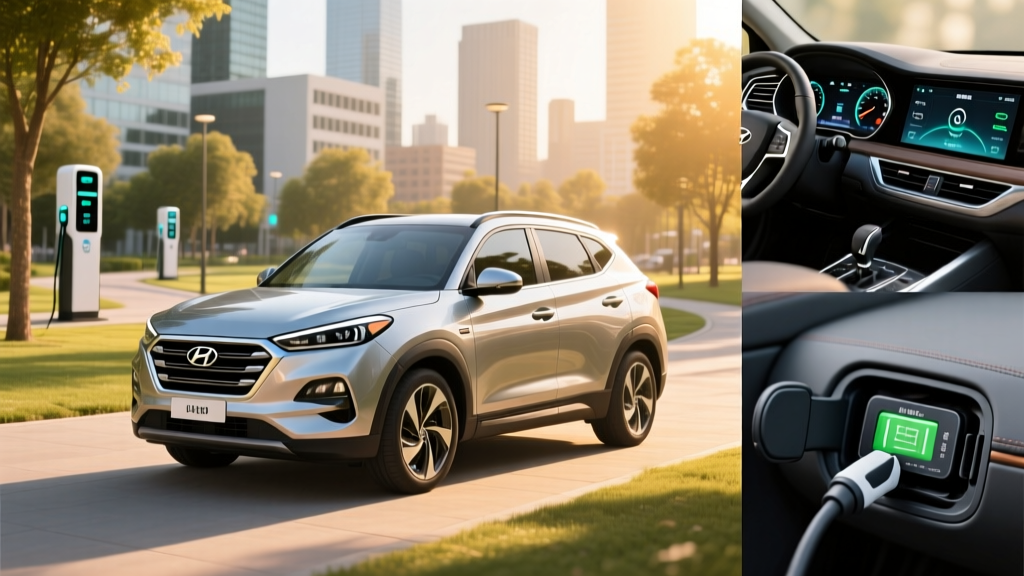
The 2025 Hyundai Tucson Hybrid occupies a compelling middle ground for compact SUV buyers who want meaningful fuel savings without the infrastructure commitment of a full battery-electric vehicle. With an EPA-rated 38 MPG combined in standard HEV form and a PHEV variant offering 33 miles of electric-only driving, the Tucson lineup covers most daily commuting needs while eliminating range anxiety entirely. Starting around $33,465 for the Blue HEV trim, it undercuts many rivals on price while matching or exceeding them on efficiency.
After spending time with both the conventional hybrid and plug-in hybrid variants, the Tucson Hybrid proves that you don't need to overhaul your driving habits to cut fuel consumption by 30-40% compared to the gas-only model. The powertrain is refined, the cabin is spacious, and the tech is competitive. The real question isn't whether the Tucson Hybrid is good — it is — but whether the HEV or PHEV version fits your specific driving pattern.
HEV vs PHEV: Which Tucson Hybrid Are We Talking About?
Hyundai offers the Tucson in two distinct electrified configurations, and confusing them is the most common mistake shoppers make. Here's the fundamental difference:
Conventional Hybrid (HEV)
- No plug required. The 1.49 kWh battery recharges through regenerative braking and the gasoline engine.
- Always ready. You fuel up at any gas station; the hybrid system manages energy automatically.
- Best for: Drivers without reliable home or workplace charging access.
Plug-In Hybrid (PHEV)
- Plug in to unlock full potential. The larger 13.8 kWh battery charges via Level 1 (120V) or Level 2 (240V) charging.
- 33 miles electric-only. Most daily commutes can be completed without burning a drop of gas.
- Best for: Drivers with home charging and predictable short commutes who still want road-trip flexibility.
Both share the same 1.6-liter turbocharged four-cylinder engine paired with an electric motor, but the PHEV uses a more powerful motor and larger battery to deliver higher combined output and that electric-only range. The HEV is strictly a fuel-efficiency play; the PHEV is a part-time EV.
Fuel Economy and Real-World MPG
Fuel economy is the headline number for any hybrid purchase. The 2025 Tucson Hybrid's EPA ratings, sourced from fueleconomy.gov, break down as follows:
| Trim / Variant | City MPG | Highway MPG | Combined MPG | MPGe (PHEV EV mode) |
|---|---|---|---|---|
| HEV Blue | 38 | 38 | 38 | — |
| HEV SEL Convenience / Limited | 37 | 36 | 37 | — |
| PHEV (all trims, hybrid mode) | 35 | 35 | 35 | 80 MPGe |
Real-World MPG Expectations
The Tucson HEV's 38 MPG combined EPA rating is achievable in mixed driving, but real-world results depend heavily on your route profile. In city-heavy commuting with frequent stops, hybrid owners regularly report 39-42 MPG because regenerative braking recaptures energy at every light. On sustained highway trips at 75+ mph, expect 33-35 MPG as aerodynamic drag dominates and the engine works harder. In cold weather (below 30°F), the engine runs more frequently to heat the cabin and warm the catalytic converter, reducing observed economy to 30-33 MPG until the powertrain reaches operating temperature.
The PHEV's 33-mile electric-only range holds up well in moderate temperatures (60-80°F) but drops to approximately 26-28 miles in winter due to battery chemistry limitations and cabin heating demands. Once the battery depletes, the PHEV operates as a conventional hybrid at its 35 MPG combined rating.
Compared to the gas-only Tucson AWD (26 MPG combined), the HEV saves roughly 3.2 gallons per 100 miles — about $1,100 annually at $3.50/gallon for a driver covering 15,000 miles per year.
Powertrain Specs: What's Under the Hood
| Specification | HEV | PHEV |
|---|---|---|
| Engine | 1.6L Turbo I4 | 1.6L Turbo I4 |
| Engine HP | 178 hp | 178 hp |
| Electric Motor HP | 64 hp (47 kW) | 97 hp (72 kW) |
| Combined System Output | 226 hp / 258 lb-ft | 261 hp / 271 lb-ft |
| Transmission | 6-speed automatic | 6-speed automatic |
| Drivetrain | AWD (standard) | AWD (standard) |
| Battery Capacity | 1.49 kWh | 13.8 kWh |
| Battery Chemistry | Lithium-ion polymer | Lithium-ion polymer |
| 0-60 mph (est.) | ~7.1 sec | ~6.3 sec |
| Towing Capacity | 2,000 lbs | 2,000 lbs |
| EPA Electric-Only Range (PHEV) | — | 33 miles |
| Total Range (PHEV) | — | ~440 miles |
The PHEV's additional 35 horsepower and stronger electric motor give it noticeably quicker off-the-line acceleration, particularly in EV mode where torque delivery is instant. Both variants use Hyundai's HTRAC all-wheel-drive system, which can route torque between axles as needed — a practical advantage in rain and light snow.
PHEV Charging: Speeds, Connectors, and Home Setup
If you're considering the Tucson PHEV, charging logistics matter. Here's what you need to know:
| Charging Level | Power (kW) | Time to Full (13.8 kWh) | Miles of Range Added/Hour |
|---|---|---|---|
| Level 1 (120V household) | ~1.4 kW | ~10-11 hours | ~3-4 miles |
| Level 2 (240V home/public) | ~7.2 kW | ~2 hours | ~16-18 miles |
| DC Fast Charge | Not supported — J1772 connector only | ||
The Tucson PHEV uses a standard J1772 connector for Level 1 and Level 2 AC charging. It does not support DC fast charging (CCS or otherwise), which is typical for PHEVs in this class. That's not a meaningful limitation — the 13.8 kWh battery is small enough that a full Level 2 charge completes in about two hours, easily replenished overnight or during a workday.
For home Level 2 charging, expect to spend $500-$1,200 on a quality 32-amp or 40-amp charging station (ChargePoint Home Flex, Emporia Level 2, or similar) plus $500-$2,000 for electrician installation depending on your panel capacity and conduit run distance. A dedicated 240V/50A circuit is recommended. Always have a licensed electrician evaluate your panel before purchasing equipment.
Pricing, Trims, and Tax Credit Eligibility
The 2025 Tucson Hybrid lineup spans multiple trims, with pricing that positions it competitively against the Toyota RAV4 Hybrid, Honda CR-V Hybrid, and Ford Escape Hybrid:
| Trim | Variant | MSRP (approx.) |
|---|---|---|
| Blue | HEV | $33,465 |
| SEL Convenience | HEV | $36,615 |
| N Line | HEV | $39,115 |
| Limited | HEV | $41,115 |
| SEL Convenience | PHEV | $40,415 |
| Limited | PHEV | $45,565 |
Federal Tax Credit Eligibility (IRS §30D)
As of current IRS rules referenced at irs.gov, the Tucson PHEV may qualify for a partial or full federal tax credit, but eligibility depends on several factors that change periodically:
- Battery sourcing requirements: Critical minerals and battery components must meet escalating domestic-content thresholds. Hyundai's supply chain has been shifting, so verify current-year eligibility on the IRS qualified vehicles list before purchasing.
- MSRP cap: SUVs must have an MSRP at or below $80,000 — the Tucson PHEV clears this easily.
- Income cap: Modified AGI must not exceed $150,000 (single), $225,000 (head of household), or $300,000 (joint).
- Point-of-sale transfer: Eligible buyers can transfer the credit to the dealer at purchase, reducing the out-of-pocket price immediately rather than waiting for a tax refund.
The conventional HEV does not qualify for the §30D federal EV tax credit because it lacks sufficient battery capacity and plug-in capability. Some states offer separate hybrid incentives — check your state energy office or DSIRE (dsireusa.org) for local programs.
Reliability, Battery Warranty, and Long-Term Costs
Hyundai Hybrid Battery Warranty
Hyundai backs the Tucson Hybrid and PHEV traction battery with one of the strongest warranties in the industry:
- Original owner: 10 years / 100,000 miles (whichever comes first)
- Subsequent owners: In most states, the 10/100k warranty transfers; in states that adopted California emissions standards (CARB states), coverage extends further.
- Capacity threshold: Hyundai covers battery replacement if capacity drops below approximately 70% of original during the warranty period.
- Hybrid system components: The electric motor, inverter, and related hybrid components carry the same 10yr/100k coverage.
Out-of-warranty replacement cost: A Tucson Hybrid battery replacement currently runs approximately $2,500-$4,000 (HEV) or $5,000-$7,500 (PHEV) including parts and labor, based on current dealer pricing. However, Hyundai's lithium-ion polymer packs have demonstrated strong longevity — widespread premature failures have not been reported for this generation. Most hybrid batteries outlast the vehicle itself when properly maintained.
The Tucson Hybrid's 1.6L turbocharged engine uses a timing chain (not a belt), which typically requires no scheduled replacement. Routine maintenance mirrors a conventional vehicle: oil changes every 7,500-10,000 miles, cabin air filter, brake fluid, and coolant. One maintenance advantage of the hybrid: regenerative braking significantly reduces wear on friction brake pads, often extending pad life to 80,000+ miles.
Hyundai's overall vehicle warranty — 5 years/60,000 miles bumper-to-bumper and 10 years/100,000 miles powertrain — remains among the most generous in the segment and applies to both HEV and PHEV variants.
Hybrid vs PHEV vs Full EV: Which Tucson Is Right for You?
Choose the Tucson HEV If:
- You rent or live somewhere without reliable access to a charging outlet
- You want maximum fuel efficiency with zero behavior change — just drive and fuel up normally
- Your budget is tighter and you want to stay under $35,000 MSRP
- You drive a mix of city and highway and want consistent 35-40 MPG regardless of conditions
Choose the Tucson PHEV If:
- You have a garage or driveway where you can install a Level 2 charger (or use a 120V outlet overnight)
- Your daily round-trip commute is under 30 miles — you'll rarely use gasoline on weekdays
- You want EV-like quiet, instant-torque driving for most trips but need gas-engine flexibility for road trips
- You may qualify for the federal tax credit, effectively narrowing the price gap with the HEV
Choose a Full EV (e.g., Ioniq 5) Instead If:
- You want zero tailpipe emissions and are ready to commit fully to electric driving
- You have reliable home charging and your typical trips fall within 250-300 miles
- You want to eliminate oil changes, spark plugs, and exhaust-system maintenance entirely
- DC fast charging infrastructure exists along your common road-trip routes
The Tucson Hybrid isn't trying to replace your next EV — it's the pragmatic bridge. For buyers who aren't ready to manage charging logistics or who frequently drive beyond 300 miles in a day, the HEV delivers 30%+ fuel savings with zero compromise. The PHEV adds genuine EV commuting capability for those with charging access, while keeping the safety net of a gas engine for longer journeys.
Pros
- 38 MPG combined (HEV Blue) — class-leading efficiency
- Standard AWD across all hybrid trims
- 10-year/100,000-mile hybrid battery warranty
- Spacious interior with 38.7 cu ft cargo volume
- Competitive pricing starting at $33,465
- PHEV offers 33 miles EV-only for gas-free commuting
- Strong safety ratings from IIHS and NHTSA
Cons
- PHEV does not support DC fast charging
- HEV does not qualify for federal §30D tax credit
- Turbo engine requires premium fuel for maximum output (regular acceptable with slight power reduction)
- PHEV trims push past $45,000 — approaching EV territory
- Regenerative braking feel takes adjustment (less aggressive than full EVs)
- No spare tire — tire inflation kit only
Frequently Asked Questions
How many MPG does the 2025 Hyundai Tucson Hybrid get?
The Tucson HEV Blue trim achieves an EPA-rated 38 MPG city, 38 MPG highway, and 38 MPG combined. Higher trims (SEL Convenience, N Line, Limited) are rated at 37/36/37 MPG due to additional weight from features and larger wheels. In real-world city driving, many owners report exceeding the EPA estimate by 2-4 MPG thanks to frequent regenerative braking opportunities.
How far can the Tucson PHEV go on electric only?
The EPA rates the Tucson PHEV at 33 miles of electric-only range on a full charge. In moderate temperatures with gentle driving, you may see 34-35 miles. In cold weather (below freezing) or with aggressive acceleration and highway speeds, expect 26-28 miles before the gasoline engine engages. Once the battery depletes, the PHEV operates as a conventional hybrid at 35 MPG combined.
Does the Tucson Hybrid need to be plugged in?
No — the conventional Tucson HEV never needs to be plugged in. Its small 1.49 kWh battery charges entirely through regenerative braking and the gasoline engine. Only the Tucson PHEV benefits from plug-in charging, and even the PHEV will function as a regular hybrid if you never plug it in (you just lose the electric-only range advantage).
Is the Tucson Hybrid reliable, and what does battery replacement cost?
Hyundai's hybrid system has demonstrated strong reliability since its introduction, with no widespread battery failure patterns reported for the current Tucson generation. The hybrid battery is covered by a 10-year/100,000-mile warranty for the original owner. Out-of-warranty replacement costs approximately $2,500-$4,000 for the HEV battery or $5,000-$7,500 for the larger PHEV battery, including labor. Given Hyundai's warranty coverage and the proven durability of lithium-ion polymer packs, most owners will never face this expense.
Does the Tucson Hybrid qualify for any federal tax credit?
The conventional Tucson HEV does not qualify for the federal §30D clean vehicle tax credit because it is not a plug-in vehicle. The Tucson PHEV may qualify for a partial or full credit (up to $7,500) depending on current battery-sourcing requirements, your income level, and the vehicle's placement on the IRS qualified vehicles list. Rules change periodically — verify eligibility at irs.gov or consult a tax professional before purchasing. Some states also offer additional incentives for PHEVs.
How does the Tucson Hybrid compare to the RAV4 Hybrid?
The Toyota RAV4 Hybrid is rated at 41 MPG combined (vs. the Tucson's 38 MPG) and starts at a similar price point. The RAV4 has a slight efficiency edge and Toyota's long-standing hybrid reputation, but the Tucson offers a more modern interior, more standard tech features, a longer powertrain warranty (10yr/100k vs. Toyota's 8yr/100k hybrid battery warranty), and a PHEV option that the current RAV4 Prime matches but at a significantly higher price. Both are strong choices — the decision often comes down to brand preference and which feature set resonates more.
Can I tow with the Tucson Hybrid?
Yes. Both the HEV and PHEV variants are rated to tow up to 2,000 pounds when properly equipped — sufficient for a small utility trailer, a pair of dirt bikes, or a light camping trailer. Keep in mind that towing will reduce fuel economy significantly, likely into the mid-to-high 20s MPG range depending on trailer weight and terrain.
Sources: EPA fuel economy data via fueleconomy.gov, Hyundai Motor America specifications, IRS clean vehicle credit guidance at irs.gov. Pricing and credit eligibility reflect model-year information available at time of publication and are subject to change. Verify all figures with your dealer and tax professional before purchasing.