Hyundai's compact SUV lineup splits into three distinct electrification paths for 2025: the conventional Tucson Hybrid (HEV), the Tucson Plug-in Hybrid (PHEV), and the fully electric Ioniq 5. If you've landed here searching for the 2025 Hyundai Tucson Hybrid interior, you're likely weighing cabin practicality against fuel savings without committing to a plug. This guide covers exactly what the Tucson HEV and PHEV deliver — from dashboard layout and cargo volume to EPA MPG, real-world efficiency, battery warranties, and federal tax credit eligibility — so you can match the right powertrain to your driving routine.
HEV vs PHEV: Which Tucson Hybrid Are We Talking About?
Hyundai sells two electrified Tucsons, and confusing them is the single most common buyer mistake. Here's the hard line:
| Attribute | Tucson Hybrid (HEV) | Tucson Plug-in Hybrid (PHEV) |
|---|---|---|
| Plug-in charging required? | No — self-charging via regen & engine | Yes — plug in for electric-only miles |
| Battery capacity | 1.49 kWh (small buffer) | 13.8 kWh usable |
| Electric-only driving | Brief low-speed EV mode (~1 mi) | EPA-est. 33 miles electric-only |
| Combined horsepower | 231 hp / 271 lb-ft | 268 hp / 271 lb-ft |
| DC fast charging | N/A | No — Level 2 AC only (7.2 kW onboard) |
| Drivetrain | AWD standard | AWD standard |
The conventional HEV never needs a plug. It recovers energy during braking and coasting, storing it in a small lithium-ion pack that assists the 1.6-liter turbocharged engine. The PHEV adds a larger battery and a more powerful electric motor, enabling genuine zero-emission commuting for most daily errands before the gas engine seamlessly takes over for longer trips.
2025 Hyundai Tucson Hybrid Interior: Layout, Tech, and Cargo
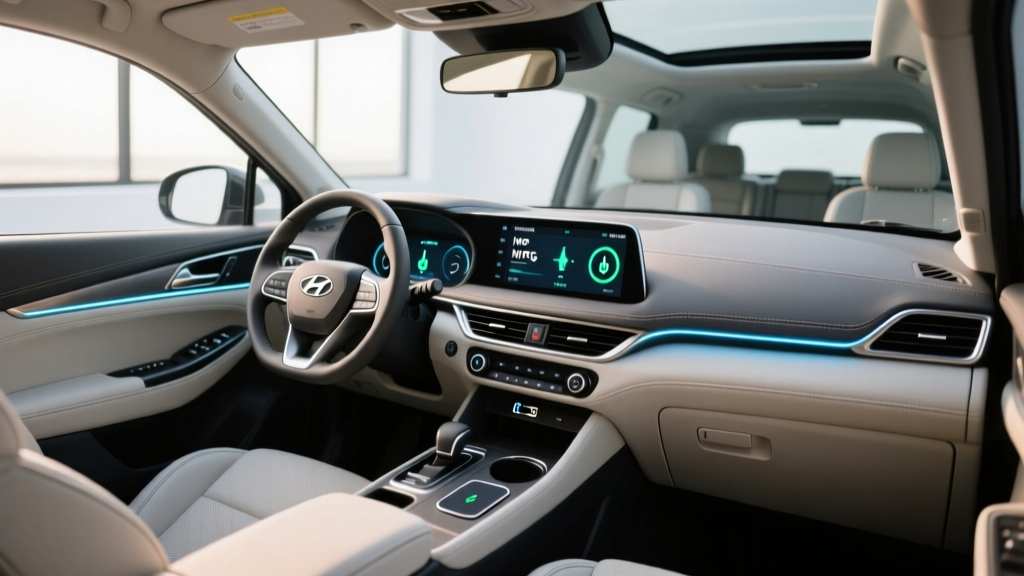
The 2025 refresh brought a redesigned cabin across the Tucson lineup. Both the HEV and PHEV share the same interior architecture, though trim availability differs slightly.
Digital Cockpit and Displays
Higher trims (SEL Convenience and above) feature dual 12.3-inch screens — a digital instrument cluster and an infotainment touchscreen — housed under a single curved glass panel. Lower trims use a 10.25-inch touchscreen with a conventional gauge cluster. Wireless Apple CarPlay and Android Auto are standard on the 10.25-inch system; the larger 12.3-inch screen requires a USB-C cable for phone projection on 2025 models.
Materials and Build Quality
Soft-touch materials cover the upper dashboard and door panels on SEL and above. The Limited trim adds leather-trimmed seats, a heated steering wheel, and ventilated front seats. Fit and finish are competitive with the Toyota RAV4 Hybrid and Honda CR-V Hybrid, though the Ford Escape Hybrid's cabin feels slightly more premium at the top trim.
Cargo Volume and Passenger Space
This is where the Tucson Hybrid's interior shines. Hyundai packages the hybrid battery under the rear seats, preserving cargo space:
- Behind rear seats: 38.7 cu ft (HEV and PHEV)
- Rear seats folded: 80.3 cu ft (HEV) / 79.6 cu ft (PHEV — slight reduction from larger battery)
- Rear legroom: 41.3 inches — class-leading for the segment
For context, the RAV4 Hybrid offers 37.5 cu ft behind the rear row. If cargo capacity is your priority, the Tucson Hybrid interior has a measurable edge.
Climate and Comfort
Dual-zone automatic climate control is standard on SEL and above. The PHEV benefits from an electric-driven A/C compressor, meaning cabin cooling works even when the gas engine is off during electric-only driving — a real advantage in stop-and-go summer traffic.
Fuel Economy: EPA MPG and Real-World Results
Efficiency is the core reason buyers cross-shop hybrids. Here's what the EPA says, followed by what you'll actually see on the road.
| Model | City MPG | Highway MPG | Combined MPG | Total Range (est.) |
|---|---|---|---|---|
| 2025 Tucson Hybrid (HEV) AWD | 38 | 38 | 38 | ~480 mi (13.7-gal tank) |
| 2025 Tucson PHEV AWD (electric + gas) | 80 MPGe combined | — | 80 MPGe / 35 MPG gas-only | ~430 mi total (33 mi EV + ~397 mi gas) |
| 2024 Tucson Gas AWD (baseline) | 23 | 29 | 26 | ~370 mi |
Source: EPA / fueleconomy.gov
Real-World MPG vs. EPA Sticker
Hybrids typically exceed their EPA city rating because stop-and-go driving maximizes regenerative braking. In mixed suburban testing, owners commonly report 39–42 MPG city in the Tucson HEV. Highway efficiency is a different story: at sustained 75+ mph speeds, the electric motor contributes less, and real-world highway MPG often drops to 33–35 MPG. If your commute is 90% freeway, expect combined numbers closer to 34–35 MPG, not the 38 MPG sticker.
The PHEV's 35 MPG gas-only figure applies once the 33-mile electric buffer is depleted. Owners who plug in nightly and drive under 30 miles daily may go months without visiting a gas station, effectively achieving 80+ MPGe on electricity alone.
Powertrain Specs: What's Under the Hood
| Specification | Tucson HEV | Tucson PHEV |
|---|---|---|
| Engine | 1.6L turbocharged 4-cylinder | 1.6L turbocharged 4-cylinder |
| Engine output | 178 hp / 195 lb-ft | 178 hp / 195 lb-ft |
| Electric motor output | 47.7 kW (64 hp) | 74.2 kW (99.5 hp) |
| Combined system output | 231 hp / 271 lb-ft | 268 hp / 271 lb-ft |
| Transmission | 6-speed automatic | 6-speed automatic |
| Drivetrain | HTRAC AWD | HTRAC AWD |
| 0–60 mph (est.) | ~7.1 sec | ~6.3 sec |
| Towing capacity | 2,000 lbs | 2,000 lbs |
Both models use Hyundai's Smartstream 1.6L turbo four paired with a traditional 6-speed automatic — not a CVT. This matters: the Tucson Hybrid avoids the rubber-band acceleration feel that plagues the RAV4 Hybrid's eCVT, delivering more natural throttle response at the cost of a fractional MPG penalty.
PHEV Charging Details
The Tucson PHEV's 13.8 kWh battery charges via a standard J1772 AC inlet. At its 7.2 kW onboard charger rate, a full 0–100% charge takes roughly 1 hour 45 minutes on a Level 2 home charger. On a standard 120V household outlet (Level 1, ~1.4 kW), expect about 9–10 hours — feasible for overnight top-ups but tight if you need a full battery every morning. There is no DC fast charging capability, which is typical for PHEVs in this class.
Pricing, Trims, and Tax Credit Eligibility
Hyundai prices the Tucson Hybrid across three trims for 2025:
- Blue: ~$33,465 MSRP (includes destination)
- SEL Convenience: ~$36,215 MSRP
- Limited: ~$40,165 MSRP
The Tucson PHEV starts higher:
- SEL Convenience: ~$39,715 MSRP
- Limited: ~$44,265 MSRP
Does the Tucson Hybrid or PHEV Qualify for a Federal Tax Credit?
Under IRS §30D rules, the Tucson PHEV qualifies for up to $3,750 in federal tax credit, provided the buyer meets income caps (modified AGI ≤ $150,000 single / $300,000 joint) and the vehicle's MSRP does not exceed $80,000 for SUVs. The credit amount depends on critical-mineral and battery-component sourcing requirements, which shift annually — verify current-year eligibility on IRS.gov's qualified vehicle list.
The conventional Tucson HEV does not qualify for the §30D new clean vehicle credit, as it is not a plug-in vehicle. However, some states offer separate rebates for HEVs — check your state energy office or AFDC's state incentive database.
§30D Federal Tax Credit Checklist (Tucson PHEV):
- Vehicle must be new, purchased for personal use in the U.S.
- MSRP must not exceed $80,000 (SUV threshold — Tucson PHEV clears this easily)
- Buyer MAGI must not exceed $150K (single), $225K (HOH), or $300K (joint)
- Credit amount ($3,750 or $7,500) depends on battery sourcing compliance for the model year
- Credit is non-refundable but can be transferred to the dealer as a point-of-sale discount
Battery Warranty, Reliability, and Replacement Costs
Hyundai Hybrid Battery Warranty
- HEV: 10 years / 100,000 miles (hybrid battery and hybrid system components)
- PHEV: 10 years / 100,000 miles (high-voltage battery and PHEV system)
- General powertrain: 10 years / 100,000 miles
- Bumper-to-bumper: 5 years / 60,000 miles
Capacity retention threshold: Hyundai warrants the PHEV battery against dropping below 70% of original capacity during the warranty period.
Is the Tucson Hybrid Reliable?
Hyundai's 1.6L turbo hybrid powertrain has been in production since the 2022 model year (also used in the Santa Fe Hybrid and Kia Sorento Hybrid). Early-production 2022 models had scattered reports of transmission shudder and 12V battery drain, both addressed via software updates. By the 2025 model year, the powertrain is considered mature. Hyundai's 10-year/100,000-mile hybrid warranty is among the longest in the industry, matched only by Kia.
What Does Hybrid Battery Replacement Cost?
If the high-voltage battery fails outside warranty, replacement costs are estimated at $2,500–$4,500 for the HEV (smaller 1.49 kWh pack) and $5,000–$8,000 for the PHEV (13.8 kWh pack), including labor. However, hybrid battery failures before 150,000 miles are statistically uncommon. Most degradation manifests as a gradual 10–15% capacity loss over 10 years, which slightly reduces electric-assist contribution but doesn't strand the vehicle.
Who Should Buy the Tucson Hybrid vs. PHEV vs. a Full EV?
Choosing between Hyundai's three electrified SUVs comes down to your charging access, commute distance, and budget.
Choose the Tucson Hybrid (HEV) if:
- You can't install a home charger (apartment, street parking, landlord restrictions)
- You want a simple ownership experience — no plugs, no apps, no charging planning
- Your priority is reducing fuel cost from ~$2,400/yr (gas Tucson) to ~$1,500/yr without lifestyle changes
- You tow occasionally (2,000-lb capacity matches the PHEV)
Choose the Tucson PHEV if:
- You have reliable Level 2 home charging and a commute under 33 miles round-trip
- You want EV-like daily driving but need gas-engine flexibility for road trips
- The $3,750 federal tax credit (if eligible) helps close the price gap with the HEV
- You value the extra 37 hp for highway merging confidence
Choose a full EV (e.g., Hyundai Ioniq 5) if:
- You have home charging and rarely drive more than 250 miles in a single day
- You want to eliminate oil changes, transmission fluid, and spark plugs entirely
- You qualify for the full $7,500 §30D credit, making the EV price-competitive with the PHEV
- Your area has reliable DC fast charging infrastructure for road trips
Tucson Hybrid (HEV) Pros
- 38 MPG combined — strong for a turbo AWD SUV
- Class-leading rear legroom (41.3 in) and strong cargo volume (38.7 cu ft)
- 10-year/100,000-mile hybrid warranty
- No plug-in needed — zero infrastructure dependency
- Natural 6-speed automatic feel (no CVT drone)
Tucson Hybrid (HEV) Cons
- No federal tax credit (unlike the PHEV)
- Highway MPG drops to ~33–35 at sustained 75+ mph
- Base Blue trim lacks premium features (heated seats, larger screen)
- AWD system is traction-oriented, not off-road capable
- Towing limited to 2,000 lbs (some rivals offer 3,500)
Frequently Asked Questions
How many MPG does the 2025 Hyundai Tucson Hybrid get?
The EPA rates the Tucson Hybrid AWD at 38 MPG city, 38 MPG highway, and 38 MPG combined. In real-world driving, expect 39–42 MPG in city traffic (regenerative braking helps) and 33–35 MPG on sustained highway trips above 75 mph.
How far can the Tucson PHEV go on electric only?
The EPA estimates 33 miles of electric-only range on a full charge. Real-world results vary: 35–37 miles is achievable in mild weather at city speeds, while cold temperatures (below 35°F) or highway driving may reduce this to 25–28 miles.
Does the Tucson Hybrid need to be plugged in?
No. The conventional Tucson Hybrid (HEV) charges its small battery through regenerative braking and the gasoline engine. You never plug it in. Only the Tucson Plug-in Hybrid (PHEV) requires plugging in to access its 33-mile electric range.
Is the hybrid battery expensive to replace?
Out-of-warranty replacement costs roughly $2,500–$4,500 for the HEV and $5,000–$8,000 for the PHEV. However, Hyundai's 10-year/100,000-mile hybrid battery warranty covers premature failure, and most hybrid batteries last well beyond 150,000 miles with gradual capacity loss rather than sudden failure.
Does the 2025 Tucson Hybrid qualify for any tax credit?
The conventional HEV does not qualify for the federal §30D clean vehicle credit. The Tucson PHEV may qualify for up to $3,750, subject to buyer income limits, MSRP caps, and battery sourcing requirements. Always verify current eligibility on IRS.gov before purchasing. Some states offer additional incentives for both HEVs and PHEVs.
How does the Tucson Hybrid compare to the RAV4 Hybrid?
The Toyota RAV4 Hybrid AWD is EPA-rated at 41 MPG combined (3 MPG higher) but offers less rear legroom (37.8 in vs. 41.3 in) and slightly less cargo space (37.5 cu ft vs. 38.7 cu ft). The RAV4 uses an eCVT, which some drivers find less engaging than the Tucson's 6-speed automatic. Pricing is comparable within $1,000 at equivalent trims.
Can the Tucson PHEV DC fast charge?
No. The Tucson PHEV only supports AC charging via a J1772 connector at up to 7.2 kW (Level 2). A full charge takes about 1 hour 45 minutes on a 240V home charger. DC fast charging is not available, which is standard for PHEVs in this segment.