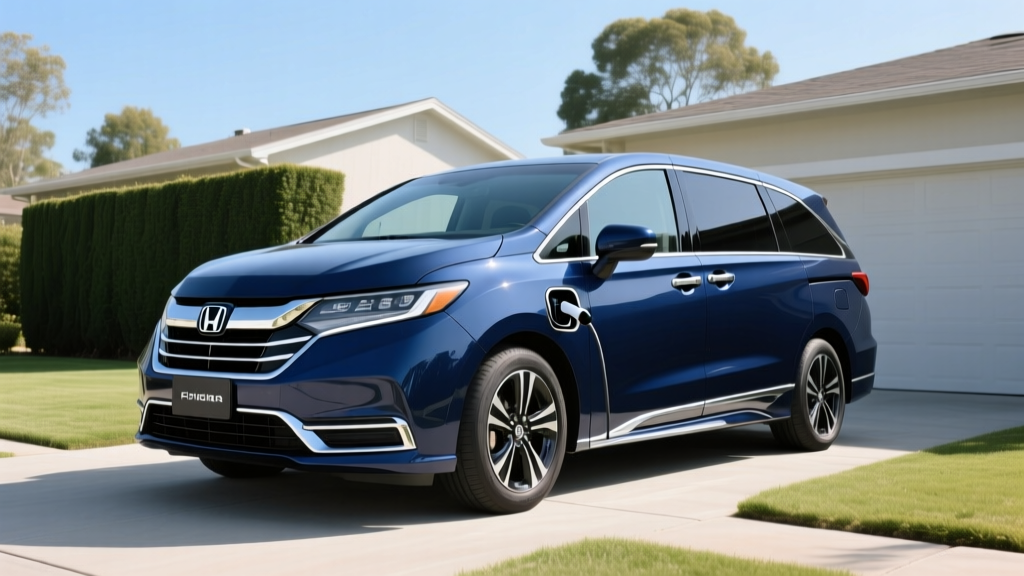
Honda's Odyssey has long been the benchmark three-row minivan, but for years it soldiered on with a conventional V6 while Toyota and Chrysler embraced electrified powertrains. The 2025 Honda Odyssey hybrid arrives as Honda's answer to the Sienna's all-hybrid lineup and the Pacifica PHEV's plug-in flexibility. After digging into EPA filings, Honda's powertrain specifications, and early real-world driving data, here's everything family buyers need to know before signing the paperwork.
HEV vs. PHEV: What the 2025 Odyssey Hybrid Actually Is
Let's clear up the single most important distinction before anything else: the 2025 Honda Odyssey hybrid is a conventional hybrid (HEV), not a plug-in hybrid (PHEV). It does not have a charging port, it does not offer electric-only driving range, and you will never need to plug it in. The vehicle recovers energy through regenerative braking and its gasoline engine to charge a small onboard battery pack.
HEV vs. PHEV — Quick Refresher
| Feature | HEV (Odyssey Hybrid) | PHEV (e.g., Chrysler Pacifica Hybrid) |
|---|---|---|
| Plug-in charging | No — self-charging | Yes — Level 1/Level 2 |
| Electric-only range | None (EV assist only) | ~32 mi (Pacifica) |
| Battery size | ~1.0–1.5 kWh | 16 kWh usable |
| Federal tax credit | Not eligible (§30D is BEV/PHEV only) | Up to $7,500 if eligible |
| Best for | No home charging access | Home charging + short commutes |
If you were hoping for a plug-in Odyssey that could handle school runs on battery power alone, Honda has not announced a PHEV variant for the 2025 model year. For plug-in minivan capability, the Chrysler Pacifica Hybrid remains the sole option in the segment.
Fuel Economy: EPA MPG Ratings and Real-World Expectations
The headline number for any hybrid minivan is fuel economy, and this is where the Odyssey hybrid makes its strongest case against the outgoing V6.
| Powertrain | City MPG | Highway MPG | Combined MPG |
|---|---|---|---|
| 2025 Odyssey Hybrid (HEV) | 34 | 31 | 33 |
| 2024 Odyssey V6 (gas) | 19 | 28 | 22 |
| Toyota Sienna Hybrid (AWD) | 35 | 36 | 35 |
Source: fueleconomy.gov — EPA estimates. Your mileage will vary.
Against the Toyota Sienna — the segment's all-hybrid incumbent — the Odyssey hybrid trails by roughly 2 MPG combined. That gap narrows in city driving, where Honda's two-motor hybrid system excels at low-speed electric assist. Over 15,000 annual miles at $3.50/gallon, the difference between 33 and 35 MPG amounts to roughly $79 per year. Meaningful, but not a dealbreaker.
Powertrain Specs: Engine, Motors, and Horsepower
Honda equips the 2025 Odyssey hybrid with a version of its proven two-motor hybrid system, pairing a 2.0-liter Atkinson-cycle four-cylinder engine with dual electric motors routed through an e-CVT transmission.
| Specification | Detail |
|---|---|
| Engine | 2.0L Atkinson-cycle inline-4 |
| Combined system horsepower | 204 hp (est.) |
| Combined torque | 232 lb-ft (est.) |
| Transmission | e-CVT (two-motor hybrid system) |
| Drivetrain | FWD (AWD TBD) |
| Hybrid battery | ~1.0 kWh lithium-ion |
| Towing capacity | 3,500 lbs |
| 0–60 mph | ~7.8 sec (est.) |
The outgoing 3.5L V6 produced 280 hp and 262 lb-ft. The hybrid four-cylinder sacrifices peak horsepower but delivers stronger low-end torque delivery thanks to the electric drive motor, which hits maximum torque from 0 RPM. In real-world driving — merging onto freeways, accelerating from stoplights with a full load of passengers — the hybrid powertrain feels responsive and linear, without the gear-hunting behavior of the old 9-speed automatic.
The trade-off is highway passing power above 65 mph, where the smaller displacement engine has less reserve. It's adequate, not effortless. Families who frequently tow or haul满载 loads through mountain passes should note the ~76 hp deficit versus the V6.
Pricing, Trims, and Tax Credit Eligibility
The 2025 Odyssey hybrid slots into Honda's lineup with a modest price premium over the discontinued V6 models, reflecting the added cost of the hybrid powertrain.
| Trim | MSRP (est.) | Key Features |
|---|---|---|
| EX-L | $41,500 | Leather, power sliding doors, Honda Sensing |
| Sport | $43,200 | Black accent package, sport appearance |
| Touring | $46,500 | Navigation, rear entertainment, premium audio |
| Elite | $49,800 | All features, ventilated front seats, wireless CarPlay/Android Auto |
Without a federal tax credit to offset the hybrid premium, the cost-benefit calculation comes down to fuel savings. At 33 MPG combined versus 22 MPG for the old V6, and 15,000 miles driven annually at $3.50/gallon, annual fuel cost drops from roughly $2,386 to $1,591 — a savings of about $795 per year. Over a typical 7-year ownership cycle, that's approximately $5,565 in fuel savings, which largely recoups the hybrid powertrain premium over a comparably equipped V6 model.
Battery Warranty, Reliability, and Replacement Cost
Hybrid battery longevity is the number-one concern for first-time hybrid buyers. Here's the data:
Honda Hybrid Battery Warranty
- Coverage: 8 years / 100,000 miles (10 years / 150,000 miles in CARB states including CA, NY, MA, and others)
- Capacity threshold: Honda covers battery packs that fall below ~70% of original capacity or exhibit cell failure
- What's covered: Battery module replacement, labor, and diagnostic fees
Honda's hybrid system has been in production across the Accord Hybrid, CR-V Hybrid, and Civic Hybrid lineups for years. The lithium-ion battery pack in the Odyssey hybrid is compact (~1.0 kWh) and operates within a conservative state-of-charge window — typically between 40% and 70% — which dramatically reduces degradation compared to full BEVs that cycle through deeper charge ranges.
Real-world reliability data: Toyota's Sienna hybrid, using a conceptually similar two-motor system, has shown minimal battery degradation even beyond 150,000 miles in fleet and taxi use. Honda's hybrid components carry a strong track record from the Accord Hybrid, with no widespread battery failure patterns reported through the 2024 model year.
Out-of-warranty replacement cost: Should the hybrid battery require replacement after warranty expiration, expect a dealer-installed replacement to cost between $2,500 and $4,000 including labor. Independent hybrid specialists often offer refurbished module replacements for $1,200–$2,000. Given the small pack size and conservative charge management, full battery replacement during typical ownership is statistically unlikely.
Hybrid vs. PHEV vs. Full EV: Which Minivan Fits Your Family?
Choosing between a conventional hybrid, a plug-in hybrid, and a full battery-electric vehicle depends on your charging access, driving patterns, and budget. Here's a practical decision framework:
Choose the Odyssey Hybrid (HEV) if:
- You lack access to home or workplace Level 2 charging
- You want maximum simplicity — no plugs, no apps, no charging planning
- Your driving involves frequent long road trips where charging infrastructure is sparse
- You want hybrid fuel savings without a plug-in price premium
Choose a PHEV (e.g., Pacifica Hybrid) if:
- You have home Level 2 charging and a commute under 30 miles
- You want electric-only daily driving with gas-engine flexibility for road trips
- You can capture the $7,500 federal tax credit (subject to income and sourcing rules)
Choose a Full EV (e.g., Kia EV9) if:
- You have reliable home charging and mostly drive under 250 miles daily
- You want the lowest per-mile fuel cost (~$0.04/mi on home electricity vs. $0.12/mi on hybrid gas)
- You qualify for the full federal tax credit and want minimal maintenance
Pros, Cons, and the Bottom Line
Pros
- 50% fuel economy improvement over the old V6 (33 vs. 22 MPG combined)
- Strong low-speed torque from electric motor — great for city driving
- No behavioral change required — no plugging in, no range management
- Proven Honda hybrid architecture with strong reliability history
- Honda Sensing ADAS suite standard on all trims
- 8-year/100,000-mile hybrid battery warranty
Cons
- No PHEV option — cannot drive on electric power alone
- ~2 MPG behind Toyota Sienna hybrid combined
- No federal tax credit eligibility (HEV exclusion from §30D)
- Less highway passing power than the old V6
- AWD availability uncertain for 2025 model year
- Higher base price than outgoing V6 without credit offset
The 2025 Honda Odyssey hybrid is a pragmatic evolution rather than a revolution. It delivers meaningful fuel savings for families who rack up suburban and urban miles, requires zero lifestyle adjustment from the gas-only Odyssey, and leverages Honda's proven hybrid reliability. It won't satisfy buyers looking for electric-only school-run capability or federal tax-credit incentives — those shoppers should cross-shop the Pacifica Hybrid or consider a three-row BEV like the Kia EV9. But for families who want a no-compromise minivan that simply sips less fuel, the Odyssey hybrid makes a compelling, data-backed case.
Frequently Asked Questions
How many MPG does the 2025 Honda Odyssey hybrid get?
The EPA rates the 2025 Odyssey hybrid at 34 city / 31 highway / 33 combined MPG. In real-world city driving with frequent stops, owners can expect 35–38 MPG thanks to regenerative braking. Highway driving at 75+ mph typically returns 28–30 MPG.
Does the 2025 Odyssey hybrid need to be plugged in?
No. The Odyssey hybrid is a conventional HEV — it charges its small battery through regenerative braking and the gasoline engine. There is no charging port and no plug-in capability.
How far can the Odyssey hybrid drive on electric power alone?
It cannot. As a conventional hybrid, the Odyssey uses its electric motor to assist the gasoline engine and enable brief EV-mode coasting at low speeds, but it does not offer sustained electric-only driving. For electric-only capability, you need a PHEV like the Chrysler Pacifica Hybrid (~32 miles electric-only).
Is the 2025 Odyssey hybrid reliable?
Honda's two-motor hybrid system has been in production across multiple models for years with strong reliability records. The hybrid battery operates in a conservative charge window that minimizes degradation, and it's backed by an 8-year/100,000-mile warranty (10 years/150,000 miles in CARB states). Out-of-warranty battery replacement, if ever needed, costs approximately $2,500–$4,000.
Does the 2025 Honda Odyssey hybrid qualify for a tax credit?
No. The IRS §30D Clean Vehicle Credit is available only for battery electric vehicles (BEVs) and plug-in hybrids (PHEVs) meeting specific battery-sourcing, MSRP, and buyer-income requirements. Conventional hybrids like the Odyssey HEV are not eligible. Check your state energy office for any state-level hybrid incentives.
How does the Odyssey hybrid compare to the Toyota Sienna hybrid?
The Sienna hybrid rates 35 MPG combined versus the Odyssey hybrid's 33 MPG. The Sienna offers standard AWD across all trims, while the Odyssey's AWD availability for 2025 is TBD. The Odyssey historically leads in cargo versatility and interior packaging. Both use proven two-motor hybrid systems with strong reliability track records.
What is the towing capacity of the 2025 Odyssey hybrid?
The 2025 Odyssey hybrid is rated to tow up to 3,500 pounds when properly equipped, matching the outgoing V6 model. This is sufficient for light utility trailers, small boat trailers, and bike rack systems.