Quick Verdict: The 2025 CR-V Sport Hybrid at a Glance
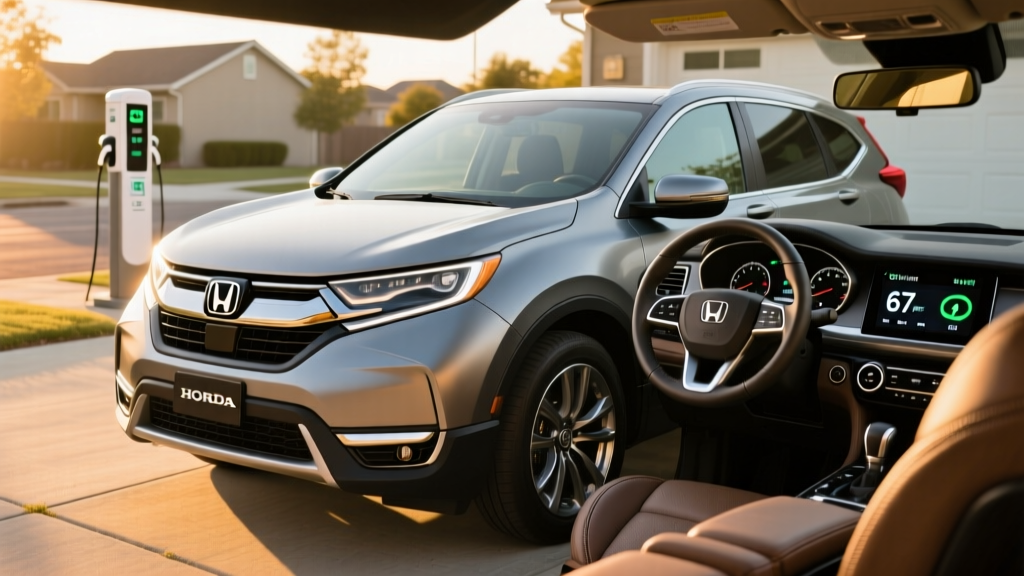
The 2025 Honda CR-V Sport Hybrid is one of the most compelling conventional hybrid SUVs on the market for buyers who want meaningful fuel savings without plugging in. With an EPA-estimated 40 MPG combined, a proven two-motor hybrid powertrain, and Honda's strong reliability record, the Sport Hybrid trim hits a sweet spot between the base gas-only CR-V and a full battery-electric vehicle. It doesn't qualify for federal EV tax credits, but its lower starting price and zero charging hassle make it a pragmatic choice for the majority of SUV shoppers.
2025 CR-V Sport Hybrid: Full Spec Sheet
| Specification | 2025 CR-V Sport Hybrid (FWD) | 2025 CR-V Sport Hybrid (AWD) |
|---|---|---|
| Powertrain Type | Conventional Hybrid (HEV) | Conventional Hybrid (HEV) |
| Engine | 2.0L Atkinson-cycle 4-cylinder | 2.0L Atkinson-cycle 4-cylinder |
| Combined System Horsepower | 204 hp | 204 hp |
| Combined System Torque | 247 lb-ft | 247 lb-ft |
| EPA City MPG | 43 MPG | 40 MPG |
| EPA Highway MPG | 36 MPG | 34 MPG |
| EPA Combined MPG | 40 MPG | 37 MPG |
| Fuel Tank Capacity | 14.0 gallons | 14.0 gallons |
| Estimated Total Range | ~560 miles | ~518 miles |
| 0–60 mph (est.) | ~7.6 seconds | ~7.8 seconds |
| Drivetrain | FWD | AWD (Real Time AWD) |
| Cargo Volume (behind rear seats) | 36.3 cu ft | 36.3 cu ft |
| Towing Capacity | 1,000 lbs | 1,000 lbs |
| Starting MSRP | $36,395 | $37,895 |
Source: EPA fueleconomy.gov, Honda Newsroom. Verify exact trim pricing with your local dealer as destination charges apply.
Fuel Economy: EPA Numbers vs. Real-World MPG
The headline figure for the 2025 CR-V Sport Hybrid with front-wheel drive is 40 MPG combined (43 city / 36 highway) according to the EPA. The AWD variant drops slightly to 37 MPG combined (40 city / 34 highway).
How Many MPG Does the 2025 CR-V Sport Hybrid Get?
| Driving Scenario | FWD Expected MPG | AWD Expected MPG |
|---|---|---|
| EPA City | 43 | 40 |
| EPA Highway | 36 | 34 |
| EPA Combined | 40 | 37 |
| Real-World City-Heavy Commute | 41–45 | 38–42 |
| Real-World Highway (75 mph) | 33–35 | 31–33 |
| Cold Weather (sub-30°F, mixed) | 36–38 | 33–35 |
For comparison, the gas-only 2025 CR-V with the 1.5L turbo achieves 29 MPG combined (28 city / 34 highway) with FWD. The hybrid's advantage is most pronounced in stop-and-go traffic where it can operate on electric power at low speeds, while the turbo engine's efficiency peaks on the highway.
Hybrid (HEV) vs. Plug-In Hybrid (PHEV) vs. Full EV: Which Fits You?
The 2025 CR-V lineup in the U.S. is offered as a conventional hybrid (HEV) in the Sport, Sport-L, and Sport Touring trims. Honda does not currently sell a plug-in hybrid (PHEV) CR-V in the United States, though a PHEV variant exists in other markets. Understanding the difference is critical before you buy.
What the CR-V Sport Hybrid is
• No plug-in required — charges via regen braking and engine
• Small battery (~1.06 kWh usable)
• Electric-only driving limited to brief low-speed bursts (under ~1 mile)
• 40 MPG combined (FWD)
• Zero behavior change from a gas car
e.g., Toyota RAV4 Prime, Hyundai Tucson PHEV
• Plug in to charge a larger battery (15–20 kWh)
• 30–42 miles of electric-only range
• Gas engine kicks in for longer trips
• May qualify for partial federal tax credit
• Requires home charging access for maximum benefit
e.g., Tesla Model Y, Hyundai Ioniq 5
• No gasoline engine — 100% electric
• 250–330+ miles of EPA range
• Lowest per-mile "fuel" cost with home charging
• Eligible for up to $7,500 federal tax credit (if qualifying)
• Requires reliable charging access (home or public)
Who Should Choose the CR-V Sport Hybrid Over a PHEV or EV?
The CR-V Sport Hybrid is ideal if:
- You lack home charging access — apartment dwellers, street parkers, or those without a garage benefit from a hybrid that never needs a plug.
- Your budget favors lower upfront cost — at ~$36,400, the Sport Hybrid undercuts most PHEVs ($40,000–$45,000) and BEVs ($42,000+) in the compact SUV segment.
- You take frequent long road trips — 560+ miles of total range and a 5-minute gas station stop beats planning DC fast-charging routes.
- You want zero lifestyle change — drive it exactly like a gas car, just visit the gas station less often.
Consider a PHEV or BEV instead if you have reliable Level 2 home charging, a commute under 40 miles (PHEV covers it on electricity alone), or want to maximize fuel-cost savings and reduce emissions.
Powertrain Deep Dive: How the CR-V Hybrid System Works
The 2025 CR-V Sport Hybrid uses Honda's fourth-generation two-motor hybrid system, which pairs a 2.0-liter Atkinson-cycle inline-4 engine with two electric motors and a lithium-ion battery pack. Combined system output is 204 horsepower and 247 lb-ft of torque.
Unlike a traditional parallel hybrid, Honda's system operates primarily in series-hybrid mode at low to moderate speeds: the gasoline engine spins a generator motor to produce electricity, which then powers the drive motor that turns the wheels. This gives the CR-V Hybrid the smooth, linear acceleration feel of an EV around town. At sustained highway speeds (typically above 45–50 mph), a lock-up clutch engages to let the engine directly drive the wheels for better efficiency.
The hybrid battery in the CR-V Sport Hybrid is a relatively small pack — approximately 1.06 kWh usable capacity. This is by design: a conventional hybrid doesn't need a large battery since it continuously recharges through regenerative braking and the engine-driven generator. The small pack keeps weight down (the Sport Hybrid FWD weighs roughly 3,730 lbs, only about 200 lbs more than the gas-only turbo model) and avoids the cost and packaging penalties of a larger battery.
Pricing, Trims, and Tax Credit Eligibility
The 2025 Honda CR-V Sport Hybrid starts at $36,395 MSRP for FWD (including destination). The AWD version adds approximately $1,500. Higher hybrid trims include:
- Sport Hybrid (FWD): ~$36,395
- Sport Hybrid (AWD): ~$37,895
- Sport-L Hybrid (AWD): ~$40,595
- Sport Touring Hybrid (AWD): ~$43,395
Does the 2025 CR-V Sport Hybrid Qualify for a Federal Tax Credit?
No. The federal §30D Clean Vehicle Credit (up to $7,500) applies only to plug-in electric vehicles — battery-electric vehicles (BEVs) and plug-in hybrids (PHEVs) with a minimum battery capacity of 7 kWh. The CR-V Sport Hybrid is a conventional hybrid (HEV) with a ~1 kWh battery and no plug-in capability, so it does not qualify for the federal EV tax credit under current IRS rules.
Some states offer incentives for conventional hybrids, though these are increasingly rare as state programs shift focus to zero-emission vehicles. Check your state's energy or environmental agency website for current programs. Honda has historically offered promotional financing rates (e.g., 0.9%–2.9% APR for well-qualified buyers) on the CR-V Hybrid, which can offset the lack of a tax credit — check Honda's current offers page for the latest.
Battery Warranty, Reliability, and Long-Term Costs
Hybrid battery longevity is one of the most common concerns among first-time hybrid buyers. Here's what you need to know about the 2025 CR-V Sport Hybrid.
• Hybrid battery: 8 years / 100,000 miles (10 years / 150,000 miles in CARB states including CA, CT, ME, MA, NJ, NY, OR, VT, WA, and others adopting California emissions standards)
• Hybrid system components: 8 years / 100,000 miles
• Powertrain warranty: 5 years / 60,000 miles
• Limited vehicle warranty: 3 years / 36,000 miles
Is the CR-V Hybrid Reliable?
Honda's two-motor hybrid system has been in production since the 2014 Accord Hybrid and has accumulated extensive real-world reliability data. The system is mechanically simpler than a traditional automatic transmission — there is no multi-gear transmission, torque converter, or complex planetary gearset. The e-CVT design uses the two motors and a single lock-up clutch, reducing wear points.
Based on historical data from Honda's hybrid fleet (Accord Hybrid, Insight, CR-V Hybrid), hybrid battery packs routinely last 150,000–200,000+ miles before significant degradation. Unlike a BEV's large battery, the CR-V Hybrid's small ~1 kWh pack operates within a narrow state-of-charge window (roughly 20%–80%), which dramatically reduces stress on the cells and extends cycle life.
What Does a Hybrid Battery Replacement Cost?
If the hybrid battery does need replacement out of warranty, expect to pay between $2,000 and $4,000 for a refurbished or aftermarket pack, or approximately $4,000–$6,000 for a new OEM battery from Honda including labor. This is substantially less than a BEV battery replacement ($10,000–$20,000+) because the hybrid pack is far smaller. In practice, very few CR-V Hybrid owners have needed out-of-warranty battery replacements given the system's age and reliability record.
Pros and Cons: The Honest Assessment
- 40 MPG combined (FWD) — excellent for a compact SUV
- Smooth, EV-like acceleration feel in city driving
- No plugging in — zero lifestyle change
- 560+ mile total range eliminates road-trip range anxiety
- Strong reliability history from Honda's hybrid system
- 8-year/100,000-mile hybrid battery warranty
- Competitive cargo space (36.3 cu ft) with no battery intrusion
- Honda Sensing ADAS suite standard on all trims
- No federal tax credit eligibility (HEV, not PHEV/BEV)
- AWD drops combined MPG to 37
- Highway MPG less impressive than city (36/34 FWD/AWD)
- 1,000-lb towing capacity — lower than some turbo competitors
- Engine drone under hard acceleration (e-CVT characteristic)
- No plug-in hybrid CR-V option in the U.S. market
- Sport Hybrid starts ~$3,500 above the gas-only EX trim
- Regenerative braking feel takes adjustment (no true one-pedal mode)
Frequently Asked Questions
How many MPG does the 2025 CR-V Sport Hybrid get?
The EPA rates the FWD model at 43 city / 36 highway / 40 combined MPG, and the AWD model at 40 city / 34 highway / 37 combined MPG. In real-world city-heavy driving, many owners report 41–45 MPG with the FWD model, while sustained highway driving at 75+ mph drops to roughly 33–35 MPG.
Do I need to plug in the CR-V Sport Hybrid?
No. The 2025 CR-V Sport Hybrid is a conventional hybrid (HEV). It charges its small battery pack entirely through regenerative braking and the gasoline engine. There is no plug, no charging cable, and no need for any charging infrastructure. You fuel it exclusively at gas stations, just like a conventional car.
How far can the CR-V Sport Hybrid go on electric only?
Only about 0.5–1 mile at very low speeds (under 25 mph) in EV mode under light load. The CR-V Sport Hybrid's ~1 kWh battery is not designed for meaningful electric-only range. Its electric motor assists the engine and enables brief EV-mode cruising, but the gasoline engine is always the primary energy source. If you want 30+ miles of electric-only driving, you need a plug-in hybrid (PHEV) like the Toyota RAV4 Prime or a full BEV.
Is the 2025 CR-V Sport Hybrid reliable?
Honda's two-motor hybrid system has been in production since 2014 and has demonstrated strong reliability across the Accord Hybrid, Insight, and CR-V Hybrid lineups. The system eliminates the conventional transmission entirely, reducing mechanical complexity. The hybrid battery carries an 8-year/100,000-mile warranty (10 years/150,000 miles in CARB states), and real-world data suggests these packs routinely last 150,000–200,000+ miles.
What is the hybrid battery replacement cost?
Out-of-warranty hybrid battery replacement for the CR-V Hybrid typically costs $2,000–$4,000 for a refurbished pack or $4,000–$6,000 for a new OEM unit with labor. This is far less than BEV battery replacement costs. Given the battery's track record and the 8–10 year warranty coverage, most owners will never face this expense.
Does the CR-V Sport Hybrid qualify for any tax credit?
It does not qualify for the federal §30D Clean Vehicle Credit, which is reserved for plug-in vehicles (BEVs and PHEVs with 7+ kWh batteries). Some states may offer small incentives for conventional hybrids, but these are uncommon. Check your state energy office for current programs. Honda frequently offers promotional financing on the CR-V Hybrid as an alternative incentive.
How does the CR-V Sport Hybrid compare to the Toyota RAV4 Hybrid?
The 2025 Toyota RAV4 Hybrid (all AWD) is rated at 41 city / 38 highway / 40 combined MPG — essentially matching the CR-V Sport Hybrid FWD on the combined cycle while offering standard AWD. The RAV4 Hybrid starts around $33,995 for the LE trim, making it less expensive at the base level, though the CR-V Sport Hybrid offers a more premium interior at its price point. Both have excellent reliability records and similar hybrid battery warranties. The RAV4 also offers a PHEV variant (RAV4 Prime) with 42 miles of electric range if you want plug-in capability.
Is AWD worth the MPG trade-off?
AWD costs you 3 MPG combined (40 vs. 37) and adds approximately $1,500 to the price. If you live in a region with significant snow, ice, or rain, the traction and resale-value benefits of AWD typically outweigh the modest fuel-economy penalty. In mild climates, FWD saves fuel and money with no practical downside for most drivers.