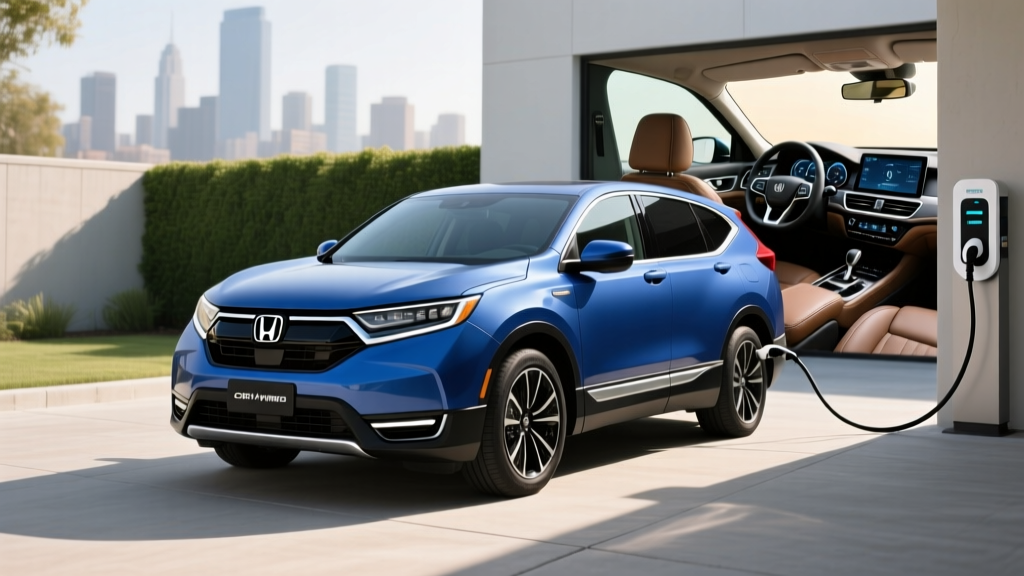
The Honda CR-V Hybrid has quietly become one of the best-selling electrified vehicles in America — not because it's flashy, but because it solves a specific problem: getting SUV practicality with fuel economy that embarrasses many compact sedans. If you've been searching for the 2025 Honda CR-V Hybrid MSRP and trying to figure out which trim makes financial sense, you're in the right place. This guide breaks down every trim's price, the real-world MPG you can actually expect, the hybrid battery warranty, and whether any tax credits apply.
Before we get into the numbers, one critical clarification: the 2025 CR-V Hybrid is a conventional hybrid (HEV), not a plug-in hybrid (PHEV). You never plug it in. It generates and recaptures all its own electricity through regenerative braking and its gasoline engine. If you want electric-only driving, you need to look at PHEVs like the Toyota RAV4 Prime or a full EV like the Honda Prologue. The CR-V Hybrid occupies a different, highly practical lane.
2025 Honda CR-V Hybrid MSRP by Trim Level
Honda offers the CR-V Hybrid across four trims for 2025, with the hybrid powertrain standard on Sport, Sport-L, and Sport Touring. The base LX and mid-tier EX trims are also available with the hybrid system depending on the market. Here is the complete pricing breakdown:
| Trim | Drivetrain | MSRP | Key Additions Over Lower Trim |
|---|---|---|---|
| Sport Hybrid | FWD | $36,395 | Hybrid powertrain, 19-inch wheels, black exterior accents, heated front seats |
| Sport Hybrid | AWD | $37,895 | Real-time AWD with torque vectoring |
| Sport-L Hybrid | FWD | $39,045 | Leather-trimmed seats, power tailgate, wireless Apple CarPlay/Android Auto |
| Sport-L Hybrid | AWD | $40,545 | AWD system |
| Sport Touring Hybrid | AWD (standard) | $43,395 | Bose 12-speaker audio, navigation, heated steering wheel, wireless charging, hands-free tailgate |
All prices include Honda's $1,395 destination charge. The Sport Touring Hybrid is AWD-only, which Honda positions as the flagship for buyers in snow-belt states. For context, the non-hybrid CR-V LX FWD starts at $31,450, so the hybrid premium is roughly $4,945 at the Sport trim — a gap you'll close through fuel savings within 3-5 years depending on your mileage and local gas prices.
EPA MPG Ratings and Real-World Fuel Economy
The 2025 CR-V Hybrid's two-motor hybrid system pairs a 2.0-liter Atkinson-cycle four-cylinder engine with two electric motors for a combined output of 204 horsepower and 247 lb-ft of torque. Here is how the EPA rates it:
| Drivetrain | City MPG | Highway MPG | Combined MPG |
|---|---|---|---|
| FWD | 43 | 36 | 40 |
| AWD | 40 | 34 | 37 |
For comparison, the non-hybrid 2025 CR-V with the 1.5L turbo is rated at 29 city / 36 highway / 32 combined (FWD). The hybrid delivers a 25% improvement in combined driving and a dramatic 48% improvement in city driving — the scenario where most families actually use their SUVs.
HEV vs. PHEV vs. EV: Which Powertrain Fits Your Life?
The CR-V Hybrid is a conventional hybrid. It has no plug, no electric-only range, and no charging requirement. Understanding how it differs from PHEVs and EVs is essential before you commit to a purchase.
| Factor | HEV (CR-V Hybrid) | PHEV (e.g., RAV4 Prime) | BEV (e.g., Honda Prologue) |
|---|---|---|---|
| Plug-in required? | No | Yes (Level 1 or 2) | Yes (Level 2 recommended) |
| Electric-only range | 0 miles | 25-42 miles typical | 250-320 miles (EPA) |
| Fuel/energy cost per mile | ~$0.10-$0.12 | ~$0.04 electric / ~$0.11 gas | ~$0.03-$0.06 |
| Upfront price premium | Low ($3-5K over gas) | High ($8-12K over gas) | High ($5-15K over gas) |
| Federal tax credit | Not eligible | Up to $7,500 (§30D) | Up to $7,500 (§30D) |
| Home charging needed? | No | Strongly recommended | Essential |
Choose a PHEV if: You have home charging, your daily commute is under 35 miles, and you want to drive mostly on electricity while keeping a gas engine for road trips.
Choose a full EV if: You have reliable Level 2 home charging, want the lowest per-mile fuel cost, and are comfortable planning around DC fast charging on road trips.
Hybrid Powertrain and Battery Specs
Honda's fourth-generation two-motor hybrid system in the CR-V uses a 2.0L direct-injection Atkinson-cycle engine producing 146 hp on its own, supplemented by two electric motors that bring the combined system output to 204 hp. The traction battery is a lithium-ion pack mounted beneath the cargo floor. Honda does not publish the exact kWh capacity for its HEV batteries (it is small — typically in the 1.0-1.5 kWh range for conventional hybrids — because the battery only needs to store energy recaptured from braking and engine excess, not provide extended electric-only driving).
The CR-V Hybrid cannot be plugged in and does not support DC fast charging or Level 2 charging. All energy comes from the gasoline engine and regenerative braking. This is by design: the battery acts as a buffer, not a primary energy source.
Does the 2025 CR-V Hybrid Qualify for a Tax Credit?
No. The 2025 Honda CR-V Hybrid does not qualify for the federal §30D Clean Vehicle Credit. Under current IRS rules, only plug-in electric vehicles (PHEVs and BEVs) with a battery capacity of at least 7 kWh are eligible. Conventional hybrids like the CR-V, which cannot be plugged in and have very small battery packs, have not qualified for any federal purchase incentive since the original Hybrid Tax Credit expired for most manufacturers years ago.
Some states and local utilities offer rebates for hybrid purchases, but these vary significantly by jurisdiction. Check your state energy office or utility provider for current programs. Also note that the Alternative Fuel Vehicle Refueling Property Credit (up to $1,000) applies to home charging equipment installation, which is irrelevant for HEV owners but worth knowing if you're cross-shopping a PHEV or EV.
Battery Warranty, Lifespan, and Replacement Cost
Real-world data from Honda's hybrid fleet (Accord Hybrid, CR-V Hybrid, Civic Hybrid going back to 2005) shows that modern lithium-ion hybrid batteries are extremely durable. Because HEV batteries operate in a narrow state-of-charge window (roughly 40-60% SoC) and are never deeply discharged or fully charged, degradation is minimal. Most Honda hybrid batteries last well beyond 150,000 miles without significant capacity loss.
If replacement is eventually needed out of warranty, a refurbished CR-V Hybrid battery pack typically costs $2,000-$3,500 installed at an independent hybrid specialist, or $3,500-$5,000 at a Honda dealer for a new OEM pack. For context, this is significantly less than EV battery replacement costs ($5,000-$20,000+), because the HEV pack is much smaller. The hybrid system's power electronics and electric motors are also covered under the same warranty period.
Beyond the battery, the CR-V carries Honda's standard 3-year/36,000-mile limited warranty and 5-year/60,000-mile powertrain warranty. IIHS has rated the 2025 CR-V a Top Safety Pick, and NHTSA gives it a 5-star overall rating — important context since reliability and safety are top concerns for family SUV buyers.
Real-World Ownership: Who Should Buy the CR-V Hybrid?
After evaluating the specs, pricing, and ownership economics, the 2025 CR-V Hybrid makes the most sense for a specific buyer profile:
- Suburban commuters driving 10,000-15,000 miles/year in mixed city/highway conditions, where the 40 MPG combined rating translates to roughly $500-$700/year in fuel savings over the turbo gas model.
- Apartment dwellers or renters who cannot install a Level 2 charger at home and therefore cannot practically own a PHEV or EV.
- Buyers who want zero lifestyle change — no charging apps, no route planning around chargers, no range calculations. You fill up at any gas station and go.
- Cold-climate drivers who would lose 20-40% of EV range in winter but will see only a 5-10% MPG dip in the hybrid.
The CR-V Hybrid is not the right choice if you have home charging and a short commute (a PHEV would let you drive on electricity daily) or if you want to eliminate gasoline entirely (consider the Honda Prologue EV, which offers up to 296 miles of EPA range).
Frequently Asked Questions
How many MPG does the 2025 Honda CR-V Hybrid actually get?
The EPA rates the FWD model at 43 city / 36 highway / 40 combined, and AWD at 40 city / 34 highway / 37 combined. In real-world suburban driving, FWD owners commonly see 41-44 MPG. Highway-only driving at 75+ mph drops economy to the low-to-mid 30s.
Do I need to plug in the CR-V Hybrid?
No. The CR-V Hybrid is a conventional hybrid (HEV). It charges its own small battery through regenerative braking and the gasoline engine. There is no plug and no electric-only driving range.
Is the CR-V Hybrid reliable?
Honda's hybrid system has been in production since the early 2000s, and the fourth-generation two-motor system in the CR-V has proven very reliable in early data. The hybrid battery is warranted for 8 years/100,000 miles (10 years/150,000 miles in CARB states). CR-V reliability ratings from Consumer Reports and J.D. Power have historically been strong for this nameplate.
What does a CR-V Hybrid battery replacement cost?
Out of warranty, expect $2,000-$3,500 for a refurbished pack at an independent shop or $3,500-$5,000 for a new OEM battery at a Honda dealer. Most hybrid batteries last well past 150,000 miles due to the shallow charge/discharge cycles.
Does the 2025 CR-V Hybrid get a tax credit?
No federal tax credit applies to conventional hybrids under current IRS §30D rules. Only plug-in vehicles (PHEVs and BEVs) qualify. Check your state and local utility for any hybrid-specific rebate programs.
CR-V Hybrid vs. RAV4 Hybrid: which is better?
The Toyota RAV4 Hybrid is rated at 41 MPG combined (AWD standard) with a starting MSRP around $33,575, making it slightly cheaper and more fuel-efficient on paper. The CR-V Hybrid offers a more refined ride, a more modern interior, and slightly more cargo space. Both are excellent — test-drive both and choose based on which cockpit and ride quality you prefer.