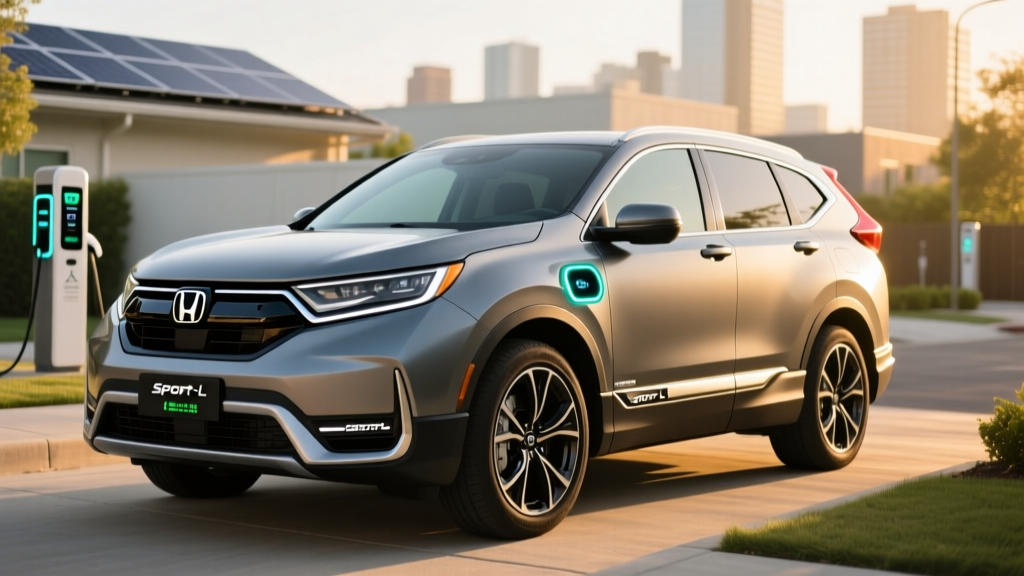
The 2025 Honda CR-V Sport-L Hybrid sits in the sweet spot of Honda's compact SUV lineup: leather-trimmed seats, a sunroof, and the brand's proven two-motor hybrid powertrain — all without a plug or range anxiety. For buyers who want electric-motor smoothness around town but aren't ready to install a home charger or commit to a battery-electric vehicle, this trim delivers a compelling middle ground.
In this guide, we break down the exact EPA fuel economy, real-world MPG expectations, powertrain output, ownership costs, battery warranty, and how the Sport-L Hybrid stacks up against a plug-in hybrid or full EV for different driving lifestyles.
Quick Verdict: Who the 2025 Honda CR-V Sport-L Hybrid Is For
Choose the CR-V Sport-L Hybrid if: You drive 30–60 miles daily, want 40+ MPG in the city without plugging in, value a quiet electric-motor launch at stoplights, and want zero change to your fueling routine.
Consider a PHEV or EV instead if: You have home Level 2 charging, a short commute you'd like to run entirely on electricity, or you want to eliminate gasoline use for daily driving.
Fuel Economy: EPA Ratings vs. Real-World MPG
The 2025 Honda CR-V Hybrid with front-wheel drive (FWD) carries an EPA rating of 43 MPG city / 36 MPG highway / 40 MPG combined. The all-wheel-drive (AWD) variant, which most Sport-L buyers select, drops slightly to 40 MPG city / 34 MPG highway / 37 MPG combined, according to fueleconomy.gov.
| Drivetrain | City MPG | Highway MPG | Combined MPG |
|---|---|---|---|
| FWD Hybrid | 43 | 36 | 40 |
| AWD Hybrid | 40 | 34 | 37 |
| Gas-only AWD (baseline) | 27 | 32 | 29 |
Real-World MPG: What to Actually Expect
Honda's two-motor hybrid system excels in stop-and-go traffic, where the electric motor handles low-speed propulsion and the 2.0-liter Atkinson-cycle engine acts primarily as a generator. In real-world city and suburban driving, many owners report matching or slightly exceeding the EPA city figure — often seeing 41–44 MPG on the trip computer in warm weather.
Highway driving tells a different story. Above 65 mph, the engine must directly drive the wheels through a fixed-ratio clutch, and aerodynamic drag works against the CR-V's boxy crossover profile. Expect 32–35 MPG on sustained highway trips at 70–75 mph with the AWD model. In cold weather (below 35°F), the engine runs more frequently for cabin heat and battery warmth, dropping city MPG to roughly 34–37 MPG until the powertrain reaches operating temperature.
Powertrain Specs: Horsepower, Engine, and Motors
| Specification | 2025 CR-V Sport-L Hybrid (AWD) |
|---|---|
| Engine | 2.0L DOHC Atkinson-cycle 4-cylinder |
| Engine Output | 145 HP / 138 lb-ft torque |
| Drive Motors | Dual electric motors (propulsion + generator) |
| Motor Output | 184 HP / 247 lb-ft torque |
| Combined System Output | 204 HP / 247 lb-ft torque |
| Transmission | Electronic continuously variable (e-CVT) |
| Drivetrain | Real Time AWD™ (AWD model) |
| 0–60 MPH | ~7.6 seconds (est.) |
| Towing Capacity | 1,000 lbs |
Honda's fourth-generation two-motor hybrid system is fundamentally a series hybrid at low speeds: the engine spins the generator motor, which feeds electricity to the propulsion motor driving the wheels. Only at steady highway cruising does a lock-up clutch engage to connect the engine directly to the front axle. This architecture delivers seamless, EV-like acceleration from a stop — the electric motor's 247 lb-ft of torque is available instantly — while maintaining efficiency the gas-only 1.5L turbo CR-V can't match.
The 204 combined horsepower is adequate for merging and passing, though not sporty. The AWD system uses a mechanical connection to the rear axle (not a dedicated rear motor), so the rear wheels engage only when the front wheels slip or under hard acceleration.
HEV vs. PHEV vs. EV: Which Powertrain Fits Your Life?
A common question from CR-V shoppers: should I get the hybrid, wait for a plug-in version, or go full electric? Here's the honest breakdown.
| Factor | CR-V Hybrid (HEV) | Typical Compact PHEV SUV | Compact EV SUV (e.g., Ioniq 5, EV6) |
|---|---|---|---|
| Plugs in? | No — gas only | Yes — Level 1/2 | Yes — Level 2 + DC fast |
| Electric-only range | N/A (EV assist only) | 25–38 miles | 250–310 miles (EPA) |
| City MPG / MPGe | 40 MPG | 35–40 MPG + 80–100 MPGe | 110–130 MPGe |
| Home charging needed? | No | Recommended | Essential |
| Upfront cost (base MSRP) | ~$36,000–$40,000 | ~$40,000–$48,000 | ~$42,000–$55,000 |
| Federal tax credit (§30D) | Not eligible | Up to $7,500 (if eligible) | Up to $7,500 (if eligible) |
| Best for | No home charging; long trips | Short commute + home charger | Home charger + mostly electric |
Key takeaway: Honda does not currently offer a CR-V Plug-In Hybrid in the US market. If you want PHEV capability in this segment, you're looking at competitors like the Toyota RAV4 Prime (42 miles electric-only, ~$44,000) or the Hyundai Tucson PHEV (33 miles electric-only, ~$39,000). The CR-V Sport-L Hybrid is strictly a conventional HEV — it never plugs in, and that's by design.
Pricing, Trim Positioning, and Tax Credit Eligibility
The 2025 Honda CR-V Sport-L Hybrid carries an MSRP of approximately $39,350 (including destination charge) for the AWD configuration. This positions it between the mid-level Sport Hybrid (~$36,350) and the top-tier Sport Touring Hybrid (~$42,350).
What you get at the Sport-L trim that the Sport lacks:
- Leather-trimmed seats (heated front)
- Power-adjustable front passenger seat
- Wireless phone charger
- Leather-wrapped steering wheel and shift knob
- Power tailgate with walk-away close
Does the CR-V Hybrid Qualify for a Federal Tax Credit?
No. Under current IRS §30D Clean Vehicle Credit rules, only plug-in electric vehicles (BEVs and PHEVs with sufficient battery capacity) qualify for the federal tax credit of up to $7,500. Conventional hybrids like the CR-V Sport-L Hybrid do not have a plug or a large enough battery to meet the threshold. You cannot claim any federal EV credit for this vehicle.
Some states offer modest hybrid incentives (typically $250–$500 rebates), but these vary by jurisdiction and change frequently. Check your state's energy or environmental agency website for current programs. The fuel savings themselves — roughly $600–$900 per year versus the gas-only CR-V AWD at 15,000 miles annually — are the primary financial benefit.
Battery Warranty, Reliability, and Replacement Cost
Honda Hybrid Battery Warranty: 8 years / 100,000 miles (10 years / 150,000 miles in CARB states including CA, CT, ME, MD, MA, NJ, NY, OR, RI, VT, WA, and others adopting California emissions standards).
Powertrain Warranty: 5 years / 60,000 miles.
Hybrid System Warranty: 8 years / 100,000 miles (covers inverter, motors, and control units).
How Reliable Is the CR-V Hybrid System?
Honda's two-motor hybrid architecture is now in its fourth generation and has proven highly durable. Unlike early hybrid systems from the 2000s, modern Honda hybrids use a relatively small lithium-ion battery pack (approximately 1.1 kWh) that is never deeply discharged — the system maintains a narrow state-of-charge window (roughly 40–80%) to minimize degradation. This shallow-cycling strategy is the same principle used to extend EV battery life.
Real-world failure data is encouraging. Third-generation CR-V Hybrids (2020–2022) have shown minimal battery-related warranty claims based on owner forums and repair databases. The hybrid battery in a well-maintained CR-V should comfortably last 150,000–200,000+ miles before capacity loss becomes noticeable.
Hybrid Battery Replacement Cost
If the hybrid battery does fail outside of warranty, replacement costs typically range from $2,000 to $4,000 for a new OEM unit, including labor. Refurbished or aftermarket packs may be available for $1,200–$2,000. Given the small battery size (1.1 kWh vs. 60–100+ kWh in a full EV), replacement is far less expensive than an EV traction battery swap. The inverter and electric motors are similarly compact and less costly to service than EV drivetrain components.
Interior, Tech, and Daily Practicality
The Sport-L Hybrid shares the sixth-generation CR-V's interior, which earned praise for its step up in material quality and space. Key specs:
- Cargo volume: 39.3 cu ft (rear seats up) / 76.5 cu ft (rear seats folded)
- Infotainment: 7-inch touchscreen with wireless Apple CarPlay and Android Auto
- Audio: 6-speaker system
- Driver assist: Honda Sensing® suite (adaptive cruise, lane-keeping, collision mitigation, traffic sign recognition)
- Instrument cluster: 10.2-inch digital display with hybrid power-flow indicator
One practical note: the hybrid battery is mounted under the cargo floor, slightly reducing under-floor storage compared to the gas model. Cargo volume figures remain the same, but the spare tire is replaced by a tire repair kit on hybrid trims.
Safety Ratings
The 2025 CR-V (including Hybrid trims) earned the IIHS Top Safety Pick award with Good ratings across all crashworthiness tests. The NHTSA awarded it a 5-Star Overall Safety Rating. The Honda Sensing suite is standard on every trim, including the Sport-L Hybrid — no upgrade package required for automatic emergency braking, lane-keeping assist, or adaptive cruise control.
Pros and Cons
Pros
- 40 MPG combined (FWD) — best-in-class for non-plug-in compact SUVs
- Smooth, EV-like acceleration from stoplights (247 lb-ft instant torque)
- No plug, no charging infrastructure required
- Generous 8-yr/100k-mi hybrid battery warranty (10 yr in CARB states)
- Spacious cargo area and rear seat for the segment
- Honda Sensing safety suite standard on all trims
- Strong resale value trajectory
Cons
- Highway MPG drops to 32–35 at 70+ mph
- No plug-in hybrid option in the CR-V lineup
- No federal tax credit eligibility
- Engine drone under hard acceleration (e-CVT characteristic)
- 1,000-lb towing limit (lower than gas model's 1,500 lbs)
- 7-inch screen feels small vs. competitors' 9–12 inch displays
- No DC fast charging (not applicable — HEV)
Frequently Asked Questions
How many MPG does the 2025 Honda CR-V Sport-L Hybrid get?
The AWD Sport-L Hybrid is EPA-rated at 40 city / 34 highway / 37 combined MPG. The FWD version achieves 43/36/40. In real-world city driving, expect 38–44 MPG depending on traffic patterns and temperature; highway driving at 70+ mph typically yields 32–35 MPG.
Does the CR-V Hybrid need to be plugged in?
No. The CR-V Hybrid is a conventional hybrid (HEV), not a plug-in hybrid (PHEV). It recharges its small battery through regenerative braking and the gasoline engine. You fuel it exclusively at gas stations, exactly like a conventional car.
Can the 2025 CR-V Hybrid drive on electric power alone?
Only for very short distances at low speeds (typically under 1 mile below 25 mph). The 1.1 kWh battery is too small for meaningful electric-only range. This is normal for conventional hybrids — the electric motor assists the engine rather than replacing it.
Is the CR-V Hybrid reliable, and what does battery replacement cost?
Honda's hybrid system has a strong reliability track record across multiple generations. The hybrid battery is warrantied for 8 years/100,000 miles (10 years/150,000 miles in CARB states). Out-of-warranty replacement runs $2,000–$4,000 for an OEM pack — far less than an EV battery swap.
Does the 2025 CR-V Sport-L Hybrid qualify for any tax credit?
No federal tax credit applies. The IRS §30D Clean Vehicle Credit requires plug-in capability and minimum battery capacity that conventional hybrids don't meet. Some states offer small hybrid rebates — check your local energy agency.
How does the CR-V Hybrid compare to the Toyota RAV4 Hybrid?
The RAV4 Hybrid (AWD) is EPA-rated at 41/38/39 MPG — slightly better highway, slightly worse city. The CR-V offers more cargo space (39.3 vs. 37.5 cu ft) and a more refined interior at the Sport-L trim level. Both are class leaders; the choice often comes down to styling preference and dealer pricing.
Should I buy the CR-V Hybrid or a full EV?
If you lack reliable home charging access, drive frequently over 300 miles in a day, or live in an area with sparse public charging infrastructure, the CR-V Hybrid is the pragmatic choice. If you have a Level 2 home charger and a commute under 50 miles, a compact EV like the Hyundai Ioniq 5 or Tesla Model Y will eliminate gasoline costs entirely and may qualify for the $7,500 federal credit — effectively narrowing the price gap.