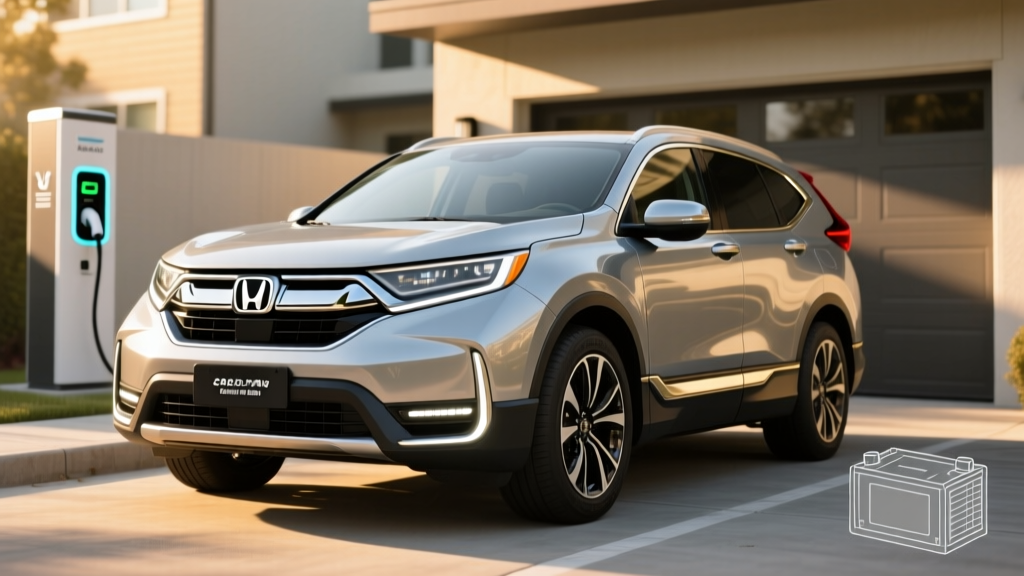
The 2025 Honda CR-V Plug-In Hybrid (sold in the U.S. as the CR-V Sport Touring PHEV) occupies a specific niche: compact-SUV buyers who want electric commuting without range anxiety on road trips. With 34 miles of EPA-rated electric-only range and a combined 43 MPG once the battery depletes, it's a pragmatic bridge between conventional hybrids and full battery-electric vehicles. But the $40,850 starting price and limited DC fast-charging capability mean it isn't for everyone. Here's the data-driven breakdown.
HEV vs PHEV: What Honda Actually Sells
Honda offers the 2025 CR-V in two electrified flavors, and confusing them is easy at the dealership:
| Feature | CR-V Hybrid (HEV) | CR-V Plug-In Hybrid (PHEV) |
|---|---|---|
| Plugs in to charge? | No — self-charging via regen | Yes — 17.7 kWh usable battery |
| Electric-only range | ~1 mile at low speed | 34 miles (EPA) |
| Combined MPG (gas) | 40 MPG combined | 43 MPG combined (after battery) |
| Combined horsepower | 204 hp | 204 hp |
| Starting MSRP | ~$34,050 | $40,850 (Sport Touring PHEV) |
| Federal tax credit | None | Up to $7,500 (§30D, if eligible) |
The conventional HEV never plugs in — it recovers energy through regenerative braking and engine-driven generation. The PHEV adds a larger battery and a charge port, letting you drive on electricity alone for most daily commutes before the gasoline engine seamlessly takes over. If you can't charge at home or work, the PHEV premium is hard to justify; the HEV delivers strong fuel economy with zero behavior change.
Electric-Only Range and Total Driving Range
The 2025 CR-V PHEV carries a 17.7 kWh lithium-ion battery pack. The EPA rates it at 34 miles of electric-only range, which is competitive for the compact PHEV SUV segment (the Toyota RAV4 Prime offers 42 miles; the Hyundai Tucson PHEV offers 33).
Once the battery depletes, the 2.0-liter Atkinson-cycle four-cylinder engine and two-motor hybrid system deliver 43 MPG combined (40 city / 45 highway, per fueleconomy.gov). Combined with the 12.2-gallon fuel tank, total driving range exceeds 480 miles — eliminating any range anxiety on road trips.
Fuel Economy and Efficiency Breakdown
| Mode | City | Highway | Combined |
|---|---|---|---|
| Electric-only (MPGe) | 105 MPGe | 88 MPGe | 97 MPGe |
| Hybrid (gas, after depletion) | 40 MPG | 45 MPG | 43 MPG |
Real-world MPG note: Honda's two-motor hybrid system excels in stop-and-go traffic, where the electric motors do most of the work and the engine acts primarily as a generator. Many owners report 45–48 MPG in city driving, exceeding the EPA city figure. Highway driving at sustained 75–80 mph typically yields 38–41 MPG. If your commute is mostly suburban and you charge nightly, you may go weeks without visiting a gas station.
The 97 MPGe rating in electric mode translates to roughly 35 kWh per 100 miles. At the U.S. average electricity rate of $0.17/kWh, that's about $0.06 per mile on electricity versus roughly $0.12–$0.14 per mile on gasoline (at $3.50/gallon and 43 MPG).
Powertrain Specs and Performance
| Specification | 2025 CR-V Sport Touring PHEV |
|---|---|
| Engine | 2.0L Atkinson-cycle 4-cylinder |
| Electric motors | Dual-motor hybrid system |
| Combined system output | 204 hp / 247 lb-ft torque |
| Battery capacity | 17.7 kWh (lithium-ion, NMC chemistry) |
| Transmission | e-CVT (direct drive, no traditional gears) |
| 0–60 mph | ~7.8 seconds (estimated) |
| Drivetrain | FWD standard; AWD not available on PHEV |
| Towing capacity | 1,000 lbs |
The PHEV powertrain is front-wheel drive only — if you need all-wheel drive, Honda limits that to the conventional CR-V Hybrid. This is a notable limitation for snow-belt buyers. The 204 hp is adequate for merging and passing but won't win any stoplight races; the CR-V PHEV prioritizes efficiency over sportiness. The e-CVT is smooth and drone-free under normal acceleration, a hallmark of Honda's two-motor design that avoids the rubber-band feel of older CVTs.
Charging: Speed, Connectors, and Home Setup
| Charging Level | Power | Time (0–100%) | Connector |
|---|---|---|---|
| Level 1 (120V household) | ~1.4 kW | ~12–14 hours | |
| Level 2 (240V home/public) | ~3.6 kW (onboard charger max) | ~5 hours | |
| DC Fast Charge | Not supported | N/A |
The CR-V PHEV uses a standard J1772 connector for Level 1 and Level 2 AC charging. It does not support DC fast charging — a limitation shared with many PHEVs in this class but still disappointing for road-trip scenarios where you'd want a quick 10-minute top-up.
The 3.6 kW onboard charger is relatively slow by 2025 standards. A Level 2 home charger (240V, 16A or higher) will refill the pack in about 5 hours, which is fine for overnight charging but means a midday top-up won't add much. A standard 120V outlet works but takes 12+ hours — adequate only if the car sits for long periods.
Home charging cost: A basic Level 2 home station (ChargePoint Home Flex, Emporia Vue) runs $300–$700 for the unit. Professional installation by a licensed electrician typically adds $500–$1,500 depending on panel proximity and whether a 240V circuit already exists. Total budget: $800–$2,200 for a reliable home charging setup.
Pricing, Trims, and Tax Credit Eligibility
The 2025 CR-V Plug-In Hybrid is sold exclusively in the Sport Touring trim, which is also the top-of-line CR-V configuration:
| Trim | MSRP | Key Features |
|---|---|---|
| Sport Touring PHEV (FWD) | $40,850 | Leather, Bose audio, wireless CarPlay/Android Auto, Honda Sensing suite, heated seats, power liftgate |
Destination charge adds approximately $1,350, bringing the as-delivered base to roughly $42,200.
- Battery sourcing: The battery components and critical minerals must meet phased-in domestic-content thresholds per IRS §30D rules. Honda has historically sourced PHEV batteries from suppliers that may or may not meet current-year thresholds.
- MSRP cap: SUVs must be under $80,000 — the CR-V PHEV clears this easily.
- Income cap: Buyer AGI must not exceed $150,000 (single) / $300,000 (joint).
- Point-of-sale transfer: As of 2024+, eligible buyers can transfer the credit to the dealer for an immediate price reduction at purchase.
Reliability, Battery Warranty, and Long-Term Costs
- Hybrid battery: 8 years / 100,000 miles (10 years / 150,000 miles in CARB states including CA, NY, MA, and others)
- Powertrain: 5 years / 60,000 miles
- New vehicle: 3 years / 36,000 miles
Honda's hybrid system has a strong reliability track record. The two-motor e-CVT design has fewer moving parts than a traditional automatic transmission, and the Atkinson-cycle engine operates under lower thermal stress. According to IIHS, the 2025 CR-V earns Top Safety Pick+ recognition, and Honda Sensing (adaptive cruise, lane-keeping, automatic emergency braking) comes standard.
Battery degradation: PHEV batteries experience shallower charge cycles than full EVs (you're using 17.7 kWh instead of 80+), which generally means slower degradation. Expect 5–10% capacity loss over 10 years based on historical Honda hybrid data. If the battery does fail outside warranty, replacement costs typically range from $4,000–$7,000 including labor — though out-of-warranty failures remain rare for Honda hybrids.
Maintenance savings: The CR-V PHEV eliminates transmission fluid changes (the e-CVT is sealed), and regenerative braking extends brake pad life significantly. Expect annual maintenance costs of $300–$500 versus $600–$900 for a conventional gas SUV.
Who Should Choose the CR-V PHEV vs an EV or Gas Car?
Choose the CR-V PHEV if:
- You can charge at home (Level 1 or 2) and your daily commute is under 30 miles round-trip
- You take road trips of 200+ miles regularly and don't want to plan around charging stops
- You live in a region with extreme cold where EV range loss is a concern
- You want EV-like commuting without the $45,000+ price of a comparable electric SUV
Choose the CR-V Hybrid (HEV) if:
- You can't charge at home or at work
- You need AWD (PHEV is FWD only)
- Your budget is closer to $35,000 and the $6,800 PHEV premium doesn't pencil out
Choose a full EV (e.g., Hyundai Ioniq 5, Tesla Model Y) if:
- You have reliable home Level 2 charging and your daily drive is under 200 miles
- You want zero tailpipe emissions and minimal maintenance (no oil changes ever)
- You want DC fast charging for road trips (150–250 kW)
Pros
- 34-mile EV range covers most commutes gas-free
- 43 MPG combined after battery depletes — excellent for a compact SUV
- Smooth, quiet electric driving in EV mode
- No range anxiety — 480+ mile total range
- Top Safety Pick+ from IIHS
- Sport Touring trim is fully loaded
Cons
- No AWD available on PHEV (FWD only)
- No DC fast charging — AC only at 3.6 kW
- $40,850 starting price is steep; HEV is $6,800 less
- Towing limited to 1,000 lbs
- Tax credit eligibility uncertain — verify before purchasing
- Only one trim level available
Frequently Asked Questions
How many MPG does the 2025 Honda CR-V Plug-In Hybrid get?
The EPA rates it at 43 MPG combined (40 city / 45 highway) after the battery is depleted. In electric-only mode, it achieves 97 MPGe combined. Real-world city driving often exceeds the EPA figure, with many owners reporting 45–48 MPG in stop-and-go traffic.
How far can the CR-V PHEV go on electric only?
The EPA rates it at 34 miles of electric-only range. Real-world results vary: expect 30–34 miles in mild weather with moderate speeds, 25–28 miles on the highway, and 22–26 miles in freezing temperatures. For commutes under 30 miles round-trip with nightly charging, you may use gasoline only on longer trips.
Does the 2025 CR-V PHEV qualify for the $7,500 federal tax credit?
It may, but eligibility under IRS §30D depends on battery component and critical-mineral sourcing requirements that change annually, plus buyer income caps ($150K single / $300K joint) and the $80K SUV MSRP cap. The CR-V PHEV clears the MSRP cap easily. Verify current eligibility on irs.gov and consult a tax professional before purchasing.
Is the CR-V PHEV reliable? What does battery replacement cost?
Honda's hybrid systems have an excellent reliability record, and the PHEV battery is warrantied for 8 years/100,000 miles (10 years/150,000 miles in CARB states). Out-of-warranty battery replacement, if needed, typically costs $4,000–$7,000. Shallow PHEV charge cycles mean slower degradation than full EVs, and most Honda hybrid batteries last well beyond 150,000 miles.
Should I buy the PHEV or the regular CR-V Hybrid?
If you can charge at home and your daily commute is under 34 miles, the PHEV will save you significantly on fuel — potentially $800–$1,200 per year depending on electricity and gas prices. The $6,800 price premium pays back in roughly 5–7 years. If you can't charge, need AWD, or want a lower purchase price, the conventional CR-V Hybrid at 40 MPG combined is the smarter buy.
Can the CR-V PHEV DC fast charge?
No. The 2025 CR-V PHEV supports only AC charging: Level 1 (120V, ~1.4 kW) and Level 2 (240V, up to 3.6 kW). A full Level 2 charge takes about 5 hours. This is typical for compact PHEVs but means you can't quickly top up on road trips the way a full EV can.