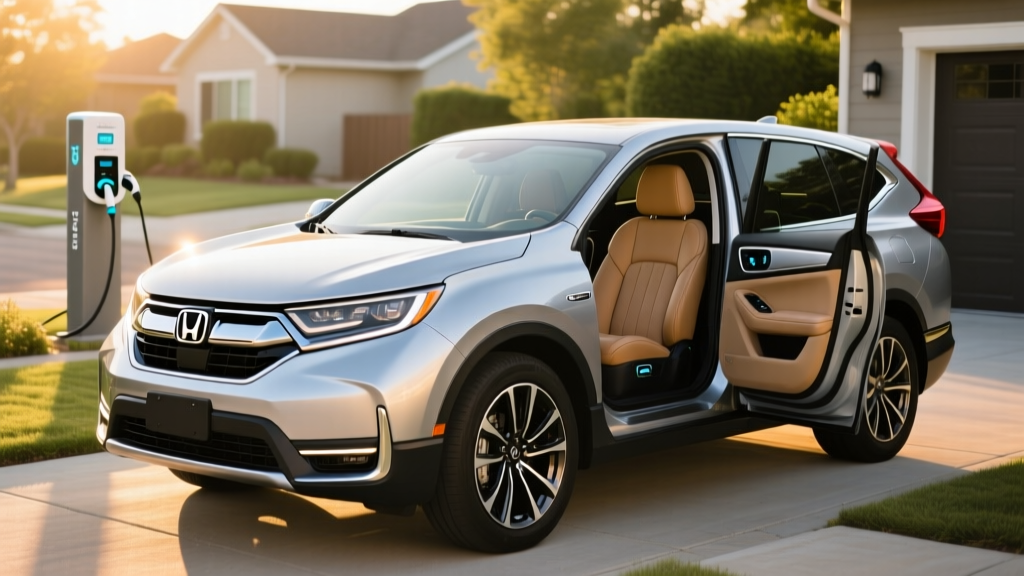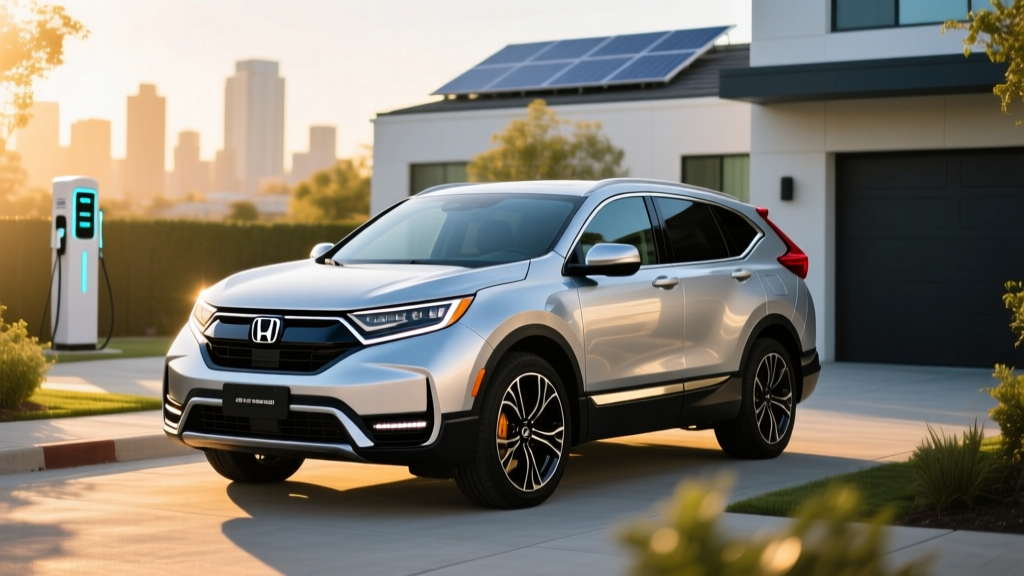
Quick Verdict: The Top-Trim Hybrid CR-V Delivers Where It Counts
The 2025 Honda CR-V Hybrid Sport Touring sits at the apex of Honda's compact SUV lineup, pairing a 204-horsepower two-motor hybrid system with premium features typically reserved for luxury badges. At an MSRP of $40,850 (including destination), it's not cheap—but its 40 MPG combined EPA rating and proven reliability record make it one of the most rational purchases in the segment. This is a conventional hybrid (HEV), meaning you never plug it in; the system recovers energy through regenerative braking and the gasoline engine to keep its small lithium-ion battery charged.
For buyers cross-shopping the Toyota RAV4 Hybrid, Ford Escape Hybrid, or even considering a plug-in hybrid or full EV, this guide breaks down exactly what the CR-V Hybrid Sport Touring delivers—and where it falls short.
HEV vs PHEV vs EV: Where Does the CR-V Hybrid Fit?
Before diving into specs, it's critical to understand what the CR-V Hybrid is—and isn't. Honda does not currently offer a plug-in hybrid (PHEV) version of the CR-V in the United States. The CR-V Hybrid is a conventional hybrid electric vehicle (HEV): it has a small battery (roughly 1.1 kWh usable) that is charged exclusively by the engine and regenerative braking. There is no charging port, no plug, and no meaningful electric-only driving range.
HEV vs PHEV vs BEV — Which Powertrain Fits You?
| Factor | HEV (CR-V Hybrid) | PHEV (e.g., RAV4 Prime) | BEV (e.g., Ioniq 5) |
|---|---|---|---|
| Plug in to charge? | No | Yes (optional but beneficial) | Yes (required) |
| Electric-only range | ~1 mi at low speed | 25–42 mi typical | 250–350+ mi |
| Home charging needed? | No | Recommended (Level 2) | Essential (Level 2) |
| Federal tax credit (§30D) | Not eligible | Up to $7,500 if eligible | Up to $7,500 if eligible |
| Fuel cost (annual, 15k mi) | ~$1,300 (gas) | ~$500–$900 (gas + elec) | ~$500–$700 (electric) |
| Best for | No home charging access, simplicity | Short commutes + road trips | Home charging + low running costs |
Bottom line: If you can install a Level 2 home charger and have a commute under 35 miles, a PHEV or BEV will save more on fuel. If you live in an apartment, lack charging access, or simply want zero behavioral change from your gas car, the CR-V HEV is the pragmatic pick.
Fuel Economy: EPA Ratings and Real-World MPG
The 2025 CR-V Hybrid Sport Touring comes standard with all-wheel drive (AWD), which slightly reduces fuel economy compared to the FWD hybrid trims. Here's the official EPA breakdown:
| Metric | EPA Rating | Real-World Expectation |
|---|---|---|
| City | 40 MPG | 38–43 MPG |
| Highway | 34 MPG | 31–35 MPG |
| Combined | 37 MPG | 35–39 MPG |
Source: fueleconomy.gov
Real-World MPG Note
Hybrids typically exceed their EPA city rating in stop-and-go driving because regenerative braking recovers energy that would otherwise be lost. Highway driving is where hybrids lose their advantage—the engine runs more continuously and aerodynamic drag dominates. In cold weather (below 30°F), expect a 5–10% MPG reduction as the engine runs more frequently to provide cabin heat and warm the catalytic converter. Owners in mixed suburban driving routinely report 37–41 MPG year-round.
With a 15.3-gallon fuel tank, the CR-V Hybrid Sport Touring delivers a theoretical maximum range of approximately 566 miles on a fill-up (at combined EPA). Real-world range between refueling typically lands around 480–530 miles.
Powertrain: Two-Motor Hybrid System Specs
The CR-V Hybrid uses Honda's fourth-generation two-motor hybrid system. Unlike Toyota's planetary-gear hybrid synergy drive, Honda's system operates primarily as a series hybrid at lower speeds—the gasoline engine acts as a generator, and the electric traction motor drives the wheels. At highway speeds, a lock-up clutch connects the engine directly to the wheels for efficiency.
| Specification | 2025 CR-V Hybrid Sport Touring |
|---|---|
| Engine | 2.0L DOHC 4-cylinder (Atkinson cycle) |
| Engine output | 145 hp / 138 lb-ft torque |
| Electric traction motor | 184 hp / 247 lb-ft torque |
| Combined system output | 204 hp / 247 lb-ft torque |
| Drivetrain | AWD (standard on Sport Touring) |
| Transmission | e-CVT (direct-drive with lock-up clutch) |
| 0–60 mph | ~7.6 seconds |
| Hybrid battery | ~1.1 kWh lithium-ion |
| Towing capacity | 1,000 lbs |
| Cargo volume (behind rear seats) | 36.3 cu ft |
| Cargo volume (rear seats folded) | 76.5 cu ft |
The Sport Touring's AWD system uses a rear-mounted electric motor that engages the rear axle when additional traction is needed. This isn't a mechanical driveshaft connection—Honda's e-AWD sends up to 50% of torque rearward in low-grip conditions. The result is confident rain and light-snow performance without the drivetrain losses of a traditional mechanical AWD system.
Battery Warranty, Lifespan, and Replacement Cost
Honda Hybrid Battery Warranty
Coverage: 8 years / 100,000 miles (10 years / 150,000 miles in CARB states including CA, CT, ME, MA, NJ, NY, OR, VT, WA, and others adopting California emissions standards).
What's covered: Defects and capacity loss below a functional threshold. Honda's hybrid batteries are designed to last the life of the vehicle under normal use.
Replacement cost (out of warranty): Approximately $2,000–$4,000 for the hybrid battery pack, based on current parts pricing and labor. This is significantly less than a full EV battery replacement because the HEV battery is small (~1.1 kWh).
Honda's hybrid system has an excellent longevity track record. The fourth-generation two-motor system has been in production since 2023 (in the Accord Hybrid and CR-V Hybrid), and earlier Honda hybrid systems in the Insight and Accord have demonstrated 200,000+ mile lifespans with minimal degradation. The small battery cycles shallowly—it never fully charges or fully depletes—which dramatically extends cycle life compared to a BEV or PHEV battery.
The CR-V Hybrid also carries Honda's standard 3-year/36,000-mile limited warranty and 5-year/60,000-mile powertrain warranty covering the engine, motors, and e-CVT assembly.
Pricing, Trims, and Tax Credit Eligibility
The 2025 Honda CR-V Hybrid is available in four trims, all using the same 204-hp powertrain:
| Trim | Drivetrain | MSRP (incl. destination) | EPA Combined MPG |
|---|---|---|---|
| Sport | FWD or AWD | $35,350 (AWD) | 37 MPG (AWD) |
| Sport-L | FWD or AWD | $37,350 (AWD) | 37 MPG (AWD) |
| Sport Touring | AWD only | $40,850 | 37 MPG |
Source: Honda CR-V Hybrid official page
Federal Tax Credit: Not Eligible
The CR-V Hybrid is a conventional HEV and does not qualify for the IRS §30D Clean Vehicle Credit (up to $7,500 for new PHEVs and BEVs). The §30D credit requires a minimum battery capacity of 7 kWh and plug-in capability—neither of which the CR-V Hybrid has.
However, some states and utilities offer rebates for hybrid purchases. Check your state energy office or local utility for current programs. The IRS §30D page details eligibility requirements for plug-in vehicles if you're considering alternatives.
What the Sport Touring trim adds: Over the Sport-L, the Sport Touring includes a Bose 12-speaker premium audio system, wireless Apple CarPlay and Android Auto, a 9-inch touchscreen, heated rear seats, a heated steering wheel, Honda Sensing (ADAS suite with adaptive cruise, lane-keeping, and collision mitigation), navigation, a hands-free power tailgate, and low-speed braking control. It's the only hybrid trim with standard AWD exclusively.
Sport Touring Features, Interior, and Technology
The Sport Touring occupies the premium end of the CR-V lineup, and the interior reflects it. Soft-touch materials cover the dashboard and door panels, the leather-trimmed seats are well-bolstered, and the cabin is noticeably quieter than lower trims thanks to active noise cancellation and additional sound insulation.
The 9-inch touchscreen with wireless Apple CarPlay/Android Auto is responsive, though not class-leading in resolution compared to Hyundai/Kia's latest interfaces. The Bose audio system is a genuine upgrade over the base 8-speaker setup. Wireless phone charging, dual-zone automatic climate control, and USB-C ports (front and rear) round out the tech suite.
The Honda Sensing ADAS package is a Level 2 driver-assist system (per SAE J3016), meaning it can manage steering and speed simultaneously on marked highways—but the driver must remain fully engaged with hands on the wheel and eyes on the road. It is not a self-driving system. Competitors like Ford's BlueCruise and GM's Super Cruise offer hands-free highway driving on approved roads, but Honda's system remains more conservative and widely functional across all road types.
5-Year Ownership Cost Estimate
| Cost Category | 5-Year Estimate | Notes |
|---|---|---|
| Purchase price | $40,850 | MSRP before incentives |
| Fuel (15,000 mi/yr) | ~$6,500 | At $3.20/gal, 37 MPG combined |
| Insurance | ~$7,500 | National avg; varies by state/driver |
| Maintenance | ~$2,500 | Oil changes, tires, brakes (regen reduces brake wear) |
| Depreciation | ~$14,000 | CR-V holds value well (~65% retention at 5 yr) |
| Total 5-year cost | ~$71,350 | Excludes tax credit (not eligible) |
For comparison, a similarly equipped gasoline CR-V (EX-L AWD, ~$37,000 MSRP, 28 MPG combined) would cost approximately $69,000 over five years—savings on purchase price are offset by ~$2,500 more in fuel. The hybrid's advantage grows as gas prices rise and as brake-pad replacement intervals extend thanks to regenerative braking.
Pros, Cons, and Who Should Buy
✅ Pros
- 37 MPG combined AWD — class-competitive with RAV4 Hybrid
- Smooth, responsive two-motor hybrid with 204 hp
- Top-tier safety: IIHS Top Safety Pick+, 5-star NHTSA
- Strong resale value (CR-V historically retains ~65% at 5 years)
- No plug-in required — zero behavioral change from a gas car
- Spacious 36.3 cu ft cargo area with no battery intrusion
- Comprehensive Honda Sensing ADAS standard
❌ Cons
- $40,850 is steep for a compact SUV — rivals start lower
- No federal tax credit (HEV ineligible for §30D)
- Highway MPG (34) trails city (40) — typical hybrid limitation
- 1,000-lb towing capacity — insufficient for most trailers
- Infotainment screen smaller than some competitors (9-inch max)
- No PHEV variant available in the US for electric-only commuting
- Road noise still present on coarse pavement despite Sport Touring insulation
Decision Framework: Is the CR-V Hybrid Sport Touring Right for You?
Choose the CR-V Hybrid Sport Touring if:
- You can't install a home charger (apartment, condo, street parking)
- You want maximum fuel efficiency with zero plug-in hassle
- You prioritize safety ratings, reliability, and resale value
- You drive a mix of city and suburban miles (where hybrids shine)
- You want AWD for weather without a fuel-economy penalty
Look elsewhere if:
- You have home charging and a short commute — a PHEV (RAV4 Prime, Tucson PHEV) will save more on fuel and may qualify for the $7,500 federal credit
- You want a fully electric daily driver — consider the Ioniq 5, EV6, or Tesla Model Y with home Level 2 charging
- You need to tow more than 1,000 lbs — look at body-on-frame hybrids or larger SUVs
- Budget is the top priority — the CR-V Sport Hybrid AWD at $35,350 delivers identical powertrain efficiency for $5,500 less
Frequently Asked Questions
How many MPG does the 2025 Honda CR-V Hybrid Sport Touring get?
The EPA rates the AWD CR-V Hybrid Sport Touring at 40 MPG city, 34 MPG highway, and 37 MPG combined. In real-world driving, owners typically report 35–41 MPG depending on driving mix, weather, and terrain. City-heavy commutes often exceed the EPA city rating thanks to regenerative braking.
Does the CR-V Hybrid need to be plugged in?
No. The CR-V Hybrid is a conventional HEV, not a plug-in hybrid. It charges its small battery through regenerative braking and the gasoline engine. There is no charging port. You simply fill it with gasoline like any other car.
How far can the CR-V Hybrid drive on electric power alone?
Effectively zero miles at meaningful speeds. The hybrid system can propel the CR-V at very low speeds (under 15 mph) for roughly a mile in stop-and-go traffic, but the engine engages quickly. This is not a plug-in hybrid—there is no usable electric-only range for commuting.
Is the Honda CR-V Hybrid reliable, and what does battery replacement cost?
Yes. Honda's hybrid systems have demonstrated strong long-term reliability across multiple model generations. The hybrid battery is covered by an 8-year/100,000-mile warranty (10 years/150,000 miles in CARB states). Out-of-warranty replacement costs approximately $2,000–$4,000—a modest figure given the small battery size. The e-CVT has no traditional transmission fluid or clutch wear concerns.
Does the 2025 CR-V Hybrid qualify for any federal tax credit?
No. The IRS §30D Clean Vehicle Credit applies only to plug-in electric vehicles (PHEVs and BEVs) with a minimum battery capacity of 7 kWh. The CR-V Hybrid's ~1.1 kWh battery and lack of a charging port make it ineligible. Some state or utility programs may offer hybrid incentives—check your local programs.
How does the CR-V Hybrid compare to the Toyota RAV4 Hybrid?
Both are class leaders. The RAV4 Hybrid AWD is rated at 39 MPG combined (vs. 37 for the CR-V Hybrid AWD) and offers a PHEV variant (RAV4 Prime, 42 miles electric-only, eligible for tax credit). The CR-V Hybrid counters with a more refined ride, slightly more rear-seat legroom, and a stronger safety reputation (IIHS Top Safety Pick+). Choice often comes down to styling preference, dealer experience, and whether you want PHEV availability.
What's the difference between the CR-V Hybrid Sport and Sport Touring?
The Sport Touring adds approximately $5,500 over the Sport AWD and includes: Bose 12-speaker audio, wireless CarPlay/Android Auto, heated rear seats, heated steering wheel, navigation, hands-free power tailgate, low-speed braking control, and exclusive 19-inch alloy wheels. The powertrain, fuel economy, and cargo space are identical across all hybrid trims.
Specifications sourced from fueleconomy.gov, Honda's official CR-V Hybrid page, and IIHS. Pricing reflects 2025 model year MSRP including destination. Tax credit rules reflect current IRS §30D guidance and are subject to change. Verify eligibility with a tax professional.