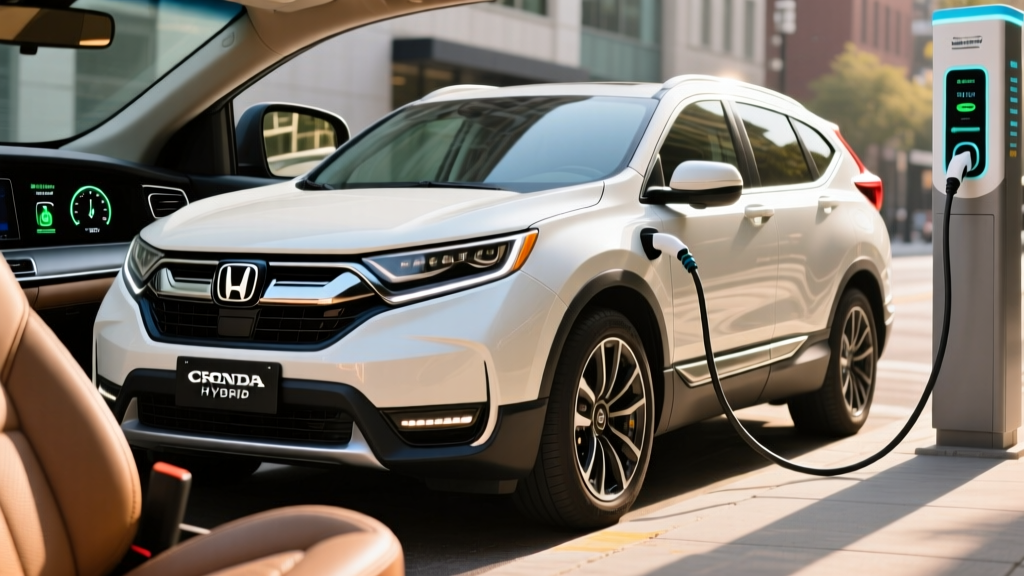
The Honda CR-V has been America's best-selling compact SUV for years, and the hybrid powertrain is quickly becoming the default choice for buyers who want efficiency without plugging in. The 2025 Honda CR-V Hybrid carries over the fourth-generation two-motor system introduced with this generation's redesign, pairing a 2.0-liter Atkinson-cycle engine with twin electric motors for a combined 204 horsepower. With an EPA-estimated 40 MPG combined, it undercuts the gas-only CR-V's fuel cost by roughly 30% while delivering smoother, more responsive acceleration around town.
This guide covers everything a prospective buyer needs: exact EPA and real-world MPG figures, trim pricing, the hybrid powertrain architecture, battery longevity, and how the CR-V Hybrid stacks up against plug-in hybrid and full EV alternatives in 2025.
2025 CR-V Hybrid Fuel Economy: EPA vs. Real-World MPG
The headline number for the 2025 Honda CR-V Hybrid is its EPA-rated fuel economy. Front-wheel-drive (FWD) models achieve the highest figures, while all-wheel-drive (AWD) trims — which account for the majority of CR-V Hybrid sales — sacrifice just 1 MPG on the highway.
| Drivetrain | City MPG | Highway MPG | Combined MPG |
|---|---|---|---|
| FWD (Sport, Sport-L) | 43 | 36 | 40 |
| AWD (Sport, Sport-L, Sport Touring) | 40 | 34 | 37 |
Source: EPA fueleconomy.gov
How the CR-V Hybrid Powertrain Works
The 2025 CR-V Hybrid uses Honda's fourth-generation two-motor hybrid system. This is a conventional hybrid (HEV), meaning it generates all its electricity internally — you never plug it in. Here's the architecture:
- Engine: 2.0-liter DOHC Atkinson-cycle 4-cylinder, producing 145 HP on its own
- Drive motor: Permanent-magnet electric motor producing 181 HP and 247 lb-ft of torque
- Generator motor: Second electric motor that acts as a generator and starter
- Combined system output: 204 HP and 247 lb-ft of torque
- Transmission: No traditional gearbox — Honda uses an e-CVT with a single fixed-ratio gear for highway cruising and a lock-up clutch for direct engine drive at higher speeds
- Battery: Lithium-ion pack (approximately 1.06 kWh usable), mounted under the cargo floor
At low speeds and during city driving, the CR-V Hybrid operates primarily as a series hybrid: the gasoline engine spins the generator motor, which produces electricity to feed the drive motor. This gives it EV-like smoothness and torque delivery around town. At highway speeds (roughly above 45–50 MPH), the lock-up clutch engages and the engine drives the wheels directly, which is more efficient than converting mechanical energy to electrical and back again.
HEV vs. PHEV vs. EV: Which Powertrain Fits Your Life?
The CR-V Hybrid is an HEV. Honda does not currently offer a plug-in hybrid (PHEV) version of the CR-V in the United States, though the closely related Honda Clarity PHEV was discontinued after 2022. Here's how the three electrified powertrain types compare for buyers cross-shopping this segment:
| Factor | HEV (CR-V Hybrid) | PHEV (e.g., Toyota RAV4 Prime) | BEV (e.g., Tesla Model Y) |
|---|---|---|---|
| Plug-in required? | No | Optional (best value when plugged in) | Yes — mandatory |
| Electric-only range | None (motor assists engine) | 25–42 miles typical | 250–330 miles |
| Combined efficiency | 37–40 MPG | 38 MPG + 94 MPGe (electric) | 110–130 MPGe |
| Home charging install | Not needed | Level 2 recommended ($500–$1,500) | Level 2 required ($800–$2,500) |
| Federal tax credit (§30D) | Not eligible | Up to $7,500 (if eligible) | Up to $7,500 (if eligible) |
| Base MSRP (segment) | ~$36,000 | ~$44,000 | ~$44,000 |
| Best for | Apt/condo dwellers, no plug access | Homeowners with short commutes | Homeowners with Level 2, mostly local |
2025 CR-V Hybrid Pricing by Trim
Honda offers the CR-V Hybrid exclusively in the sport-oriented trims for 2025. Pricing below includes the mandatory destination charge of $1,395:
| Trim | Drivetrain | MSRP (incl. destination) |
|---|---|---|
| Sport Hybrid | FWD | $36,395 |
| Sport Hybrid | AWD | $37,895 |
| Sport-L Hybrid | FWD | $38,795 |
| Sport-L Hybrid | AWD | $40,295 |
| Sport Touring Hybrid | AWD (standard) | $42,895 |
Source: Honda.com official pricing
Federal Tax Credit Eligibility
The 2025 Honda CR-V Hybrid does not qualify for the federal §30D Clean Vehicle Credit. Under current IRS rules, only plug-in electric vehicles (BEVs and PHEVs with at least 7 kWh of battery capacity and the ability to be recharged from an external source) are eligible for the up-to-$7,500 credit. Conventional hybrids like the CR-V Hybrid generate their own electricity and do not meet this threshold.
Some states and municipalities offer their own incentives for hybrid purchases, though these are less common than EV incentives. Check your state's energy office or department of environmental quality for current programs. Honda also occasionally offers manufacturer loyalty or lease incentives that can reduce the effective price — check with your local dealer for current offers.
Battery Longevity, Warranty, and Replacement Cost
Battery durability is consistently the top concern among hybrid buyers. Honda's track record here is strong, and the warranty provides meaningful protection.
• Coverage period: 8 years / 100,000 miles (10 years / 150,000 miles in CARB states including CA, CO, CT, ME, MD, MA, NJ, NY, OR, RI, VT, WA)
• What's covered: Defects in materials/workmanship and capacity loss below a defined threshold
• Hybrid system components: Power control unit, electric motors, and related components carry the same 8/100k warranty
The CR-V Hybrid's lithium-ion battery pack is relatively small (around 1.06 kWh usable) and operates within a narrow state-of-charge window — typically between 20% and 80% SoC. Honda's battery management system (BMS) never fully charges or fully depletes the pack, which dramatically reduces degradation stress. This is fundamentally different from a BEV battery that cycles through a much wider range daily.
Real-world longevity data: Honda's hybrid systems in the Accord, Civic, and CR-V have shown excellent durability. Third-generation CR-V Hybrids (2020–2022 model years) with 80,000+ miles are showing minimal capacity loss based on owner reports. The lithium-ion chemistry used is designed for high cycle life in shallow-discharge applications. Most hybrid battery failures before 100,000 miles are due to manufacturing defects (covered under warranty) rather than wear-out degradation.
Out-of-warranty replacement cost: If the hybrid battery requires replacement after the warranty period, expect to pay between $2,000 and $4,000 for a new OEM battery pack including labor. Third-party remanufactured packs are available for $1,500–$2,500. Given the narrow SoC operating window and Honda's engineering history, most CR-V Hybrid batteries should last well beyond 150,000 miles without significant issues.
Driving Impressions and Practical Ownership
The CR-V Hybrid's two-motor system gives it a driving character noticeably different from the gas-only CR-V. Electric motor torque is available instantly from a stop, so the Hybrid feels more responsive in city traffic and during passing maneuvers despite having only 14 more combined horsepower than the 190-HP turbocharged gas model. The transition between electric-only, series-hybrid, and direct-engine-drive modes is seamless — most drivers won't notice the switchovers.
Noise and refinement: Under gentle acceleration, the CR-V Hybrid can operate in EV mode at low speeds (typically up to 15–25 MPH for short distances), which makes it noticeably quieter in parking lots and residential areas. Under harder acceleration, the engine RPM rises to feed the drive motor, and the e-CVT can hold a steady, elevated RPM that some drivers find droning. This is common to all series-hybrid systems, not unique to Honda.
Cargo and interior space: The hybrid battery pack is mounted under the cargo floor, so trunk capacity is essentially unchanged from the gas CR-V at 36.3 cubic feet behind the rear seats and 76.5 cubic feet with the rear seats folded. The Sport Touring Hybrid includes a hands-free power tailgate, heated rear seats, a Bose 12-speaker audio system, and a 9-inch touchscreen with wireless Apple CarPlay and Android Auto.
Towing: The CR-V Hybrid is rated to tow 1,000 pounds — adequate for a small utility trailer or a couple of dirt bikes but not for a boat or camper. If you need to tow more than 1,000 pounds, the gas-only CR-V AWD is rated for 1,500 pounds.
Who Should Buy the 2025 CR-V Hybrid?
- You want better fuel economy without changing your routine (no plugging in)
- You live in an apartment, condo, or lack reliable home charging access
- Most of your driving is city and suburban (where hybrids shine brightest)
- You want Honda's reliability reputation and strong resale value
- You need a compact SUV with AWD and cargo versatility
- You plan to keep the vehicle 8+ years (well within warranty coverage)
- You have home charging and a short commute (a PHEV saves more on fuel)
- You want to maximize federal tax credits (HEVs don't qualify for §30D)
- You need more than 1,000 lbs of towing capacity
- You want a third row (consider the Honda Pilot Hybrid instead)
- You drive predominantly highway miles (the hybrid advantage shrinks at sustained high speeds)
- You want EV-only driving for zero tailpipe emissions on short trips
CR-V Hybrid vs. Key Competitors
The compact hybrid SUV segment is competitive. Here's how the CR-V Hybrid stacks up against its two primary rivals on paper:
| Spec | Honda CR-V Hybrid AWD | Toyota RAV4 Hybrid AWD | Hyundai Tucson Hybrid AWD |
|---|---|---|---|
| Combined MPG (EPA) | 37 | 39 | 38 |
| Combined HP | 204 | 219 | 226 |
| Cargo (behind rear seats) | 36.3 cu ft | 37.6 cu ft | 38.7 cu ft |
| Towing capacity | 1,000 lbs | 1,750 lbs | 2,000 lbs |
| Base AWD MSRP | $37,895 | $35,050 | $36,435 |
| Battery warranty | 8 yr / 100k mi | 10 yr / 150k mi | 10 yr / 100k mi |
The RAV4 Hybrid leads on MPG and towing, and starts at a lower price. The Tucson Hybrid offers the most cargo space and horsepower. The CR-V Hybrid's advantages are its driving refinement, interior material quality (especially in Sport Touring trim), and Honda's historically strong resale values. Source: fueleconomy.gov and manufacturer specifications.
Frequently Asked Questions
How many MPG does the 2025 CR-V Hybrid actually get?
The EPA rates the AWD model at 40 city / 34 highway / 37 combined MPG, and the FWD at 43 city / 36 highway / 40 combined. In real-world city driving, many owners report 40–45 MPG with the AWD. Highway driving at 75+ MPH typically yields 31–33 MPG AWD. Cold weather reduces these figures by roughly 8–12%.
Do I need to plug in the CR-V Hybrid?
No. The CR-V Hybrid is a conventional hybrid (HEV), not a plug-in hybrid. It charges its own small battery through regenerative braking and the gasoline engine. You simply fill it with gas like any other car. There is no charging port, no plug, and no electric-only range to manage.
Does the 2025 CR-V Hybrid qualify for a federal tax credit?
No. Under IRS §30D rules, only plug-in electric vehicles with at least 7 kWh of battery capacity are eligible for the federal Clean Vehicle Credit (up to $7,500). The CR-V Hybrid's battery is approximately 1.06 kWh and cannot be charged externally, so it does not qualify. Some state-level incentives may apply — check your state energy office.
How long will the CR-V Hybrid battery last?
Honda warrants the hybrid battery for 8 years/100,000 miles (10 years/150,000 miles in CARB states). Based on Honda's track record with prior-generation hybrid systems, most batteries should last 150,000+ miles without significant degradation. The battery operates in a narrow charge window (roughly 20–80% SoC), which minimizes wear. Out-of-warranty replacement costs $2,000–$4,000 if ever needed.
Is the CR-V Hybrid better than the gas CR-V?
For most buyers, yes. The Hybrid costs roughly $1,500–$2,000 more than a comparably equipped gas CR-V AWD but saves approximately $400–$600 per year in fuel costs (based on 15,000 miles/year and $3.50/gallon). Payback takes 3–5 years. Beyond fuel savings, the Hybrid offers smoother acceleration, quieter low-speed operation, and typically stronger resale value. The gas CR-V retains a slight advantage in towing (1,500 vs. 1,000 lbs) and has a marginally lower starting price if budget is the primary concern.
Hybrid vs. PHEV vs. EV — which should I choose?
Choose the CR-V Hybrid (HEV) if you can't charge at home and want hassle-free efficiency. Choose a PHEV (like the Toyota RAV4 Prime, 42 miles electric range) if you have home charging, a commute under 40 miles, and want to drive mostly on electricity while keeping a gas backup. Choose a full EV (like the Tesla Model Y or Hyundai Ioniq 5) if you have reliable Level 2 home charging, want zero tailpipe emissions, and your trips mostly fall within 250–300 miles.