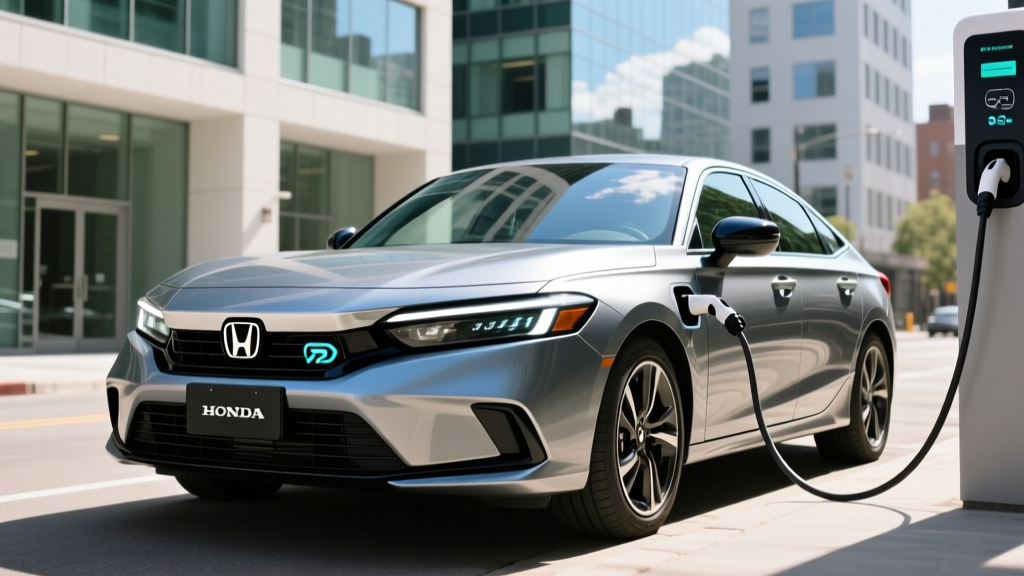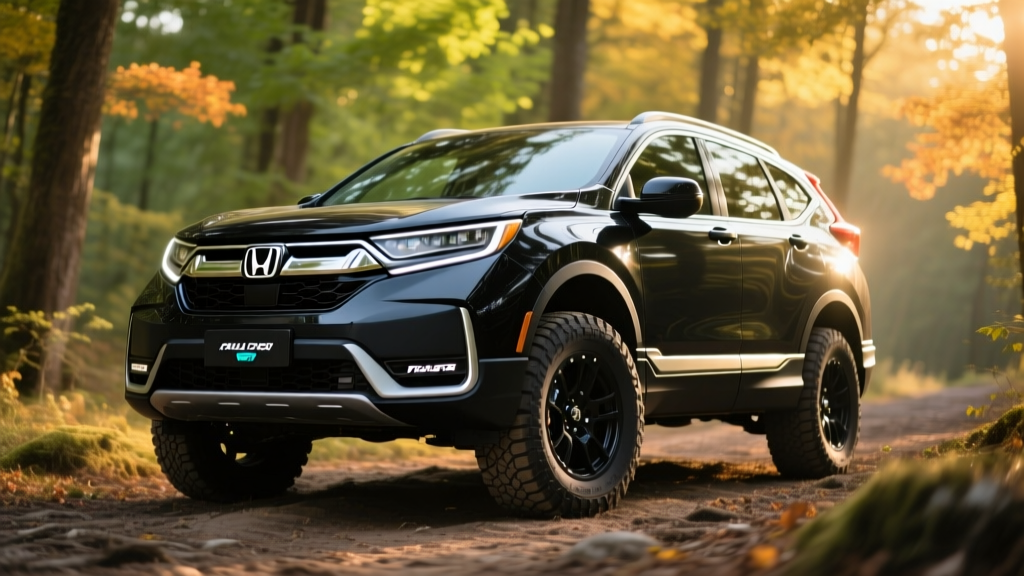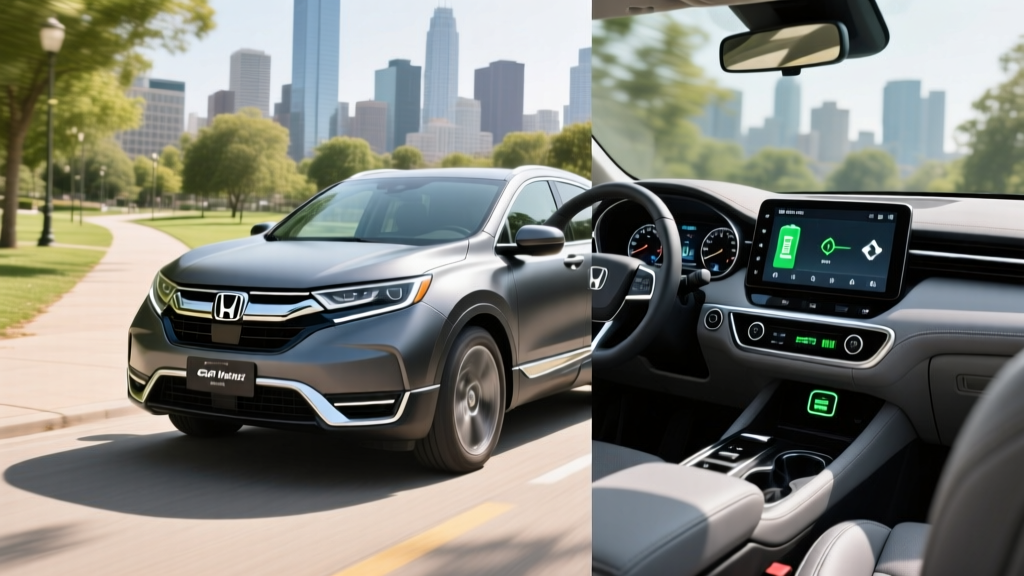
If you've been searching for 2025 Honda CR-V Hybrid images, you're likely weighing whether this compact SUV's electrified powertrain justifies its premium over the gas-only model. The CR-V Hybrid is Honda's volume play in the electrified family-SUV segment — a conventional hybrid (HEV) that requires no plug, delivers strong city fuel economy, and avoids the range or charging anxieties of a full battery-electric vehicle.
Below, we break down every spec that matters: EPA MPG, real-world efficiency, the two-motor hybrid powertrain, pricing by trim, battery warranty details, and how the CR-V Hybrid stacks up against both PHEVs and full EVs. Whether you're browsing configurator photos or researching on the dealer lot, this is your data-driven buyer's guide.
2025 Honda CR-V Hybrid Powertrain and Performance Specs
The 2025 CR-V Hybrid uses Honda's fourth-generation two-motor hybrid system, pairing a 2.0-liter Atkinson-cycle four-cylinder engine with two electric motors. Unlike some competitors that use a traditional geared transmission, Honda's system operates primarily as a series hybrid at low speeds (the engine acts as a generator) and switches to direct engine drive at highway cruising speeds.
| Specification | Value |
|---|---|
| Engine | 2.0L Atkinson-cycle I-4 |
| Combined System Horsepower | 204 hp |
| Combined System Torque | 247 lb-ft |
| Electric Motors | Dual-motor (propulsion + generator) |
| Transmission | Direct-drive (no traditional gearbox) |
| Drivetrain (Sport Touring) | AWD standard on Hybrid trims |
| 0–60 mph | ~7.6 seconds (est.) |
| Towing Capacity | 1,000 lbs |
The 204 combined horsepower is competitive with the Toyota RAV4 Hybrid (219 hp) and slightly ahead of the Hyundai Tucson Hybrid (226 hp in its latest iteration). Where Honda differentiates is in low-end electric torque — the propulsion motor delivers strong initial acceleration that makes the CR-V Hybrid feel quicker in city driving than its 0–60 time suggests.
EPA Fuel Economy: How Many MPG Does the CR-V Hybrid Get?
This is the number most buyers care about. According to fueleconomy.gov, the 2025 Honda CR-V Hybrid AWD earns the following EPA estimates:
| Driving Cycle | EPA MPG |
|---|---|
| City | 40 MPG |
| Highway | 34 MPG |
| Combined | 37 MPG |
Note that the FWD Hybrid variant (available on the Sport trim) bumps the combined figure to approximately 40 MPG, with city driving rated at 43 MPG — making it one of the most efficient non-plug-in compact SUVs available.
Real-World MPG vs. EPA Estimates
Conventional hybrids like the CR-V often exceed their EPA city rating in real-world stop-and-go driving, because the electric motor handles low-speed propulsion where regenerative braking recaptures the most energy. In mixed suburban commuting, owners frequently report 38–42 MPG in the AWD model and 41–45 MPG in FWD.
Highway efficiency is a different story. At sustained 70–80 mph speeds, the engine operates under direct drive with less electric assist, and real-world highway MPG typically drops to 30–33 MPG — slightly below the EPA highway sticker. Cold weather (below 40°F) can reduce overall efficiency by 5–10% as the engine runs more frequently to provide cabin heat.
Hybrid (HEV) vs. Plug-In Hybrid (PHEV) — What's the Difference?
A common source of confusion: the CR-V Hybrid is a conventional hybrid (HEV), not a plug-in hybrid (PHEV). Honda does not currently offer a CR-V PHEV in the US market (though a plug-in variant exists in China and Europe). Here's what that means for you:
| Feature | Conventional Hybrid (HEV) | Plug-In Hybrid (PHEV) |
|---|---|---|
| Plug-in charging | No — refuels at gas station only | Yes — plugs into Level 1 or Level 2 |
| Electric-only range | None (EV assist only at low speeds) | Typically 25–45 miles |
| Battery size | ~1.0–1.5 kWh (small buffer) | ~13–20 kWh |
| DC fast charging | No | Rarely — most PHEVs are Level 2 only |
| Federal tax credit | Not eligible | Up to $7,500 (if §30D criteria met) |
| Example | Honda CR-V Hybrid | Toyota RAV4 Prime, Hyundai Tucson PHEV |
If you want electric-only commuting with a gas backup, a PHEV like the RAV4 Prime (42 miles EV range) or Tucson PHEV (33 miles EV range) is worth considering — but expect a higher purchase price and the need for home charging to capture the benefit.
2025 CR-V Hybrid Pricing and Tax Credit Eligibility
The 2025 CR-V Hybrid is offered across three trims, with AWD standard on the Sport Touring and available on the Sport:
| Trim | Drivetrain | Starting MSRP |
|---|---|---|
| Sport | FWD | ~$34,950 |
| Sport | AWD | ~$36,450 |
| Sport-L | AWD | ~$38,500 |
| Sport Touring | AWD | ~$41,350 |
Does the CR-V Hybrid Qualify for a Federal Tax Credit?
No. The federal §30D Clean Vehicle Credit applies only to plug-in electric vehicles (BEVs and PHEVs) with sufficient battery capacity. Since the CR-V Hybrid is a conventional HEV with a small battery that cannot be plugged in, it does not qualify for the federal EV tax credit or the point-of-sale transfer option. Some states offer their own hybrid incentives — check your state energy office for current programs.
For buyers who want the tax credit, the fully electric Honda Prologue (a BEV SUV) may be eligible depending on your income, the vehicle's MSRP cap compliance, and battery sourcing requirements under current IRS §30D rules. Always consult a tax professional before assuming eligibility.
Battery Warranty, Reliability, and Replacement Cost
Hybrid battery longevity is the top concern for first-time hybrid buyers — and it's largely a solved problem in 2025. Honda's hybrid system uses a lithium-ion battery pack that is substantially smaller and less stressed than a full EV battery, contributing to excellent long-term durability.
What Does a Replacement Cost?
If the hybrid battery fails outside of warranty, replacement costs typically range from $2,000 to $4,000 including parts and labor at a Honda dealer. However, real-world failure rates for modern Honda hybrid batteries are very low. The smaller battery size means less thermal stress, and Honda's battery management system keeps the cells within a conservative state-of-charge window, further extending lifespan.
According to long-term ownership data and IIHS safety ratings, the CR-V platform continues to earn top marks for reliability and crashworthiness, and the hybrid variant has proven equally dependable in fleet and consumer reports.
Who Should Choose the CR-V Hybrid vs. an EV or Gas SUV?
The CR-V Hybrid occupies a specific sweet spot. Here's a practical decision framework:
Choose the CR-V Hybrid if:
- You want better fuel economy without changing your fueling habits (no plug, no charger install)
- Your driving is primarily suburban/city, where hybrid efficiency shines
- You live in an apartment or lack access to home charging
- You want a lower purchase price than a PHEV or BEV
- You plan to keep the vehicle 8+ years and value proven reliability
Choose a PHEV (RAV4 Prime, Tucson PHEV) if:
- You can charge at home and want 30–42 miles of electric-only commuting
- You want to qualify for a federal tax credit (up to $7,500, income/MSRP permitting)
- You're willing to pay a $5,000–$10,000 premium for plug-in capability
Choose a full EV (Honda Prologue, Tesla Model Y, Hyundai Ioniq 5) if:
- You have reliable home Level 2 charging
- Your daily driving is under 250 miles and you road-trip infrequently
- You want zero tailpipe emissions and the lowest per-mile fuel cost
- You want maximum tax credit eligibility
Pros and Cons at a Glance
- 40 MPG city (FWD) — class-leading efficiency
- No plug required — zero lifestyle change
- 204 hp with strong low-end electric torque
- AWD standard on Sport Touring
- 8–10 year hybrid battery warranty
- Spacious interior with 36.3 cu ft cargo (rear seats up)
- No federal tax credit (HEV, not PHEV/BEV)
- Highway MPG drops below EPA in real-world testing
- 1,000-lb towing limit (gas model tows 1,500 lbs)
- No plug-in option in US market
- Sport Touring trim pushes $42K+ with options
- Engine drone under hard acceleration (CVT-like effect)
Frequently Asked Questions
How many MPG does the 2025 Honda CR-V Hybrid actually get?
The EPA rates the AWD model at 40 city / 34 highway / 37 combined MPG. The FWD Sport trim achieves up to 43 city / 36 highway / 40 combined. In real-world suburban driving, many owners report exceeding the EPA city figure thanks to regenerative braking, while highway MPG at 75+ mph tends to run 30–33 MPG.
Does the CR-V Hybrid need to be plugged in?
No. The CR-V Hybrid is a conventional hybrid (HEV). It charges its small battery through regenerative braking and the gasoline engine. You refuel it exclusively at a gas station — there is no plug, no charging cable, and no home charger required.
Is there a plug-in hybrid (PHEV) version of the CR-V?
Not in the United States for 2025. Honda sells a CR-V e:PHEV in China and Europe with roughly 40–50 miles of electric-only range, but it has not been confirmed for the US market. If you need a plug-in compact SUV, the Toyota RAV4 Prime and Hyundai Tucson PHEV are the closest competitors.
How long will the CR-V Hybrid battery last, and what does replacement cost?
Honda covers the hybrid battery for 8 years/100,000 miles (10 years/150,000 miles in CARB states). Modern Honda hybrid batteries have very low failure rates. Out-of-warranty replacement runs approximately $2,000–$4,000 at a dealership, though most batteries last well beyond 150,000 miles with normal use.
Does the 2025 CR-V Hybrid qualify for any tax credit?
The CR-V Hybrid does not qualify for the federal §30D Clean Vehicle Credit, which is limited to plug-in vehicles (BEVs and PHEVs). Some states may offer separate hybrid incentives — check your state's energy or environmental agency website for current programs.
CR-V Hybrid vs. RAV4 Hybrid — which is more efficient?
The Toyota RAV4 Hybrid AWD is EPA-rated at 41 MPG combined, slightly ahead of the CR-V Hybrid AWD's 37 MPG combined. However, the CR-V Hybrid FWD (40 MPG combined) is competitive with the RAV4 Hybrid FWD. The RAV4 Prime PHEV offers 42 miles of electric range if you can plug in at home.