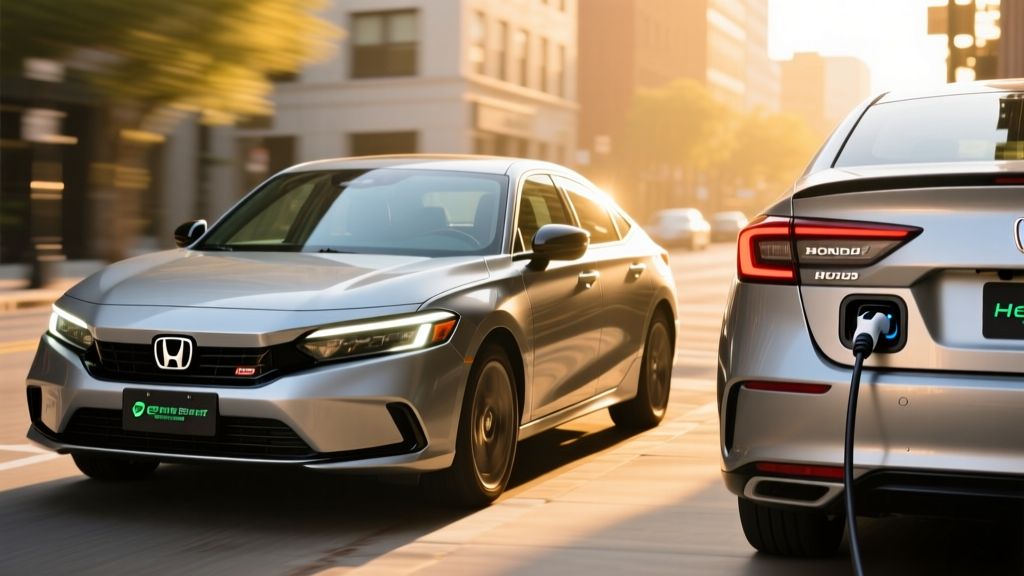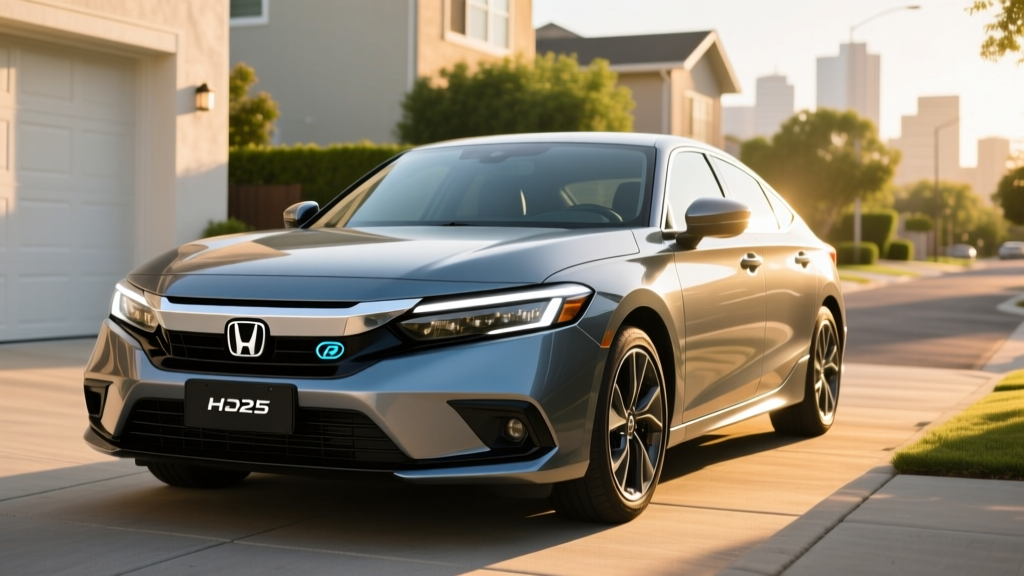
The 2025 Honda Civic Sedan Hybrid is one of the most fuel-efficient compact sedans on the market, combining a 2.0-liter Atkinson-cycle engine with a two-motor hybrid system to deliver an EPA-rated 50 MPG combined. Unlike a plug-in hybrid (PHEV) or a full battery-electric vehicle (BEV), the Civic Hybrid is a conventional hybrid (HEV) — meaning it never needs to be plugged in. It generates all its electricity from regenerative braking and the gasoline engine.
This guide covers everything buyers need to know: exact EPA and real-world fuel economy, the powertrain behind those numbers, battery longevity and warranty, pricing, tax credit eligibility, and how the Civic Hybrid stacks up against PHEVs and EVs for different driving lifestyles.
Fuel Economy: EPA Ratings and Real-World MPG
The headline number for the 2025 Civic Sedan Hybrid is its exceptional efficiency. Honda's two-motor hybrid system is optimized for city driving, where regenerative braking and electric-only low-speed operation deliver outsized gains over a gasoline-only car.
| Trim | City MPG | Highway MPG | Combined MPG |
|---|---|---|---|
| Sport Hybrid | 50 | 47 | 49 |
| Sport Touring Hybrid | 50 | 45 | 48 |
Source: EPA / fueleconomy.gov
The Sport Touring trim loses 1–2 MPG compared to the Sport due to heavier equipment (leather seats, Bose audio, additional sound insulation) and wider 18-inch wheels. For maximum efficiency, the Sport trim is the pick.
Powertrain Specs: Two-Motor Hybrid System
The 2025 Civic Hybrid uses Honda's fourth-generation two-motor hybrid system. This is a series-parallel hybrid — the car can operate in pure electric mode at low speeds, engine-direct-drive mode at highway cruising, or a blended mode under hard acceleration.
| Specification | Detail |
|---|---|
| Engine | 2.0L DOHC 4-cylinder (Atkinson cycle) |
| Engine Power | 143 hp @ 6,000 rpm / 134 lb-ft torque |
| Drive Motor Output | 184 hp / 232 lb-ft torque |
| Combined System Output | 200 hp / 232 lb-ft torque |
| Transmission | e-CVT (no traditional gears) |
| Drivetrain | Front-wheel drive |
| 0–60 mph | ~7.2 seconds (est.) |
| Hybrid Battery | Lithium-ion, ~1.1 kWh (non-plug-in) |
| Fuel Tank | 12.4 gallons |
| Total Driving Range | ~607 miles (EPA combined) |
The 200 combined horsepower makes the Civic Hybrid meaningfully quicker than the non-hybrid 2.0L Civic (158 hp) and gives it confident highway passing power. The electric drive motor delivers its 232 lb-ft of torque instantly from a stop, which is why the Civic Hybrid feels punchy in city driving despite its efficiency focus.
HEV vs PHEV vs EV: Which Powertrain Fits You?
The Civic Sedan Hybrid is a conventional hybrid (HEV). It's important to understand how it differs from plug-in hybrids and full EVs, because the right choice depends entirely on your charging access and driving patterns.
| Factor | HEV (Civic Hybrid) | PHEV (e.g., Toyota Prius Prime) | BEV (e.g., Tesla Model 3) |
|---|---|---|---|
| Plug-in Required? | No — gas only | Yes, for EV range | Yes, always |
| Electric-Only Range | ~1 mile at low speed | 25–44 miles | 250–360 miles |
| Total Range | ~607 miles | 400–600+ miles | 250–360 miles |
| Home Charging Needed? | No | Recommended (Level 1 or 2) | Essential (Level 2) |
| Federal Tax Credit | No (§30D is BEV/PHEV only) | Up to $7,500 (if eligible) | Up to $7,500 (if eligible) |
| Best For | No home charging; long commutes; simplicity | Short commutes + home charging + road trips | Home charging access; mostly daily driving under 300 mi |
The Civic Hybrid is the right call if: you don't have access to home or workplace charging, you drive long distances regularly and don't want to plan around charging stops, or you simply want maximum fuel savings with zero lifestyle change. It's also the lowest up-front cost option of the three.
Consider a PHEV instead if: you have a garage or driveway where you can install a 120V or 240V outlet, your daily commute is under 40 miles round-trip, and you want EV-like daily driving with a gas engine for road trips.
Consider a full EV instead if: you have reliable home Level 2 charging, your daily driving is under 250 miles, you want to eliminate gasoline entirely, and you want access to the $7,500 federal tax credit (subject to eligibility).
Pricing, Trims, and Tax Credit Eligibility
The 2025 Honda Civic Sedan Hybrid is available in two trims:
| Trim | MSRP | Key Features |
|---|---|---|
| Sport Hybrid | $29,845 | 18" wheels, sport pedals, heated front seats, 7" display, wireless CarPlay/Android Auto |
| Sport Touring Hybrid | $32,845 | Leather seats, Bose 12-speaker audio, 9" touchscreen, wireless charging, Honda Sensing suite, navigation |
Prices include destination charge. Source: Honda.com
The IRS §30D Clean Vehicle Credit applies only to plug-in electric vehicles (BEVs and PHEVs) with a minimum battery capacity of 7 kWh and plug-in charging capability. The Civic Sedan Hybrid is a conventional HEV with a ~1.1 kWh battery that cannot be plugged in. It does not qualify for any federal EV tax credit.
- §30D credit: $0 (vehicle does not meet plug-in requirement)
- State/local incentives: Some states offer rebates for hybrids — check your state energy office or AFDC state incentive database
- Previously owned clean vehicle credit (§25E): Does not apply to HEVs
While the lack of a federal tax credit is a disadvantage compared to qualifying PHEVs and BEVs, the Civic Hybrid's lower base price (~$29,845 vs. $33,000–$40,000+ for most plug-in alternatives) partially offsets this gap. Over five years of ownership, the fuel savings alone versus a gas-only Civic (EPA 35 MPG combined) total roughly $1,800–$2,400 at current fuel prices.
Battery Warranty, Longevity, and Replacement Cost
Hybrid battery lifespan is consistently the top concern for hybrid buyers. Honda's track record here is strong — the company has been producing hybrids since the 1999 Insight, and its lithium-ion hybrid batteries have demonstrated excellent longevity in real-world use.
- Duration: 8 years / 100,000 miles (whichever comes first)
- Coverage: Defects and capacity loss below functional threshold
- CARB States: 10 years / 150,000 miles in states that follow California Air Resources Board emissions standards (CA, CO, CT, DE, ME, MD, MA, MN, NV, NJ, NY, OR, RI, VT, VA, WA)
- Powertrain Warranty: 5 years / 60,000 miles (covers engine, e-CVT, hybrid control units)
In practice, Honda hybrid batteries routinely last well beyond the warranty period. Third-generation Civic and Accord hybrids from 2012–2015 are still running on original batteries at 150,000+ miles in many cases. The lithium-ion cells in the 2025 model are more durable and energy-dense than the older nickel-metal-hydride packs.
If replacement is needed out of warranty, a Honda hybrid battery pack typically costs $2,000–$4,000 for the part, with labor adding $500–$1,000. Independent hybrid specialists often offer refurbished packs for $1,500–$2,500 installed. This is dramatically less than a full EV battery replacement ($8,000–$20,000+), reflecting the Civic Hybrid's much smaller ~1.1 kWh pack.
Driving Impressions and Practicality
The 2025 Civic Hybrid drives like a normal Civic — which is to say, it's one of the better-handling compact sedans available. The hybrid system adds roughly 180 pounds over the gas model, mostly over the rear axle where the battery is mounted, which actually improves weight distribution slightly.
The e-CVT operation is smooth and unobtrusive. Unlike early Honda hybrids (the first-generation Insight and CR-Z), the fourth-generation system rarely produces the "rubber band" drone associated with CVTs. Under moderate acceleration, the electric motor does most of the work, and the engine engages via a lock-up clutch at highway speeds for direct mechanical drive — bypassing the CVT effect entirely.
Cargo space is unchanged from the gas Civic sedan at 14.8 cubic feet, because the hybrid battery is packaged under the rear seats rather than intruding into the trunk. Rear seat space is also identical, with 37.4 inches of legroom.
Who Should Buy the 2025 Civic Sedan Hybrid?
Pros
- 49–50 MPG EPA combined; real-world often higher in city driving
- 200 hp — quicker than the gas Civic, confident highway merging
- No plug-in required; zero lifestyle change from a gas car
- 607-mile total range — fewer fill-ups, great for road trips
- Strong battery warranty (8 yr/100k mi; 10 yr/150k mi in CARB states)
- Honda Sensing safety suite standard on all trims
- Competitive pricing starting under $30,000
Cons
- No federal tax credit (HEVs excluded from §30D)
- No electric-only driving beyond very low-speed creep
- FWD only — no AWD option (the Toyota Prius offers AWD)
- Sport Touring at $32,845 approaches PHEV territory
- 12.4-gallon tank means more frequent stops than some competitors on long trips
- Choose the Civic Hybrid if: you want 50 MPG without plugging in, you lack home charging access, your budget is under $33,000, or you drive 15,000+ miles per year and want to minimize fuel costs.
- Choose a PHEV (Prius Prime, etc.) if: you have home charging, your daily commute is under 40 miles, and you want to drive mostly on electricity while keeping a gas backup.
- Choose a full EV (Model 3, Ioniq 6, etc.) if: you have Level 2 home charging, want zero tailpipe emissions, and qualify for the $7,500 federal tax credit.
Frequently Asked Questions
How many MPG does the 2025 Honda Civic Sedan Hybrid get?
The Sport Hybrid trim is EPA-rated at 50 city / 47 highway / 49 combined MPG. The Sport Touring Hybrid is rated at 50 city / 45 highway / 48 combined. In real-world city-dominant driving, many owners report 50–53 MPG. Sustained highway driving at higher speeds drops efficiency to roughly 42–45 MPG.
Does the Civic Hybrid need to be plugged in?
No. The 2025 Civic Sedan Hybrid is a conventional hybrid (HEV), not a plug-in hybrid (PHEV). It charges its small lithium-ion battery entirely through regenerative braking and the gasoline engine. You fuel it exactly like a regular gas car.
How far can the Civic Hybrid drive on electric power alone?
Effectively about one mile at very low speeds (under 25 mph) in stop-and-go traffic. The ~1.1 kWh battery is too small for meaningful electric-only range. If you want 25–40+ miles of electric-only driving, you need a plug-in hybrid (PHEV) like the Toyota Prius Prime.
Is the 2025 Civic Hybrid reliable, and what does battery replacement cost?
Honda's hybrid systems have a strong reliability record spanning over two decades. The hybrid battery is covered by an 8-year/100,000-mile warranty (10 years/150,000 miles in CARB states). Out-of-warranty battery replacement typically costs $2,000–$4,000 for a new pack or $1,500–$2,500 for a refurbished unit installed at an independent hybrid specialist.
Does the 2025 Civic Hybrid qualify for any tax credit?
It does not qualify for the federal §30D Clean Vehicle Credit, which requires plug-in capability and a minimum 7 kWh battery. The Civic Hybrid's ~1.1 kWh non-plug-in battery does not meet these requirements. Some states may offer separate hybrid incentives — check the AFDC state incentive database for your location.
How does the Civic Hybrid compare to the Toyota Prius?
The 2025 Toyota Prius (LE trim) is EPA-rated at 57 MPG combined — significantly higher than the Civic Hybrid's 49 MPG. However, the Prius starts at a similar price point and offers an available AWD powertrain. The Civic Hybrid counters with a more refined driving experience, a roomier rear seat, and a more conventional sedan design. If pure MPG is your priority, the Prius wins. If driving dynamics and interior quality matter more, the Civic Hybrid is the stronger pick.
What is the total driving range of the 2025 Civic Hybrid?
With its 12.4-gallon fuel tank and 49 MPG combined EPA rating, the Civic Hybrid delivers approximately 607 miles of total range. In real-world mixed driving at 50+ MPG, some drivers will see 620+ miles between fill-ups.