Quick Verdict: The Sweet Spot Between Gas and Electric
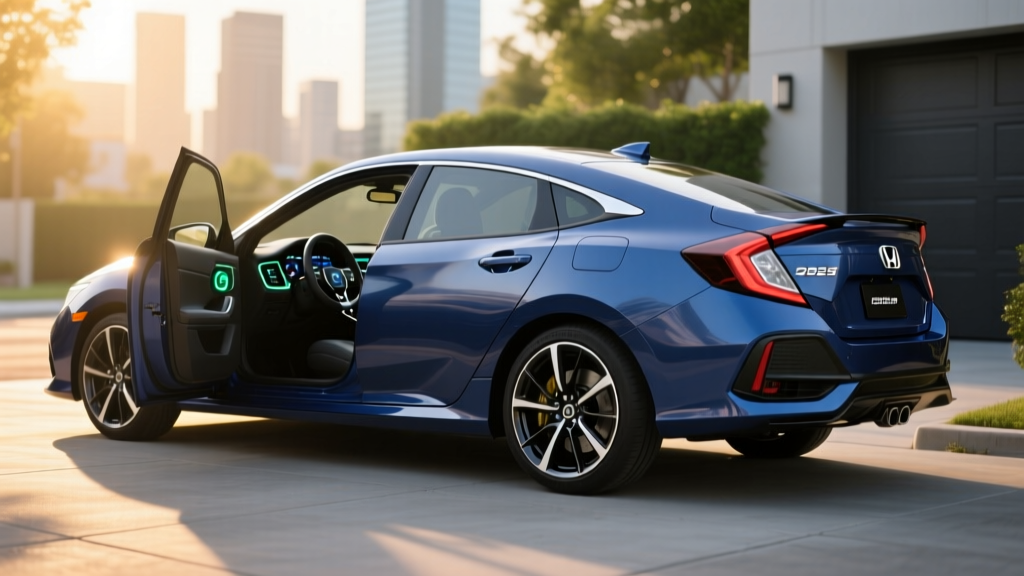
The 2025 Honda Civic Hybrid Sport occupies a precise niche: it delivers near-50 MPG without requiring you to plug in, change your habits, or worry about charging infrastructure. Honda's two-motor hybrid system pairs a 2.0-liter Atkinson-cycle engine with two electric motors for a combined 200 horsepower — enough to make this genuinely quick off the line while sipping fuel at a rate that embarrasses most compact sedans.
This is a conventional hybrid (HEV), not a plug-in hybrid (PHEV). You never plug it in. The battery recharges through regenerative braking and the gasoline engine. If you want electric-only driving, you'll need to look elsewhere — but if you want maximum efficiency with zero lifestyle change, the Civic Hybrid Sport is one of the strongest options on the market.
HEV vs PHEV: What the Civic Hybrid Actually Is
Honda does not offer a plug-in hybrid version of the Civic in the US market. The Civic Hybrid is strictly a conventional hybrid electric vehicle (HEV). Here's the functional difference:
| Feature | Civic Hybrid (HEV) | Plug-In Hybrid (PHEV) — e.g., Toyota Prius Prime |
|---|---|---|
| Plugs in to charge? | No — self-charging via regen + engine | Yes — has a larger battery you plug in |
| Electric-only range | ~1 mile at low speed | 25–44 miles typical |
| Battery size | ~1.0 kWh (small buffer) | 10–14 kWh typical |
| Fuel economy when battery depleted | 49 MPG combined (always) | 43–48 MPG combined (gas-only mode) |
| Requires home charging access? | No | Yes, to realize full value |
| Federal tax credit (§30D)? | No | Up to $7,500 (if eligible) |
The Civic Hybrid's small lithium-ion battery (approximately 1.0 kWh) acts as a buffer. It captures energy from braking and coasting, then deploys it for electric motor assist during acceleration. The system seamlessly switches between engine-only, motor-only, and combined operation — you'll never need to think about it.
Fuel Economy: EPA Ratings vs Real-World MPG
The EPA rates the 2025 Civic Hybrid Sport at 50 city / 47 highway / 49 combined MPG. These numbers come from fueleconomy.gov, the official EPA database.
| Driving Condition | EPA Estimate | Real-World Expectation |
|---|---|---|
| City | 50 MPG | 50–55 MPG (hybrids often beat EPA in stop-and-go) |
| Highway (70 mph) | 47 MPG | 42–46 MPG (sustained speed favors gas engines) |
| Combined | 49 MPG | 46–52 MPG depending on driving mix |
| Cold weather (below 30°F) | — | 40–44 MPG (engine runs more for cabin heat) |
Real-world insight: Honda's two-motor system excels in city driving, where the electric motor handles low-speed propulsion and the engine only kicks in as a generator. Owners who commute in stop-and-go traffic frequently report exceeding the EPA city estimate. Highway driving at 75–80 mph will drop efficiency noticeably — the engine does more direct work and aerodynamic drag increases. In cold weather, expect a 10–15% MPG reduction because the engine must run to provide cabin heat (there's no heat pump on the HEV).
Powertrain Specs: 200 HP From a Hybrid
Honda's fourth-generation two-motor hybrid system is the heart of this car. Here's the complete breakdown:
| Specification | 2025 Civic Hybrid Sport |
|---|---|
| Engine | 2.0L DOHC Atkinson-cycle 4-cylinder |
| Engine output | 145 hp @ 6,000 rpm / 134 lb-ft torque |
| Electric motors | Two-motor system (drive + generator) |
| Drive motor output | 184 hp / 232 lb-ft torque |
| Combined system output | 200 hp / 232 lb-ft torque |
| Transmission | e-CVT (no traditional gears — motor-driven) |
| Drivetrain | Front-wheel drive |
| 0–60 mph | ~6.5 seconds (est.) |
| Battery type | Lithium-ion, ~1.0 kWh |
| Battery location | Under rear seats (no cargo compromise) |
| Fuel tank | 10.6 gallons |
| EPA MPG (city/hwy/combined) | 50 / 47 / 49 |
| Base MSRP (Sport trim) | $30,650 (incl. $1,095 destination) |
The key engineering detail: in most driving scenarios below 50 mph, the engine doesn't directly drive the wheels. Instead, it acts as a generator powering the drive motor. Only at sustained highway speeds does a lock-up clutch connect the engine directly to the wheels for efficiency. This means acceleration feels linear and electric — more like an EV than a traditional hybrid with a rubber-band CVT.
The Sport trim adds paddle shifters that adjust regen intensity across four levels, letting you approximate one-pedal driving in city traffic without fully committing to it.
Pricing, Trims, and Tax Credit Eligibility
The 2025 Civic Hybrid is offered in two trims:
- Sport: $30,650 MSRP (includes destination)
- Sport Touring: $33,650 MSRP (adds leather, Bose audio, wireless CarPlay/Android Auto, Honda Sensing upgrades)
- The §30D New Clean Vehicle Credit applies only to plug-in electric vehicles (BEVs and PHEVs) with batteries ≥7 kWh
- The Civic Hybrid's ~1.0 kWh battery does not qualify
- No federal purchase incentive applies to conventional hybrids (HEVs)
- Some states offer hybrid rebates — check your state energy office or AFDC state incentive database
While the lack of a federal tax credit stings compared to a PHEV like the Toyota Prius Prime (which can qualify for up to $3,750 under current IRS §30D rules), the Civic Hybrid's lower base price partially offsets the gap. The price delta between the Civic Hybrid Sport and a comparably equipped Prius Prime is narrow once you factor in the Prius's higher MSRP against its tax credit.
Battery Warranty, Reliability, and Replacement Cost
Hybrid battery longevity is the top concern for first-time hybrid buyers. Honda addresses this with strong warranty coverage:
- 8 years / 100,000 miles (standard in most states)
- 10 years / 150,000 miles in CARB states (CA, CT, ME, MA, NJ, NY, OR, RI, VT, WA, CO, and others adopting California emissions standards)
- Covers battery capacity loss below a functional threshold and any hybrid system component failure
- Transferable to subsequent owners
Replacement cost if out of warranty: A Civic Hybrid battery replacement runs approximately $2,000–$3,500 including labor at a Honda dealer. Independent hybrid specialists may offer refurbished batteries for $1,500–$2,500. Given Honda's hybrid track record — the company has been refining this system since the 2000 Insight — catastrophic battery failure before 150,000 miles is uncommon.
For context, Honda's hybrid components (power control unit, drive motor, generator) are also covered under the hybrid system warranty. The conventional 3-year/36,000-mile bumper-to-bumper and 5-year/60,000-mile powertrain warranties apply to the rest of the vehicle.
Reliability data: Honda's two-motor hybrid system has proven durable across the Accord Hybrid and CR-V Hybrid lineups. The Civic Hybrid uses an evolution of this proven architecture. Early long-term tests and owner reports suggest no systemic issues. The e-CVT design (which has no belts, pulleys, or traditional gears) eliminates a common failure point found in conventional automatic transmissions.
Who Should Choose the Civic Hybrid vs a Full EV or PHEV?
- You can't charge at home (apartment, street parking, no garage outlet)
- You drive 30–60 miles/day in mixed city/highway commuting
- You want 49 MPG without thinking about charging, range, or plugs
- You take road trips regularly and don't want to plan around DC fast chargers
- You want a sub-$31,000 efficient sedan with strong resale value
- You have home Level 2 charging and a short commute (<30 miles)
- You want to drive most days on electricity but keep gas for road trips
- You qualify for the §30D tax credit and want to offset a higher MSRP
- You have reliable home charging
- You want zero tailpipe emissions and minimal maintenance
- You qualify for the full $7,500 federal credit
- Your daily driving is under 250 miles and you're comfortable with public DC charging for road trips
The Civic Hybrid Sport is fundamentally a no-compromise efficiency play. It asks nothing of you — no plugs, no apps, no charging planning, no range calculations. You drive it exactly like a gas car, and it returns nearly 50 MPG. For buyers who aren't ready for the infrastructure requirements of a PHEV or BEV, or who live in charging-desert regions, this is the rational choice.
- 49 MPG combined — top-tier for a non-plug-in sedan
- 200 hp makes it genuinely quick for a hybrid
- No plug-in required — zero lifestyle change
- 500+ mile range per tank
- Battery under rear seat preserves full trunk space (14.8 cu ft)
- Strong hybrid battery warranty (8–10 years)
- Honda Sensing safety suite standard
- No federal tax credit (HEV ineligible for §30D)
- No electric-only driving mode (unlike PHEV)
- Highway MPG drops at 75+ mph
- Sport trim cloth seats — leather requires Sport Touring ($33,650)
- No all-wheel-drive option (FWD only)
- Regen paddle feel takes adjustment
Frequently Asked Questions
How many MPG does the 2025 Honda Civic Hybrid Sport get?
The EPA rates it at 50 city / 47 highway / 49 combined MPG. In real-world city-heavy driving, many owners report 50–55 MPG. Highway driving at sustained 70–80 mph typically yields 42–46 MPG. Cold weather reduces efficiency by roughly 10–15%.
Does the Civic Hybrid need to be plugged in?
No. The Civic Hybrid is a conventional HEV. Its small lithium-ion battery charges automatically through regenerative braking and the gasoline engine. You fuel it like any other car — there is no plug, no charging cable, and no charging port.
How far can the Civic Hybrid drive on electric only?
Approximately 1 mile at very low speeds (under 25 mph) in EV mode. This is not a meaningful electric-only range. The system uses electric assist to improve efficiency, not to replace the engine. If you want 25–44 miles of electric-only driving, you need a PHEV like the Toyota Prius Prime.
Is the hybrid battery reliable and what does replacement cost?
Honda covers the hybrid battery for 8 years/100,000 miles (10 years/150,000 miles in CARB states). Out-of-warranty replacement costs approximately $2,000–$3,500 at a dealer. Honda's hybrid systems have a strong reliability track record across multiple model lines, and premature battery failure is uncommon.
Does the 2025 Civic Hybrid qualify for any tax credit?
It does not qualify for the federal §30D New Clean Vehicle Credit, which requires a plug-in vehicle with a battery capacity of at least 7 kWh. The Civic Hybrid's ~1.0 kWh battery makes it ineligible. Some states may offer separate hybrid incentives — check the AFDC state laws database for your location.
How does the Civic Hybrid compare to the Toyota Prius?
The Prius (57 MPG combined, FWD LE) beats the Civic Hybrid on pure fuel economy by about 8 MPG. However, the Civic Hybrid offers 200 hp vs the Prius's 194 hp, a more traditional sedan design, and Honda's interior quality. The Prius also offers AWD (54 MPG) and a PHEV variant (Prius Prime, 44 miles electric-only). If maximum MPG is your only priority, the Prius wins. If you want a sportier driving experience with nearly equivalent efficiency, the Civic Hybrid Sport is the stronger pick.
What's the difference between the Sport and Sport Touring trims?
The Sport ($30,650) includes cloth seats, 7-inch touchscreen, wired Apple CarPlay/Android Auto, Honda Sensing suite, and 18-inch alloy wheels. The Sport Touring ($33,650) adds leather-trimmed seats, 9-inch touchscreen, wireless CarPlay/Android Auto, 12-speaker Bose audio, wireless phone charging, and heated front seats. Both share the identical hybrid powertrain and 49 MPG rating.