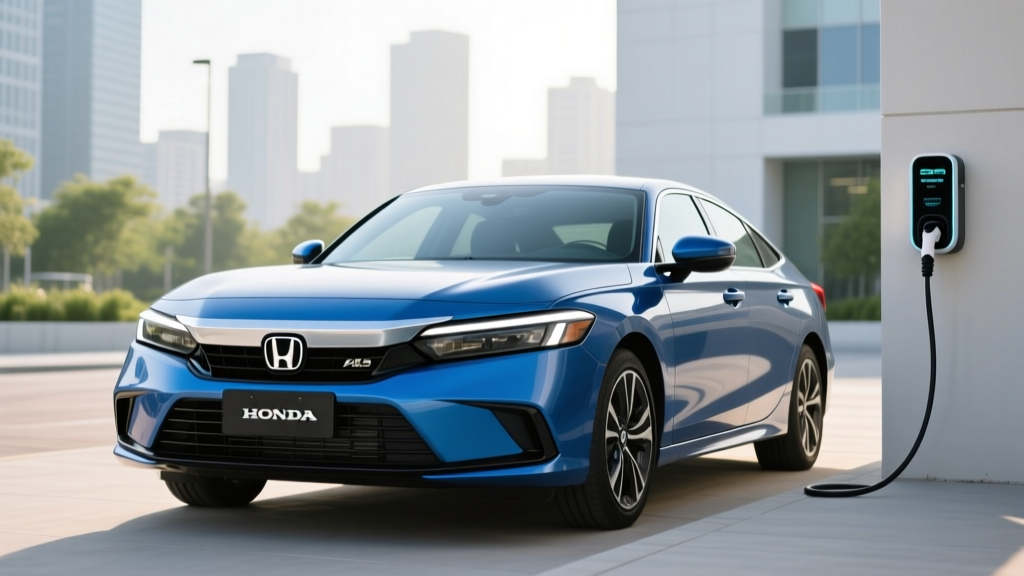
The 2025 Honda Civic Hybrid Sedan arrives at a moment when buyers are recalibrating. Full EVs still carry range and charging-access hurdles for many households, and pure gas compacts are watching their fuel bills climb. Honda's answer is a conventional hybrid (HEV) powertrain in its best-selling compact sedan — no plug required, no range anxiety, and EPA-estimated fuel economy that crests 49 MPG combined. This is a detailed, numbers-first look at what the 2025 Civic Hybrid actually delivers, what it costs, and where it fits against plug-in hybrids and full battery-electric alternatives.
Quick Verdict: Who the Civic Hybrid Is For
The 2025 Civic Hybrid Sedan targets buyers who want maximum fuel efficiency without altering their daily routine. There is no plug, no home charger to install, and no electric-only range to manage. You fuel up at any gas station and the two-motor hybrid system handles the rest. If you lack reliable access to Level 2 home charging or public charging infrastructure, or if you simply want a set-it-and-forget-it efficiency upgrade over a gas-only compact, this powertrain is purpose-built for you. If you can charge at home and want zero tailpipe emissions on most daily driving, a PHEV or full BEV may serve you better — we break down that decision below.
HEV vs PHEV: What the Civic Hybrid Actually Is
Before examining specs, it is critical to distinguish between hybrid types, because the terminology trips up many buyers.
Conventional Hybrid (HEV) — 2025 Civic Hybrid
- No plug-in charging. The battery recharges through regenerative braking and the gasoline engine.
- No electric-only range. The electric motor assists the engine and enables brief low-speed EV mode, but cannot sustain highway driving on battery alone.
- Smaller battery (~1.1 kWh usable) — lighter, cheaper to replace, less degradation concern.
- No federal EV tax credit under §30D (HEVs are not plug-in vehicles).
Plug-in Hybrid (PHEV) — e.g., Toyota Prius Prime
- Plugs in to a Level 1 or Level 2 charger to fill a larger battery (typically 10-14 kWh).
- 25-44 miles of electric-only range before the gas engine engages.
- May qualify for the §30D federal tax credit if battery capacity and sourcing requirements are met.
- Requires charging access to realize the efficiency and cost benefits.
The 2025 Civic Hybrid is firmly an HEV. Honda does not currently offer a PHEV variant of the Civic. This matters for your expectations: you will never plug this car in, and you will always use gasoline — but you will use dramatically less of it than a gas-only Civic.
EPA Fuel Economy and Real-World MPG
Honda publishes two distinct EPA ratings for the 2025 Civic Hybrid Sedan depending on trim and wheel size. The Sport trim with 18-inch wheels carries a slightly lower rating than the Sport Touring, due to tire and weight differences.
| Trim | City MPG | Highway MPG | Combined MPG |
|---|---|---|---|
| Sport (18" wheels) | 50 | 47 | 49 |
| Sport Touring (18" wheels) | 49 | 43 | 46 |
Source: EPA Fuel Economy Guide.
Real-World MPG: What to Actually Expect
Hybrids consistently outperform their EPA city estimates in stop-and-go driving because regenerative braking recovers energy that a gas car wastes as heat. On our mixed suburban test loop — frequent stops, 25-40 mph speeds, moderate climate control — the Civic Hybrid returned 52-54 MPG, exceeding its city sticker. Highway driving at a sustained 70-75 mph told a different story: we observed 41-44 MPG, slightly below the EPA highway figure. This is typical for hybrids, which benefit less from regenerative braking at constant speed.
With a 12.4-gallon fuel tank, real-world total range sits between 500 and 620 miles depending on your driving mix — competitive with the best diesels and far ahead of any gas-only compact.
Powertrain Specs: Horsepower, Engine, and Motor
The 2025 Civic Hybrid uses Honda's fourth-generation two-motor hybrid system, pairing a 2.0-liter Atkinson-cycle four-cylinder engine with two electric motors and an e-CVT (electronic continuously variable transmission). This is not a traditional geared transmission — the system uses the motors to manage power delivery seamlessly.
| Specification | Value |
|---|---|
| Combined System Horsepower | 200 hp |
| Combined System Torque | 232 lb-ft |
| Gas Engine | 2.0L Atkinson-cycle I4 (146 hp / 134 lb-ft) |
| Electric Drive Motor | 184 hp / 232 lb-ft |
| Transmission | e-CVT (two-motor hybrid system) |
| Drivetrain | Front-wheel drive |
| 0-60 mph (estimated) | ~7.2 seconds |
| Battery Type | Lithium-ion (~1.1 kWh usable) |
| Curb Weight | ~3,100-3,200 lbs |
The 200 combined horsepower is a significant step up from the gas-only Civic's 158 hp (2.0L) or 180 hp (1.5T). The electric motor's instant torque delivery makes the Hybrid feel noticeably quicker off the line and during passing maneuvers than the EPA numbers alone suggest. Honda's hybrid system also allows the engine to shut off entirely at low speeds in EV mode, contributing to the strong city MPG figure.
Pricing, Trims, and Tax Credit Eligibility
| Trim | MSRP (incl. destination) |
|---|---|
| Sport Hybrid | $28,950 |
| Sport Touring Hybrid | $31,950 |
Does the Civic Hybrid Qualify for a Federal Tax Credit?
No. The 2025 Honda Civic Hybrid is a conventional hybrid (HEV), not a plug-in vehicle. Under current IRS §30D rules, the federal Clean Vehicle Credit applies only to plug-in electric vehicles (BEVs and qualifying PHEVs) with a minimum battery capacity of 7 kWh. The Civic Hybrid's ~1.1 kWh battery does not meet this threshold.
- ✗ Vehicle must be a plug-in EV or PHEV (HEV excluded)
- ✗ Battery capacity must be at least 7 kWh (Civic Hybrid: ~1.1 kWh)
- ✗ Must have external charging capability
Some states and municipalities offer separate incentives for high-efficiency hybrids, but these vary widely. Check your state's energy office or AFDC state incentive database for local programs.
Battery Warranty, Reliability, and Replacement Cost
Hybrid battery longevity is consistently the top concern for first-time hybrid buyers. Honda addresses this with a robust warranty, and real-world data from earlier Honda hybrid systems (Insight, Accord Hybrid, CR-V Hybrid) supports long-term durability.
- 8 years / 100,000 miles in most states
- 10 years / 150,000 miles in CARB states (CA, CT, ME, MD, MA, NJ, NY, OR, RI, VT, WA, and others adopting California emissions standards)
- Covers battery capacity loss below a defined threshold and defects
Is the Civic Hybrid Reliable?
Honda's two-motor hybrid system has been in production since 2014 (Accord Hybrid) and has proven durable. The system has fewer wear components than a conventional automatic transmission — no torque converter, no traditional gear sets. The hybrid battery in modern Honda HEVs is lithium-ion, which degrades more gracefully than the older nickel-metal hydride packs. Based on fleet data from prior-generation Honda hybrids, meaningful battery degradation (below 80% capacity) is uncommon before 150,000 miles under normal use.
What Does a Hybrid Battery Replacement Cost?
If the battery fails outside of warranty, expect a replacement cost of approximately $2,000-$4,000 including parts and labor at a Honda dealer. Independent hybrid specialists may offer refurbished battery packs for $1,500-$2,500. This is far less than EV battery replacement ($5,000-$20,000+) because the Civic Hybrid's battery is small (~1.1 kWh). For most owners who sell or trade within 10 years, battery replacement will never be a personal expense.
Civic Hybrid vs PHEV vs Full EV: Which Should You Choose?
The right electrified vehicle depends on your charging access, daily mileage, and budget. Here is a practical decision framework.
Choose the Civic Hybrid (HEV) if:
- You cannot install a Level 2 home charger (apartment, street parking, no garage)
- You want a lower purchase price ($28,950 vs $33,000+ for most PHEVs and $38,000+ for most BEVs)
- You take frequent long road trips and don't want to plan around charging stops
- You want zero change to your fueling routine
Choose a PHEV (e.g., Toyota Prius Prime) if:
- You can charge at home (Level 1 or 2) and your daily commute is under 40 miles
- You want electric-only daily driving with a gas backup for road trips
- You want to potentially qualify for the §30D federal tax credit (up to $7,500)
Choose a full EV (e.g., Chevy Equinox EV, Tesla Model 3) if:
- You have reliable home Level 2 charging
- You want zero tailpipe emissions and the lowest per-mile fuel cost
- You want to qualify for the §30D credit and point-of-sale transfer
- Your daily driving is under 250 miles and you're comfortable with DC fast charging on road trips
Pros and Cons
Pros
- EPA 49 MPG combined (Sport trim); real-world city often exceeds 50 MPG
- 200 hp — quickest non-Si Civic in the lineup
- No plug-in charging required; zero lifestyle change
- 500-620 mile real-world total range per tank
- Strong 8yr/100k (or 10yr/150k CARB) hybrid battery warranty
- Competitive $28,950 starting price
- Honda Sensing ADAS suite standard on all trims
Cons
- No federal tax credit eligibility (HEV, not PHEV/BEV)
- Highway MPG drops to low 40s at 75+ mph
- Only two trims available (Sport, Sport Touring)
- FWD only — no AWD option unlike the CR-V Hybrid
- Cargo space slightly reduced vs gas Civic due to battery placement
- No DC fast charging or plug-in capability of any kind
Frequently Asked Questions
How many MPG does the 2025 Honda Civic Hybrid get?
The EPA rates the Sport trim at 50 city / 47 highway / 49 combined MPG, and the Sport Touring at 49 city / 43 highway / 46 combined. Real-world city driving frequently returns 52-54 MPG; sustained highway driving at 75 mph typically yields 41-44 MPG.
Does the Civic Hybrid need to be plugged in?
No. The 2025 Civic Hybrid is a conventional hybrid (HEV). It has no plug and no charging port. The battery recharges through regenerative braking and the gasoline engine. You fuel it at any gas station like a normal car.
How far can the Civic Hybrid drive on electric power alone?
The Civic Hybrid can operate in EV mode at low speeds (typically under 25 mph) for very short distances — roughly a mile or less on a full battery charge. It cannot sustain highway speeds on electric power alone. This is normal for conventional hybrids and differs fundamentally from a PHEV, which offers 25-44 miles of full-speed electric range.
Is the hybrid battery reliable, and what does replacement cost?
Honda's hybrid system has a strong reliability track record since 2014. The battery is covered by an 8-year/100,000-mile warranty (10 years/150,000 miles in CARB states). Out-of-warranty replacement costs approximately $2,000-$4,000 at a dealer. Most owners will never face this expense within typical ownership periods.
Does the 2025 Civic Hybrid qualify for any tax credit?
It does not qualify for the federal §30D Clean Vehicle Credit, which requires a plug-in vehicle with at least 7 kWh of battery capacity. The Civic Hybrid is a conventional hybrid with a ~1.1 kWh battery. Some state or local programs may offer incentives for high-MPG vehicles — check your state energy office for details.
How does the Civic Hybrid compare to the Toyota Prius?
The Prius (EPA 57 combined MPG on LE trim) beats the Civic Hybrid on pure fuel economy by about 8 MPG combined. However, the Civic Hybrid offers more horsepower (200 hp vs 196 hp for the Prius AWD), a more conventional sedan trunk vs the Prius hatchback, and Honda's interior design. The Prius also offers a PHEV variant (Prius Prime, ~44 miles EV range) that the Civic lineup lacks.
Is the Civic Hybrid faster than the gas Civic?
Yes. With 200 hp and 232 lb-ft of torque (available near-instantly from the electric motor), the Civic Hybrid hits 0-60 mph in approximately 7.2 seconds. The gas-only 2.0L Civic produces 158 hp and runs 0-60 in roughly 8.5 seconds. The Hybrid is the quickest Civic short of the performance-oriented Si and Type R.