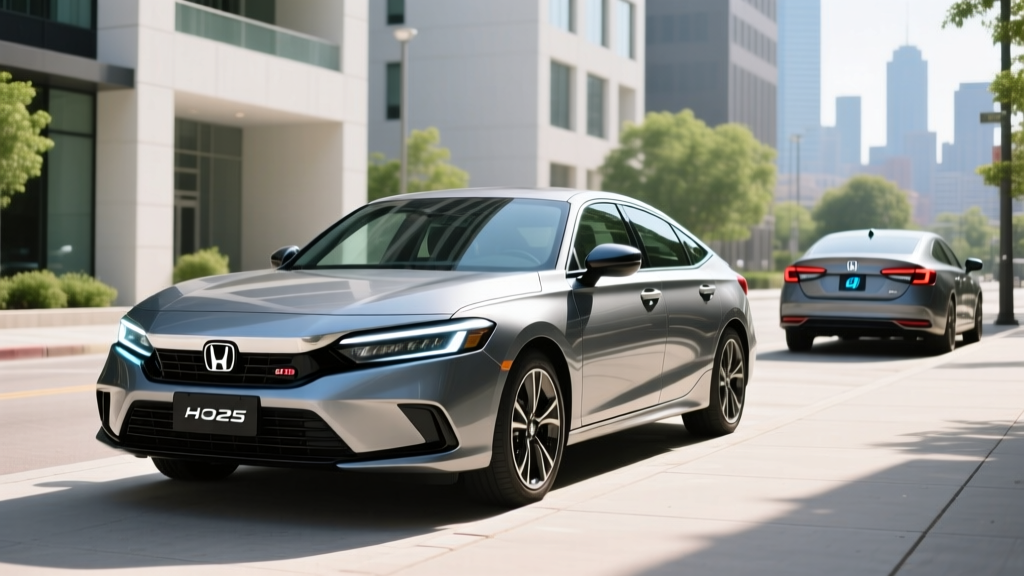
If you've been eyeing a compact hybrid that doesn't feel like a compromise, the 2025 Honda Civic Hybrid likely crossed your radar. With an EPA-estimated 50 MPG combined, sharp styling, and Honda's reputation for longevity, it's one of the most compelling hybrid sedans on the market. But if you're specifically researching a 2025 Honda Civic Hybrid lease, you need more than brochure numbers — you need real-world MPG expectations, total monthly cost context, and clarity on whether this HEV (conventional hybrid) or a plug-in alternative better suits your driving life.
This guide breaks down the Civic Hybrid's powertrain, fuel economy, lease economics, battery reliability, and how it stacks up against PHEVs and full EVs. No fluff — just the data you need to decide.
HEV vs PHEV: What the Civic Hybrid Actually Is
The 2025 Honda Civic Hybrid is a conventional hybrid electric vehicle (HEV). It does not plug in. Its small lithium-ion battery recharges through regenerative braking and the gasoline engine. You fuel it exactly like any other gas car — no charging cables, no home charger installation, no range anxiety about finding a plug.
| Feature | HEV (Civic Hybrid) | PHEV (e.g., Toyota Prius Prime) | BEV (e.g., Tesla Model 3) |
|---|---|---|---|
| Plugs in? | No | Yes | Yes |
| Electric-only range | ~1 mile at low speed | 35–44 miles | 250–360+ miles |
| Fueling | Gas station only | Gas + plug | Plug only |
| Battery size | ~1.1 kWh (small) | 13.6 kWh | 57–82 kWh |
| Federal tax credit (§30D) | Not eligible | Up to $7,500* | Up to $7,500* |
| Home charging needed? | No | Recommended | Essential |
*§30D credit eligibility depends on MSRP caps, buyer income limits, and battery sourcing requirements per IRS rules. Verify with a tax professional.
The distinction matters for leasing. A PHEV or BEV might qualify for a federal tax credit that the leasing company can factor into your deal (often passed through as a capitalized cost reduction), but the Civic Hybrid as an HEV does not qualify for the §30D new clean vehicle credit. This affects the total cost equation — which we'll quantify below.
Fuel Economy: EPA Ratings and Real-World MPG
The 2025 Civic Hybrid uses Honda's two-motor hybrid system, pairing a 2.0-liter Atkinson-cycle four-cylinder engine with two electric motors for a combined system output of 200 horsepower and 232 lb-ft of torque. That's meaningfully more power than the non-hybrid Civic's 158 hp 2.0L, and you feel it in passing acceleration and highway merging.
| Trim | City MPG | Highway MPG | Combined MPG |
|---|---|---|---|
| Sport Hybrid (sedan) | 50 | 47 | 49 |
| Sport Touring Hybrid (sedan) | 50 | 47 | 49 |
| Sport Hybrid (hatchback) | 50 | 45 | 48 |
Source: fueleconomy.gov
Real-World MPG vs. EPA Sticker
Honda's two-motor hybrid system excels in stop-and-go city driving, where regenerative braking recaptures energy constantly. In our experience and owner reports, the Civic Hybrid frequently exceeds its EPA city rating in urban commutes — 52–55 MPG is achievable with moderate driving. Highway driving at 75+ mph, however, drops efficiency to roughly 42–44 MPG because the engine operates more directly at sustained speeds. In cold weather (below 35°F), expect a 5–10% reduction as the engine runs more frequently for cabin heat and battery conditioning.
For a 12-gallon fuel tank, that translates to roughly 540–600 miles of real-world range depending on your driving mix — enough for most commuters to visit the gas station once every two to three weeks.
Powertrain and Performance Specs
| Specification | 2025 Civic Hybrid |
|---|---|
| Engine | 2.0L Atkinson-cycle 4-cylinder |
| System horsepower | 200 hp |
| System torque | 232 lb-ft |
| Transmission | e-CVT (direct drive) |
| 0–60 mph (est.) | ~7.1 seconds |
| Drivetrain | Front-wheel drive |
| Fuel tank | 10.6 gallons |
| Curb weight | ~3,100 lbs |
The two-motor system operates primarily in EV mode at low speeds and transitions seamlessly to hybrid or engine-direct drive at highway speeds. The result is smooth, linear acceleration without the rubber-band feel of older CVTs. Honda's e-CVT here uses a lock-up clutch for direct engine-to-wheel connection at cruising speeds, improving efficiency and reducing the drone typical of conventional CVTs.
2025 Honda Civic Hybrid Lease: Pricing and Monthly Cost
The 2025 Civic Hybrid is available in two trims for the sedan and hatchback body styles:
- Sport Hybrid (sedan): $28,750 MSRP (destination included)
- Sport Touring Hybrid (sedan): $31,750 MSRP
- Sport Hybrid (hatchback): $29,750 MSRP
- Sport Touring Hybrid (hatchback): $32,750 MSRP
Lease deals vary by region, dealer, and current Honda Financial Services incentives. As of early 2026, typical lease structures for the Civic Hybrid Sport sedan look approximately like this:
- 36-month / 36,000 miles: $329–$389/month with $2,500–$3,500 due at signing
- Effective monthly cost (including drive-off amortized): ~$399–$486/month
- Money factor: Typically 0.00220–0.00260 (equivalent to ~5.3–6.2% APR)
- Residual value (36 months): ~58–62%
These figures fluctuate monthly. Honda frequently offers loyalty incentives for returning Honda lessees and conquest bonuses for switching from competitors. Always request the full lease disclosure sheet showing the capitalized cost, money factor, residual, and all fees before signing.
Tax Credit Impact on Leasing
The Civic Hybrid does not qualify for the §30D federal tax credit available to PHEVs and BEVs with sufficient battery capacity and domestic sourcing. If tax credit optimization is a priority, a PHEV like the Toyota Prius Prime (eligible for up to $7,500 depending on sourcing and income) or a BEV could reduce your effective lease cost significantly. However, the Civic Hybrid's lower base price and strong residuals partially offset this gap — you're not paying a $10,000+ premium for a larger battery you may not need.
Battery Reliability, Warranty, and Replacement Cost
Hybrid battery longevity is the single most common concern among first-time hybrid buyers. Here's what the data shows:
2025 Civic Hybrid Battery Warranty
- Hybrid battery warranty: 8 years / 100,000 miles (10 years / 150,000 miles in CARB states including CA, NY, MA, and others)
- Powertrain warranty: 5 years / 60,000 miles
- Battery chemistry: Lithium-ion (small capacity, ~1.1 kWh)
- Replacement cost (out of warranty): Estimated $2,500–$4,000 including labor, based on prior-generation Civic and Accord Hybrid battery pricing
Honda's hybrid systems have proven highly durable in real-world use. The Insight (discontinued after 2022 but mechanically related) and Accord Hybrid have demonstrated battery packs lasting well beyond 150,000 miles with minimal degradation. The Civic Hybrid's battery is small and operates within a narrow state-of-charge window (roughly 40–80% SoC), which dramatically reduces stress on the cells compared to a full EV battery that cycles through wider ranges.
For a 36-month lease, battery degradation is essentially a non-issue — you'll return the car well within the warranty period. If you're considering purchasing at lease-end or buying used, the extended CARB-state warranty (10 years/150,000 miles) provides substantial coverage.
Who Should Lease the Civic Hybrid vs. a PHEV or Full EV?
Choose the Civic Hybrid (HEV) if:
- You lack access to home or workplace charging (apartment, street parking, no garage outlet)
- Your daily driving is 30–80 miles with a mix of city and highway
- You want maximum MPG without any behavioral change — just fill up and drive
- You prefer a lower monthly payment and don't want to manage charging logistics
- You drive in extreme cold regularly, where EV range loss is a concern
Choose a PHEV (e.g., Prius Prime) if:
- You have home Level 2 charging and a commute under 40 miles round-trip
- You want electric-only daily driving but gas flexibility for road trips
- You want to capture the §30D federal tax credit (up to $7,500)
- You want to reduce fuel costs by 60–80% on daily commutes
Choose a full EV (e.g., Tesla Model 3, Hyundai Ioniq 6) if:
- You have reliable home charging (Level 2 strongly recommended)
- Your daily driving is under 250 miles and you can plan road-trip charging
- You want the lowest per-mile fuel cost (~$0.04/mile on home electricity vs. ~$0.10/mile hybrid)
- You want the §30D credit and your income/vehicle qualifies
The Civic Hybrid occupies a practical sweet spot: it delivers near-Prius efficiency without requiring any infrastructure investment. For lessees who move frequently, live in apartments, or simply want zero friction in their daily routine, it's arguably the most rational compact sedan on the market.
Pros and Cons at a Glance
Pros
- 49–50 MPG combined EPA; frequently exceeds city rating in real driving
- 200 hp provides confident acceleration — quicker than most hybrid competitors
- No plug-in required; zero infrastructure investment
- Strong Honda reliability record; 8–10 year hybrid battery warranty
- Competitive lease pricing with strong residuals
- Standard Honda Sensing ADAS suite (adaptive cruise, lane keeping, auto emergency braking)
Cons
- No federal §30D tax credit eligibility (HEV, not PHEV/BEV)
- Only available in Sport and Sport Touring trims — no base-price option
- Front-wheel drive only; no AWD option unlike Toyota Prius
- Highway MPG drops noticeably above 75 mph
- Hybrid premium of ~$2,000 over non-hybrid Civic Sport (though fuel savings offset this)
Frequently Asked Questions
How many MPG does the 2025 Honda Civic Hybrid get?
The EPA rates the Civic Hybrid sedan at 50 city / 47 highway / 49 combined MPG. Real-world city driving often yields 52–55 MPG, while sustained highway driving at 75+ mph drops to approximately 42–44 MPG. Source: fueleconomy.gov.
Does the 2025 Civic Hybrid plug in?
No. The Civic Hybrid is a conventional HEV (hybrid electric vehicle). It charges its small battery through regenerative braking and the gasoline engine. You never plug it in — you simply refuel at a gas station like any other car.
Does the Civic Hybrid qualify for any tax credit?
The Civic Hybrid does not qualify for the §30D federal new clean vehicle credit, which requires a minimum battery capacity and applies to PHEVs and BEVs. Some states may offer minor hybrid incentives, but these are uncommon and vary by jurisdiction. Check IRS.gov and your state's energy office for current programs.
Is the hybrid battery reliable, and what does replacement cost?
Honda's hybrid batteries have demonstrated strong longevity, commonly exceeding 150,000 miles. The 2025 Civic Hybrid battery carries an 8-year/100,000-mile warranty (10 years/150,000 miles in CARB states). Out-of-warranty replacement is estimated at $2,500–$4,000 based on comparable Honda hybrid models.
What's a realistic monthly lease payment for the 2025 Civic Hybrid?
Expect approximately $329–$389/month on a 36-month/36,000-mile lease for the Sport Hybrid sedan, with $2,500–$3,500 due at signing. When amortizing drive-off costs, effective monthly cost is roughly $399–$486. Exact figures depend on your region, credit tier, and current Honda Financial Services incentives.
Should I lease the Civic Hybrid or buy a full EV instead?
If you have home charging access and a commute under 250 miles, a full EV offers lower per-mile fuel costs and potential tax credits. If you lack charging access, drive in extreme cold frequently, or want the lowest-friction ownership experience, the Civic Hybrid delivers outstanding efficiency without any lifestyle adjustment. The lease vs. buy decision also depends on how long you plan to keep the vehicle and whether you want to build equity.
How does the Civic Hybrid compare to the Toyota Prius?
The 2025 Prius offers 57 MPG combined (LE trim) and an available AWD powertrain, edging out the Civic Hybrid on pure efficiency. The Civic Hybrid counters with 200 hp (vs. Prius's 194 hp for the standard model), a more engaging driving experience, and Honda's interior quality. The Prius Prime PHEV variant adds 44 miles of electric-only range and potential §30D credit eligibility — a strong alternative if you can charge at home.
Lease pricing and incentive figures referenced are approximate and based on available data as of early 2026. Always confirm current offers with your local Honda dealer and Honda Financial Services. Tax credit eligibility is subject to change — consult a tax professional and IRS.gov for the latest §30D rules.