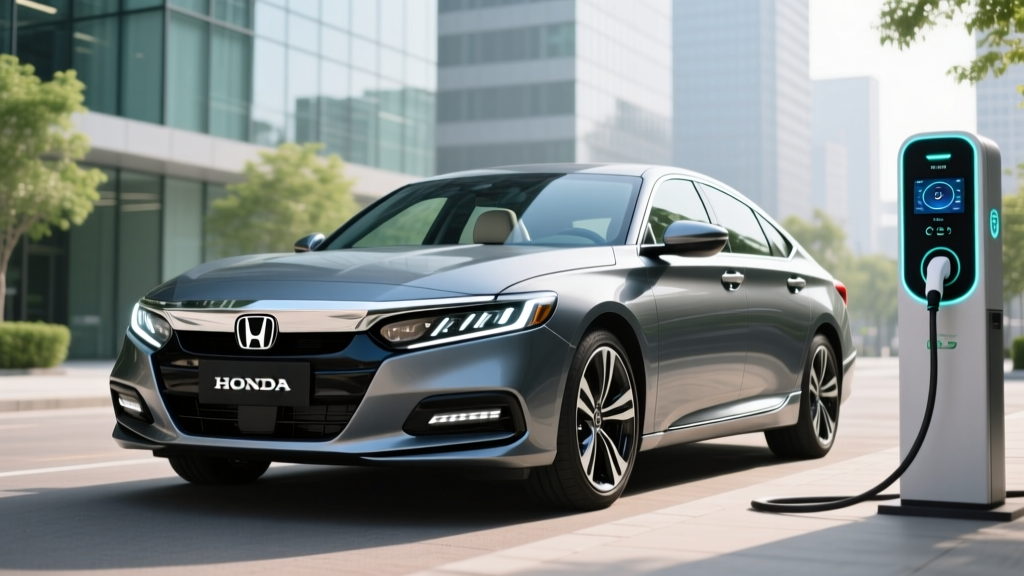
The Honda Accord has long been the midsize sedan benchmark, and for 2025, the hybrid powertrain isn't just an eco-minded alternative—it's the volume seller. With the discontinuation of the turbocharged 2.0T and the base turbo 1.5T restricted to lower trims, the two-motor hybrid system now powers the Accord's most popular configurations. Buyers searching for detailed 2025 Honda Accord Hybrid specs will find a sedan that prioritizes efficiency, smoothness, and practicality over raw performance, but the real-world story goes deeper than the EPA sticker.
This guide breaks down every key figure: fuel economy across trims, the hybrid powertrain architecture, battery longevity and warranty coverage, pricing by trim, tax-credit eligibility, and how the Accord Hybrid stacks up against PHEVs and full EVs for different driving lifestyles.
2025 Honda Accord Hybrid MPG: EPA Estimates and Real-World Results
Fuel economy is the Accord Hybrid's headline act. Honda's fourth-generation two-motor hybrid system pairs a 2.0-liter Atkinson-cycle inline-4 with two electric motors and an electronically controlled continuously variable transmission (e-CVT). The result is class-leading efficiency in a spacious midsize sedan.
| Trim | City MPG | Highway MPG | Combined MPG | Fuel Tank (gal) | Total Range (mi) |
|---|---|---|---|---|---|
| Sport Hybrid | 46 | 41 | 44 | 12.8 | ~563 |
| Sport-L Hybrid | 46 | 41 | 44 | 12.8 | ~563 |
| EX-L Hybrid | 51 | 44 | 48 | 12.8 | ~614 |
| Sport Touring Hybrid | 46 | 41 | 44 | 12.8 | ~563 |
| Touring Hybrid | 51 | 44 | 48 | 12.8 | ~614 |
The discrepancy between the 44-MPG and 48-MPG trims comes down to wheels and equipment. The Sport, Sport-L, and Sport Touring trims ride on 19-inch alloy wheels and carry sport-tuned suspensions, which increase rolling resistance and weight enough to cost 4 MPG combined. The EX-L and Touring use 17-inch wheels and prioritize comfort, unlocking the higher rating.
Real-World MPG vs. EPA Sticker
Honda's hybrid system excels in city driving, where the electric motors handle low-speed propulsion and regenerative braking recaptures energy at every stop. In real-world mixed driving, owners frequently report matching or exceeding the EPA combined number in city-heavy commutes—48-52 MPG is achievable on the EX-L and Touring in warm-weather urban conditions.
Highway efficiency tells a different story. At sustained 75-80 MPH cruising, the gasoline engine operates more directly, and real-world highway fuel economy typically drops to 38-42 MPG for the 48-rated trims and 35-39 MPG for the 44-rated trims. Cold weather (below 35°F) further reduces efficiency by 5-10% as the engine runs more frequently to heat the cabin and maintain battery temperature.
For a 40-mile daily round-trip commute with a mix of city and highway driving, expect roughly 44-47 MPG combined in the EX-L/Touring year-round—translating to about 2.4 gallons per week at current fuel prices.
HEV vs. PHEV: Where the Accord Hybrid Fits
A common question from sedan shoppers: is the Accord Hybrid a plug-in? The answer is no, and understanding the distinction matters for your purchase decision.
Conventional Hybrid (HEV) vs. Plug-In Hybrid (PHEV)
| Feature | HEV (Accord Hybrid) | PHEV (e.g., Toyota Prius Prime) | Full EV (BEV) |
|---|---|---|---|
| Plug-in charging required | No | Yes | Yes |
| Electric-only range | ~1 mile at low speed | 25-44 miles typical | 200-400+ miles |
| Battery size | ~1.1 kWh (small buffer) | 13-18 kWh | 60-100+ kWh |
| Gas engine | Yes (always available) | Yes (always available) | No |
| Home charging install | Not needed | Recommended (Level 2) | Essential (Level 2) |
| Federal tax credit (§30D) | No | Up to $7,500 (eligibility varies) | Up to $7,500 (eligibility varies) |
| Best for | No home charging, long trips | Short commutes + home charging | Home charging + daily driving under 300 mi |
The Accord Hybrid is a conventional hybrid (HEV). It never needs to be plugged in. The small lithium-ion battery pack charges exclusively through regenerative braking and the gasoline engine. You drive it exactly like a conventional car—fill up at the gas station, turn the key, and go. The hybrid system simply makes every gallon go further.
If you want plug-in capability with electric-only commuting, Honda does not currently offer a PHEV version of the Accord. The closest competitor with PHEV availability in the midsize segment would be looking at vehicles like the Hyundai Sonata Plug-In Hybrid (limited availability) or stepping into a compact PHEV like the Toyota Prius Prime, which offers 44 miles of electric-only range on a full charge.
Powertrain Deep Dive: 204 HP Two-Motor System
Honda's hybrid system in the 2025 Accord is the brand's fourth-generation two-motor design, and it operates differently from most competitors' setups.
| Specification | Value |
|---|---|
| Engine | 2.0L Atkinson-cycle DOHC inline-4 |
| Engine horsepower | 146 hp @ 6,100 RPM |
| Engine torque | 134 lb-ft @ 4,500 RPM |
| Drive motor output | 181 hp / 247 lb-ft |
| Combined system output | 204 hp / 247 lb-ft |
| Transmission | e-CVT (no fixed gears) |
| Drivetrain | Front-wheel drive |
| 0-60 MPH (est.) | ~7.2 seconds |
| Battery type | Lithium-ion |
| Battery capacity | ~1.1 kWh (usable buffer) |
The system operates primarily in EV Drive mode at low to moderate speeds, where the gasoline engine acts as a generator powering the drive motor rather than turning the wheels directly. At highway speeds, a lock-up clutch engages to connect the engine directly to the drive wheels for maximum efficiency. Under hard acceleration, both the engine and drive motor contribute simultaneously.
The result is a driving experience that feels more like an EV around town—smooth, linear torque delivery with no gear-shift interruptions—while maintaining the range and refueling convenience of a gasoline car. The 204 combined horsepower isn't sports-sedan territory, but the 247 lb-ft of electric motor torque available from low RPM makes the Accord Hybrid feel responsive in daily driving, especially in city and suburban conditions.
Trim Pricing and Tax Credit Eligibility
The 2025 Accord Hybrid is available across five trims, with pricing that reflects Honda's strategy of making the hybrid the mainstream option rather than a premium upgrade.
| Trim | MSRP | Combined MPG | Key Equipment |
|---|---|---|---|
| Sport Hybrid | $33,655 | 44 | 19" wheels, heated seats, wireless CarPlay/Android Auto |
| Sport-L Hybrid | $36,005 | 44 | Leather-trimmed seats, power moonroof, heated rear seats |
| EX-L Hybrid | $36,705 | 48 | 17" wheels, leather, power moonroof, wireless charging |
| Sport Touring Hybrid | $39,755 | 44 | Bose 12-speaker audio, navigation, heated steering wheel |
| Touring Hybrid | $40,055 | 48 | Adaptive dampers, ventilated front seats, heated rear seats |
Federal and State Tax Credit Status
Because the Accord Hybrid is a conventional hybrid (HEV) and not a plug-in vehicle, it does not qualify for the federal §30D Clean Vehicle Credit. That credit—worth up to $7,500—applies only to battery electric vehicles (BEVs) and plug-in hybrids (PHEVs) that meet battery-sourcing, critical-mineral, MSRP, and buyer income requirements as outlined by the IRS.
Some states offer separate incentives for conventional hybrids, though these are increasingly rare as state programs shift focus to zero-emission vehicles. Check your state's energy or environmental agency website for current hybrid rebates. A few states have offered $500-$1,000 rebates on HEVs in recent years, but availability varies widely and programs frequently change.
The practical implication: the Accord Hybrid's value proposition rests entirely on fuel savings and lower total operating costs rather than purchase incentives. At 48 MPG combined, a Touring-trim owner driving 15,000 miles annually would use approximately 312 gallons per year—roughly $1,090 at $3.50/gallon. A comparable gasoline midsize sedan averaging 30 MPG combined would consume 500 gallons ($1,750), yielding annual fuel savings of approximately $660.
Battery Warranty, Reliability, and Replacement Costs
Hybrid battery longevity remains one of the top concerns for buyers transitioning from conventional vehicles. Here's what the data shows for the 2025 Accord Hybrid.
Battery Warranty Coverage
Hybrid Battery: 8 years / 100,000 miles (10 years / 150,000 miles in CARB states including CA, CT, ME, MA, NJ, NY, OR, RI, VT, WA)
Hybrid System Components: 8 years / 100,000 miles (including inverter, electric motors, control unit)
Limited Vehicle Warranty: 3 years / 36,000 miles bumper-to-bumper; 5 years / 60,000 miles powertrain
The warranty covers the hybrid battery if its capacity drops below a defined threshold (typically around 60-70% of original capacity, though Honda does not publish an exact figure). In practice, Honda's lithium-ion hybrid batteries have demonstrated strong longevity. The smaller battery buffer in an HEV—compared to a full EV or PHEV—means shallower charge-discharge cycles, which reduces stress on the cells.
Real-World Reliability Data
Honda's hybrid systems have accumulated significant field data. The previous-generation Accord Hybrid (2018-2022) and the closely related CR-V Hybrid have shown hybrid battery failure rates well below 1% within the first 100,000 miles, according to reliability aggregators. Most hybrid battery issues that do arise occur in high-heat climates with frequent deep-discharge patterns—conditions the Accord's thermal management system is designed to mitigate.
If replacement becomes necessary outside of warranty, a new OEM hybrid battery pack for the Accord Hybrid typically costs between $2,500 and $4,000 including installation at a dealership. Independent hybrid specialists often offer refurbished or reconditioned packs for $1,500-$2,500. This is significantly less expensive than full EV battery replacement ($8,000-$20,000+) because the HEV battery pack is far smaller (~1.1 kWh vs. 60-100+ kWh).
For perspective, at $3,500 average replacement cost, the hybrid battery would need to fail at approximately 150,000 miles for the total replacement expense to offset the fuel savings accumulated over that distance (roughly $5,500-$7,000 in fuel savings vs. a 30-MPG gasoline sedan at $3.50/gallon).
Who Should Choose the Accord Hybrid vs. a PHEV or Full EV?
Decision Framework
Choose the Accord Hybrid if:
- You lack access to home or workplace charging (apartment, street parking, no garage outlet)
- You regularly drive 300+ miles in a single trip and don't want to plan around charging stops
- You want maximum fuel efficiency without changing any driving or refueling habits
- Your budget is $33,000-$40,000 and you want a spacious midsize sedan
- You prioritize proven reliability and low maintenance costs
Consider a PHEV (like the Prius Prime) if:
- Your daily commute is under 40 miles round-trip and you have home Level 2 charging
- You want to drive on electricity most days but keep a gas engine for road trips
- You may qualify for the §30D federal tax credit (up to $7,500) based on income, MSRP caps, and battery-sourcing rules
Consider a full EV (like the Tesla Model 3 or Hyundai Ioniq 6) if:
- You have reliable home Level 2 charging and your daily driving stays under 250 miles
- You want zero tailpipe emissions and the lowest per-mile energy cost (electricity vs. gasoline)
- You qualify for federal and state EV incentives that offset the higher purchase price
- You're comfortable planning DC fast-charging stops on longer road trips
The Accord Hybrid occupies a specific niche: maximum efficiency without infrastructure dependency. If you can charge at home and your commute is short, a PHEV or BEV will deliver lower operating costs and potential tax credits. But if charging access is uncertain or your driving patterns are unpredictable, the Accord Hybrid delivers 48 MPG without requiring you to change anything about how you drive or refuel.
Pros and Cons at a Glance
Pros
- Class-leading 48 MPG combined (EX-L/Touring trims)
- Smooth, EV-like driving feel in city conditions
- No charging infrastructure required—refuel at any gas station
- Spacious interior with 16.7 cu-ft trunk (no battery intrusion)
- Strong reliability track record for Honda hybrid systems
- Comprehensive 8-year/100,000-mile hybrid battery warranty
- Honda Sensing ADAS suite standard on all trims
Cons
- 204 hp is adequate but not quick; ~7.2-second 0-60 time
- No PHEV variant available—no electric-only commuting
- No federal tax credit eligibility (HEV, not plug-in)
- 19-inch wheels on Sport trims reduce MPG by 4 combined
- e-CVT drone under hard acceleration (common to Honda hybrids)
- FWD only—no all-wheel-drive option (unlike Toyota Camry Hybrid)
- Road noise is noticeable on coarse pavement at highway speed
Frequently Asked Questions
How many MPG does the 2025 Honda Accord Hybrid get?
The EPA rates the EX-L and Touring trims at 51 city / 44 highway / 48 combined MPG. The Sport, Sport-L, and Sport Touring trims are rated at 46 city / 41 highway / 44 combined MPG due to larger 19-inch wheels and sport-tuned equipment. In real-world driving, city-heavy commuters often match or slightly exceed the combined rating, while sustained highway driving at 75+ MPH typically yields 38-42 MPG for the higher-rated trims.
Does the Accord Hybrid need to be plugged in?
No. The 2025 Accord Hybrid is a conventional hybrid (HEV), not a plug-in hybrid (PHEV). The battery charges exclusively through regenerative braking and the gasoline engine. You never plug it in—just refuel at any gas station as you would with a conventional car.
Does the 2025 Accord Hybrid qualify for any tax credit?
No. The federal §30D Clean Vehicle Credit applies only to plug-in vehicles (BEVs and PHEVs). As a conventional hybrid, the Accord Hybrid is not eligible. Some states may offer small rebates for hybrids, but these vary by jurisdiction and change frequently. Consult your state's energy agency or a tax professional for current local incentives.
Is the Accord Hybrid reliable and what does battery replacement cost?
Honda's hybrid systems have demonstrated strong reliability, with hybrid battery failure rates well under 1% in the first 100,000 miles based on field data from the previous generation. The hybrid battery is warranted for 8 years/100,000 miles (10 years/150,000 miles in CARB states). If replacement is needed outside warranty, expect $2,500-$4,000 for a new OEM pack or $1,500-$2,500 for a refurbished unit from an independent specialist.
How does the Accord Hybrid compare to the Toyota Camry Hybrid?
Both are excellent choices. The Camry Hybrid offers standard all-wheel drive (the Accord is FWD only) and a slightly lower starting price. The Accord Hybrid counters with a larger rear seat, bigger trunk (16.7 vs. 15.1 cu-ft), and a more refined interior. Fuel economy is comparable, with the Accord holding a slight edge in combined MPG on equivalent trims. According to fueleconomy.gov, both vehicles rank at the top of the midsize hybrid segment for efficiency.
What is the Accord Hybrid's electric-only range?
Effectively zero for practical purposes. The Accord Hybrid can creep at very low speeds (under 25 MPH) on electric power alone for roughly one mile under ideal conditions, but this is not a usable electric-only range. The system is designed for electric assist and regenerative efficiency, not plug-in electric commuting. If you need meaningful electric-only range, you'll want a PHEV or BEV.
Is the Accord Hybrid good for long road trips?
Yes. With a 12.8-gallon fuel tank and 48 MPG combined (EX-L/Touring), the Accord Hybrid delivers over 600 miles of total range—more than most EVs and comparable to or better than gasoline sedans. There are no charging stops to plan, and the e-CVT powertrain is relaxed at highway cruising speeds. The main trade-off versus a gasoline-only Accord is slightly less power for high-altitude mountain passes, where the naturally aspirated 2.0L engine loses output faster than a turbocharged engine would.