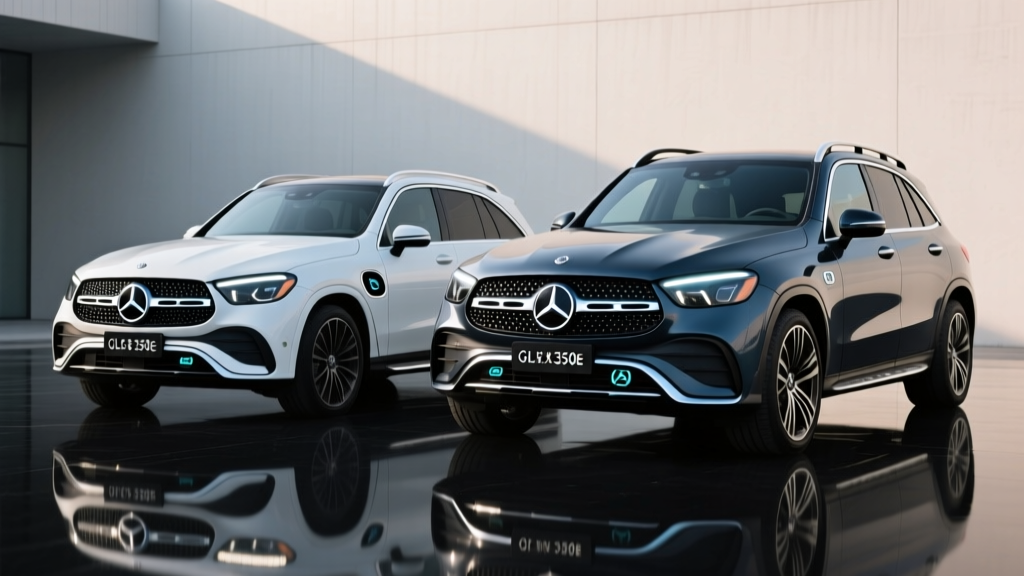
If you want the luxury and refinement of a Mercedes-Benz but aren't ready to commit to a full battery-electric vehicle, the brand's plug-in hybrid (PHEV) SUVs split the difference. For 2026, Mercedes offers two core PHEV SUV options in the US market: the compact GLC 350e 4MATIC and the midsize GLE 350e 4MATIC. Both pair a turbocharged gasoline engine with an electric motor and a usable battery large enough to handle daily commutes on electricity alone.
This guide breaks down exact EPA figures, real-world expectations, charging logistics, powertrain specs, and whether either model qualifies for federal tax incentives under current IRS §30D rules. We'll also clarify how these PHEVs differ from conventional hybrids and full EVs so you can match the right powertrain to your driving life.
HEV vs PHEV vs EV: Where Mercedes Plug-In Hybrids Fit
Before diving into specs, it's worth defining the three electrified powertrain types, because Mercedes sells vehicles in each category and the differences affect your wallet and daily routine.
| Powertrain | How It Works | Plug In? | Electric-Only Range | Example |
|---|---|---|---|---|
| HEV (Hybrid) | Small battery recharged by engine and regenerative braking | No | 0–1 mi at low speed | Toyota RAV4 Hybrid |
| PHEV (Plug-In Hybrid) | Larger battery; plug in to charge, engine kicks in when depleted | Yes | 20–55 mi typical | Mercedes GLC 350e |
| BEV (Battery Electric) | Electric motor only, no gasoline engine | Yes | 200–400+ mi | Mercedes EQB / EQS SUV |
A conventional hybrid (HEV) never needs to be plugged in — it captures energy from braking and the engine to charge a small battery. A plug-in hybrid (PHEV) like the GLC 350e or GLE 350e has a substantially larger battery (typically 20+ kWh) that you charge via a wall outlet, Level 2 home charger, or public station. Drive within the electric-only range, and you're effectively driving an EV. Exceed it, and the gasoline engine takes over seamlessly.
The sweet spot for a PHEV buyer: you can plug in at home, handle most weekday commuting on electricity, and still take a 600-mile road trip without planning charging stops.
2026 Mercedes GLC 350e 4MATIC: Specs, Range, and MPG
The GLC is Mercedes' best-selling SUV globally, and the 350e PHEV variant adds meaningful electric capability to the package. Here's what the numbers look like for the 2026 model year.
| Spec | 2026 GLC 350e 4MATIC |
|---|---|
| Powertrain | 2.0L turbo I4 + electric motor (P2 architecture) |
| Combined Output | 312 hp / 406 lb-ft torque |
| Battery (Usable) | ~23.3 kWh (lithium-ion, NMC chemistry) |
| EPA Electric-Only Range | 54 miles |
| EPA Combined Range (elec + gas) | ~440 miles |
| EPA MPGe (Electric Mode) | 79 MPGe combined |
| EPA MPG (Hybrid/Charge-Sustaining) | 25 city / 29 hwy / 27 combined |
| Level 2 AC Charging (Max) | 9.6 kW (onboard charger) |
| DC Fast Charging | Not available (AC only) |
| Level 2 Charge Time (0–100%) | ~2.5 hours at 9.6 kW |
| 0–60 mph | 6.2 seconds |
| Starting MSRP | $59,900 |
Real-World MPG vs EPA
Once the battery depletes, the GLC 350e operates as a conventional hybrid. The EPA rates it at 27 MPG combined in charge-sustaining mode. In real-world testing, PHEVs in this class tend to slightly exceed their EPA city rating because regenerative braking recovers more energy in urban traffic than the test cycle fully captures. Expect 28–30 MPG in city-heavy driving once the battery is empty, and closer to 26 MPG on sustained highway cruising at 75+ mph. If you charge nightly and commute under 50 miles, you may burn gasoline only a handful of times per month.
2026 Mercedes GLE 350e 4MATIC: Bigger SUV, Different Trade-Offs
The GLE 350e scales the PHEV formula up to a midsize, three-row-capable luxury SUV. It uses a similar powertrain architecture but carries more mass, which affects both electric range and fuel economy.
| Spec | 2026 GLE 350e 4MATIC |
|---|---|
| Powertrain | 2.0L turbo I4 + electric motor (P2 architecture) |
| Combined Output | 375 hp / 480 lb-ft torque |
| Battery (Usable) | ~23.3 kWh (lithium-ion, NMC chemistry) |
| EPA Electric-Only Range | 48 miles |
| EPA Combined Range (elec + gas) | ~480 miles |
| EPA MPGe (Electric Mode) | 69 MPGe combined |
| EPA MPG (Hybrid/Charge-Sustaining) | 22 city / 26 hwy / 24 combined |
| Level 2 AC Charging (Max) | 9.6 kW (onboard charger) |
| DC Fast Charging | Not available (AC only) |
| Level 2 Charge Time (0–100%) | ~2.5 hours at 9.6 kW |
| 0–60 mph | 5.8 seconds |
| Starting MSRP | $72,550 |
The GLE 350e sacrifices about six miles of electric range compared to the GLC due to its ~700-pound weight penalty and less aerodynamic profile. The combined output is higher (375 hp), which gives it confident highway merging and passing. Charge-sustaining fuel economy drops to 24 MPG combined — still respectable for a 5,000+ pound luxury SUV, but noticeably thirstier than the GLC 350e.
Charging Logistics: What You Need at Home
Both the GLC 350e and GLE 350e use a J1772 connector for AC charging and accept up to 9.6 kW on Level 2. Neither model offers DC fast charging — a limitation worth understanding if you rely on public charging networks.
| Charging Level | Power | Time (0–100%) | Miles of EV Range Added per Hour |
|---|---|---|---|
| Level 1 (120V household outlet) | ~1.4 kW | ~17 hours | ~5–6 mi/hr |
| Level 2 (240V, 40A circuit) | 9.6 kW | ~2.5 hours | ~22–25 mi/hr |
| DC Fast Charge | N/A — not supported | — | — |
The practical takeaway: A Level 2 home charger is essentially mandatory for PHEV ownership. At 9.6 kW, both vehicles fully recharge overnight — plug in when you get home, wake up to a full battery every morning. Level 1 (standard 120V outlet) technically works but adds only about 5 miles of range per hour, meaning a full charge takes 17+ hours. That's viable only if your daily driving is under 20 miles and you have 14+ hours between plug-in sessions.
Without DC fast charging, you won't benefit from highway charging stations on road trips. That's fine — the gasoline engine handles long-distance driving. But don't expect to "top up" the battery at an Electrify America or Tesla Supercharger station.
Home Charger Installation Cost
For a Level 2 setup (240V, 50A circuit with a 40A continuous charger like the ChargePoint Home Flex or Emporia Vue), expect the following cost ranges:
- Charger hardware: $350–$700
- Electrician labor + materials: $500–$2,000 (depends on panel proximity, conduit run length, and whether your panel has spare capacity)
- Electrical panel upgrade (if needed): $1,500–$3,500 (for older homes with 100A service upgrading to 200A)
- Permit and inspection: $50–$250 depending on municipality
Total cost for a straightforward install near your panel: roughly $900–$2,500. Always have a licensed electrician evaluate your panel capacity before purchasing equipment.
Tax Credit Eligibility: What the IRS §30D Rules Mean for 2026
Under the current federal §30D Clean Vehicle Credit rules, new plug-in hybrid vehicles can qualify for up to $7,500, but eligibility is far from guaranteed. Here's the checklist as of the 2026 tax year:
- Battery capacity: Must be at least 7 kWh — both the GLC 350e and GLE 350e exceed this (~23.3 kWh usable).
- MSRP caps: SUVs must have an MSRP at or below $80,000. The GLC 350e ($59,900 base) clears this easily. The GLE 350e ($72,550 base) qualifies at base and modestly optioned trims, but loaded examples can exceed the cap.
- Buyer income limits: Adjusted gross income must not exceed $150,000 (single), $225,000 (head of household), or $300,000 (married filing jointly).
- Battery component sourcing: A percentage of battery components must be manufactured or assembled in North America, and critical minerals must meet sourcing thresholds. These thresholds tighten annually. For 2026, both sourcing requirements are stringent — and Mercedes' supply chain sourcing for these specific models may or may not satisfy the full $7,500 credit.
- Point-of-sale transfer: Eligible buyers can transfer the credit to the dealer at purchase, reducing the sale price directly rather than waiting for a tax refund.
- Final assembly: Vehicle must undergo final assembly in North America. Verify the specific VIN at fueleconomy.gov.
Bottom line: Do not assume either Mercedes PHEV qualifies for the full $7,500. Check the VIN-specific eligibility on fueleconomy.gov and consult the IRS §30D guidance or a tax professional before factoring the credit into your purchase budget. Some buyers may qualify for $3,750 (meeting one of the two sourcing requirements) rather than the full amount.
Battery Warranty, Reliability, and Replacement Costs
Mercedes' PHEV battery warranty is competitive but not class-leading — Toyota and Hyundai cover hybrid batteries for 10 years/100,000 miles nationwide. If you live in a CARB state (California, New York, Washington, Oregon, Colorado, and others), the extended 10-year coverage applies.
Reliability Track Record
The GLC and GLE PHEV powertrains have been in production since the 2023 model year refresh. The 2.0L turbocharged inline-four (M254 engine) paired with the P2 hybrid module is a known quantity within Mercedes' lineup. Common owner-reported concerns center on software integration (occasional infotainment glitches, charge-scheduling quirks in the Mercedes me app) rather than powertrain mechanical failures.
Hybrid-specific components — the electric motor integrated into the transmission, the power electronics, and the battery pack — have proven durable in Mercedes' earlier PHEV generations (C 350e, S 560e). There is no widespread pattern of premature battery degradation in the current-generation SUVs.
Battery Replacement Cost
If the high-voltage battery fails outside of warranty, expect a replacement cost in the range of $12,000–$18,000 including parts and labor at a Mercedes dealer. This is comparable to other luxury-brand PHEV batteries in the 20–25 kWh range. Third-party hybrid battery repair shops can sometimes replace individual cell modules for $3,000–$6,000, but this is a developing market for current-generation Mercedes PHEVs. Most owners will never face this cost within typical ownership periods, and the 6–10 year warranty provides substantial coverage.
Who Should Buy a Mercedes Plug-In Hybrid SUV?
Pros
- 48–54 miles of electric range covers most commutes gas-free
- Over 440 miles total range eliminates road-trip charging anxiety
- Mercedes build quality, cabin materials, and MBUX tech
- 9.6 kW Level 2 charging fills the battery in ~2.5 hours
- Strong combined horsepower (312–375 hp) for confident acceleration
- May qualify for partial or full $7,500 federal tax credit (VIN-dependent)
Cons
- No DC fast charging — irrelevant on road trips, limiting for apartment dwellers without home charging
- Charge-sustaining MPG (24–27 combined) is mediocre once battery depletes
- Battery warranty shorter than Toyota/Hyundai in non-CARB states (6 yr vs 10 yr)
- Base price is premium ($59,900–$72,550) before options
- Cargo space slightly reduced vs gas-only GLC/GLE due to battery placement
- Tax credit eligibility uncertain due to battery-sourcing rules
Decision Framework: Which Powertrain Fits You?
- Choose the Mercedes PHEV if: You have home Level 2 charging, your daily commute is under 50 miles round-trip, you take road trips several times a year, and you want luxury without range anxiety.
- Choose a full EV (like the EQB or EQS SUV) if: You have reliable home charging, rarely drive more than 250 miles in a day, want to eliminate gasoline entirely, and your budget supports the higher upfront cost.
- Choose a conventional hybrid (HEV) if: You cannot charge at home (apartment, street parking), want simpler ownership with zero plug-in behavior change, and are willing to trade luxury features for lower cost and strong MPG everywhere.
- Stick with gasoline if: You drive fewer than 8,000 miles per year, fuel costs are negligible in your budget, and you want the lowest possible purchase price.
Frequently Asked Questions
How many MPG does the Mercedes plug-in hybrid SUV get?
Once the battery is depleted, the 2026 GLC 350e returns an EPA-estimated 25 city / 29 highway / 27 combined MPG. The larger GLE 350e is rated at 22 city / 26 highway / 24 combined MPG. In real-world city driving with frequent regenerative braking, both tend to slightly exceed their EPA city ratings by 1–3 MPG. However, if you charge daily and drive within the electric-only range, your gasoline consumption may drop to near zero for weeks at a time.
How far can the Mercedes PHEV SUV go on electric only?
The EPA rates the GLC 350e at 54 miles of electric-only range and the GLE 350e at 48 miles. Real-world results vary: expect 45–55 miles in the GLC during mild-weather suburban driving, but only 38–44 miles at sustained highway speeds in cold weather. The GLE delivers proportionally less due to its greater weight. For most commuters with a daily round-trip under 40 miles, either vehicle can handle weekday driving entirely on electricity.
Can I DC fast charge the Mercedes GLC 350e or GLE 350e?
No. Both models support AC charging only, up to 9.6 kW on Level 2. This is typical for PHEVs in this class — the battery is small enough that a 2.5-hour Level 2 charge fully replenishes it, and DC fast-charging hardware would add cost and weight. For road trips, the gasoline engine handles long-distance driving, so fast charging isn't necessary.
Does the Mercedes plug-in hybrid SUV qualify for a tax credit?
Both models meet the battery capacity (7+ kWh) and MSRP cap (under $80,000 for SUVs) requirements for the federal §30D Clean Vehicle Credit. However, eligibility also depends on your income (capped at $150K single / $300K joint), battery component sourcing from North America, and critical mineral sourcing thresholds — all of which tighten annually. The final assembly location must also be in North America. Check VIN-specific eligibility at fueleconomy.gov and consult a tax professional. The credit can be transferred to the dealer at point of sale if you qualify.
Is the Mercedes PHEV battery reliable, and what does replacement cost?
Mercedes' current-generation PHEV battery packs have shown no widespread reliability issues. The warranty covers 6 years/62,000 miles in most states and 10 years/150,000 miles in CARB states, guaranteeing at least 70% capacity retention. Out-of-warranty replacement runs $12,000–$18,000 at a dealer, though third-party module-level repair is becoming available at lower cost. Most owners will trade or sell the vehicle well before battery replacement becomes a concern.
Hybrid vs PHEV vs EV — which should I choose?
A conventional hybrid (HEV) is best if you can't charge at home. A PHEV like these Mercedes models is ideal if you have home charging, a sub-50-mile commute, and want road-trip flexibility. A full EV (BEV) is the right call if you want zero gasoline use, have reliable charging access, and your longest regular trips fall within 250–300 miles. The PHEV is the bridge technology — it rewards plug-in discipline with EV-like daily driving while keeping a gas tank for when you need it.
Sources: EPA fuel economy data via fueleconomy.gov, Mercedes-Benz USA specifications, IRS §30D Clean Vehicle Credit guidance via irs.gov. Specifications reflect 2026 model year as published; verify with your dealer before purchase. Tax credit eligibility is subject to change — consult a tax professional.