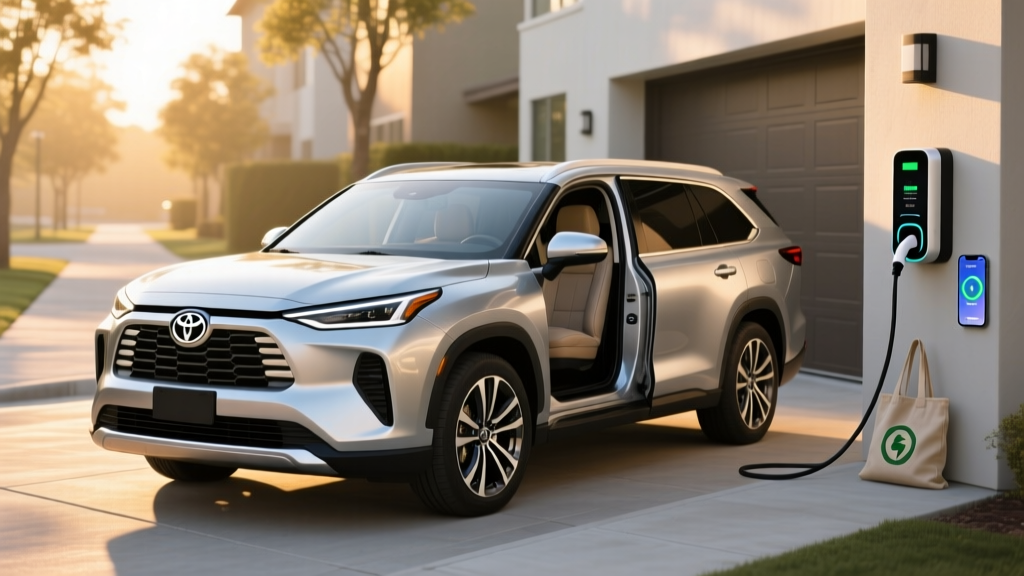
The three-row SUV segment has no shortage of options, but few balance passenger space, cargo volume, and fuel efficiency the way Toyota's hybrid system does. The 2025 Grand Highlander Hybrid XLE sits in a specific sweet spot: it's the mid-tier trim of Toyota's largest hybrid SUV, offering three rows of seating, standard all-wheel drive, and an EPA-estimated 36 MPG combined — all without ever needing to plug in. This is a conventional hybrid (HEV), not a plug-in, and that distinction matters for buyers weighing electrified options.
Below, we break down exactly what the XLE trim delivers, how its real-world fuel economy compares to the EPA sticker, what the hybrid battery warranty actually covers, and whether this HEV makes more sense for your household than a PHEV or full battery-electric vehicle.
2025 Grand Highlander Hybrid XLE: Key Specs at a Glance
| Spec | Value |
|---|---|
| Powertrain | 2.5L 4-cyl + electric motors (HEV) |
| Combined Horsepower | 245 hp |
| Drivetrain | Electronic On-Demand AWD (standard) |
| EPA MPG (City / Hwy / Combined) | 36 / 32 / 35 |
| Fuel Tank Capacity | 17.1 gallons |
| Total Driving Range | ~598 miles (EPA est.) |
| Seating Capacity | 7 or 8 passengers |
| Cargo Volume (behind 3rd / 2nd / 1st row) | 20.6 / 57.9 / 97.5 cu ft |
| Towing Capacity | 3,500 lbs |
| MSRP (XLE AWD) | $45,490 |
| Federal Tax Credit (§30D) | Not eligible (HEV) |
| Hybrid Battery Warranty | 10 years / 150,000 miles |
Fuel Economy: EPA Estimates vs. Real-World MPG
The EPA rates the 2025 Grand Highlander Hybrid XLE at 36 city / 32 highway / 35 combined MPG with the standard hybrid AWD powertrain. These figures come from fueleconomy.gov, the official DOE/EPA source.
However, Toyota's hybrid system — which uses a planetary gearset to blend engine and electric motor power — tends to outperform its EPA city estimate in real-world stop-and-go driving. The electric motors handle low-speed propulsion and regenerative braking recaptures energy that a conventional gas SUV would waste as heat. Owners frequently report city MPG in the 37–40 range during moderate-temperature commutes.
Highway driving is where the hybrid advantage narrows. At sustained 70–80 mph speeds, the 2.5L engine does most of the work, and the aerodynamic penalty of a large three-row SUV becomes the dominant factor. Expect highway MPG closer to 30–33 in real-world conditions, especially with a full load of passengers and cargo. Cold weather (below 30°F) typically reduces hybrid fuel economy by 5–10% due to increased engine warm-up time and reduced battery efficiency.
| Driving Scenario | EPA Estimate | Expected Real-World |
|---|---|---|
| City (stop-and-go) | 36 MPG | 37–40 MPG |
| Highway (70–80 mph) | 32 MPG | 30–33 MPG |
| Combined | 35 MPG | 33–37 MPG |
| Cold weather (below 30°F) | — | 30–33 MPG combined |
HEV vs. PHEV vs. EV: Which Powertrain Fits Your Family?
The Grand Highlander is available only as a conventional hybrid (HEV) or a turbocharged Hybrid MAX — there is no plug-in hybrid (PHEV) variant. This matters because the two technologies serve different use cases. Here's how they compare:
HEV vs. PHEV: What's the Difference?
Conventional Hybrid (HEV): The Grand Highlander Hybrid charges its small battery (~1.6 kWh) entirely through regenerative braking and the gas engine. You never plug it in. It uses the electric motor to assist acceleration and enable brief low-speed electric-only driving, but the engine is always the primary power source. Result: significantly better MPG than a gas-only SUV, zero behavior change required.
Plug-In Hybrid (PHEV): A PHEV carries a larger battery (typically 15–25 kWh) that you charge by plugging into a wall outlet or Level 2 charger. It can drive 25–50 miles on electricity alone before the gas engine kicks in. PHEVs qualify for the federal §30D tax credit (up to $7,500) if they meet battery-sourcing, MSRP, and buyer income requirements. Toyota does not currently offer a Grand Highlander PHEV.
Choose the HEV (Grand Highlander Hybrid) if:
- You don't have access to home charging
- You want zero behavior change — just fill up with gas
- You drive a mix of city and highway with three rows needed regularly
- You want lower upfront cost ($45,490 vs. $55K+ for comparable PHEVs)
Choose a PHEV if:
- You have Level 2 home charging and a short commute (<40 mi round trip)
- You want to drive mostly electric on weekdays, gas on road trips
- You qualify for the §30D federal tax credit (up to $7,500)
- Three rows aren't a daily requirement (most PHEV SUVs are two-row)
Choose a Full EV (BEV) if:
- You have reliable home Level 2 charging
- Your daily driving is under 250 miles
- You want the lowest per-mile fuel cost (~$0.04–0.06/mi vs. $0.14/mi for this hybrid)
- You can accept current three-row EV trade-offs (higher price, fewer options)
Powertrain Deep Dive: 245 hp Hybrid System
The Grand Highlander Hybrid XLE uses Toyota's fourth-generation hybrid system, pairing a 2.5-liter naturally aspirated four-cylinder engine with front and rear electric motors. The combined system output is 245 horsepower. The rear motor enables electronic on-demand AWD — there is no mechanical driveshaft connecting the front and rear axles. Instead, the rear motor engages when the system detects slip or when additional traction is needed.
This powertrain prioritizes efficiency over performance. The 0–60 mph time is approximately 8.1 seconds, which is adequate for highway merging and family hauling but noticeably slower than the available Hybrid MAX powertrain (362 hp, ~6.0 seconds to 60). The Hybrid MAX, however, drops fuel economy to 27 MPG combined and adds roughly $5,000 to the price, making the standard hybrid the efficiency-focused choice.
The hybrid battery in the Grand Highlander is a nickel-metal hydride (NiMH) pack with a usable capacity of approximately 1.6 kWh. This is not designed for meaningful electric-only range — it exists to buffer regenerative braking energy and provide electric motor assist. You will not see an "EV mode" range figure because this vehicle is not a plug-in.
Pricing, Trims, and Tax Credit Eligibility
The 2025 Grand Highlander Hybrid XLE carries an MSRP of $45,490 including destination charge. This positions it roughly $4,000 above the base LE Hybrid ($41,490) and $5,000 below the Limited Hybrid ($50,490). The XLE adds SofTex-trimmed seats, a power liftgate, heated front seats, wireless phone charging, and a 12.3-inch touchscreen over the LE.
Federal tax credit: The Grand Highlander Hybrid does not qualify for the IRS §30D Clean Vehicle Credit. That credit applies only to plug-in electric vehicles (BEVs and PHEVs) that meet battery component and critical mineral sourcing requirements. Conventional hybrids like this one are excluded regardless of price or buyer income. You can review current §30D eligibility rules at IRS.gov.
Some states offer separate incentives for hybrid vehicles, though these are increasingly rare as state programs shift focus to zero-emission vehicles. Check your state's energy or environmental agency website for current programs.
Hybrid Battery Warranty and Long-Term Reliability
Hybrid Battery Warranty: 10 Years / 150,000 Miles
Toyota covers the Grand Highlander's hybrid battery for 10 years or 150,000 miles, whichever comes first. This is one of the longest hybrid battery warranties in the segment and applies to all 50 states (California-emissions states receive the same coverage).
The warranty covers defects and capacity loss that causes the battery to fail to hold a functional charge. In practice, Toyota's NiMH hybrid batteries have demonstrated strong longevity — many Prius and Highlander Hybrid owners report 200,000+ miles on the original pack with minimal degradation.
Toyota's hybrid system reliability is well-documented. The planetary gearset e-CVT has no belts, clutches, or traditional transmission components to wear out. The regenerative braking system also reduces wear on the friction brakes, meaning brake pads often last 80,000–100,000 miles. According to IIHS and long-term ownership data, the hybrid powertrain is among the lowest-maintenance systems Toyota produces.
Battery replacement cost: If the hybrid battery does need replacement outside of warranty, expect to pay between $3,000 and $5,000 for a new OEM pack including labor. Refurbished packs are available for $1,500–$2,500. Given the 10-year/150,000-mile warranty and Toyota's track record, this is a low-probability expense for most owners.
Daily Ownership: What It's Like to Live With
The Grand Highlander Hybrid XLE's defining ownership characteristic is normalcy. You fuel it at any gas station. There is no plug, no charging app, no range calculation to manage. The hybrid system operates transparently — the instrument cluster shows a small energy flow display, but most drivers ignore it after the first week.
With a 17.1-gallon fuel tank and 35 MPG combined, expect roughly 550–600 miles between fill-ups in mixed driving. That's fewer fuel stops than virtually any non-hybrid three-row SUV on the market. At current national average gas prices (~$3.40/gallon), annual fuel cost for 15,000 miles of driving is approximately $1,457 — roughly $600–$800 less per year than a comparable gas-only three-row SUV rated at 22–24 MPG combined.
The XLE's 20.6 cubic feet of cargo space behind the third row is genuinely usable for groceries or luggage with all seats occupied — a key advantage over midsize SUVs that offer only token cargo room with three rows in use. Fold the third row and you get 57.9 cu ft; fold both rear rows for 97.5 cu ft of flat-load space.
Pros
- 36 MPG city is class-leading for a 3-row SUV
- Standard AWD with no fuel-economy penalty vs. FWD
- 10-year / 150,000-mi hybrid battery warranty
- Usable 20.6 cu ft cargo with all 3 rows up
- No plug-in required — zero infrastructure dependency
- ~600-mile total range between fill-ups
Cons
- 245 hp feels modest for a 4,700-lb SUV when loaded
- No PHEV option for electric-only commuting
- No federal tax credit eligibility
- 32 MPG highway drops further at 80+ mph or in cold
- XLE lacks ventilated seats and premium audio (Limited trim)
- Hybrid MAX (362 hp) costs ~$5K more for meaningful power bump
Frequently Asked Questions
How many MPG does the 2025 Grand Highlander Hybrid XLE get?
The EPA rates it at 36 city / 32 highway / 35 combined MPG. In real-world driving, expect 37–40 MPG in city conditions and 30–33 MPG on the highway. Cold weather reduces combined economy to roughly 30–33 MPG.
Can the Grand Highlander Hybrid drive on electric power only?
Only for very short distances at low speeds (typically under 1 mile below 25 mph). This is a conventional hybrid — it cannot sustain electric-only driving and does not plug in. If electric-only commuting is a priority, you need a PHEV or BEV.
Does the 2025 Grand Highlander Hybrid qualify for any tax credit?
No. The IRS §30D Clean Vehicle Credit applies only to plug-in vehicles (BEVs and PHEVs). Conventional hybrids are not eligible regardless of price or buyer income. Some states may offer minor hybrid incentives — check your local energy agency.
Is the hybrid battery reliable and what does replacement cost?
Toyota's hybrid batteries carry a 10-year/150,000-mile warranty. The NiMH pack and e-CVT have an excellent long-term reliability record, with many owners exceeding 200,000 miles on the original battery. Out-of-warranty replacement runs $3,000–$5,000 for an OEM pack.
Should I buy this hybrid or wait for a PHEV three-row SUV?
If you need three rows now and don't have home charging, the Grand Highlander Hybrid is the efficiency benchmark in its class. If you have Level 2 charging and a short commute, three-row PHEV options are extremely limited (the Kia Sorento PHEV is smaller; the Mazda CX-90 PHEV offers a cramped third row). For a true three-row PHEV with adult-sized rear seats, you may be waiting for future product announcements.
How does the Hybrid compare to the Hybrid MAX?
The Hybrid MAX produces 362 hp (vs. 245 hp) and achieves 0–60 in ~6.0 seconds (vs. ~8.1 seconds). The trade-off: 27 MPG combined vs. 35 MPG combined, and approximately $5,000 higher pricing. If you regularly tow near the 3,500-lb limit or drive in mountainous terrain, the MAX's power is worthwhile. For daily commuting and road trips, the standard hybrid's fuel savings are more impactful.