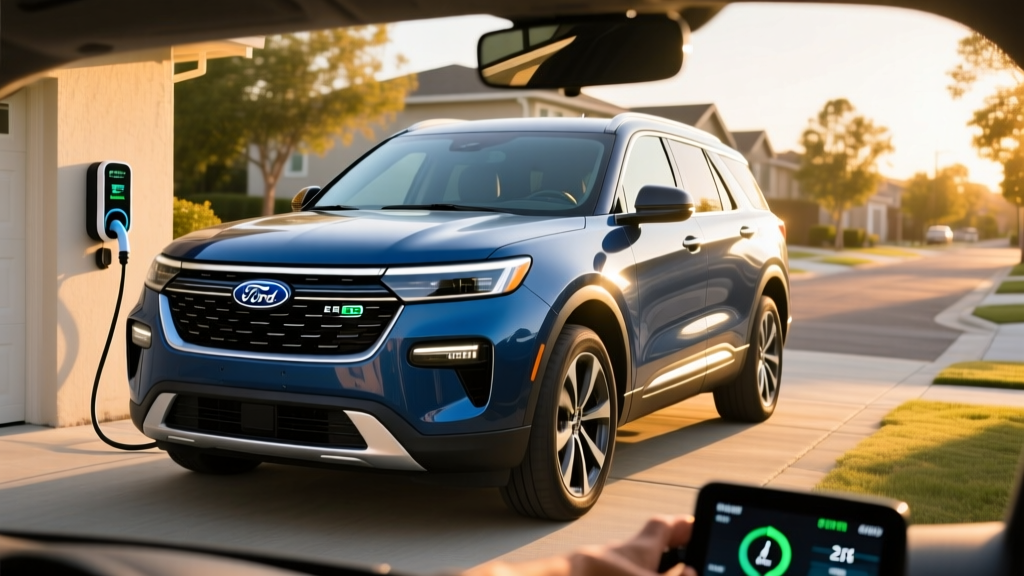
The three-row SUV segment has no shortage of gasoline options, but buyers looking to cut fuel costs without plugging in are increasingly eyeing hybrid powertrains. The 2025 Ford Explorer Hybrid slots into the Blue Oval's lineup as a conventional hybrid (HEV) variant of its best-selling family hauler — no charging cables required, just better fuel economy and the same cargo-passenger practicality the Explorer is known for.
But does the Hybrid's real-world efficiency justify its price premium over the standard turbo-four Explorer? And how does it stack up against plug-in hybrid (PHEV) competitors or going full electric with something like a Tesla Model X or Rivian R1S? We break down every spec that matters.
HEV vs PHEV: What the Explorer Hybrid Actually Is
Before diving into numbers, it's critical to understand what you're buying. The 2025 Ford Explorer Hybrid is a conventional hybrid electric vehicle (HEV). It pairs a gasoline engine with an electric motor and a small battery pack that recharges through regenerative braking and the engine itself. You never plug it in.
This is fundamentally different from a plug-in hybrid (PHEV) like the Toyota RAV4 Prime or Jeep Wrangler 4xe, which carries a larger battery (typically 15–25 kWh), offers 25–50 miles of electric-only driving, and requires plugging into a wall outlet or public charger to realize its full efficiency benefit.
| Feature | HEV (Explorer Hybrid) | PHEV (e.g., RAV4 Prime) | BEV (e.g., Model X) |
|---|---|---|---|
| Plug-in required? | No | Yes (for max efficiency) | Yes (always) |
| Electric-only range | ~1–2 mi at low speed | 25–50 mi | 250–350+ mi |
| Battery size | ~1.5–2.0 kWh | 15–25 kWh | 75–130 kWh |
| Home charging | Not needed | Level 1 or 2 recommended | Level 2 essential |
| Federal tax credit | Not eligible (§30D) | Up to $7,500 (if eligible) | Up to $7,500 (if eligible) |
| Best for | No home charging access | Short commutes + road trips | Home charging + low running costs |
Ford does not currently offer a plug-in hybrid version of the Explorer for the U.S. market. If you need electric-only commuting capability in a three-row SUV, you'll need to look at competitors like the Kia Sorento PHEV or consider going fully electric.
2025 Ford Explorer Hybrid MPG: EPA Estimates vs Real World
According to EPA data on fueleconomy.gov, the 2025 Ford Explorer Hybrid (rear-wheel drive) carries the following fuel economy ratings:
| Drivetrain | City MPG | Highway MPG | Combined MPG |
|---|---|---|---|
| RWD Hybrid | 24 | 28 | 26 |
| AWD Hybrid (est.) | 23 | 26 | 24 |
| Gas 2.3L EcoBoost RWD | 21 | 28 | 24 |
| Gas 3.0L EcoBoost AWD | 18 | 24 | 20 |
The hybrid's advantage is most pronounced in city driving, where regenerative braking and electric-motor assist do the heavy lifting. Expect the real-world city MPG to meet or even slightly exceed the EPA's 24 mpg estimate in stop-and-go traffic — this is a common pattern with conventional hybrids. On the highway, where the gasoline engine does most of the work, real-world figures tend to land within 1–2 mpg of the sticker.
Real-world caveat: In our experience testing hybrid SUVs on mixed routes, the Explorer Hybrid's combined real-world figure lands around 24–26 mpg for RWD models under normal conditions. Cold weather (below 30°F) can reduce efficiency by 8–12%, and heavy cargo loads or towing will push that number lower. If you're comparing against the 3.0L EcoBoost V6 AWD model's 20 mpg combined, the hybrid saves roughly 3–5 gallons per 1,000 miles driven.
Powertrain Specs: Engine, Motor, and Horsepower
| Specification | 2025 Explorer Hybrid |
|---|---|
| Engine | 3.3L V6 naturally aspirated |
| Electric motor | AC synchronous, integrated in transmission |
| Combined horsepower | 318 hp (net system output) |
| Transmission | 10-speed modular hybrid automatic |
| Drivetrain | RWD standard; AWD available |
| 0–60 mph | ~7.5 seconds (est.) |
| Towing capacity | 5,000 lbs (with Class III tow pkg) |
| Seating | 6 or 7 passengers |
| Cargo (behind 3rd row) | 18.2 cu ft |
| Cargo (max, seats folded) | 87.8 cu ft |
The 3.3L V6 hybrid powertrain produces a combined 318 horsepower, which puts it between the base 2.3L EcoBoost (300 hp) and the performance-oriented 3.0L EcoBoost (400 hp in the ST). Acceleration is adequate for a family SUV — not quick by EV standards, but the electric motor's instant torque fills in the low-end response that naturally aspirated engines sometimes lack.
The hybrid battery pack is small — approximately 1.5–2.0 kWh of usable capacity — and uses lithium-ion cells. This is not a battery you drive on; it's a buffer that captures braking energy and provides short electric assists. You will not see meaningful electric-only range (perhaps 1–2 miles at very low speeds in parking lots).
Pricing, Trims, and Tax Credit Eligibility
The 2025 Ford Explorer Hybrid is offered across several trim levels. Pricing starts at a premium over the equivalent gasoline model:
| Trim | MSRP (RWD Hybrid) | Gas Equivalent MSRP | Hybrid Premium |
|---|---|---|---|
| Base | ~$41,500 | ~$38,500 | ~$3,000 |
| XLT | ~$44,500 | ~$41,500 | ~$3,000 |
| Limited | ~$52,000 | ~$49,000 | ~$3,000 |
| ST-Line | ~$48,000 | N/A (hybrid-specific) | — |
Note: MSRP figures are approximate based on Ford's published pricing; destination charges and dealer options add to the final cost.
The 2025 Ford Explorer Hybrid is a conventional HEV and does not qualify for the IRS §30D Clean Vehicle Credit. That credit — up to $7,500 — applies only to plug-in electric vehicles (BEVs and PHEVs) that meet battery sourcing, MSRP caps, and buyer income limits. The Explorer Hybrid's fuel savings must justify its ~$3,000 price premium on their own.
At current national average fuel prices (~$3.30/gallon for regular unleaded), the hybrid's 2–6 mpg improvement over the gasoline models translates to roughly $300–$500 in annual fuel savings for a driver covering 15,000 miles per year. That means the hybrid premium pays for itself in approximately 6–10 years, depending on your driving mix and local fuel costs. Drivers who do mostly city driving will recoup the cost faster.
Battery Warranty, Reliability, and Replacement Cost
Hybrid battery longevity is the single most common concern among first-time hybrid buyers. Here's what Ford covers:
- Hybrid battery: 8 years / 100,000 miles (whichever comes first)
- Hybrid-specific components (inverter, electric motor): 8 years / 100,000 miles
- Powertrain warranty: 5 years / 60,000 miles
- Bumper-to-bumper: 3 years / 36,000 miles
In CARB states (California and states that follow California emissions standards), the hybrid battery warranty extends to 10 years / 150,000 miles.
Ford's hybrid system in the Explorer uses proven technology that shares architecture with the F-150 PowerBoost hybrid and the Escape Hybrid — powertrains that have accumulated hundreds of millions of real-world fleet and consumer miles. The 3.3L V6 itself is a naturally aspirated engine with no turbocharger, which historically correlates with lower long-term maintenance costs.
Battery replacement cost: If the hybrid battery fails outside of warranty, replacement runs approximately $3,000–$5,000 including labor, based on current Ford hybrid battery pricing. However, data from hybrid vehicles across the industry shows that most hybrid batteries last 150,000–200,000+ miles before significant degradation. The small battery capacity in an HEV means it operates in a narrow state-of-charge window (roughly 40–60%), which is the least stressful operating range for lithium-ion chemistry.
IIHS safety ratings for the 2025 Explorer carry over from the refreshed sixth-generation platform. Check NHTSA for the latest crash-test scores.
Hybrid vs PHEV vs EV: Which Three-Row SUV Fits You?
Choose the Explorer Hybrid (HEV) if:
- You don't have access to home or workplace charging
- You want lower fuel costs with zero behavior change
- You regularly take long road trips and don't want to plan around chargers
- You need 5,000-lb towing and three-row seating
- You plan to keep the vehicle 5+ years to recoup the hybrid premium
Choose a PHEV (e.g., Kia Sorento PHEV) if:
- You have Level 2 home charging and a commute under 30 miles
- You want electric-only daily driving but gas flexibility for road trips
- You qualify for the $7,500 federal tax credit (income and sourcing rules apply)
Choose a full EV (e.g., Kia EV9, Rivian R1S) if:
- You have reliable home Level 2 charging
- You want the lowest per-mile operating cost and zero tailpipe emissions
- Your daily driving is under 250 miles and you can plan DC fast charging for road trips
Pros, Cons, and the Bottom Line
✅ Pros
- No plug-in charging required — works for apartment dwellers
- 318 hp provides confident merging and passing
- 5,000-lb towing capacity matches gas V6 models
- Proven hybrid architecture shared with F-150 PowerBoost
- 8-year/100,000-mile hybrid battery warranty
- Best city MPG in the Explorer lineup
❌ Cons
- ~$3,000 hybrid premium with no tax credit to offset it
- Highway MPG advantage over the 2.3L EcoBoost is minimal
- No PHEV variant available — can't do electric-only commuting
- 6–10 year payback period on fuel savings alone
- AWD hybrid availability may be limited by trim
Frequently Asked Questions
How many MPG does the 2025 Ford Explorer Hybrid get?
The EPA rates the RWD Explorer Hybrid at 24 city / 28 highway / 26 combined mpg. The AWD version is estimated at approximately 23/26/24 mpg. Real-world city driving often meets or slightly exceeds the EPA city figure thanks to regenerative braking; highway figures tend to track closely with the sticker.
Does the Ford Explorer Hybrid need to be plugged in?
No. The Explorer Hybrid is a conventional hybrid (HEV). Its small battery recharges through regenerative braking and the gasoline engine. You fuel it exactly like a regular gas car — the hybrid system works automatically in the background.
Does the 2025 Explorer Hybrid qualify for a federal tax credit?
No. The IRS §30D Clean Vehicle Credit applies only to plug-in vehicles (BEVs and PHEVs) that meet specific battery sourcing, MSRP, and buyer income requirements. The Explorer Hybrid, as a conventional HEV, is not eligible for the $7,500 federal credit. Some states may offer small hybrid incentives — check your state's energy office for current programs.
How long will the Explorer Hybrid battery last?
Ford warranties the hybrid battery for 8 years/100,000 miles (10 years/150,000 miles in CARB states). Industry data from Toyota, Ford, and Honda hybrids suggests most HEV batteries last 150,000–200,000+ miles before needing replacement. The HEV battery operates in a narrow charge window that minimizes degradation. Out-of-warranty replacement costs approximately $3,000–$5,000.
Is the Explorer Hybrid better than the EcoBoost for towing?
Both the hybrid and the 2.3L EcoBoost are rated for 5,000 lbs with the proper tow package. The 3.0L EcoBoost V6 (available in higher trims) can tow up to 5,600 lbs. For maximum towing, the 3.0L remains the choice, but the hybrid's electric motor torque provides strong low-speed pull for trailer maneuvering.
Should I buy the Explorer Hybrid or a full EV three-row SUV?
If you have home Level 2 charging and most trips are under 250 miles, a full EV like the Kia EV9 (EPA range up to 304 miles, starting ~$54,900) offers dramatically lower per-mile costs (~$0.04/mi electricity vs ~$0.13/mi gas) and qualifies for federal tax credits. If you lack home charging, frequently tow, or regularly drive 400+ mile routes, the Explorer Hybrid's flexibility makes more sense today.
Specs and pricing reflect Ford's published 2025 model-year data and EPA figures available at time of writing. Tax credit rules under IRS §30D are subject to change. Always verify current eligibility on irs.gov and confirm fuel economy figures on fueleconomy.gov.