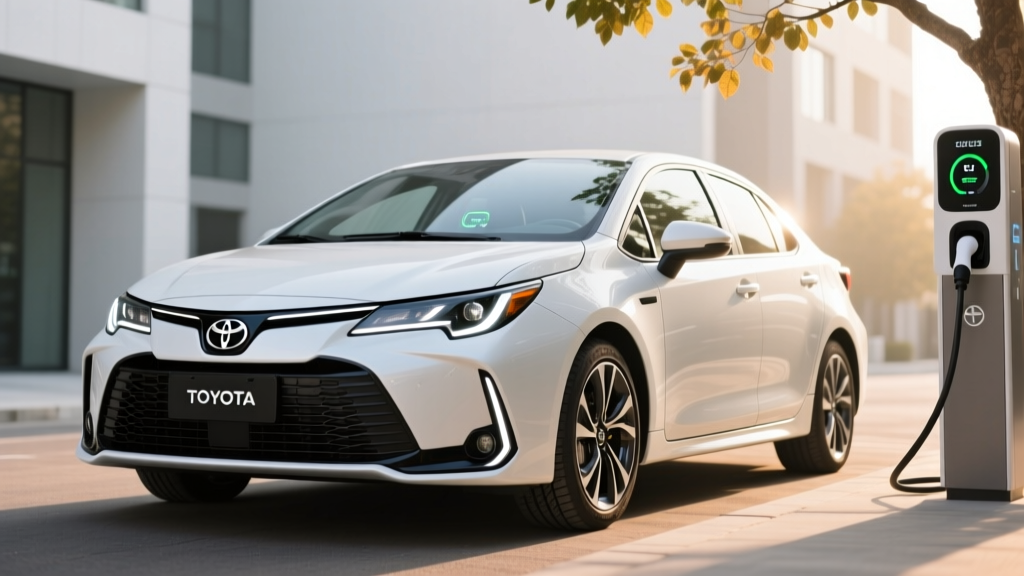
The Toyota Corolla Hybrid occupies a rare sweet spot in today's market: it's one of the least expensive new hybrids available, yet it returns fuel economy that rivals cars costing twice as much. For the 2025 model year, Toyota carries forward the fifth-generation hybrid powertrain introduced in 2023, adding minor trim shuffles and standard safety-tech updates. If you're researching the corolla hybrid 2025 lineup, this guide covers every number that matters — from EPA MPG to battery warranty to real-world ownership costs.
HEV vs PHEV: What the Corolla Hybrid Actually Is
Before diving into specs, a critical distinction: the Corolla Hybrid is a conventional hybrid (HEV), not a plug-in hybrid (PHEV). That means:
Corolla Hybrid (HEV): You never plug it in. A small battery recharges through regenerative braking and the gasoline engine. It cannot drive on electric power alone for meaningful distances. Think of it as a hyper-efficient gas car.
Plug-in Hybrid (PHEV) — e.g., Toyota Prius Prime: Has a larger battery you plug in overnight. Delivers 30–40+ miles of pure electric driving before the gas engine kicks in. Requires home charging access to justify the price premium.
Full Battery EV (BEV) — e.g., Tesla Model 3: No gasoline engine at all. Requires regular charging and offers 250–350+ miles of range. Lowest operating cost, highest upfront cost.
Toyota does not currently offer a Corolla PHEV in the US market. If plug-in capability matters to you, look at the Prius Prime or the RAV4 Prime instead.
EPA Fuel Economy: City, Highway, and Combined MPG
The 2025 Corolla Hybrid's headline number is its efficiency. Here's the full EPA breakdown by drivetrain configuration:
| Trim / Drivetrain | City MPG | Highway MPG | Combined MPG |
|---|---|---|---|
| LE (FWD) | 53 | 46 | 50 |
| LE (AWD) | 51 | 44 | 48 |
| XLE (FWD) | 53 | 46 | 50 |
Source: EPA fueleconomy.gov
The FWD LE and XLE trims share the same 50 MPG combined rating. Opting for electronic AWD — which adds a rear-mounted electric motor for traction in rain and snow — costs you just 2 MPG combined. That's a remarkably small penalty for all-weather capability.
Real-World MPG: What Owners Actually See
Hybrids tend to beat their EPA estimates in city driving, where regenerative braking recaptures energy at every stoplight. On the highway, where the gas engine does most of the work, real-world figures typically align with or slightly fall below the sticker.
Based on aggregated driver reports on Fuelly and independent testing:
- City driving: Expect 52–56 MPG in stop-and-go traffic. The hybrid system shines here.
- Highway (70 mph sustained): Expect 43–47 MPG. Aerodynamic drag and sustained engine load reduce the hybrid advantage.
- Cold weather (below 30°F): Expect a 5–10% drop, roughly 45–47 MPG combined, as the engine runs more frequently to warm the cabin and maintain battery temperature.
- Mixed real-world average: Most owners report 48–52 MPG across varied driving conditions.
At 50 MPG combined and a national average gas price of $3.25/gallon (early 2026), filling the 11.4-gallon tank costs about $37 and yields roughly 570 miles of range. Annual fuel cost for 12,000 miles: approximately $780. Compare that to a 30 MPG gas compact at $1,300/year — a $520 annual savings before any incentives.
Powertrain Specs: Engine, Motors, and Horsepower
| Specification | 2025 Corolla Hybrid |
|---|---|
| Engine | 1.8L 4-cylinder Atkinson cycle |
| Combined Net Horsepower | 138 hp |
| Front Motor Output | 70 kW (94 hp) |
| Rear Motor (AWD only) | 30 kW (40 hp) |
| Transmission | ECVT (planetary gearset) |
| 0–60 mph (est.) | ~9.0 seconds |
| Hybrid Battery | ~1.3 kWh, lithium-ion (sealed, not plug-in) |
| Fuel Tank | 11.4 gallons |
| Drivetrain | FWD standard; electronic AWD available |
The 138 combined horsepower figure is modest, and the ~9-second 0–60 time won't win any stoplight drag races. But the electric motor's instant torque makes the Corolla Hybrid feel surprisingly responsive in city driving — the initial pull from 0–30 mph is where you notice it most. The eCVT is smooth and gearless, with none of the rubber-band effect that plagued older CVTs.
The AWD system is worth noting: it's not a mechanical driveshaft to the rear wheels. Instead, a separate 30 kW electric motor at the rear axle engages automatically when the front wheels slip or under hard acceleration from a stop. It operates up to about 43 mph, after which the car reverts to FWD. This is a traction aid, not an off-road system.
Pricing, Trims, and Tax Credit Eligibility
The 2025 Corolla Hybrid is offered in two trims, with AWD available on the LE:
| Trim | Drivetrain | MSRP (incl. destination) |
|---|---|---|
| LE | FWD | $24,595 |
| LE | AWD | $25,995 |
| XLE | FWD | $28,495 |
Pricing per Toyota's official configurator. Verify with your dealer for current incentives.
Does the Corolla Hybrid Qualify for Federal Tax Credits?
No. Under current IRS §30D rules, the federal clean vehicle credit applies only to plug-in electric vehicles — battery EVs and plug-in hybrids with a minimum battery capacity of 7 kWh. The Corolla Hybrid's ~1.3 kWh battery does not meet this threshold. It does not qualify for the $7,500 federal credit, nor the $4,000 used-EV credit.
However, check your state. Some states (e.g., Colorado, Maryland) offer their own incentives for conventional hybrids, though these are increasingly rare as state programs shift toward plug-in vehicles. Always verify current rules on your state's energy or DMV website.
- ❌ Federal §30D credit: Not eligible (HEV, not plug-in)
- ❌ Federal used-EV credit: Not eligible
- ⚠️ State incentives: Varies by jurisdiction — check local programs
- ✅ Fuel savings: ~$520/year vs. a 30 MPG gas compact
Battery Warranty, Reliability, and Replacement Cost
Hybrid Battery Warranty: Toyota covers the Corolla Hybrid's battery pack for 10 years or 150,000 miles, whichever comes first. This applies to the original owner and is transferable to subsequent owners for the same duration.
Powertrain Warranty: 5 years / 60,000 miles.
Basic Bumper-to-Bumper: 3 years / 36,000 miles.
How Reliable Is the Corolla Hybrid?
Toyota's hybrid system is among the most proven in the industry — the same basic architecture has been in continuous production since the 1997 Prius. The Corolla Hybrid's fifth-generation powertrain benefits from two decades of iterative refinement. Consumer Reports consistently rates the Corolla Hybrid at or above average for predicted reliability, and Toyota's hybrid battery failure rates remain extremely low within the warranty period.
The eCVT transmission has no traditional clutch packs, torque converter, or shifting belts — it's a planetary gearset with few wear components. This contributes to the system's longevity.
What Does Hybrid Battery Replacement Cost?
If the hybrid battery fails outside the 10-year/150,000-mile warranty window, replacement costs typically range from $2,000 to $3,500 for a refurbished or new OEM battery pack, plus labor. Independent hybrid specialists often offer refurbished packs at the lower end of this range. Given that Toyota hybrid batteries routinely last 150,000–200,000+ miles, many owners will never face this expense.
The 12V auxiliary battery (a standard lead-acill or lithium unit that powers electronics) is a separate, inexpensive maintenance item — expect replacement every 4–6 years for $150–$250.
Corolla Hybrid vs. Prius vs. Full EV: Decision Framework
Choose the Corolla Hybrid if:
- You want maximum MPG without ever plugging in
- Your budget is under $29,000 and you want a new car with a full warranty
- You live in an apartment or lack home charging access
- You drive 12,000–15,000 miles/year and want to minimize fuel spend
- You value proven reliability and low maintenance costs
Choose the Toyota Prius (57 MPG) if:
- You want 7 MPG more and a more distinctive design, and can spend $29,000–$35,000
- You want a hatchback cargo layout for more versatility
Choose the Prius Prime (PHEV) if:
- You have home Level 2 charging and a commute under 44 miles
- You want to drive most days on electricity alone but need gas for road trips
- You may qualify for the $7,500 federal tax credit (check IRS sourcing rules)
Choose a full EV (e.g., Chevy Equinox EV, Tesla Model 3) if:
- You have reliable home charging
- Your daily driving is under 250 miles
- You want zero tailpipe emissions and the lowest per-mile fuel cost
- You're ready for the EV ownership learning curve (charging networks, preconditioning, range planning)
Pros and Cons at a Glance
Pros
- 50 MPG combined EPA — among the best of any non-plug-in vehicle
- Under $25,000 starting MSRP for the LE FWD
- 10-year / 150,000-mile hybrid battery warranty
- Toyota Safety Sense 3.0 standard (AEB, lane-keep, adaptive cruise)
- Available AWD for just $1,400 more
- Proven hybrid reliability with decades of real-world data
Cons
- 138 hp — leisurely acceleration, especially on highway merges
- No plug-in option — cannot drive on electric-only power
- No federal tax credit eligibility
- Tight rear seat and modest trunk (13.1 cu ft) vs. hatchback rivals
- Infotainment is functional but dated; no wireless CarPlay on LE
- XLE FWD only — no AWD option on the top trim
Frequently Asked Questions
How many MPG does the 2025 Corolla Hybrid get?
The FWD LE and XLE trims are EPA-rated at 53 city / 46 highway / 50 combined MPG. The AWD LE drops to 51/44/48. In real-world city driving, many owners report exceeding the EPA city estimate by 2–6 MPG thanks to regenerative braking.
Does the Corolla Hybrid need to be plugged in?
No. The Corolla Hybrid is a conventional hybrid (HEV). Its small battery charges automatically through regenerative braking and the gasoline engine. You fuel it exactly like a regular car — at the gas pump.
How far can the Corolla Hybrid go on electric-only power?
Essentially zero meaningful distance. The Corolla Hybrid can creep at very low speeds (parking lots, traffic jams) on electric power for a few hundred feet, but it is not designed for electric-only driving. If EV-only commuting matters to you, consider the Prius Prime PHEV (44 miles electric-only EPA).
Is the Corolla Hybrid reliable, and what is the battery replacement cost?
Yes. Toyota's hybrid system has an outstanding reliability track record spanning over 25 years. The hybrid battery is warranted for 10 years/150,000 miles, and replacement outside warranty typically costs $2,000–$3,500. Most batteries last well beyond 150,000 miles.
Does the 2025 Corolla Hybrid qualify for any federal tax credit?
No. Under current IRS §30D rules, only plug-in vehicles (BEVs and PHEVs meeting minimum battery capacity thresholds) qualify for the federal clean vehicle credit. The Corolla Hybrid is an HEV and is not eligible. Check your state for any local hybrid incentives.
How does the Corolla Hybrid compare to the regular gas Corolla?
The gas-only Corolla (2.0L, 169 hp) is rated at 32 city / 41 highway / 35 combined MPG. The hybrid costs roughly $2,500–$3,000 more upfront but saves about $520/year in fuel at 12,000 miles annually — paying back the premium in about 5 years. If you plan to own the car 7+ years, the hybrid almost always wins on total cost.
Is the AWD system worth it?
If you live where roads see rain, snow, or ice regularly, the $1,400 premium for electronic AWD is worthwhile. You sacrifice only 2 MPG combined, and the system adds genuine traction confidence. If you're in a dry, warm climate, FWD is the more efficient and economical choice.
Safety ratings: The 2025 Corolla Hybrid earned a 5-star overall rating from NHTSA and a Top Safety Pick designation from IIHS (when equipped with specific headlights). Always verify the latest ratings for the exact trim and build date you're considering.