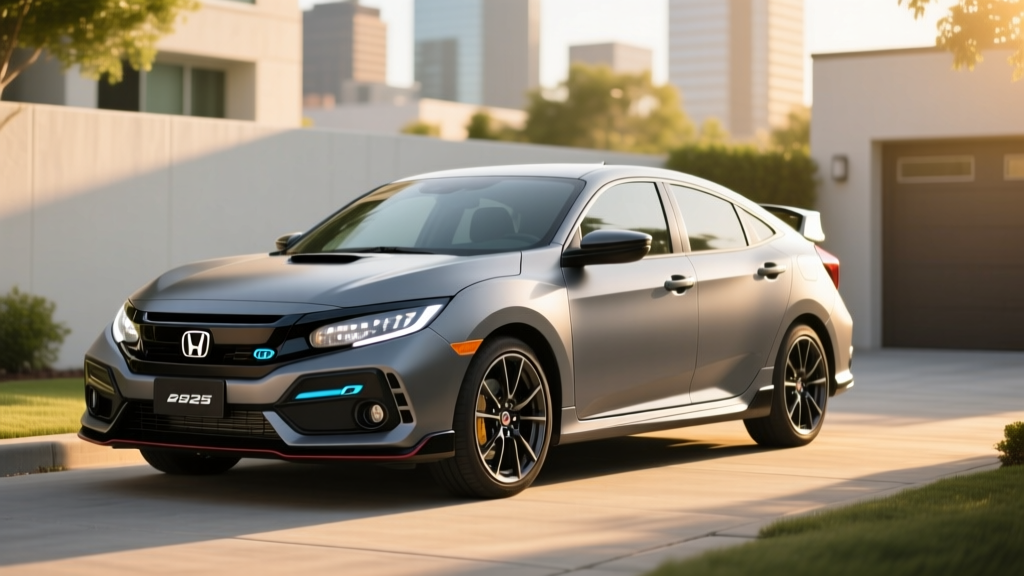
The 2025 Honda Civic Sport Hybrid Hatchback occupies a specific niche: a practical, efficient hatchback that requires zero lifestyle adjustment to own. No plugs, no charging apps, no range calculations. You fill it with gas and drive. Honda's two-motor hybrid system pairs a 2.0-liter Atkinson-cycle four-cylinder with two electric motors for a combined 200 horsepower and an EPA-estimated 50 MPG combined. At a starting MSRP of $30,950 (including destination), it undercuts many compact crossovers while delivering superior efficiency and cargo versatility.
This guide breaks down the powertrain, real-world fuel economy expectations, battery longevity, and where the Civic Sport Hybrid fits against plug-in hybrids and full EVs for different driver profiles.
Powertrain Specs: Honda's Two-Motor Hybrid System
| Spec | Value |
|---|---|
| Engine | 2.0L Atkinson-cycle 4-cylinder |
| Combined System Horsepower | 200 hp |
| Combined System Torque | 232 lb-ft |
| Transmission | e-CVT (direct drive) |
| Drivetrain | Front-wheel drive |
| 0–60 mph (est.) | ~7.5 seconds |
| EPA Combined MPG | 50 MPG |
| EPA City MPG | 50 MPG |
| EPA Highway MPG | 47 MPG |
| Fuel Tank Capacity | 10.6 gallons |
| Total Range (EPA est.) | ~530 miles |
| Cargo Volume (rear seats up) | 24.5 cu ft |
| Cargo Volume (rear seats folded) | 47.0 cu ft |
| Base MSRP (Sport Hybrid, incl. dest.) | $30,950 |
Honda's hybrid architecture is fundamentally different from Toyota's planetary-gear system. The Civic uses a series-parallel setup where the gasoline engine primarily acts as a generator, feeding electricity to the drive motor. At steady highway speeds, a lock-up clutch connects the engine directly to the wheels for efficiency. This means most of your driving — especially in the city — feels like an electric car, with instant torque delivery and no traditional gear shifts.
The 200-horsepower combined output makes the Sport Hybrid the quickest non-Type-R Civic hatchback. Torque peaks at 232 lb-ft, available almost immediately from the electric drive motor. The result is confident highway merging and responsive city acceleration that the non-hybrid 1.5L turbo Civic (180 hp) cannot match.
Real-World MPG: What to Actually Expect
| Scenario | EPA Estimate | Real-World Expectation |
|---|---|---|
| City Driving | 50 MPG | 50–55 MPG |
| Highway (70 mph) | 47 MPG | 43–46 MPG |
| Combined (mixed) | 50 MPG | 46–50 MPG |
| Cold Weather (below 32°F) | N/A | 40–45 MPG |
| Aggressive/Heavy Load | N/A | 36–40 MPG |
Hybrids routinely exceed their EPA city estimates because regenerative braking recovers energy that conventional cars waste as heat. On city routes with frequent stops, expect 50–55 MPG with normal driving habits. The EPA highway figure of 47 MPG is achievable at 60–65 mph; at sustained 75–80 mph interstate speeds, aerodynamic drag pushes real-world highway economy down to roughly 43–46 MPG.
Cold weather impacts all vehicles, but hybrids see a more pronounced drop. Below freezing, the engine runs more frequently to provide cabin heat and maintain battery temperature. Expect a 10–15% fuel economy reduction in winter months, landing around 40–45 MPG combined. This is still dramatically better than a comparable gas-only compact car, which might drop to 25–28 MPG in the same conditions.
According to fueleconomy.gov, the 2025 Civic Hybrid's 50 MPG combined ranks among the most efficient non-plug-in vehicles sold in the US, trailing only the Toyota Prius and Hyundai Elantra Hybrid in the compact segment.
Hybrid vs. Plug-In Hybrid vs. Full EV: Which Fits Your Life?
- HEV (Conventional Hybrid): No plug. Battery charges via regenerative braking and the engine. The Civic Sport Hybrid is an HEV. You never plug it in.
- PHEV (Plug-In Hybrid): Larger battery (typically 10–20 kWh) that charges from a wall outlet, providing 20–45 miles of electric-only range before the gas engine takes over. Examples: Toyota RAV4 Prime, Jeep Wrangler 4xe.
- BEV (Battery Electric Vehicle): No gasoline engine. Runs entirely on battery power (50–100+ kWh). Must be charged from an outlet or public station. Examples: Tesla Model 3, Hyundai Ioniq 5.
The Civic Sport Hybrid Hatchback is a conventional hybrid (HEV). It has a small battery (approximately 1.1 kWh usable) that charges exclusively through regenerative braking and engine-driven generation. There is no plug, no charging port, and no electric-only driving range to manage. This is a deliberate feature, not a limitation — it means the car works for any driver regardless of home charging access.
- You lack home charging access (apartment, street parking)
- You want EV-like efficiency with zero infrastructure changes
- Your daily commute is under 40 miles round-trip
- You want a lower purchase price than a PHEV or EV
- You have a garage/driveway with a 120V or 240V outlet
- Your daily commute is under 35 miles (cover it on electric)
- You take regular road trips and want no range anxiety
- You want to reduce gas consumption by 70–90%
- You have reliable Level 2 home charging
- You want zero tailpipe emissions and lowest fuel cost
- Most trips are under 250 miles or you're willing to DC fast-charge
- You want minimal maintenance (no oil changes, fewer moving parts)
Pricing, Trims, and Tax Credit Eligibility
| Trim | MSRP (incl. destination) |
|---|---|
| Sport Hybrid | $30,950 |
| Sport Touring Hybrid | $33,950 |
Under current IRS §30D Clean Vehicle Credit rules, conventional hybrids like the Civic Sport Hybrid do not qualify for the federal $7,500 EV tax credit. The §30D credit applies exclusively to battery electric vehicles (BEVs) and plug-in hybrids (PHEVs) that meet battery capacity thresholds, critical mineral sourcing, and battery component manufacturing requirements.
The Civic Hybrid also does not qualify for the up-to-$4,000 used clean vehicle credit (§25E), as it is a new vehicle purchase and the credit applies to pre-owned BEVs and PHEVs only.
Some states and municipalities offer rebates or HOV lane access for hybrids. California's Clean Fuel Rebate program, for example, has historically offered up to $1,000 for certain hybrid models, though availability and amounts vary by year and funding. Check your state's energy office or Alternative Fuels Data Center for current local incentives.
Battery Longevity, Warranty, and Replacement Cost
Honda covers the Civic Hybrid's lithium-ion battery pack with a warranty of 8 years or 100,000 miles (whichever comes first). In California Air Resources Board (CARB) states — including CA, CT, ME, MD, MA, NJ, NY, OR, RI, VT, and WA — the warranty extends to 10 years or 150,000 miles under California emissions warranty requirements.
The Civic Hybrid's battery pack is approximately 1.1 kWh (usable capacity). This is a small battery by design — it buffers energy from regenerative braking and engine generation, then deploys it for electric motor assist. Because it never depletes below roughly 40% state of charge and never charges above roughly 80%, the battery operates in a narrow, low-stress window that dramatically extends its lifespan.
Honda's hybrid battery track record is strong. Third-generation Civic Hybrids (2012–2015) and earlier IMA-system vehicles experienced some battery failures, but the current two-motor system (introduced in the Accord Hybrid and refined for the Civic) uses more robust lithium-ion cells with advanced thermal management. Real-world data from high-mileage Honda hybrid owners suggests batteries routinely last 150,000–200,000+ miles before significant capacity loss.
If a replacement is needed out of warranty, Honda hybrid battery packs typically cost between $2,000 and $4,000 including installation at a dealership. Independent hybrid battery shops offer refurbished packs for $1,000–$2,000. This is a fraction of EV battery replacement costs ($8,000–$20,000+) because the pack is far smaller.
Driving Impressions and Practical Ownership
The Sport Hybrid's e-CVT behavior is notably different from older Honda IMA hybrids. Because the electric drive motor handles most propulsion, acceleration is linear and quiet. The gasoline engine only engages directly at highway cruising speeds (via the lock-up clutch) or under hard acceleration demands. Most drivers won't notice the transitions.
Honda includes three driving modes: ECON, Normal, and Sport. ECON mode softens throttle response and increases regenerative braking for maximum efficiency. Sport mode sharpens accelerator mapping and holds the engine at higher RPM for more aggressive power delivery. Normal mode strikes a balance that most owners will leave selected permanently.
The hatchback body style adds genuine utility. With 24.5 cubic feet behind the rear seats and 47.0 cubic feet with them folded, the Civic hatchback offers cargo capacity that rivals small crossovers. The Sport Hybrid trim includes a spare tire (a compact temporary), which some hybrid competitors delete to save weight.
Honda Sensing — the brand's ADAS suite — comes standard on all trims. This includes adaptive cruise control, lane-keeping assist, forward collision warning with automatic emergency braking, and traffic sign recognition. This is an SAE Level 2 driver-assistance system, meaning the driver must remain fully attentive with hands on the wheel at all times. It does not enable autonomous or self-driving operation.
Pros and Cons
- 50 MPG EPA combined — among the most efficient non-PHEV vehicles sold
- 200 hp provides strong acceleration for the segment
- No plug required — works for apartment dwellers and street parkers
- Hatchback cargo versatility (47 cu ft max)
- 8-year/100,000-mile hybrid battery warranty (10/150k in CARB states)
- Honda Sensing ADAS standard on all trims
- Compact spare tire included
- No federal tax credit eligibility
- Highway MPG drops at sustained 75+ mph speeds
- FWD only — no AWD option (unlike Toyota Prius)
- Rear-seat legroom is adequate but not class-leading
- Infotainment screen (7-inch on Sport) is smaller than rivals
- No plug-in hybrid variant available in the US
Frequently Asked Questions
How many MPG does the 2025 Honda Civic Sport Hybrid Hatchback get?
The EPA rates it at 50 MPG city, 47 MPG highway, and 50 MPG combined. In real-world city driving with frequent stops, many owners report 50–55 MPG thanks to regenerative braking. Highway fuel economy at 75+ mph drops to roughly 43–46 MPG. Cold weather reduces combined economy by 10–15%.
Does the Civic Sport Hybrid need to be plugged in?
No. The Civic Sport Hybrid is a conventional hybrid (HEV), not a plug-in hybrid. The battery charges entirely through regenerative braking and the gasoline engine. There is no charging port and no plug-in capability. You simply fill the 10.6-gallon fuel tank and drive.
Is the 2025 Civic Hybrid reliable?
Honda's two-motor hybrid system has proven reliable since its introduction in the Accord Hybrid. The battery operates in a narrow state-of-charge window (roughly 40–80%) that minimizes degradation. Honda's 8-year/100,000-mile hybrid battery warranty (10 years/150,000 miles in CARB states) provides long-term protection. Historical data suggests these batteries routinely last 150,000+ miles.
What does a Honda Civic Hybrid battery replacement cost?
Out-of-warranty replacement at a Honda dealership typically costs $2,000–$4,000 including parts and labor. Independent hybrid specialists offer refurbished battery packs for $1,000–$2,000. This is significantly less than EV battery replacement costs due to the Civic Hybrid's small ~1.1 kWh pack.
Does the Civic Sport Hybrid qualify for any tax credit?
No. Under IRS §30D rules, the federal clean vehicle credit applies only to battery electric vehicles and plug-in hybrids that meet specific battery sourcing and capacity requirements. The Civic Sport Hybrid, as a conventional HEV, does not qualify. Some states offer modest hybrid rebates — check the Alternative Fuels Data Center for your state's current programs.
How does the Civic Hybrid compare to the Toyota Prius?
The Toyota Prius (57 MPG combined, 196 hp) is slightly more efficient and offers available AWD, but the Civic Hybrid provides more cargo space (24.5 vs. 20.1 cu ft behind rear seats), a more engaging driving experience with its 200 hp output, and a traditional hatchback design. The Prius starts lower (~$28,550), making it the efficiency-per-dollar winner, while the Civic Hybrid wins on practicality and driving dynamics.
Should I buy the Civic Hybrid or a full EV?
Choose the Civic Hybrid if you lack home charging access, regularly drive more than 300 miles between stops, or want a lower upfront cost with no infrastructure investment. Choose a BEV (like the Chevrolet Equinox EV or Hyundai Ioniq 5) if you have Level 2 home charging, want the lowest per-mile fuel cost (~$0.04/mile on electricity vs. ~$0.08/mile on gas for the Civic Hybrid at $3.50/gal), and qualify for the $7,500 federal tax credit, which can make an EV cheaper to own over five years.