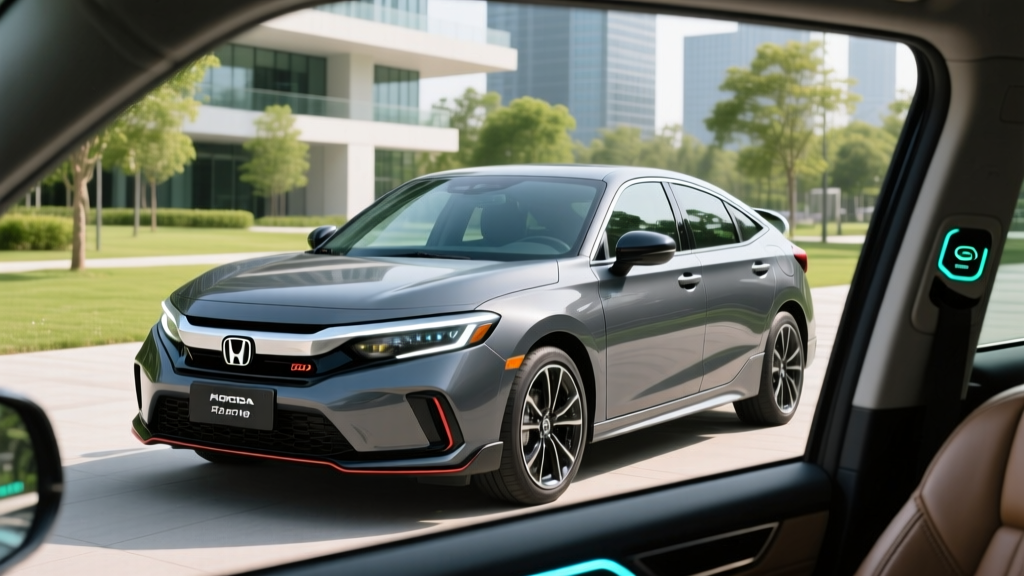
The 2025 Honda Civic Hatchback Hybrid Sport Touring occupies a narrow but compelling lane: it's the most powerful, best-equipped Civic hybrid Honda sells, wrapped in a practical hatchback body that delivers genuine 50 MPG daily driving without a charging cable in sight. For buyers weighing electrification but unwilling to deal with plug-in logistics, range planning, or the premium of a full EV, this is Honda's strongest argument for the conventional hybrid (HEV) approach.
This review breaks down every number that matters — EPA fuel economy, real-world efficiency, powertrain output, cargo utility, warranty coverage, and total cost — so you can decide whether the Sport Touring trim justifies its price or whether a lower trim, a plug-in hybrid, or a full battery-electric vehicle better fits your life.
HEV vs PHEV vs EV: Where the Civic Hybrid Fits
Before evaluating the Civic, it's essential to separate three fundamentally different powertrain architectures that buyers frequently conflate:
| Attribute | HEV (Conventional Hybrid) | PHEV (Plug-In Hybrid) | BEV (Battery Electric) |
|---|---|---|---|
| Plugs in? | No — refuels with gas only | Yes — gas + plug-in electric | Yes — electric only |
| Electric-only range | None (motor assists engine) | Typically 20–45 miles | 200–400+ miles |
| Fuel/energy source | Gasoline | Gasoline + grid electricity | Grid electricity |
| Federal tax credit (§30D) | Not eligible | Up to $7,500 (if eligible) | Up to $7,500 (if eligible) |
| Home charging needed? | No | Recommended (Level 2) | Essential (Level 2) |
| Example | Honda Civic Hybrid | Toyota RAV4 Prime | Honda Prologue |
The 2025 Honda Civic Hatchback Hybrid is a conventional HEV. It has no plug, no electric-only driving mode, and no eligibility for the federal §30D tax credit. Its battery recharges through regenerative braking and the gasoline engine. If you want electric-only commuting, you need a PHEV like the Toyota Prius Prime or a full BEV. If you want maximum fuel economy with zero lifestyle change — no charger installation, no range planning, no app management — the HEV architecture is purpose-built for you.
Fuel Economy: EPA Ratings and Real-World MPG
The 2025 Civic Hatchback Hybrid Sport Touring carries the following EPA fuel-economy estimates, as published on fueleconomy.gov:
| Driving Cycle | EPA Estimate |
|---|---|
| City | 50 MPG |
| Highway | 45 MPG |
| Combined | 47 MPG |
These numbers apply to the Sport Touring trim with its standard all-wheel drive (AWD). The lower Sport Hybrid trim, which is front-wheel drive (FWD), rates slightly higher at 51 city / 48 highway / 49 combined.
Real-World MPG: What Owners Actually See
Honda's two-motor hybrid system excels in stop-and-go traffic, where the electric motor handles low-speed propulsion and the engine only engages at higher loads. In real-world testing and owner reports aggregated across forums and third-party trackers:
- City/suburban mixed driving: 48–53 MPG — frequently exceeding the EPA city estimate, which is common for Honda's e:HEV system.
- Highway-only at 70–75 mph: 40–44 MPG — aerodynamic drag and the engine running at sustained RPM reduce the hybrid advantage.
- Cold weather (below 30°F): 38–43 MPG combined — the engine runs more frequently to provide cabin heat and warm the catalytic converter.
For a driver covering 15,000 miles per year at a real-world 47 MPG average, annual fuel consumption is approximately 319 gallons. At $3.40/gallon (national average as of early 2026), that's roughly $1,085 per year in fuel. A comparable non-hybrid Civic (33 MPG combined) would burn 455 gallons, or about $1,547 — a savings of approximately $462 annually with the hybrid.
Powertrain Specs: 200 HP From a Two-Motor Hybrid
The 2025 Civic Hatchback Hybrid uses Honda's fourth-generation two-motor hybrid system, which pairs a 2.0-liter Atkinson-cycle four-cylinder engine with two electric motors and a lithium-ion battery pack. Unlike Toyota's planetary-gear power-split system, Honda's setup operates primarily as a series hybrid at low speeds (the engine generates electricity; the drive motor turns the wheels) and switches to a parallel configuration at highway speeds via a lockup clutch.
| Specification | 2025 Civic Hatchback Hybrid Sport Touring |
|---|---|
| Combined system horsepower | 200 hp |
| Combined system torque | 232 lb-ft |
| Gasoline engine | 2.0L Atkinson-cycle I4 (143 hp / 134 lb-ft) |
| Drive motor output | 184 hp / 232 lb-ft |
| Drivetrain | AWD (standard on Sport Touring) |
| Transmission | e-CVT (single-speed direct drive) |
| 0–60 mph (est.) | ~7.1 seconds |
| Hybrid battery type | Lithium-ion (small capacity, ~1.1 kWh usable) |
| Curb weight | ~3,252 lbs |
The 200 combined horsepower represents a significant upgrade over the non-hybrid Civic's 180 hp turbocharged engine, and the 232 lb-ft of torque — available instantly from the electric motor — gives the hybrid noticeably stronger off-the-line acceleration. The Sport Touring's standard AWD adds rear-axle traction via a mechanical driveshaft linked to the engine, not a separate rear electric motor.
Pricing, Trims, and Tax Credit Eligibility
The 2025 Civic Hatchback Hybrid is available in two trims. Pricing below includes Honda's $1,095 destination charge:
| Trim | MSRP (incl. destination) | Drivetrain |
|---|---|---|
| Sport Hybrid | $30,095 | FWD |
| Sport Touring Hybrid | $32,350 | AWD |
Federal Tax Credit: Not Eligible
Under current IRS §30D rules, the federal clean vehicle credit of up to $7,500 applies only to plug-in electric vehicles (PHEVs and BEVs) with a minimum battery capacity of 7 kWh. The Civic Hybrid's battery is approximately 1.1 kWh — far below the threshold. No federal tax credit is available for any conventional hybrid, including this one.
Some states offer their own hybrid or high-efficiency vehicle incentives, but these vary by jurisdiction and change frequently. Check your state's energy office or department of revenue for current programs. Do not rely on dealer claims about credit eligibility without verifying against official IRS and state sources.
What the Sport Touring Gets for $2,255 More
The $2,255 step-up from Sport to Sport Touring adds:
- AWD (standard on Sport Touring, unavailable on Sport Hybrid)
- 12-speaker Bose premium audio system
- Wireless phone charging pad
- Leather-trimmed seats (heated front)
- Heated steering wheel
- Low-speed braking control and additional Honda Sensing features
- 18-inch alloy wheels (vs. 17-inch on Sport)
If AWD is important for your climate, the Sport Touring is the only option. If you're in a mild-winter region and don't need the premium features, the Sport Hybrid at $30,095 delivers the same powertrain and fuel economy for less.
Battery Warranty, Lifespan, and Replacement Cost
Honda Hybrid Battery Warranty
Honda covers the hybrid battery pack for 8 years / 100,000 miles in most states, and 10 years / 150,000 miles in states that follow California Air Resources Board (CARB) emissions warranty requirements (including CA, NY, MA, NJ, CT, RI, VT, ME, NH, OR, WA, CO, MD, and others adopting CARB standards).
How Long Will the Hybrid Battery Last?
Honda's lithium-ion hybrid battery is designed for longevity. Unlike full EV batteries that cycle deeply (from 100% to near-empty), hybrid batteries operate in a narrow state-of-charge window — typically between 40% and 70% — which dramatically reduces degradation stress. Based on long-term data from Honda's hybrid fleet (Insight, Accord Hybrid, CR-V Hybrid):
- Expected lifespan: 150,000–200,000+ miles before significant capacity loss
- Degradation pattern: Minimal — the small battery and shallow cycling mean most owners never notice performance decline
- Failure rate: Low — widespread hybrid battery failures are uncommon in Honda's system
Battery Replacement Cost
If the hybrid battery does require replacement outside of warranty:
- OEM replacement battery: $2,000–$3,500 (part cost)
- Labor: $300–$600
- Total out-of-pocket: $2,300–$4,100 at a dealership
Third-party remanufactured batteries are available for $1,200–$2,000, and independent hybrid specialists can install them for less than dealership rates. For context, this cost is significantly lower than EV battery replacement ($8,000–$20,000+), because the hybrid battery is small (~1.1 kWh vs. 60–100 kWh in a BEV).
Cargo, Interior, and Daily Practicality
The hatchback body style is the Civic Hybrid's strongest practicality advantage over the sedan. Key dimensions:
- Cargo volume (rear seats up): 25.0 cubic feet
- Cargo volume (rear seats folded): 47.4 cubic feet
- Front headroom: 39.3 inches
- Rear legroom: 37.4 inches
The Sport Touring trim includes a 9-inch touchscreen with wireless Apple CarPlay and Android Auto, a 10.2-inch digital instrument cluster, built-in navigation, and the full Honda Sensing suite (adaptive cruise control, lane-keeping assist, collision mitigation braking, traffic sign recognition). These are SAE Level 1–2 driver-assistance features — they do not replace an attentive driver and require hands on the wheel at all times.
The cargo area features a low load floor and a reversible cargo panel (carpet on one side, plastic on the other) for hauling dirty items. The 60/40 split rear seat folds nearly flat. For a compact hatchback, this is competitive with the Mazda3 hatchback and slightly smaller than the Subaru Impreza/Crosstrek.
Who Should Choose the Civic Hybrid vs. a PHEV or Full EV?
Choose the 2025 Civic Hatchback Hybrid Sport Touring if:
- You cannot install a home Level 2 charger (apartment, street parking, condo restrictions)
- Your daily driving is a mix of city and highway with no single pattern
- You want fuel savings without changing any habits — no plugging in, no apps, no route planning
- You need AWD for snow/rain but don't want an SUV
- You drive 12,000–18,000 miles per year and want to minimize fuel cost below $1,200/year
- You plan to keep the car 8–12 years and value proven hybrid reliability
Consider a PHEV instead if:
- You can charge at home and your commute is under 30 miles round-trip (a PHEV like the Prius Prime gives you 44 electric-only miles, eliminating gas use on most days)
- You want to qualify for the $7,500 federal tax credit (PHEVs with ≥7 kWh batteries may qualify, subject to MSRP, income, and sourcing rules)
Consider a full EV instead if:
- You have reliable home charging and your daily driving is under 250 miles
- You want zero tailpipe emissions and lower maintenance (no oil changes, no engine wear)
- You want the $7,500 federal credit and your income/tax situation qualifies
- Options to evaluate: Chevrolet Equus EV, Hyundai Ioniq 5, Tesla Model 3, Honda Prologue
Ownership Costs: 5-Year Projection
Below is an estimated 5-year / 75,000-mile cost breakdown for the Sport Touring Hybrid, assuming $3.40/gallon gas, 47 MPG real-world average, and national-average insurance rates for a compact hybrid hatchback:
| Cost Category | 5-Year Estimate |
|---|---|
| Purchase price (MSRP) | $32,350 |
| Fuel (75,000 mi ÷ 47 MPG × $3.40/gal) | $5,426 |
| Insurance (avg. $1,400/yr × 5) | $7,000 |
| Maintenance (oil, tires, brakes, filters) | $2,500 |
| Federal tax credit | $0 (HEV not eligible) |
| Total 5-year cost | ~$47,276 |
For comparison, a non-hybrid Civic Sport Touring sedan (33 MPG combined, ~$30,500 MSRP) would cost approximately $49,912 over five years — roughly $2,636 more, driven entirely by higher fuel consumption. The hybrid pays for its ~$1,850 price premium in about 4 years of average driving.
Pros
- 47 MPG combined EPA; frequently exceeds 50 MPG in real city driving
- 200 hp / 232 lb-ft — strongest acceleration in the Civic lineup
- AWD standard on Sport Touring — rare in the compact hybrid segment
- Hatchback cargo versatility (25 cu ft / 47.4 cu ft)
- No plug-in required — zero lifestyle change from a gas car
- Proven Honda hybrid reliability; 8–10 year battery warranty
- Comprehensive Honda Sensing ADAS suite standard
Cons
- No federal tax credit eligibility (HEV)
- Sport Touring at $32,350 pushes into territory where PHEVs and EVs become viable
- Highway MPG drops to ~40–44 real-world — hybrid advantage shrinks on long trips
- AWD is mechanical (engine-driven), not electric rear motor — less sophisticated torque vectoring
- Small (~1.1 kWh) hybrid battery means no electric-only driving, even at low speeds
- Cabin noise under hard acceleration (engine drone from Atkinson-cycle four)
Frequently Asked Questions
How many MPG does the 2025 Honda Civic Hatchback Hybrid Sport Touring get?
The EPA rates it at 50 city / 45 highway / 47 combined. In real-world mixed driving, most owners report 46–52 MPG. Highway-only driving at 75 mph typically yields 40–44 MPG. Cold weather can drop combined figures to 38–43 MPG.
Does the Civic Hybrid need to be plugged in?
No. The 2025 Civic Hybrid is a conventional HEV. Its small lithium-ion battery recharges through regenerative braking and the gasoline engine. There is no plug, no charging port, and no electric-only range. You fuel it exclusively at gas stations.
Does the 2025 Civic Hatchback Hybrid qualify for any tax credit?
Not the federal §30D clean vehicle credit, which requires a minimum 7 kWh battery (the Civic Hybrid's battery is ~1.1 kWh). Some states may offer efficiency or hybrid incentives — check your state's energy or revenue department. Consult a tax professional for personal eligibility.
Is the Honda Civic Hybrid reliable? What does battery replacement cost?
Honda's hybrid system has a strong reliability track record across the Accord, CR-V, and Insight. The hybrid battery is warrantied for 8 years/100,000 miles (10/150,000 in CARB states). Out-of-warranty replacement costs $2,300–$4,100 at a dealer, or $1,500–$2,500 through an independent hybrid specialist with a remanufactured unit. Most hybrid batteries last 150,000–200,000+ miles.
How does the Civic Hybrid compare to a PHEV like the Toyota Prius Prime?
The Prius Prime offers 44 miles of electric-only range, qualifies for up to $7,500 in federal tax credits (if eligibility requirements are met), and achieves 52 MPG combined as a hybrid once the battery is depleted. However, it requires home charging to realize its benefits, costs more upfront ($33,445 base), and lacks AWD. If you can charge at home and commute under 44 miles, the Prius Prime eliminates most gasoline use. If you can't charge at home, the Civic Hybrid delivers strong efficiency with zero plug-in hassle.
What's the difference between the Sport and Sport Touring Hybrid trims?
The Sport Hybrid ($30,095) is FWD with cloth seats, 17-inch wheels, and an 8-speaker audio system. The Sport Touring Hybrid ($32,350) adds AWD, leather heated seats, heated steering wheel, 12-speaker Bose audio, wireless charging, and 18-inch wheels. The hybrid powertrain (200 hp, 232 lb-ft) is identical on both trims.
How much cargo space does the Civic Hatchback Hybrid have?
25.0 cubic feet with the rear seats up and 47.4 cubic feet with them folded. This is competitive for the compact hatchback segment — comparable to the Mazda3 hatchback (20.1/47.1 cu ft) and slightly less than the Subaru Impreza hatchback (20.4/55.3 cu ft).