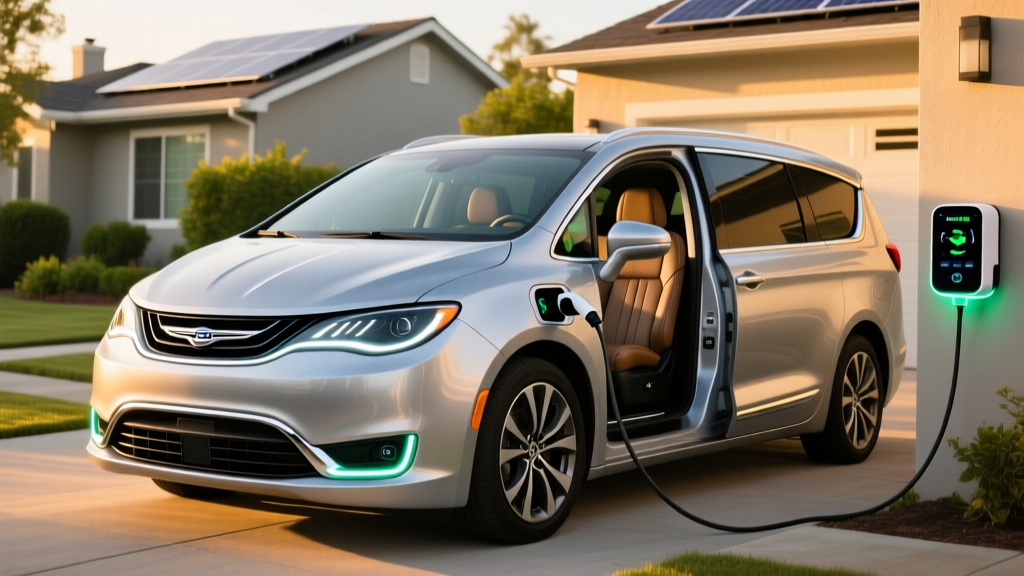
The minivan segment hasn't gone fully electric yet, but the 2025 Chrysler Pacifica Plug-In Hybrid Select comes closer than any rival to bridging school-run efficiency with cross-country practicality. With 32 miles of electric-only range, a combined 82 MPGe, and the flexibility of a gasoline engine for longer trips, it occupies a unique niche: the family hauler that can commute on electrons and road-trip on unleaded. But at a starting MSRP hovering around $51,000, does the math work? We break down every spec, real-world efficiency number, and ownership cost you need to evaluate before signing on the dotted line.
HEV vs PHEV: What the Pacifica Plug-In Hybrid Actually Is
Before diving into specs, it's worth clarifying what you're buying — because Chrysler also sells a conventional hybrid Pacifica, and the two powertrains behave very differently.
| Feature | Pacifica Hybrid (HEV) | Pacifica Plug-In Hybrid (PHEV) |
|---|---|---|
| Battery size | ~1.0 kWh (small buffer) | 16.2 kWh usable |
| Plugs in? | No — regenerative braking only | Yes — Level 1 (120V) or Level 2 (240V) |
| Electric-only range | 0 miles (motor assists engine) | 32 miles (EPA) |
| EV mode capability | Very short low-speed EV creep | Full highway-capable EV driving to ~75 mph |
| EPA combined (hybrid mode) | 30 MPG | 30 MPG (after battery depleted) |
| MPGe (charge-sustaining + EV) | N/A | 82 MPGe combined |
| Federal tax credit | None | Up to $7,500 (eligibility varies) |
The Select trim is the entry point for the PHEV lineup. If you never plug in, you're essentially driving a heavy conventional hybrid and forfeiting most of the efficiency benefit. The PHEV rewards owners who can charge at home nightly — more on that below.
Electric-Only Range, MPGe, and Fuel Economy Breakdown
The headline numbers from the EPA on fueleconomy.gov tell a two-part story depending on whether the battery is charged or depleted.
| Mode | City | Highway | Combined |
|---|---|---|---|
| Charge-depleting (EV + gas blend) | 82 MPGe combined | ||
| Charge-sustaining (gas-only hybrid) | 29 MPG | 30 MPG | 30 MPG |
| Electric-only range | 32 miles (EPA) | ||
| Total combined range (EV + gas) | ~520 miles | ||
Once the battery depletes, the 3.6-liter Pentastar V6 takes over as a conventional hybrid, delivering a respectable 30 MPG combined. That's meaningful for a 4,800–5,100 lb minivan — comparable midsize SUVs without hybridization average 22–25 MPG.
Powertrain Specs: Engine, Motors, and Combined Output
| Specification | Detail |
|---|---|
| Engine | 3.6L Pentastar V6 (Atkinson cycle) |
| Electric motors | Two motor-generators integrated into eFlite CVT |
| Combined system horsepower | 260 hp |
| Transmission | eFlite electrically variable transmission (single-speed) |
| Battery chemistry | Lithium-ion (NMC) |
| Battery capacity (usable) | 16.2 kWh |
| Drivetrain | Front-wheel drive only (no AWD on PHEV) |
| 0–60 mph | ~7.5 seconds (estimated) |
| Cargo volume (behind 3rd row) | 32.3 cu ft (no Stow 'n Go in 2nd row due to battery) |
One critical packaging note: the PHEV's battery sits beneath the second-row floor, which means second-row Stow 'n Go seating is deleted. You get captain's chairs that fold forward but don't disappear into the floor. If maximum flat-load cargo space is a dealbreaker, the conventional hybrid or gas Pacifica retains full Stow 'n Go. This is the single biggest practical compromise of the PHEV powertrain.
The two electric motors and V6 combine for 260 horsepower — adequate for merging and passing, though not quick by EV standards. The eFlite transmission is smooth and avoids the rubber-band feel of some CVTs because the electric motors handle low-speed torque seamlessly.
Charging: Level 1, Level 2, and What You Need at Home
Unlike a full BEV, the Pacifica PHEV does not support DC fast charging. Its onboard charger maxes out at 6.6 kW on Level 2 AC power. Here's what to expect:
| Charging Level | Power | 0–100% Time | Practical Notes |
|---|---|---|---|
| Level 1 (120V household outlet) | ~1.4 kW | ~14 hours | Works overnight for most commuters; includes portable cordset |
| Level 2 (240V, 30A circuit) | 6.6 kW (peak) | ~2 hours | Requires dedicated 240V outlet or hardwired EVSE |
| DC Fast Charge | N/A | N/A | Not supported — J1772 AC inlet only |
For most PHEV owners, Level 1 from a standard 120V garage outlet is sufficient. You're only replenishing 16.2 kWh — not an 80+ kWh BEV battery. Plugging in at 7 PM gives you a full charge by 9 AM. If you want faster top-ups (say, between school runs), a Level 2 home charger like a ChargePoint Home Flex or Emporia Vue on a 30-amp/240V circuit will refill the pack in roughly two hours.
Home installation costs for a Level 2 circuit typically run $500–$1,500 if your electrical panel has capacity and the run is short. Older homes with 100-amp panels may need a $2,000–$4,000 panel upgrade. Always consult a licensed electrician for a site-specific quote.
Pricing, Trims, and Federal Tax Credit Eligibility
The 2025 Pacifica Plug-In Hybrid Select starts at an MSRP of approximately $51,095 (including destination). Higher trims — Limited and Pinnacle — push the price to $56,000–$60,000+. Here's how the federal tax credit landscape looks as of current IRS §30D rules:
- Credit amount: Up to $7,500, split into $3,750 for battery components (North American assembly) and $3,750 for critical minerals sourcing
- Vehicle MSRP cap: Vans/SUVs/trucks capped at $80,000 — Pacifica PHEV qualifies
- Buyer income cap: AGI must not exceed $150,000 (single), $225,000 (head of household), or $300,000 (married filing jointly)
- Final assembly: Must occur in North America — Pacifica is assembled in Windsor, Ontario, Canada (qualifies under USMCA)
- Battery sourcing: Partial credit ($3,750) likely; full $7,500 depends on critical-mineral supply chain compliance for the specific model year
- Point-of-sale transfer: Eligible buyers can transfer the credit to the dealer for an upfront price reduction at purchase
Rules change frequently. Verify current eligibility at fueleconomy.gov and consult a tax professional before relying on credit estimates.
If you qualify for the full $7,500, the effective price of the Select drops to roughly $43,595 — bringing it much closer to the conventional hybrid Pacifica's pricing and making the PHEV premium easier to justify on fuel savings alone.
Battery Warranty, Reliability, and Replacement Cost
- High-voltage battery: 10 years / 100,000 miles (whichever comes first) — covers defects and capacity loss below ~70%
- Hybrid components (eFlite transmission, motor-generators, inverter): 10 years / 100,000 miles
- Bumper-to-bumper: 3 years / 36,000 miles
- Powertrain (engine): 5 years / 60,000 miles
Chrysler's 10-year/100,000-mile hybrid battery warranty is competitive with Toyota and Honda. The 16.2 kWh NMC pack is relatively small compared to a full BEV, which means lower replacement cost if something goes wrong out of warranty. Industry estimates for Pacifica PHEV battery replacement currently range from $6,000 to $9,000 (parts and labor), though prices are expected to decline as the supply chain matures.
On reliability: the Pacifica PHEV has had a mixed track record. Early 2017–2019 model years saw recalls related to the high-voltage battery and electrical system. The 2021 refresh brought updated powertrain software and improved build quality. Chrysler's parent company Stellantis rates below average in most J.D. Power and Consumer Reports reliability surveys, so the generous warranty coverage matters. Check the NHTSA recall database for any open recalls on a specific VIN before purchase.
Who Should Buy the Pacifica PHEV Select (and Who Shouldn't)
Pros
- 32 miles EV range covers most daily commutes school runs, and errands without burning gas
- 82 MPGe when charged regularly — dramatically lower fuel costs vs. gas-only minivans
- 520+ miles total range eliminates road-trip range anxiety entirely
- Eligible for up to $7,500 federal tax credit (with income/sourcing caveats)
- Smooth, quiet EV driving around town — kids nap undisturbed
- 10-year/100,000-mile battery warranty provides long-term peace of mind
Cons
- No Stow 'n Go in second row — captain's chairs don't fold into floor
- FWD only — no AWD option (available on gas Pacifica)
- No DC fast charging — long road trips run purely on gas hybrid mode
- $51,095 starting price is steep without the tax credit
- Real-world EV range drops to ~20–24 miles in winter
- Above-average weight hurts handling and braking feel
Decision Framework: Is the Pacifica PHEV Right for You?
Choose the Pacifica PHEV Select if:
- You can charge at home (even a 120V garage outlet works for PHEVs)
- Your daily driving is under 35 miles round-trip
- You want a minivan but also take 2–3 long road trips per year
- You qualify for the federal tax credit (income under $300K MFJ)
- You don't need AWD or maximum flat-floor cargo space
Choose the conventional Pacifica Hybrid (HEV) instead if:
- You can't charge at home (apartment, no garage, street parking only)
- You want Stow 'n Go second-row seating for maximum cargo flexibility
- Your daily commute exceeds 50+ miles and you'd rarely use the EV range
Choose a full BEV (like a Tesla Model X or upcoming electric minivan) instead if:
- You want zero tailpipe emissions and lower per-mile fuel cost
- You have reliable home Level 2 charging and rarely exceed 250 miles between stops
- You want DC fast charging for road trips
Ownership Costs: 5-Year Fuel Savings vs. Conventional Hybrid
Let's run the numbers. Assuming 15,000 miles/year, $3.50/gallon regular unleaded, and $0.14/kWh electricity (national average), with the PHEV charged nightly and 70% of miles driven on electricity:
| Cost Factor (5 years / 75,000 mi) | Pacifica PHEV | Pacifica HEV (30 MPG) | Gas-Only Pacifica (22 MPG) |
|---|---|---|---|
| Fuel / electricity cost | ~$5,800 | ~$8,750 | ~$11,930 |
| Maintenance (estimated) | ~$2,800 | ~$3,200 | ~$3,800 |
| Fuel savings vs gas-only | +$6,130 | +$3,180 | Baseline |
The PHEV saves roughly $6,100 in fuel alone over five years compared to the gas-only Pacifica, and about $3,000 vs. the conventional hybrid. Factor in the potential $7,500 tax credit and the PHEV Select's effective purchase price becomes competitive with mid-trim gas models — while delivering a dramatically better daily-driving experience in EV mode.
Frequently Asked Questions
How many MPG does the 2025 Chrysler Pacifica Plug-In Hybrid get?
When the battery is charged, the Pacifica PHEV achieves an EPA-rated 82 MPGe combined. Once the 16.2 kWh battery depletes after approximately 32 miles, it operates as a conventional hybrid at 30 MPG combined (29 city / 30 highway). Real-world results vary: city drivers with regenerative braking often see 31–33 MPG in hybrid mode, while highway-heavy driving at 75+ mph can dip to 26–28 MPG.
How far can the Pacifica PHEV go on electric only?
The EPA rates the Pacifica PHEV at 32 miles of electric-only range. In warm weather on suburban roads, expect 26–30 real-world miles. In freezing temperatures or sustained highway driving, that drops to 20–24 miles. The total combined range (electric + 16.5-gallon fuel tank) exceeds 520 miles.
Does the Pacifica PHEV qualify for a federal tax credit?
Yes, the Pacifica PHEV is eligible for up to $7,500 under IRS §30D, but actual credit depends on battery component sourcing (North American assembly), critical mineral requirements, buyer income caps ($300,000 MFJ), and the $80,000 MSRP cap for vans/SUVs. The credit can be transferred to the dealer at point of sale for an upfront price reduction. Always verify current eligibility on fueleconomy.gov and consult a tax professional.
Is the Pacifica PHEV reliable, and what does battery replacement cost?
The Pacifica PHEV has improved since its 2017 launch, but Stellantis/Chrysler scores below average in major reliability surveys. The high-voltage battery is covered by a 10-year / 100,000-mile warranty, which mitigates the primary concern. Out-of-warranty battery replacement is estimated at $6,000–$9,000. Early model years (2017–2019) had battery-related recalls; the 2021+ refresh addressed many issues. Always check NHTSA for open recalls on your specific VIN.
Can the Pacifica PHEV DC fast charge?
No. The Pacifica PHEV only supports AC charging via a J1772 inlet: Level 1 (120V, ~14 hours for a full charge) and Level 2 (240V at 6.6 kW, ~2 hours). DC fast charging is not available on any current PHEV minivan. For most PHEV owners who charge overnight at home, this is not a practical limitation — you're only refilling 16.2 kWh, not an 80+ kWh BEV battery.
Does the Pacifica PHEV have all-wheel drive?
No. The plug-in hybrid powertrain is front-wheel drive only. If AWD is essential, you'll need to look at the gas-only Pacifica (AWD available on certain trims) or consider a different vehicle entirely. This is a notable gap for buyers in snow-belt states.
Hybrid vs PHEV vs EV — which fits my family?
HEV (conventional hybrid): Best if you can't charge at home. No plug needed, 30 MPG, lowest upfront cost. PHEV (plug-in hybrid): Best if you can charge at home and want 20–32 miles of daily EV driving plus unlimited gas range for road trips. BEV (full electric): Best if you want the lowest per-mile cost, zero tailpipe emissions, and have reliable home charging — but you'll need to plan around DC fast charging for trips beyond ~250 miles. The Pacifica PHEV is the only minivan currently offering the PHEV middle ground.