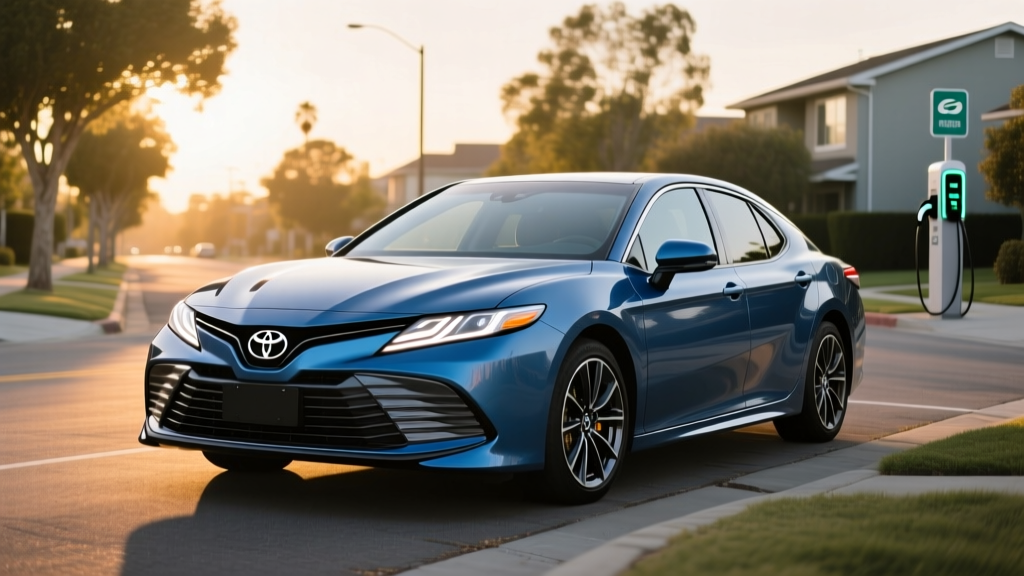
The 2025 Toyota Camry went fully hybrid for its ninth generation, and the SE trim sits in the sweet spot for buyers who want sport-tuned suspension, sharper styling, and the efficiency Toyota's hybrid system is known for. If you've been searching for the 2025 Camry Hybrid SE, you're looking at a midsize sedan that returns up to 47 MPG combined without ever needing to plug in — a conventional hybrid (HEV) that generates its own electricity through regenerative braking and engine power.
This guide breaks down the exact specs, real-world fuel economy, pricing, battery longevity, and how the Camry Hybrid SE stacks up against plug-in hybrids and full EVs for different driving lifestyles.
HEV vs. PHEV: Where the Camry Hybrid Fits
Before diving into specs, it's critical to understand what the 2025 Camry Hybrid SE is — and what it isn't. Toyota offers the Camry exclusively as a conventional hybrid (HEV) for the 2025 model year. There is no plug-in hybrid (PHEV) Camry and no fully electric variant.
| Feature | HEV (Camry Hybrid) | PHEV (e.g., Prius Prime) | BEV (e.g., Tesla Model 3) |
|---|---|---|---|
| Plug-in Charging Required? | No | Yes (optional but beneficial) | Yes (mandatory) |
| Electric-Only Range | ~1 mile at low speed | 30–45 miles typical | 250–400+ miles |
| Battery Size | ~1.0 kWh (small buffer) | 8–18 kWh | 50–100+ kWh |
| Federal Tax Credit (§30D) | Not eligible | Up to $7,500 if eligible | Up to $7,500 if eligible |
| Gasoline Engine? | Yes (primary) | Yes (backup) | No |
| Home Charging Needed? | No | Recommended (Level 2) | Essential |
The Camry Hybrid SE's battery is small — roughly 1.0 kWh of usable capacity — and charges itself through the gasoline engine and regenerative braking. You never plug it in. This makes it ideal for drivers who lack access to home or workplace charging but still want significantly better fuel economy than a gas-only sedan.
Fuel Economy: EPA Ratings and Real-World MPG
The headline number for the 2025 Camry Hybrid SE is its EPA-estimated fuel economy. The SE is available in both front-wheel drive (FWD) and electronic all-wheel drive (AWD-e), and the drivetrain choice affects efficiency slightly.
| Drivetrain | City MPG | Highway MPG | Combined MPG |
|---|---|---|---|
| FWD | 48 | 47 | 47 |
| AWD-e | 46 | 46 | 46 |
Source: EPA fueleconomy.gov
Real-World MPG: What to Actually Expect
Toyota's fifth-generation hybrid system excels in city driving, where the electric motor handles low-speed acceleration and the engine operates in its most efficient range. In real-world testing by owners and automotive publications, the Camry Hybrid consistently meets or slightly exceeds its EPA city estimate — something rare in the auto industry.
Here's what to expect based on driving conditions:
- City/commute driving: 46–50 MPG. Hybrids thrive in stop-and-go traffic where regenerative braking recaptures energy.
- Highway cruising (70–80 mph): 40–44 MPG. At sustained high speeds, the gasoline engine does most of the work and aerodynamic drag dominates.
- Cold weather (below 32°F): Expect a 10–15% reduction, bringing combined MPG to roughly 40–42. The engine runs more frequently to heat the cabin and warm the hybrid battery.
- Mixed driving (realistic average): 44–48 MPG for most owners over a full tank.
With a 13.2-gallon fuel tank, the FWD Camry Hybrid SE delivers a total driving range of approximately 620 miles per fill-up under combined conditions — enough for most drivers to visit a gas station once every two to three weeks.
Powertrain Specs: 225 Horsepower from Toyota's Fifth-Gen Hybrid System
The 2025 Camry uses Toyota's fifth-generation hybrid powertrain, which pairs a 2.5-liter four-cylinder engine operating on the Atkinson cycle with electric motors. The result is a combined system output of 225 horsepower for FWD models and 232 horsepower for AWD-e models, which add a rear-mounted electric motor.
| Specification | Detail |
|---|---|
| Engine | 2.5L 4-cylinder (Atkinson cycle) |
| Engine Output | 184 hp / 163 lb-ft torque |
| Front Electric Motor | 100 kW (134 hp) |
| Rear Electric Motor (AWD-e only) | 30 kW (40 hp) |
| Combined System Output (FWD) | 225 hp |
| Combined System Output (AWD-e) | 232 hp |
| Transmission | Electronically controlled CVT (eCVT) |
| 0–60 mph (est.) | ~7.0 seconds (FWD) |
| Hybrid Battery | Lithium-ion, ~1.0 kWh usable |
| Fuel Tank | 13.2 gallons |
| Total Range (combined) | ~620 miles (FWD) |
The SE trim adds sport-tuned suspension, paddle shifters, and a more aggressive throttle mapping compared to the LE and XLE trims. It won't feel like a sports sedan, but the instant electric-motor torque off the line and the composed chassis make it noticeably more engaging than the base Camry Hybrid LE.
Pricing: What the 2025 Camry Hybrid SE Costs
The 2025 Camry Hybrid SE starts at an MSRP of $30,495 for the FWD model, including destination charge. Adding the AWD-e system costs approximately $1,400 additional. Fully loaded with options like the premium audio package, panoramic roof, and advanced driver-assist features, an SE can approach $36,000.
| Trim | FWD MSRP | AWD-e MSRP |
|---|---|---|
| LE | $29,495 | $30,895 |
| SE | $30,495 | $31,895 |
| XSE | $33,495 | $34,895 |
| XLE | $34,495 | $35,895 |
Tax Credit Eligibility
The 2025 Camry Hybrid SE does not qualify for the federal §30D Clean Vehicle Credit (up to $7,500). That credit is reserved for plug-in electric vehicles — both battery-electric (BEV) and plug-in hybrid (PHEV) models — that meet battery sourcing, critical mineral, MSRP cap, and buyer income requirements as outlined by the IRS.
Conventional hybrids like the Camry are excluded from §30D. Some states may offer small rebates or HOV lane access for hybrids, but these vary by jurisdiction. Check your state's energy or DMV website for current local incentives.
Battery Warranty, Reliability, and Replacement Cost
Hybrid battery longevity is one of the top concerns for first-time hybrid buyers. Toyota addresses this with a robust warranty and a decades-long track record of hybrid reliability.
Hybrid Battery Warranty
- Coverage: 10 years / 150,000 miles (whichever comes first)
- Applies to: Hybrid battery pack, hybrid control module, and related components
- Transferable: Yes, to subsequent owners
- Capacity guarantee: Toyota covers defects and premature failure; there is no specific minimum capacity retention threshold as with EV batteries
How Long Do Camry Hybrid Batteries Last?
Toyota's hybrid batteries in the Camry are among the most proven in the industry. Data from long-term fleet use and owner reports indicates that most Camry Hybrid batteries last 150,000 to 200,000+ miles before any significant degradation or failure. Many first-generation Prius and Camry Hybrid owners have exceeded 200,000 miles on the original battery.
The key advantage of a conventional hybrid's small battery (~1.0 kWh) versus a full EV's large pack (60–100 kWh) is that the hybrid battery experiences shallow charge cycles — it rarely drops below 40% or charges above 80% state of charge. This narrow operating window dramatically reduces degradation stress.
Battery Replacement Cost
If the hybrid battery does fail outside of warranty, replacement costs for a Camry Hybrid typically range from $2,000 to $4,000 including parts and labor at a Toyota dealer. Independent hybrid specialists often offer refurbished or reconditioned batteries for $1,500–$2,500. This is significantly less than a full EV battery replacement, which can exceed $10,000–$20,000.
Toyota's hybrid system reliability is consistently rated among the best in the industry. The Camry Hybrid has earned strong marks from IIHS for safety, and Toyota's hybrid synergy drive system has accumulated billions of real-world miles across its global fleet.
Who Should Choose the Camry Hybrid SE Over an EV or Gas Car?
The Camry Hybrid SE occupies a specific niche. Here's a decision framework to determine if it's the right choice for your situation.
Choose the Camry Hybrid SE If:
- You don't have access to home or workplace charging (apartment, street parking, no garage outlet)
- You want 45+ MPG without changing your refueling habits
- You regularly take road trips over 300 miles and don't want to plan around charging stops
- You want a lower purchase price ($30k–$35k) versus a comparable EV ($40k–$55k before credits)
- You live in an area with limited public DC fast-charging infrastructure
- You want Toyota's long-term reliability and strong resale value
Choose a Plug-In Hybrid (PHEV) Instead If:
- You have home charging and a commute under 35 miles round-trip (a PHEV like the Prius Prime can run on electricity alone for most daily driving)
- You want to qualify for the federal §30D tax credit (up to $7,500, subject to eligibility)
- You want to drive partially on electricity to reduce gasoline use without full EV commitment
Choose a Full EV Instead If:
- You have reliable Level 2 home charging and your daily driving is under 250 miles
- You want zero tailpipe emissions and the lowest per-mile fuel cost (electricity at $0.13/kWh ≈ $4.50 per "gallon equivalent")
- You want the lowest maintenance costs (no oil changes, fewer moving parts)
- You qualify for the full $7,500 federal credit plus state incentives, narrowing the price gap
Camry Hybrid SE vs. Competitors: Quick Comparison
| Model | Combined MPG | Horsepower | Starting MSRP | Federal Tax Credit |
|---|---|---|---|---|
| Toyota Camry Hybrid SE | 47 | 225 | $30,495 | None |
| Honda Accord Hybrid Sport | 44 | 204 | $33,655 | None |
| Hyundai Sonata Hybrid SEL | 47 | 192 | $31,250 | None |
| Toyota Prius (HEV) | 57 | 194 | $28,550 | None |
| Toyota Prius Prime (PHEV) | 52 MPG / 44 mi EV | 220 | $33,445 | Up to $7,500* |
*Prius Prime credit eligibility depends on battery sourcing, buyer income, and MSRP caps per IRS §30D rules.
The Camry Hybrid SE holds its own on fuel economy and offers more interior space and power than the Prius. If maximum MPG is your priority and you don't need midsize sedan room, the Prius is the efficiency king. If you want plug-in capability with a similar Toyota badge, the Prius Prime is the logical PHEV alternative.
Pros and Cons at a Glance
Pros
- 47 MPG combined — among the best in the midsize sedan segment
- No plug-in charging required; works with existing gas-station habits
- 225 hp provides confident passing power and responsive acceleration
- 10-year / 150,000-mile hybrid battery warranty
- AWD-e available for snow and rain traction without a significant MPG penalty
- Strong Toyota reliability and resale value track record
- SE trim adds sport-tuned suspension and distinctive styling
Cons
- No federal tax credit eligibility (HEV exclusion from §30D)
- Not a plug-in — cannot drive on electric-only power for meaningful distances
- CVT drone under hard acceleration (common to all hybrid CVTs)
- Higher starting price than the base LE trim ($1,000 premium for SE)
- Infotainment system is functional but less polished than some competitors
- Highway MPG drops to ~40–44 in real-world 80 mph driving
Frequently Asked Questions
How many MPG does the 2025 Camry Hybrid SE get?
The EPA rates the FWD Camry Hybrid SE at 48 city / 47 highway / 47 combined MPG. The AWD-e version is rated at 46/46/46. In real-world mixed driving, most owners report 44–48 MPG, with city driving often exceeding the EPA estimate and sustained highway driving at 80 mph dropping to around 40–44 MPG.
Does the Camry Hybrid need to be plugged in?
No. The 2025 Camry Hybrid is a conventional hybrid (HEV). Its small lithium-ion battery charges through regenerative braking and the gasoline engine. You fuel it exclusively at gas stations, just like a traditional car.
How far can the Camry Hybrid drive on electric power alone?
Only about 1 mile at very low speeds (under 25 mph) in EV mode. The battery is too small (~1.0 kWh) for meaningful electric-only driving. If you want 30–40 miles of electric-only range, you need a plug-in hybrid like the Toyota Prius Prime or a full EV.
Is the 2025 Camry Hybrid SE reliable?
Yes. Toyota's hybrid system is one of the most proven in the world, with over two decades of real-world deployment across millions of vehicles. The hybrid battery is warranted for 10 years / 150,000 miles, and most batteries last well beyond that. The Camry Hybrid consistently earns high reliability scores from industry trackers.
What does a Camry Hybrid battery replacement cost?
Out-of-warranty replacement typically costs $2,000–$4,000 at a Toyota dealer, or $1,500–$2,500 through an independent hybrid specialist using a refurbished battery. Given the 10-year/150,000-mile warranty and typical battery lifespan of 150,000–200,000+ miles, most owners will never face this cost.
Does the 2025 Camry Hybrid qualify for any tax credit?
Not the federal §30D Clean Vehicle Credit — that credit applies only to plug-in electric vehicles (BEVs and PHEVs). Some states may offer small hybrid incentives or HOV lane access. Check your state's energy office or DMV for current programs.
Camry Hybrid SE vs. XSE — what's the difference?
The XSE adds premium features (leather-trimmed seats, larger wheels, upgraded audio) on top of the SE's sport-tuned suspension and styling. Both share the same 225-hp hybrid powertrain and 47 MPG rating (FWD). The SE offers the better value if you prioritize driving dynamics over luxury features.
Is the Camry Hybrid good for long road trips?
Excellent. With ~620 miles of total range, comfortable seating, and Toyota Safety Sense 3.0 (adaptive cruise control, lane-keeping assist), the Camry Hybrid is a strong road-trip sedan. You'll pass most EVs at charging stations and spend less time refueling than any gas-only midsize sedan.