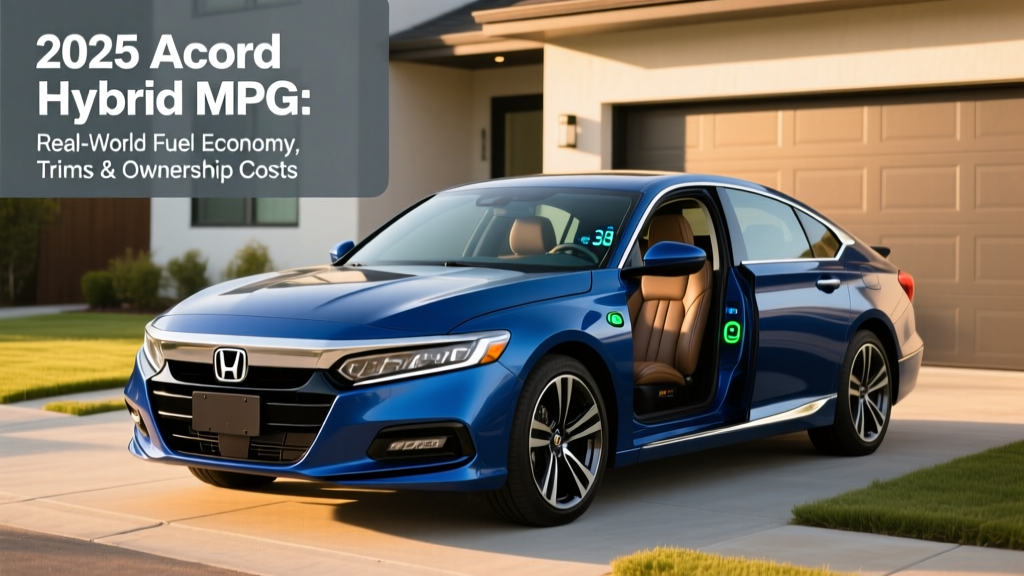
If you are searching for 2025 Accord Hybrid MPG numbers before signing a lease or purchase agreement, you are looking at one of the most efficient midsize sedans on the market. The 2025 Honda Accord Hybrid returns an EPA-estimated 48 MPG combined on the Sport, EX-L, Sport-L, and Touring trims, and a slightly higher 51 MPG combined on the base Sport Hybrid trim with smaller wheels. But EPA stickers only tell part of the story. In this guide, we break down real-world fuel economy expectations, the hybrid powertrain architecture, battery longevity, ownership costs, and how the Accord Hybrid stacks up against plug-in hybrids (PHEVs) and full battery-electric vehicles (BEVs).
2025 Accord Hybrid EPA MPG by Trim Level
Honda offers the 2025 Accord Hybrid across five trims. The wheel-and-tire package is the single biggest variable affecting fuel economy. The Sport Hybrid trim rides on 18-inch wheels with low-rolling-resistance tires, extracting an extra 3 MPG combined over the heavier, wider-tire trims.
| Trim | City MPG | Highway MPG | Combined MPG | Wheel Size |
|---|---|---|---|---|
| Sport Hybrid | 51 | 49 | 51 | 18" |
| EX-L Hybrid | 51 | 44 | 48 | 19" |
| Sport-L Hybrid | 51 | 44 | 48 | 19" |
| Touring Hybrid | 51 | 44 | 48 | 19" |
Source: EPA Fuel Economy Guide
A few things jump out from this table. First, the city MPG is consistently higher than highway MPG — a hallmark of series-parallel hybrid systems that recover energy through regenerative braking in stop-and-go traffic. Second, the gap between city and highway on the 19-inch wheel trims (51 vs. 44) is substantial. If your commute is primarily highway driving, your real-world average will lean closer to 44 MPG than 51.
In mixed driving conditions, owners of the 2025 Accord Hybrid (and the mechanically identical 2023-2024 models) typically report 44–50 MPG combined in temperate climates. Highway-only road trips at 75+ MPH often yield 40–43 MPG. In extreme cold (below 20°F), expect a temporary drop to 38–42 MPG as the engine runs more frequently to generate cabin heat. Conversely, city-heavy commutes in mild weather can push the Sport trim above its 51 MPG rating — some owners report 53–55 MPG on flat urban routes.
Powertrain: How the Accord Hybrid Generates 204 HP and 51 MPG
The 2025 Accord Hybrid uses Honda's fourth-generation two-motor hybrid system, a series-parallel architecture that operates differently from a traditional Toyota-style power-split device. Here is the spec breakdown:
| Specification | Detail |
|---|---|
| Engine | 2.0L DOHC 16-valve Atkinson-cycle 4-cylinder |
| Engine Output | 146 HP @ 6,100 RPM / 134 lb-ft @ 4,500 RPM |
| Drive Motor | AC synchronous permanent-magnet (184 HP / 247 lb-ft) |
| Combined System Output | 204 HP / 247 lb-ft torque |
| Transmission | e-CVT (no traditional gears — motor-driven with engine lock-up clutch) |
| Drivetrain | Front-wheel drive |
| 0–60 MPH | ~6.5 seconds (estimated) |
| Fuel Tank | 12.8 gallons |
| Total Driving Range | ~614 miles (Sport trim, EPA) |
The system operates in three modes depending on driving conditions:
- EV Drive: The lithium-ion battery powers the drive motor alone. This happens at low speeds, during gentle acceleration, and when coasting. The engine stays off.
- Hybrid Drive: The engine spins a generator motor that produces electricity to feed the drive motor. The engine is not mechanically connected to the wheels. This is the dominant mode at city and suburban speeds.
- Engine Drive: At steady highway cruising speeds (roughly 45–80 MPH), a lock-up clutch connects the engine directly to the wheels via a single fixed gear ratio. This avoids the efficiency losses of generating electricity when the engine is already operating in its optimal RPM band.
The traction battery is a 1.06 kWh lithium-ion pack — small by PHEV or BEV standards, but appropriate for a conventional hybrid (HEV). It buffers regenerative braking energy and provides short EV-drive bursts. You never plug it in; it charges itself through regen and the gasoline engine.
HEV vs. PHEV vs. BEV: Is the Accord Hybrid the Right Choice?
The Accord Hybrid is a conventional hybrid electric vehicle (HEV). It cannot be plugged in and has no meaningful electric-only range (less than 1 mile at very low speeds). Honda does not currently offer a plug-in hybrid (PHEV) version of the Accord in the U.S. market. If you are cross-shopping, here is how the three electrified categories compare:
HEV (Accord Hybrid)
- No plug-in required
- 48–51 MPG combined
- ~614-mile total range
- 1.06 kWh battery
- ~$32,000–$39,000 MSRP
- No federal tax credit
PHEV (e.g., Toyota Prius Prime)
- Plugs in for 39–44 EV miles
- 48–52 MPG combined (gas mode)
- ~440-mile total range
- 13.6 kWh battery
- ~$33,000–$40,000 MSRP
- Up to $3,750 federal credit
BEV (e.g., Tesla Model 3)
- Full electric, no gas
- 130–132 MPGe combined
- ~340-mile EPA range
- 60–75 kWh battery
- ~$39,000–$52,000 MSRP
- Up to $7,500 federal credit
- You lack access to home or workplace charging (apartment, street parking)
- You regularly drive 400+ miles between fuel stops and don't want to plan charging
- You want maximum range with zero lifestyle change from a gas car
- Your budget is under $35,000 and you want a midsize sedan
- You can charge at home nightly and your commute is under 40 miles round-trip
- You want EV-like daily driving with gas backup for road trips
- You want to reduce (not eliminate) gasoline consumption by 60–80%
- You have reliable Level 2 home charging
- You want zero tailpipe emissions and minimal maintenance
- You drive under 300 miles daily and can plan DC fast-charging stops for road trips
Pricing, Trims, and Tax Credit Eligibility
The 2025 Honda Accord Hybrid lineup starts at approximately $32,395 MSRP (including destination) for the Sport Hybrid trim and tops out near $39,395 for the Touring Hybrid. Here is the approximate trim pricing:
| Trim | MSRP (incl. destination) | Key Features |
|---|---|---|
| Sport Hybrid | $32,395 | 18" wheels, heated front seats, 12.3" touchscreen, wireless CarPlay/Android Auto |
| EX-L Hybrid | $34,735 | 19" wheels, leather seats, power passenger seat, wireless charging pad |
| Sport-L Hybrid | $35,335 | Sport styling + leather interior, 19" black alloy wheels |
| Touring Hybrid | $39,395 | BOSE 12-speaker audio, heated rear seats, head-up display, low-speed braking control |
The 2025 Honda Accord Hybrid is a conventional HEV, not a plug-in vehicle. Under IRS §30D rules, only plug-in electric vehicles (PHEVs and BEVs) with a battery capacity of at least 7 kWh qualify for the federal clean vehicle credit. The Accord Hybrid's 1.06 kWh battery does not meet this threshold. There is no federal tax credit for conventional hybrids. Some states or local utilities may offer minor rebates for hybrid purchases — check your state energy office or utility provider for current programs.
Battery Warranty, Lifespan, and Replacement Cost
Hybrid battery longevity is the single most common concern among first-time hybrid buyers. Here is what you need to know about the 2025 Accord Hybrid's battery system:
| Item | Detail |
|---|---|
| Battery Chemistry | Lithium-ion |
| Battery Capacity | 1.06 kWh |
| Hybrid Battery Warranty | 8 years / 100,000 miles (10 years / 150,000 miles in CARB states) |
| Powertrain Warranty | 5 years / 60,000 miles |
| Estimated Replacement Cost (out of warranty) | $2,000–$4,000 (battery pack) + labor |
The lithium-ion hybrid battery in the Accord is far smaller and less stressed than a BEV traction battery. It never deep-cycles — the system keeps the state of charge (SoC) within a narrow band (roughly 40–80%) to minimize degradation. Honda's track record with hybrid batteries is strong: the company has been using lithium-ion hybrid packs since 2011 (in the Insight and CR-Z), and widespread premature failures have not been a pattern.
In practice, most hybrid batteries outlast the 8-year/100,000-mile warranty period by a significant margin. Independent data from fleet operators and owner surveys suggest 150,000–200,000+ miles before meaningful capacity loss is typical for modern lithium-ion hybrid packs. If a replacement is eventually needed, the cost is a fraction of a BEV battery swap because the pack is small (~1 kWh vs. 60–80 kWh in a full EV).
The CARB-state extended warranty (10 years / 150,000 miles) applies in California, Colorado, Connecticut, Delaware, Maine, Maryland, Massachusetts, Nevada, New Jersey, New Mexico, New York, Oregon, Pennsylvania, Rhode Island, Vermont, Virginia, Washington, and Washington D.C. If you live in one of these states, your hybrid battery coverage is substantially stronger.
Reliability Ratings and Safety Scores
The 2025 Accord (including Hybrid trims) carries strong reliability and safety credentials:
- NHTSA: 5-Star Overall Safety Rating (the Accord has historically earned top marks across all crash-test categories)
- IIHS: The previous-generation Accord Hybrid earned TOP SAFETY PICK+; the current generation continues to perform well in updated moderate overlap and side-impact tests
- Consumer Reports: Honda as a brand typically ranks in the top third for predicted reliability; the Accord Hybrid's simpler e-CVT (no traditional transmission gears) reduces a common failure point
From a mechanical standpoint, the Accord Hybrid has fewer wear components than a conventional gas-only sedan. There is no traditional automatic transmission (the e-CVT uses a direct-drive motor with a lock-up clutch, not a belt-and-pulley CVT). Regenerative braking reduces wear on the friction brake pads — many hybrid owners report original brake pads lasting 80,000–100,000 miles. The engine itself runs fewer total hours than in a non-hybrid because it shuts off during stops, low-speed EV driving, and coasting.
5-Year Ownership Cost Estimate
To put the Accord Hybrid's fuel savings in context, here is a simplified 5-year/75,000-mile cost comparison against the gasoline-only Accord (1.5T turbo, 30 MPG combined) and a comparable BEV (Tesla Model 3 RWD, 132 MPGe):
| Cost Category | Accord Hybrid (48 MPG) | Accord 1.5T Gas (30 MPG) | Tesla Model 3 RWD |
|---|---|---|---|
| Fuel/Energy (75,000 mi) | $4,688 (gas @ $3.00/gal) | $7,500 (gas @ $3.00/gal) | $2,025 (elec @ $0.135/kWh) |
| Maintenance (est.) | $2,200 | $2,800 | $1,500 |
| Federal Tax Credit | $0 | $0 | Up to $7,500* |
| 5-Year Fuel Savings vs. Gas | $2,812 | — | $5,475 |
*Tesla Model 3 RWD federal credit eligibility depends on current-year §30D battery sourcing and buyer income requirements. Verify at fueleconomy.gov and with a tax professional.
Gas price assumption: $3.00/gal national average. Electricity: $0.135/kWh national average. Your actual costs will vary by region and driving pattern.
The Accord Hybrid saves roughly $2,800 in fuel over 5 years compared to the gas-only Accord. That savings nearly closes the price gap between the two powertrains. Against a BEV, the hybrid costs more to fuel but eliminates charging-infrastructure concerns and range planning entirely.
Pros and Cons of the 2025 Accord Hybrid
Pros
- 48–51 MPG combined — among the best in the midsize sedan segment
- 614+ mile total range; no charging infrastructure needed
- Strong 204 HP with instant electric torque off the line
- Refined cabin, 12.3" infotainment, standard Honda Sensing ADAS suite
- 8-year/100,000-mile hybrid battery warranty (10/150k in CARB states)
- Lower maintenance costs than gas-only models (regen saves brakes, no traditional transmission)
- Spacious rear seat and 16.7 cu-ft trunk (hybrid battery does not compromise cargo space)
Cons
- No plug-in option — you cannot drive on electricity alone for meaningful distances
- No federal tax credit (HEV, not PHEV/BEV)
- 19" wheel trims lose 3 MPG combined vs. Sport trim
- Engine drone under hard acceleration (e-CVT holds engine at high RPM)
- AWD not available (FWD only; a limitation in snow-belt states)
- Higher upfront cost than the gas-only Accord 1.5T LX (~$4,000 premium for hybrid)
Frequently Asked Questions
How many MPG does the 2025 Honda Accord Hybrid get?
The EPA rates the 2025 Accord Hybrid at 51 city / 49 highway / 51 combined MPG on the Sport trim (18-inch wheels) and 51 city / 44 highway / 48 combined MPG on EX-L, Sport-L, and Touring trims (19-inch wheels). In real-world mixed driving, most owners report 44–50 MPG combined, with city-heavy routes occasionally exceeding the EPA city rating.
Does the Accord Hybrid need to be plugged in?
No. The Accord Hybrid is a conventional hybrid (HEV). It charges its small 1.06 kWh battery through regenerative braking and the gasoline engine. There is no charging port and no plug. If you want a Honda you can plug in, you would need to look at a different model — Honda does not currently sell a plug-in Accord in the U.S.
How far can the Accord Hybrid drive on electric power alone?
Less than 1 mile, and only at very low speeds (under 25 MPH). The hybrid battery is too small (1.06 kWh) for meaningful EV-only driving. The electric motor assists constantly, but the gasoline engine is the primary energy source. If you want 30–40 miles of electric-only commuting, you need a PHEV like the Toyota Prius Prime or Hyundai Tucson PHEV.
Is the 2025 Accord Hybrid reliable?
Honda's hybrid system is mature — this is the fourth generation of the two-motor architecture, with extensive real-world deployment in the Accord, CR-V Hybrid, and Civic Hybrid. The e-CVT design eliminates traditional transmission failure points. The hybrid battery is warrantied for 8 years/100,000 miles (10 years/150,000 miles in CARB states), and real-world data suggests these packs commonly last 150,000–200,000+ miles. The Accord consistently earns top marks from IIHS and NHTSA.
What does it cost to replace the Accord Hybrid battery?
Out of warranty, a replacement hybrid battery pack for the Accord Hybrid typically costs $2,000–$4,000 including labor. This is significantly less than a BEV battery replacement ($8,000–$20,000+) because the pack is only 1.06 kWh. Given the 8–10 year warranty coverage and the pack's tendency to last well beyond that period, most owners will never face this expense.
Does the 2025 Accord Hybrid qualify for any tax credit?
The Accord Hybrid does not qualify for the federal §30D Clean Vehicle Credit. That credit applies only to plug-in vehicles (PHEVs and BEVs) with at least 7 kWh of battery capacity. The Accord Hybrid's 1.06 kWh battery falls far short. Some states or municipalities may offer small rebates for hybrid purchases — check your state's energy office. For current federal credit rules, see IRS.gov.
Accord Hybrid vs. Camry Hybrid: which is more efficient?
The 2025 Toyota Camry Hybrid (which is now exclusively hybrid for the 2025 model year) is rated at up to 51 MPG combined on the LE trim, matching the Accord Hybrid Sport. The Camry Hybrid offers AWD as an option (the Accord does not), while the Accord Hybrid offers a slightly larger trunk and more rear-seat legroom. Both are excellent choices — the decision often comes down to styling preference, dealer proximity, and whether you need AWD.
Is the Accord Hybrid good for highway road trips?
Yes, with a caveat. The 12.8-gallon fuel tank and 44–48 MPG highway rating (depending on trim) give the Accord Hybrid a road-trip range of roughly 560–614 miles between fill-ups — meaning you can drive 8+ hours before stopping for gas. The caveat: highway MPG is the Accord Hybrid's weakest efficiency point because the engine runs more frequently at sustained high speeds. If your driving is 90% highway, expect closer to 42–45 MPG in real-world conditions.