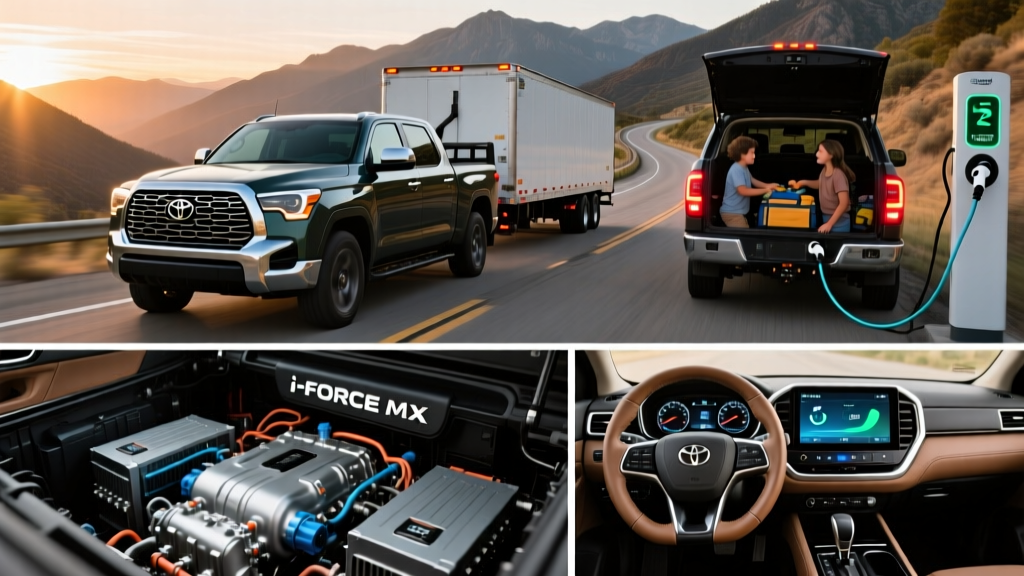
The Toyota Tundra has offered a hybrid powertrain since the 2022 redesign, and the 2024 Tundra Hybrid continues with the i-FORCE MAX system — a twin-turbo V6 paired with an electric motor sandwiched between the engine and a 10-speed automatic transmission. Unlike a plug-in hybrid, this is a conventional self-charging hybrid (HEV): you never plug it in, and there is no electric-only driving mode. The goal here is torque and modest efficiency gains in a full-size truck package, not zero-emission commuting.
For 2024, the i-FORCE MAX remains available across multiple Tundra trims, from the Limited up through the Capstone, and on both 4x2 and 4x4 configurations with either the 5.5-foot or 6.5-foot bed. If you're cross-shopping the 2024 Tundra Hybrid against the Ford F-150 PowerBoost hybrid or the Ram 1500 with eTorque, this guide breaks down exactly what you get — and what you don't.
Powertrain: How the i-FORCE MAX Hybrid Works
The i-FORCE MAX pairs a 3.4-liter twin-turbocharged V6 (V35A-FTS) with a 48-horsepower electric motor-generator integrated into the bell housing between the engine and the 10-speed automatic. Combined output is 437 horsepower and 583 lb-ft of torque. That torque figure is available low in the rev range, which is exactly what you want when towing or accelerating from a stop.
| Specification | 2024 Tundra i-FORCE MAX |
|---|---|
| Engine | 3.4L Twin-Turbo V6 |
| Electric Motor | 48 hp / 184 lb-ft (integrated) |
| Combined Output | 437 hp / 583 lb-ft |
| Transmission | 10-speed automatic |
| Hybrid Type | Conventional HEV (no plug) |
| Hybrid Battery | ~1.87 kWh, Nickel-Metal Hydride (NiMH) |
| Drivetrain | RWD or 4WD |
| 0-60 mph (est.) | ~5.7 seconds (4WD CrewMax) |
| Max Towing | Up to 11,175 lbs (varies by config) |
| Max Payload | Up to 1,640 lbs (varies by config) |
The hybrid battery is small — roughly 1.87 kWh of nickel-metal hydride (NiMH) chemistry — because its job is torque assist and regenerative braking capture, not electric-only propulsion. Toyota has used NiMH in its conventional hybrids for decades, and the chemistry is proven for longevity even if it lacks the energy density of modern lithium-ion packs.
Fuel Economy: EPA Ratings vs. Real-World MPG
According to fueleconomy.gov, the 2024 Tundra Hybrid 4WD CrewMax returns:
| Configuration | City | Highway | Combined |
|---|---|---|---|
| 4x2 CrewMax (i-FORCE MAX) | 20 mpg | 26 mpg | 22 mpg |
| 4x4 CrewMax (i-FORCE MAX) | 19 mpg | 22 mpg | 20 mpg |
| 4x4 CrewMax (non-hybrid V6) | 17 mpg | 23 mpg | 19 mpg |
The hybrid's advantage is most pronounced in city and stop-and-go driving, where regenerative braking recovers energy and the electric motor handles low-speed torque. On the highway at sustained speeds, the turbo V6 is doing most of the work, and the gap between hybrid and non-hybrid narrows considerably.
Real-world expectations: Owners who do a mix of suburban errands and highway cruising typically report 19–21 mpg combined in the 4x4 configuration. If you tow frequently, expect 12–15 mpg under load — the hybrid system helps with initial acceleration but cannot overcome the aerodynamic and rolling-resistance penalties of a heavy trailer. In cold weather, the engine runs more often for cabin heat, reducing any hybrid efficiency benefit.
Compared to the Ford F-150 PowerBoost hybrid (EPA 22–23 mpg combined for 4WD), the Tundra Hybrid trails slightly on paper. In practice, both trucks deliver similar real-world numbers in the 18–21 mpg range depending on driving style and bed load.
HEV vs. PHEV vs. Full EV: Which Truck Fits You?
| Factor | HEV (Tundra Hybrid) | PHEV (e.g., F-150 PHEV concept) | Full EV (e.g., F-150 Lightning) |
|---|---|---|---|
| Plug-in required? | No | Yes | Yes |
| Electric-only range | None | 20–40 mi (typical) | 230–320+ mi |
| Fuel/energy cost per mile | ~$0.18–$0.22 | ~$0.08–$0.18 (varies) | ~$0.04–$0.12 |
| Towing range impact | Moderate MPG drop | EV range collapses; gas takes over | Range cut by 50%+ |
| Home charging needed? | No | Recommended | Essential |
| Federal tax credit | Not eligible (§30D) | Potentially eligible | Potentially eligible |
| Best for | Truck buyers wanting simplicity + torque | Short EV commute + truck utility | Home charging access + daily driving |
The 2024 Tundra Hybrid is a conventional HEV. It does not qualify for the federal §30D clean vehicle tax credit, which is reserved for plug-in electric vehicles meeting battery-sourcing and MSRP requirements under current IRS rules. If tax incentives are a priority, you would need to look at a plug-in option like the Ford F-150 Lightning (BEV) or wait for a PHEV truck offering.
Choose the Tundra Hybrid if you want the torque benefit and slight efficiency bump of hybridization without changing your fueling habits. Choose a full EV truck if you have reliable home Level 2 charging and your daily driving stays within range limits — but understand that towing with any EV truck dramatically cuts range.
Pricing and Trim Availability
For 2024, the i-FORCE MAX hybrid powertrain is standard on the Tundra Capstone and available as an option on the Limited, Platinum, and 1794 Edition trims. It is not offered on the base SR or mid-tier SR5.
| Trim (4x4 CrewMax) | i-FORCE MAX Availability | Approx. MSRP |
|---|---|---|
| Limited | Optional (~$2,500 add) | ~$60,000–$64,000 |
| Platinum | Optional | ~$66,000–$70,000 |
| 1794 Edition | Optional | ~$66,000–$70,000 |
| TRD Pro | Standard | ~$72,000–$74,000 |
| Capstone | Standard | ~$78,000–$80,000 |
Prices vary with options, packages, and dealer markups. The hybrid premium on lower eligible trims is typically around $2,500 over the non-hybrid twin-turbo V6. Given fuel savings of roughly $150–$250 per year (depending on mileage and gas prices), the payback period on that premium is long — you're buying the hybrid for the torque and refinement, not purely for fuel-cost ROI.
Battery Warranty, Reliability, and Replacement Cost
Toyota Hybrid Battery Warranty: 10 years / 150,000 miles (whichever comes first) on the hybrid battery and all hybrid-system components. This applies to all 50 states. The standard powertrain warranty covers 5 years / 60,000 miles.
Toyota's hybrid systems are among the most proven in the industry. The NiMH battery in the Tundra i-FORCE MAX is small and operates within a narrow state-of-charge window — the truck's computer never lets it fully charge or fully deplete, which dramatically extends cycle life. Based on Toyota's track record with the Prius, Camry Hybrid, and Highlander Hybrid, these batteries routinely exceed 150,000 miles without significant degradation.
If replacement is needed out of warranty, a Toyota hybrid battery for a full-size truck typically costs between $3,000 and $5,000 for the part, plus $500–$1,000 in labor. Third-party refurbished batteries can reduce that to the $2,000–$3,000 range. For context, this is considerably less than a full EV battery replacement, which can run $10,000–$20,000+.
The i-FORCE MAX has been in production since the 2022 model year, so there are now several years of field data. Early reports have not surfaced any widespread hybrid-system failures specific to the Tundra, though some owners have noted that the transition between electric-motor assist and engine engagement is occasionally perceptible at low speeds — a characteristic of the parallel-hybrid design rather than a defect.
Towing and Payload: Does the Hybrid Help?
The i-FORCE MAX's 583 lb-ft of torque is the headline number for truck buyers. Maximum towing capacity for a properly equipped 2024 Tundra Hybrid is up to 11,175 pounds (4x2 CrewMax with 6.5-foot bed and the tow package). Payload tops out around 1,640 pounds, though 4WD and higher trim levels reduce both figures.
Where the hybrid system genuinely helps is low-speed trailer maneuvering and initial acceleration from a stop with a heavy load. The electric motor's instant torque fills in before the turbos fully spool, reducing the lag you'd feel in a non-hybrid turbo setup. On long highway grades with a trailer, the V6 is doing the heavy lifting and the hybrid contribution is minimal.
One practical note: the hybrid battery and associated electronics add roughly 200–250 pounds to the truck's curb weight versus the non-hybrid V6. This slightly reduces payload capacity on identically configured trucks. If you're maxing out payload regularly, the non-hybrid V6 actually carries a small weight advantage.
Pros and Cons
Pros
- 583 lb-ft of torque with smooth low-end delivery — excellent for towing
- No plug-in required; fuel at any gas station as normal
- 10-year / 150,000-mile hybrid battery warranty
- Slight MPG improvement over non-hybrid V6, especially in city driving
- Proven Toyota hybrid reliability pedigree
- Available across multiple trims with 4x2 and 4x4 options
Cons
- No electric-only driving; cannot operate as an EV even briefly
- Not eligible for the §30D federal EV tax credit
- Real-world highway MPG only marginally better than non-hybrid
- Hybrid premium adds ~$2,500 on mid-tier trims
- Not available on base SR/SR5 trims
- Heavy towing still drops fuel economy to 12–15 mpg
Frequently Asked Questions
How many MPG does the 2024 Tundra Hybrid get?
The EPA rates the 4x4 Tundra i-FORCE MAX at 19 city / 22 highway / 20 combined mpg. The 4x2 version is rated at 20/26/22 mpg. Real-world combined driving typically yields 19–21 mpg for the 4x4, with towing dropping that to 12–15 mpg.
Is the 2024 Tundra Hybrid a plug-in?
No. The Tundra i-FORCE MAX is a conventional hybrid (HEV). It charges its small battery through regenerative braking and the engine. You never plug it in, and there is no electric-only driving mode.
Does the 2024 Tundra Hybrid qualify for a tax credit?
No. The federal §30D clean vehicle credit applies only to plug-in electric vehicles (BEVs and PHEVs) meeting specific battery-sourcing, MSRP, and buyer-income requirements. The Tundra Hybrid is a conventional HEV and does not qualify. Check IRS.gov for current credit rules, as they are subject to legislative change.
How long will the Tundra Hybrid battery last?
Toyota covers the hybrid battery for 10 years or 150,000 miles. Based on Toyota's long history with NiMH hybrid batteries in the Prius and Highlander Hybrid lineups, these packs commonly last well beyond the warranty period. Replacement cost, if needed, is approximately $3,000–$5,000.
Should I get the Tundra Hybrid or a full EV truck like the F-150 Lightning?
If you need maximum towing range without charging stops, don't have reliable home charging, or regularly drive in areas with sparse charging infrastructure, the Tundra Hybrid is the more practical choice. If you have home Level 2 charging, a daily commute under 100 miles, and want to minimize fuel costs, an EV truck like the F-150 Lightning (EPA range up to 320 miles) may serve you well — but expect towing range to drop by roughly half.
What's the difference between the i-FORCE and i-FORCE MAX?
The standard i-FORCE is the non-hybrid 3.4L twin-turbo V6 producing 389 hp and 479 lb-ft. The i-FORCE MAX adds the electric motor-generator for a combined 437 hp and 583 lb-ft. The MAX is the hybrid variant.