Quick Verdict: The 2024 Tucson Hybrid Limited at a Glance
The 2024 Hyundai Tucson Hybrid Limited sits at the top of a three-trim HEV lineup that has quietly become one of the most practical compact SUVs on the market. With an EPA-rated 37 MPG combined, 226 horsepower, and a well-equipped Limited trim that still undercuts many rivals, it occupies a compelling middle ground between a conventional gas SUV and a full battery-electric vehicle. If you want electrified efficiency without ever plugging in, this powertrain deserves serious consideration.
But how does that EPA number hold up in real-world driving? What does the hybrid battery warranty actually cover? And should you consider the Tucson PHEV instead — or just go full EV? This guide breaks down every number that matters.
| Spec | Value |
|---|---|
| EPA Fuel Economy (City / Hwy / Combined) | 37 / 36 / 37 MPG |
| Powertrain | 1.6L turbo I4 + electric motor |
| Combined Horsepower / Torque | 226 HP / 258 lb-ft |
| Transmission | 6-speed automatic |
| Drivetrain | AWD (standard on all Hybrid trims) |
| Hybrid Battery | ~1.49 kWh (self-charging HEV, no plug) |
| Fuel Tank Capacity | 13.7 gallons |
| Total Driving Range (EPA est.) | ~507 miles |
| 0–60 MPH | ~7.1 seconds |
| Cargo Volume (behind 2nd row) | 38.7 cu ft |
| Limited Trim MSRP | $39,750 |
| Hybrid Battery Warranty | 10 years / 100,000 miles |
HEV vs. PHEV: Understanding What You're Buying
Hyundai sells the Tucson in three electrified flavors, and confusing them is easy if you're not careful. Here's the breakdown:
Conventional Hybrid (HEV) — This Article's Focus
The Tucson Hybrid uses a small battery (~1.49 kWh) that recharges through regenerative braking and the gasoline engine. You never plug it in. It provides efficiency gains at every speed, particularly in stop-and-go city driving where the electric motor handles low-speed propulsion and assists during acceleration.
Plug-In Hybrid (PHEV)
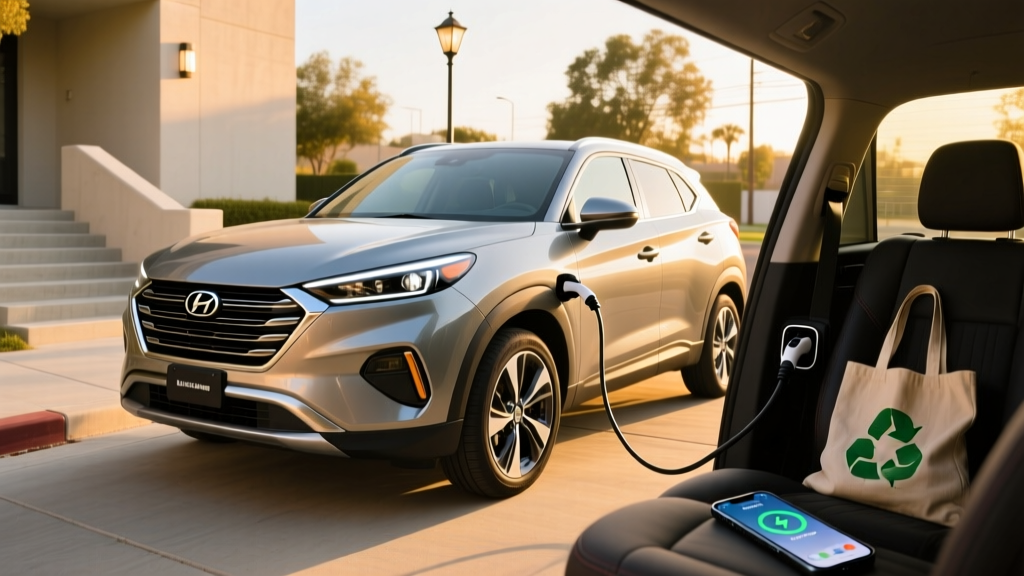
The Tucson PHEV carries a larger 13.8 kWh battery and a more powerful electric motor. It offers an EPA-rated 33 miles of electric-only driving before the gas engine kicks in. You charge it via a Level 1 (120V) or Level 2 (240V) outlet. It does not support DC fast charging. Once the battery is depleted, it operates as a conventional hybrid rated at 35 MPG combined. The PHEV SEL Convenience starts around $40,500.
Battery Electric (EV)
Hyundai does not currently offer a Tucson EV in the US. The closest electric alternative in Hyundai's lineup is the Ioniq 5, which starts around $42,000 and offers up to 303 miles of EPA range.
The 2024 Tucson Hybrid Limited is the HEV. No plug, no range anxiety about finding a charger, no dependency on home charging infrastructure. You fuel it like any other car — just less often.
Fuel Economy: EPA Ratings and Real-World MPG
The EPA rates the 2024 Tucson Hybrid at 37 city / 36 highway / 37 MPG combined across all trims, including the Limited. That's according to fueleconomy.gov. The near-identical city and highway numbers are characteristic of Toyota and Hyundai hybrid systems: the electric motor offsets the engine's worst efficiency zones (idling, low-speed crawling) while the gasoline engine handles steady-state highway cruising.
| Driving Condition | EPA Rating | Real-World Expectation |
|---|---|---|
| City | 37 MPG | 38–42 MPG (hybrids often exceed EPA in city) |
| Highway (70–80 mph) | 36 MPG | 32–35 MPG (aero drag + less regen benefit) |
| Combined | 37 MPG | 35–39 MPG (depends on driving mix) |
| Cold Weather (below 30°F) | — | 30–34 MPG (engine runs more for cabin heat) |
Real-world note: Hybrid SUVs routinely beat their EPA city numbers because regenerative braking recovers energy in stop-and-go traffic that a gas car simply wastes as brake heat. On a suburban commute with frequent lights, owners regularly report 39–42 MPG. Highway driving is the opposite story — sustained 75–80 mph speeds reduce the hybrid system's advantage, and expect numbers closer to 32–35 MPG on long interstate trips. In sub-freezing temperatures, the gasoline engine runs more frequently to provide cabin heat, pulling combined economy down to roughly 30–34 MPG until the powertrain and cabin warm up.
With a 13.7-gallon fuel tank and a realistic combined average of 36–37 MPG, you can expect roughly 490–510 miles between fill-ups in mixed driving.
Powertrain Deep Dive: 226 HP and How the Hybrid System Works
The Tucson Hybrid pairs a 1.6-liter turbocharged four-cylinder engine (producing 178 HP and 195 lb-ft of torque on its own) with a 44.2 kW (roughly 59 HP) electric motor integrated into the transmission housing. Combined system output is 226 HP and 258 lb-ft of torque.
Unlike Toyota's e-CVT planetary gearset, Hyundai uses a conventional 6-speed automatic transmission. The result is more natural-feeling acceleration with distinct gear shifts — something many drivers prefer over the rubber-band sensation of a CVT under hard acceleration. The trade-off is marginally less seamless electric-to-gas transitions at very low speeds, though Hyundai's tuning has improved this noticeably in the 2024 model year.
AWD is standard on every Tucson Hybrid trim. The system uses a traditional mechanical driveshaft to the rear axle (not a separate rear electric motor as in some competitors), which means the rear wheels engage when the system detects slip. This is adequate for rain, light snow, and gravel roads but not designed for serious off-road use.
The 0–60 MPH time of approximately 7.1 seconds places the Tucson Hybrid mid-pack for the compact SUV segment — quicker than the Toyota RAV4 Hybrid (~7.4s) and roughly on par with the Honda CR-V Hybrid.
2024 Tucson Hybrid Limited: Pricing, Features, and Tax Credits
The 2024 Tucson Hybrid is offered in three trims:
- Blue: ~$33,850 MSRP — base hybrid with strong standard equipment
- SEL Convenience: ~$36,350 MSRP — adds leatherette seats, panoramic sunroof, power liftgate
- Limited: ~$39,750 MSRP — fully loaded with leather, ventilated front seats, Bose premium audio, surround-view monitor, Highway Driving Assist, blind-spot view monitor, remote smart parking assist
Destination charges add approximately $1,335 to these figures.
Federal Tax Credit Eligibility
The conventional Tucson Hybrid (HEV) does not qualify for the federal §30D Clean Vehicle Credit. That credit applies only to plug-in electric vehicles — battery-electric (BEV) and plug-in hybrid (PHEV) models that meet battery sourcing, MSRP cap, and buyer income requirements under current IRS rules.
The Tucson PHEV, however, may qualify for up to $7,500 depending on your income, the vehicle's battery component sourcing, and MSRP caps ($80,000 for SUVs). Eligibility rules are complex and change periodically — consult a tax professional and verify current requirements on IRS.gov before purchasing. Some buyers may also qualify for state-level hybrid or clean-vehicle rebates; check your state's energy or DMV website for specifics.
Hybrid Battery Warranty: What's Covered
Hyundai covers the Tucson Hybrid's lithium-ion battery pack for 10 years or 100,000 miles (whichever comes first) under its Hybrid/EV Components warranty. This covers battery capacity loss beyond a manufacturer-defined threshold and defects in hybrid-system components including the electric motor, inverter, and related electronics. The powertrain warranty also runs 10 years/100,000 miles. For reference, the basic bumper-to-bumper warranty is 5 years/60,000 miles.
Reliability and Long-Term Battery Costs
Hyundai's hybrid system has proven durable in real-world use. Unlike early hybrid systems from two decades ago, modern lithium-ion hybrid batteries are designed to last the life of the vehicle under normal conditions. The small 1.49 kWh battery in the Tucson HEV undergoes shallow charge-discharge cycles — it rarely drops below 40% or above 80% state of charge — which dramatically extends cell longevity compared to a full EV battery that cycles through deeper ranges.
If the hybrid battery does eventually require replacement outside of warranty, current estimates for a Hyundai Tucson Hybrid battery pack range from $2,000 to $4,000 for the part, plus labor. However, individual cell modules can sometimes be replaced for significantly less. Given the 10-year/100,000-mile warranty and the shallow-cycling design, out-of-pocket battery replacement is uncommon for first owners.
The 1.6L turbocharged engine requires standard maintenance — oil changes, air filters, spark plugs — at intervals similar to a conventional gas car. One advantage of the hybrid system: regenerative braking reduces wear on the friction brake pads, which often last 80,000+ miles in hybrid driving.
Who Should Choose the Tucson Hybrid (and Who Shouldn't)
Pros
- 37 MPG combined with no plug-in requirement
- Strong Limited trim equipment at ~$39,750
- 226 HP provides confident highway merging
- 10-year/100,000-mile hybrid battery warranty
- AWD standard across all trims
- Exceeds EPA city MPG in real-world stop-and-go driving
Cons
- No federal tax credit for the HEV version
- Highway MPG drops noticeably above 75 mph
- Cold-weather fuel economy dips 3–5 MPG
- Limited trim pushes $41,000+ with destination
- ~1.5 cu ft less cargo space than gas Tucson (battery packaging)
- No DC fast charging (not applicable — it's an HEV)
Choose the Tucson Hybrid If:
- You don't have reliable access to home or workplace charging
- You want 35–40 MPG without changing your fueling habits
- You need AWD for snow/rain but don't want the fuel penalty of a gas-only AWD SUV
- You plan to keep the vehicle 8–10+ years (warranty coverage is excellent)
Choose the Tucson PHEV Instead If:
- You can charge at home (Level 2, ~240V) and your daily commute is under 33 miles
- You want to drive mostly on electricity with the gas engine as backup
- You may qualify for the §30D federal tax credit, bringing effective cost below the HEV
Choose a Full EV (e.g., Ioniq 5) Instead If:
- You have reliable home Level 2 charging
- Your daily driving is under 250 miles and you road-trip infrequently
- You want near-zero routine maintenance and the lowest per-mile fuel cost
- You qualify for the full $7,500 federal credit, narrowing the upfront price gap
2024 Tucson Hybrid vs. Key Competitors
| Model | EPA Combined | HP | AWD | Top Trim MSRP | Battery Warranty |
|---|---|---|---|---|---|
| 2024 Tucson Hybrid Limited | 37 MPG | 226 | Std | ~$39,750 | 10 yr / 100k mi |
| 2024 RAV4 Hybrid Limited | 39 MPG | 219 | Std | ~$41,500 | 10 yr / 150k mi |
| 2024 CR-V Hybrid Sport Touring | 37 MPG | 204 | Std | ~$40,850 | 8 yr / 100k mi |
| 2024 Ford Escape Hybrid Platinum | 39 MPG | 210 | Opt | ~$42,500 | 8 yr / 100k mi |
The RAV4 Hybrid edges the Tucson by 2 MPG combined and offers a slightly longer battery warranty (150,000 miles), but costs roughly $1,700 more at the top trim. The CR-V Hybrid matches the Tucson's MPG but trails in horsepower. The Tucson Hybrid Limited's value proposition is its feature-to-price ratio: ventilated leather seats, Highway Driving Assist, Bose audio, and surround-view camera are all included at a price where competitors charge more for similar equipment.
Frequently Asked Questions
How many MPG does the 2024 Tucson Hybrid Limited get?
The EPA rates it at 37 city / 36 highway / 37 MPG combined. In real-world driving, expect 38–42 MPG in city and suburban conditions, 32–35 MPG on the highway at 75+ mph, and roughly 30–34 MPG in sustained cold weather below 30°F.
Do I need to plug in the Tucson Hybrid?
No. The Tucson Hybrid (HEV) is a conventional self-charging hybrid. Its small battery recharges through regenerative braking and the gasoline engine. You fuel it at a gas station like any other vehicle. Only the Tucson PHEV requires plugging in.
Does the 2024 Tucson Hybrid qualify for a federal tax credit?
No. The federal §30D Clean Vehicle Credit applies only to plug-in vehicles (BEVs and PHEVs). The conventional Tucson Hybrid does not qualify. The Tucson PHEV may qualify for up to $7,500 depending on your income, battery sourcing compliance, and MSRP caps — verify current rules at IRS.gov.
How far can the Tucson PHEV go on electric only?
The Tucson PHEV is EPA-rated for 33 miles of electric-only driving on a full charge. After the battery depletes, it operates as a conventional hybrid at 35 MPG combined. Total range with a full tank and full battery exceeds 400 miles.
Is the Tucson Hybrid reliable, and what does a battery replacement cost?
Hyundai's hybrid system has a strong reliability record. The hybrid battery is warrantied for 10 years/100,000 miles and uses shallow charge cycles that extend longevity. Out-of-warranty replacement, if ever needed, runs approximately $2,000–$4,000 for the battery pack. In practice, most hybrid batteries outlast the vehicle's first ownership period.
Hybrid vs. PHEV vs. EV — which should I choose?
If you can't charge at home and want efficiency without lifestyle changes, choose the HEV. If you can charge at home and most trips are under 33 miles, the PHEV lets you drive on electricity daily while keeping the gas engine for road trips. If you have home charging, drive under 250 miles daily, and want the lowest running costs, a full EV like the Ioniq 5 eliminates gas entirely.
Is the Tucson Hybrid good in snow?
Standard AWD, combined with the instant torque from the electric motor at low speeds, gives the Tucson Hybrid confident traction in light to moderate snow. For severe winter conditions, dedicated winter tires make a larger difference than the AWD system alone.