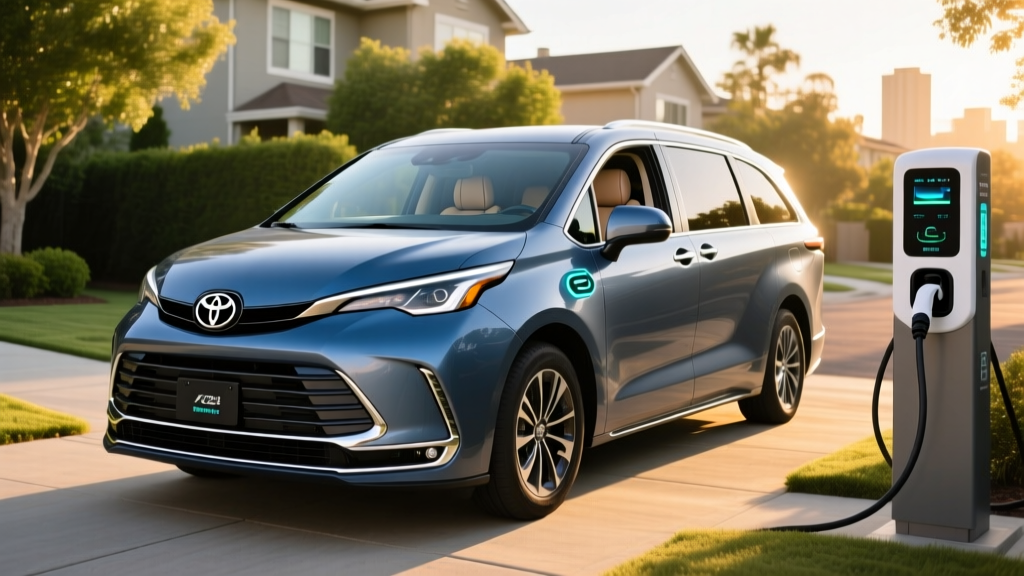
The Toyota Sienna has been an exclusively hybrid minivan since the 2021 redesign, and the 2024 model year carries forward the same fourth-generation formula: a 2.5-liter four-cylinder paired with Toyota's Hybrid Synergy Drive. For families weighing the 2024 Sienna hybrid against plug-in alternatives or full-electric minivans, the numbers tell a compelling story — but only if you understand what this powertrain does and doesn't do.
This is a conventional hybrid electric vehicle (HEV). It does not plug in. It has no electric-only driving range to speak of. What it does offer is class-leading fuel economy in the minivan segment, standard all-wheel drive availability, and the ownership simplicity of never needing to think about charging infrastructure.
HEV vs PHEV vs EV: Where the 2024 Sienna Hybrid Fits
Before digging into the Sienna's specs, it's worth clarifying what you're buying — because the minivan market now spans three distinct electrification approaches, and buyer confusion here is common.
| Feature | HEV (Sienna) | PHEV (e.g., Chrysler Pacifica Hybrid) | BEV (e.g., upcoming electric minivans) |
|---|---|---|---|
| Plugs in? | No | Yes — Level 1/2 | Yes — Level 1/2/DC |
| Electric-only range | ~1 mile (low-speed) | 32 miles (EPA) | 250-350+ miles (EPA) |
| Combined MPG / MPGe | 36 MPG | 30 MPG (gas) / 82 MPGe (elec) | ~2.0 kWh/mi |
| Refueling | Gas station only | Gas station + outlet/charger | Charger only |
| Home charging needed? | No | Recommended | Required |
| Federal tax credit (§30D) | No | Expired for Pacifica | Up to $7,500 if eligible |
| Upfront price premium | Lowest | Moderate | Highest |
The Sienna occupies the simplest position: it's a gas-electric hybrid that recovers braking energy, uses the electric motor to assist the engine and enable brief low-speed electric driving, and refuels at any gas station. No behavior change required. If you want plug-in electric range for school runs and grocery trips, you're looking at a PHEV like the Pacifica Hybrid. If you want zero tailpipe emissions and can charge at home, a BEV minivan may eventually make sense — but as of 2024, the fully electric minivan options remain limited and announced rather than widely available.
2024 Sienna Hybrid Fuel Economy: EPA Ratings and Real-World MPG
The EPA rates the 2024 Toyota Sienna hybrid as follows, per fueleconomy.gov:
| Drivetrain | City MPG | Highway MPG | Combined MPG |
|---|---|---|---|
| FWD | 36 | 36 | 36 |
| AWD (Electronic On-Demand) | 35 | 36 | 35 |
These numbers are exceptional for a three-row minivan weighing over 4,500 pounds. For comparison, the non-hybrid Honda Odyssey rates at 22 MPG combined, meaning the Sienna hybrid uses roughly 39% less fuel per mile.
Real-World MPG: What Owners Actually Report
Hybrids typically exceed their EPA city ratings in stop-and-go traffic because regenerative braking recovers kinetic energy that a conventional vehicle wastes as heat. The Sienna is no exception. Owner-reported data on Fuelly and Edmunds forums consistently shows:
- City driving: 37-42 MPG (frequent stops maximize regen benefit)
- Highway driving (70-80 mph): 30-34 MPG (aerodynamic drag dominates; less regen opportunity)
- Cold weather (below 30°F): 28-32 MPG combined (engine runs more to heat cabin and warm the hybrid battery)
- Loaded with passengers/cargo on road trips: 29-33 MPG
The Sienna's highway MPG dip is typical of hybrids and worth understanding: the 245-hp combined output means the gasoline engine is doing most of the work at sustained high speeds. If your driving is 80%+ highway, your real-world average will likely land around 32-33 MPG — still strong for the segment, but below the 36 MPG sticker. City-dominant commuters will often beat the EPA number.
Powertrain and Performance Specs
| Specification | 2024 Toyota Sienna Hybrid |
|---|---|
| Engine | 2.5L inline-4 (Atkinson cycle), 189 hp / 176 lb-ft |
| Front electric motor | 134 kW (180 hp), 199 lb-ft |
| Rear electric motor (AWD only) | 40 kW (54 hp), 89 lb-ft |
| Combined system output | 245 hp |
| Transmission | eCVT (planetary gearset, no traditional belt/chain) |
| Hybrid battery | 1.9 kWh nickel-metal hydride (NiMH) |
| 0-60 mph | ~7.1 seconds (FWD), ~7.3 seconds (AWD) |
| Towing capacity | 3,500 lbs (when properly equipped) |
| Cargo volume (behind 3rd row) | 33.5 cu ft |
| Cargo volume (max, seats folded) | 101.0 cu ft |
| Fuel tank | 14.5 gallons |
| Total range (est.) | ~520 miles (FWD, combined) |
The 1.9 kWh NiMH battery is small by electrified-vehicle standards — it's not designed for sustained electric driving. Instead, it serves as a buffer: capturing regenerative braking energy and feeding it to the electric motors during acceleration. This "charge-and-deplete" cycling happens dozens of times per drive cycle, which is why Toyota has decades of durability data on this architecture.
The AWD system is worth calling out: it uses a separate rear electric motor rather than a mechanical driveshaft from the engine. This means the rear wheels engage only when traction is needed, with zero parasitic loss during normal driving. It's an elegant solution that costs only 1 MPG on the EPA combined cycle.
Pricing, Trims, and Tax Credit Eligibility
The 2024 Sienna hybrid starts at $37,685 (LE FWD, including destination) and ranges up to approximately $52,675 for the Platinum AWD trim. Key trim pricing:
- LE: $37,685 (FWD) / $38,460 (AWD)
- XLE: $42,435 (FWD) / $43,210 (AWD)
- XSE: $44,435 (FWD) / $45,210 (AWD)
- Limited: $48,685 (FWD) / $49,460 (AWD)
- Platinum: $51,885 (FWD) / $52,675 (AWD)
Federal Tax Credit Status
§30D Federal Tax Credit: Not eligible. The 2024 Toyota Sienna hybrid does not qualify for the IRS §30D New Clean Vehicle Credit. This credit applies only to plug-in electric vehicles (PHEVs and BEVs) with sufficient battery capacity and meeting critical-mineral and battery-component sourcing requirements. As a conventional hybrid (HEV) with a 1.9 kWh battery, the Sienna falls outside the credit's scope entirely.
Some state-level programs offer incentives for high-efficiency hybrids, but these vary widely by jurisdiction. Check your state's energy office or DMV for current programs.
The lack of a federal credit is offset by the Sienna's lower starting price compared to PHEV minivans. The Chrysler Pacifica Hybrid, when it was eligible, started roughly $10,000 higher than the Sienna LE before any credit was applied. After the credit expired for the Pacifica, the Sienna's value proposition strengthened considerably for cost-conscious buyers.
Hybrid Battery Warranty, Reliability, and Replacement Cost
Hybrid battery longevity is consistently the top concern among first-time hybrid buyers. Here's what the data shows for the Sienna:
Toyota Hybrid Battery Warranty: 10 years / 150,000 miles (whichever comes first), covering defects and capacity loss below a defined threshold. This applies to all 50 states. California-emissions states (CARB states) extend coverage to 10 years / 150,000 miles on additional hybrid components.
Hybrid System Warranty: 8 years / 100,000 miles on the inverter, electric motors, and related control electronics.
Real-World Durability Data
Toyota's hybrid system is among the most proven in the industry. The Prius, which shares the same fundamental Hybrid Synergy Drive architecture, has demonstrated battery packs lasting 200,000-300,000+ miles with gradual capacity loss rather than sudden failure. The Sienna's NiMH battery chemistry is inherently stable — it doesn't suffer the thermal runaway risks associated with some lithium-ion chemistries, and its small capacity means individual cell stress is low.
According to Consumer Reports reliability surveys and iSeeCars longevity data, the Toyota Sienna ranks among the most likely vehicles to reach 200,000+ miles. The hybrid system has not emerged as a common failure point in fourth-generation models (2021+).
Battery Replacement Cost
If the hybrid battery does require replacement outside of warranty:
- New OEM battery from Toyota: $3,000 - $4,500 (parts + labor at dealership)
- Refurbished/remanufactured battery: $1,500 - $2,500 (independent hybrid specialists)
- Individual module replacement: $500 - $1,200 (only failed modules replaced — viable when 1-2 of the battery's modules degrade)
Given the 10-year/150,000-mile warranty and Toyota's track record, most Sienna owners will never face an out-of-pocket battery replacement. It remains a factor for second- or third-owners purchasing high-mileage examples.
Who Should Buy the 2024 Sienna Hybrid (and Who Shouldn't)
Pros
- Best-in-class minivan fuel economy (36 MPG combined)
- No charging infrastructure needed — works with your existing routine
- Standard hybrid system with 10-year/150,000-mile battery warranty
- AWD available with minimal fuel economy penalty
- Strong resale value and proven long-term reliability
- 3,500-lb towing adequate for light trailers and boats
- Spacious interior with 101 cu ft max cargo
Cons
- No electric-only driving range (not a PHEV)
- No federal tax credit eligibility
- Modest 245 hp — adequate but not quick for a loaded minivan
- Highway MPG drops to ~30-34 real-world (below EPA sticker)
- Non-removable second-row seats limit cargo flexibility vs. some rivals
- No DC fast charging capability (irrelevant for HEV, but noted for completeness)
- Infotainment system lags behind competitors in responsiveness
The Decision Framework
Choose the 2024 Sienna hybrid if:
- You want minivan practicality with the lowest possible fuel cost and no lifestyle changes
- You don't have reliable access to home or workplace charging
- Your driving is city-heavy (where hybrids shine brightest)
- You plan to own the vehicle 8-15 years and value long-term reliability data
- You want AWD for snow/rain without the fuel penalty of a traditional AWD system
Look at a PHEV minivan instead if:
- You can install a Level 2 charger at home and want 30+ miles of electric-only commuting
- Your daily driving is under 35 miles round-trip (a PHEV could cover most trips on electricity)
- You want to reduce gasoline consumption more aggressively without range limitations
Consider a full EV when:
- You have reliable home Level 2 charging and your daily needs are within 250 miles
- You want to eliminate gasoline entirely and minimize maintenance
- A qualifying EV minivan becomes available and you meet §30D income and sourcing requirements for the $7,500 credit
2024 Sienna Hybrid vs. the Competition
The minivan segment has thinned, but key alternatives remain for cross-shoppers:
| Model | Powertrain | EPA Combined | Starting MSRP | Tax Credit |
|---|---|---|---|---|
| 2024 Toyota Sienna | HEV (2.5L I4 + motors) | 36 MPG | $37,685 | None |
| 2024 Chrysler Pacifica Hybrid | PHEV (3.6L V6 + motor) | 30 MPG / 82 MPGe | $49,095 | Expired |
| 2024 Honda Odyssey | Gas (3.5L V6) | 22 MPG | $38,135 | None |
| 2024 Kia Carnival | Gas (3.5L V6) | 22 MPG | $33,600 | None |
| 2024 Hyundai Santa Fe Hybrid | HEV (1.6L turbo + motor) | 34 MPG | $38,450 | None |
The Sienna's only direct hybrid minivan rival is the Pacifica Hybrid, which offers 32 miles of electric-only range but at a $11,000+ premium and with Chrysler's less-established long-term reliability profile. The Odyssey and Carnival are conventional gas vehicles that cost significantly more to fuel over a 10-year ownership period — at 15,000 miles/year and $3.50/gallon, the Sienna saves approximately $1,800-$2,200 annually in fuel compared to the Odyssey.
Ownership Costs Over 5 Years
A practical look at what owning the 2024 Sienna hybrid actually costs, compared to the gas-only Honda Odyssey (both FWD, LE/base trim, 15,000 miles/year):
| Cost Category | Sienna Hybrid (36 MPG) | Odyssey (22 MPG) |
|---|---|---|
| Fuel (5 years, $3.50/gal avg) | $7,292 | $11,932 |
| Fuel savings vs. gas minivan | $4,640 over 5 years | |
| Estimated maintenance (5 yr) | ~$2,800 | ~$3,400 |
| Insurance (avg, varies by driver) | ~$8,400 | ~$8,100 |
| Federal tax credit | $0 | $0 |
The Sienna's fuel savings alone nearly cover its modest price premium over the Odyssey within five years, before factoring in Toyota's historically stronger resale value. According to Kelley Blue Book, the Sienna retains approximately 55-60% of its value at 5 years, compared to 45-50% for the Odyssey.
Frequently Asked Questions
How many MPG does the 2024 Toyota Sienna hybrid get?
The EPA rates the 2024 Sienna hybrid at 36 MPG combined (36 city / 36 highway) for FWD models and 35 MPG combined for AWD. Real-world city driving often yields 37-42 MPG thanks to regenerative braking, while sustained highway driving at 75+ mph typically drops to 30-34 MPG. Cold weather reduces efficiency by 10-15%.
Does the 2024 Sienna hybrid plug in?
No. The 2024 Sienna is a conventional hybrid (HEV), not a plug-in hybrid (PHEV). It charges its 1.9 kWh battery entirely through regenerative braking and the gasoline engine. You never plug it in — you simply refuel at a gas station. If you want plug-in electric driving range, consider the Chrysler Pacifica Hybrid.
How far can the 2024 Sienna go on electric power alone?
Effectively less than 1 mile at very low speeds (under 25 mph) in specific conditions. The Sienna's hybrid system uses the electric motor primarily to assist the gasoline engine during acceleration and to enable engine-off coasting — not for sustained electric-only driving. This is by design for a conventional hybrid.
Is the 2024 Sienna hybrid reliable? What about battery replacement cost?
Yes. Toyota's Hybrid Synergy Drive is among the most proven hybrid systems globally, with millions of units on the road. The hybrid battery is covered by a 10-year/150,000-mile warranty. Out-of-warranty replacement costs $3,000-$4,500 for a new OEM battery, or $1,500-$2,500 for a refurbished unit. Most owners will never need a replacement within typical ownership periods.
Does the 2024 Sienna hybrid qualify for a federal tax credit?
No. The IRS §30D New Clean Vehicle Credit applies only to plug-in electric vehicles (PHEVs and BEVs) that meet battery sourcing and capacity requirements. As a conventional hybrid, the Sienna does not qualify. Some states may offer incentives for high-efficiency vehicles — check your state's energy office for current programs.
How does AWD work on the 2024 Sienna hybrid?
The Sienna's Electronic On-Demand AWD uses a separate 40 kW electric motor to power the rear wheels — there is no mechanical driveshaft connecting the engine to the rear axle. The rear motor engages only when the system detects front-wheel slip or when additional traction is needed. This design costs just 1 MPG on the EPA combined cycle and adds minimal weight.
Can the 2024 Sienna hybrid tow?
Yes, the 2024 Sienna hybrid is rated to tow up to 3,500 pounds when properly equipped with the factory tow package. This is adequate for small boat trailers, lightweight campers, and utility trailers. It matches the Kia Carnival but falls short of the Honda Odyssey's 3,500-lb rating — both are sufficient for typical minivan towing needs.
Sources: EPA fuel economy data via fueleconomy.gov; Toyota Motor Corporation official specifications; IRS §30D credit rules via irs.gov.