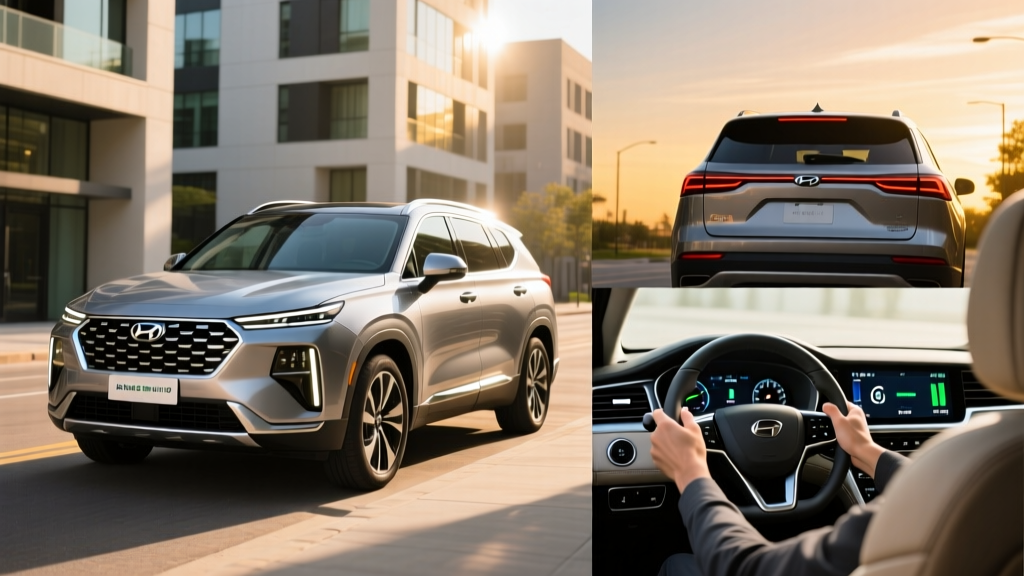
The 2024 Hyundai Santa Fe Hybrid arrived with a bold, boxy redesign that turned heads across the midsize SUV segment. But beyond the polarizing styling, buyers are asking the practical questions: Does the hybrid powertrain actually deliver on fuel economy promises? How does it stack up against a plug-in hybrid or a full battery-electric vehicle for daily commuting and road trips? We've analyzed the EPA data, real-world driving reports, and ownership economics to give you the definitive buyer's guide.
HEV vs. PHEV: Understanding the 2024 Santa Fe Lineup
Before diving into specs, it is critical to distinguish between the two electrified versions of the 2024 Santa Fe. Hyundai offers both a conventional hybrid (HEV) and a plug-in hybrid (PHEV). They serve fundamentally different use cases.
Conventional Hybrid (HEV)
The Santa Fe Hybrid (HEV) uses a small battery and electric motor to assist the gas engine. It recovers energy through regenerative braking and never needs to be plugged in. It is ideal for drivers who want better fuel economy without changing their fueling habits.
Plug-In Hybrid (PHEV)
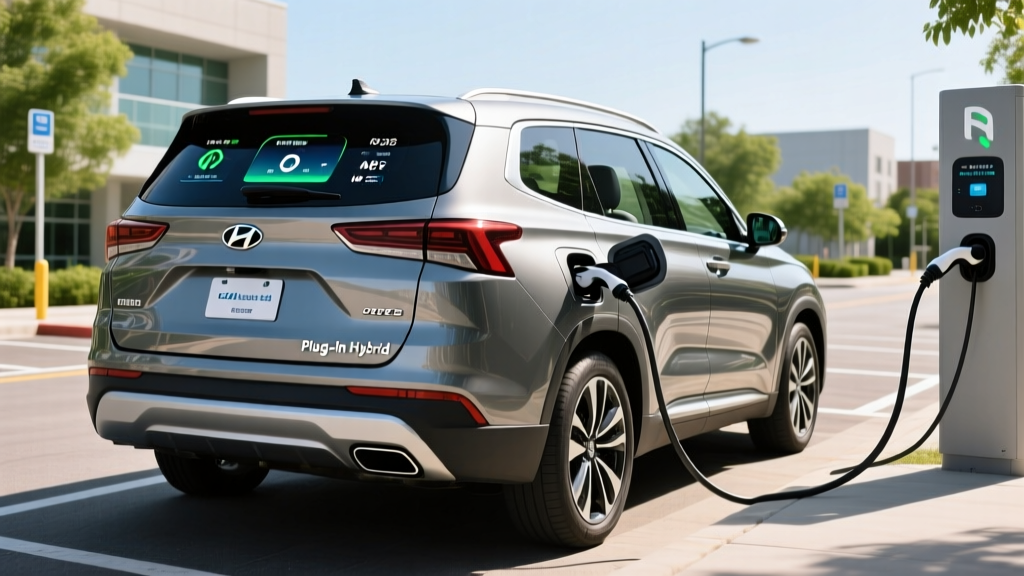
The Santa Fe Plug-In Hybrid features a larger battery that can be charged from a wall outlet or public charger, providing a window of pure electric driving before the gas engine engages. It is best for drivers with short commutes and access to home charging.
Fuel Economy and Real-World MPG
For the conventional 2024 Santa Fe Hybrid (HEV), the EPA estimates are strong for a boxy, three-row SUV. According to fueleconomy.gov, the HEV achieves:
| Driving Condition | EPA Estimate (MPG) | Real-World Expectation |
|---|---|---|
| City | 36 MPG | 34–38 MPG |
| Highway | 31 MPG | 28–32 MPG |
| Combined | 34 MPG | 32–35 MPG |
Real-World Insight: Like most hybrids, the Santa Fe HEV often exceeds its EPA city rating in stop-and-go traffic where regenerative braking is most effective. However, highway driving at sustained speeds above 70 mph will push fuel economy toward the lower end of the range due to the vehicle's aerodynamic profile. In cold weather, expect a 5–10% drop in efficiency as the engine runs more frequently to provide cabin heat.
Powertrain and Performance Specs
The 2024 Santa Fe Hybrid pairs a 1.6-liter turbocharged four-cylinder engine with an electric motor integrated into the transmission. This setup prioritizes smooth acceleration and low-end torque over raw performance.
| Specification | Santa Fe Hybrid (HEV) | Santa Fe Plug-In Hybrid (PHEV) |
|---|---|---|
| Engine | 1.6L Turbo I4 | 1.6L Turbo I4 |
| Combined System Horsepower | 230 HP | 258 HP |
| Combined System Torque | 271 lb-ft | 271 lb-ft |
| Transmission | 6-Speed Automatic | 6-Speed Automatic |
| Drivetrain | AWD (Standard) | AWD (Standard) |
| 0–60 MPH (Est.) | ~7.8 seconds | ~7.2 seconds |
The hybrid powertrain provides confident merging power and responsive acceleration from a stop, but it is not a performance-oriented SUV. The six-speed automatic avoids the rubber-band feel of CVTs found in some competitors, though it can hunt for gears under heavy throttle on inclines.
Santa Fe Plug-In Hybrid: Electric-Only Range and Charging
If you are considering the PHEV variant, electric-only range is the headline feature. The 2024 Santa Fe Plug-In Hybrid features a 13.8 kWh battery pack (usable capacity approximately 11.5 kWh), which the EPA rates for 30 miles of electric-only driving. Total combined range (electric + gas) exceeds 400 miles.
Charging the PHEV:
- Level 1 (120V household outlet): ~7 hours from empty to full. Suitable for overnight charging if you drive less than 30 miles daily.
- Level 2 (240V home or public charger): ~1 hour 45 minutes from empty to full using the onboard 7.2 kW charger.
- DC Fast Charging: Not supported. The Santa Fe PHEV cannot use DC fast chargers. This is a limitation compared to some competitors like the Toyota RAV4 Prime (which also lacks DCFC) but is standard for most PHEVs in this class.
Real-World Electric Range: Expect 25–28 miles of electric driving in mixed conditions. Highway speeds, cold weather, and aggressive acceleration will reduce this to 20–22 miles. If your daily commute is under 25 miles round-trip and you charge at home nightly, you could go weeks without visiting a gas station.
Pricing and Tax Credit Eligibility
The 2024 Santa Fe Hybrid lineup is positioned as a value-oriented alternative to premium midsize SUVs. Pricing (MSRP, excluding destination) starts as follows:
- Santa Fe Hybrid (HEV) SEL Premium: ~$38,000
- Santa Fe Hybrid (HEV) Limited: ~$43,000
- Santa Fe Plug-In Hybrid (PHEV) SEL Premium: ~$45,000
- Santa Fe Plug-In Hybrid (PHEV) Limited: ~$50,000
Federal Tax Credit (§30D): As of 2024, the Santa Fe Plug-In Hybrid does not qualify for the full $7,500 federal tax credit due to battery component and critical mineral sourcing requirements under the Inflation Reduction Act. Hyundai vehicles are assembled in South Korea, which disqualifies them from the new-vehicle credit under current IRS rules. Always verify eligibility with a tax professional before purchasing, as rules can change and point-of-sale transfer options may apply to used vehicles.
State Incentives: Some states offer rebates for PHEVs regardless of assembly location. Check your state's energy or environmental agency website for current programs.
Battery Warranty, Reliability, and Replacement Costs
Hyundai provides one of the strongest hybrid battery warranties in the industry, which is a major factor for long-term ownership confidence.
Santa Fe Hybrid Battery Warranty
- Coverage: 10 years / 100,000 miles (whichever comes first)
- Capacity Retention Threshold: Hyundai typically warrants the hybrid battery to retain at least 70% of original capacity. If degradation falls below this threshold within the warranty period, replacement or repair is covered.
- Powertrain Warranty: 10 years / 100,000 miles (engine, transmission, electric motor)
Reliability: Hyundai's hybrid systems have proven reliable in recent model years, with fewer reported issues than early-generation hybrids from other brands. The 1.6L turbo engine is shared across multiple Hyundai/Kia models and has a solid track record.
Battery Replacement Cost: Out-of-warranty hybrid battery replacement for the Santa Fe HEV typically costs between $2,000 and $3,500 (parts and labor). The PHEV battery is larger and more expensive, ranging from $4,000 to $6,000. However, hybrid batteries rarely fail catastrophically; most degradation is gradual and may not require full replacement if the vehicle is maintained properly.
Who Should Choose the Santa Fe Hybrid vs. EV or Gas?
The decision between a hybrid, plug-in hybrid, or full EV depends on your driving patterns, charging access, and budget. Here is a practical framework:
Choose the Santa Fe Hybrid (HEV) If:
- You drive 15,000+ miles annually and want to reduce fuel costs without plug-in infrastructure.
- You frequently take long road trips and want to avoid charging stops.
- You live in an apartment or lack access to home or workplace charging.
- You want a three-row SUV with strong fuel economy and a lower purchase price than a full EV.
Choose the Santa Fe Plug-In Hybrid (PHEV) If:
- Your daily commute is under 30 miles and you can charge at home nightly.
- You want electric-only driving for most trips but need gas flexibility for weekend road trips.
- You want to reduce emissions without committing to a full EV's range limitations.
- You are willing to pay a premium for the PHEV powertrain and can absorb the lack of federal tax credit.
Choose a Full EV (e.g., Hyundai Ioniq 5, Tesla Model Y) If:
- You have reliable home Level 2 charging and your daily driving is under 250 miles.
- You want to eliminate gas station visits entirely and benefit from lower per-mile energy costs.
- You qualify for the $7,500 federal tax credit on an eligible EV (e.g., U.S.-assembled models).
- You prioritize instant torque, quiet operation, and minimal maintenance.
Frequently Asked Questions
How many MPG does the 2024 Santa Fe Hybrid get?
The EPA rates the 2024 Santa Fe Hybrid (HEV) at 36 MPG city, 31 MPG highway, and 34 MPG combined. Real-world driving typically yields 32–35 MPG combined, with city driving often exceeding the EPA estimate due to regenerative braking.
How far can the Santa Fe Plug-In Hybrid go on electric only?
The EPA rates the 2024 Santa Fe PHEV for 30 miles of electric-only range. Real-world conditions (highway speeds, cold weather, hills) typically reduce this to 25–28 miles. Total combined range (electric + gas) exceeds 400 miles.
Does the 2024 Santa Fe Hybrid qualify for a tax credit?
The new Santa Fe Hybrid and Plug-In Hybrid do not qualify for the federal §30D tax credit due to South Korean assembly and battery sourcing rules. However, some states offer rebates for PHEVs. Used hybrid and PHEV models may qualify for the up-to-$4,000 used clean vehicle credit if income and price caps are met.
Is the Santa Fe Hybrid reliable, and what is battery replacement cost?
Hyundai's hybrid systems have strong reliability ratings, and the 10-year/100,000-mile hybrid battery warranty provides long-term peace of mind. Out-of-warranty battery replacement costs $2,000–$3,500 for the HEV and $4,000–$6,000 for the PHEV, though full replacements are rare.
Can I tow with the Santa Fe Hybrid?
Yes. The 2024 Santa Fe Hybrid is rated to tow up to 3,500 pounds when properly equipped, which is sufficient for a small trailer, boat, or bike rack. Towing will reduce fuel economy by 5–10 MPG depending on load and terrain.