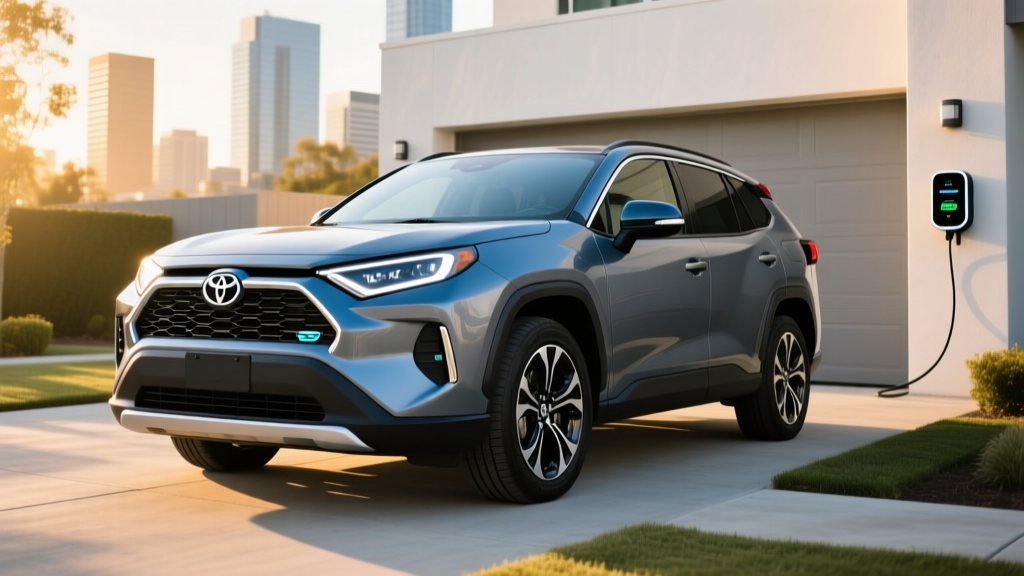
Quick Verdict: The Sportiest RAV4 Hybrid Still Prioritizes Efficiency
The 2024 RAV4 XSE Hybrid occupies a specific niche in Toyota's lineup: it's the trim that pairs the hybrid powertrain's fuel-sipping character with sport-tuned suspension, black exterior accents, and SofTex-trimmed seats. Underneath the cosmetic upgrades, it shares the same proven 2.5-liter four-cylinder hybrid system found across the RAV4 Hybrid range, delivering an EPA-estimated 41 MPG city, 38 MPG highway, and 39 MPG combined. With 219 combined horsepower and standard electronic on-demand AWD, the XSE Hybrid offers a practical middle ground between a conventional gas SUV and a full battery-electric vehicle — no plug required, no range anxiety, and a starting MSRP of $36,285 before destination.
| Specification | 2024 RAV4 XSE Hybrid |
|---|---|
| Powertrain | 2.5L 4-cyl + 2 electric motors (eAWD) |
| Combined Horsepower | 219 hp |
| EPA MPG (City / Hwy / Combined) | 41 / 38 / 39 |
| Fuel Tank Capacity | 14.5 gallons |
| Total Driving Range | ~565 miles |
| 0–60 mph | 7.4 seconds (est.) |
| Drivetrain | Electronic on-demand AWD (eAWD) |
| Cargo Volume (behind rear seats) | 37.6 cu ft |
| Towing Capacity | 1,750 lbs |
| Hybrid Battery Warranty | 10 years / 150,000 miles |
| Base MSRP (excl. destination) | $36,285 |
HEV vs PHEV: What the RAV4 XSE Hybrid Actually Is
A common point of confusion in the RAV4 lineup is the difference between the RAV4 Hybrid (HEV) and the RAV4 Prime (PHEV). The 2024 RAV4 XSE Hybrid is a conventional hybrid (HEV). It does not plug in. It has no meaningful electric-only driving range. Instead, it uses a small 1.6 kWh nickel-metal hydride (NiMH) traction battery that charges itself through regenerative braking and the gasoline engine. The electric motors assist the gas engine during acceleration and allow brief low-speed electric-only movement — typically under 1 mile at parking-lot speeds.
The RAV4 Prime, by contrast, is a plug-in hybrid (PHEV) with an 18.1 kWh lithium-ion battery, 42 miles of EPA-rated electric-only range, 302 combined horsepower, and the ability to charge from a wall outlet. The Prime is available only in SE and XSE trims but is priced significantly higher (starting around $43,690 for 2024). If you're cross-shopping the XSE Hybrid against the Prime XSE, here's the core trade-off:
| Feature | RAV4 XSE Hybrid (HEV) | RAV4 Prime XSE (PHEV) |
|---|---|---|
| Plugs in? | No | Yes (Level 1 & Level 2) |
| Electric-only range | Negligible (<1 mi at low speed) | 42 miles (EPA) |
| Combined HP | 219 hp | 302 hp |
| Battery | 1.6 kWh NiMH | 18.1 kWh Li-ion |
| EPA Combined MPG / MPGe | 39 MPG | 94 MPGe (elec) / 38 MPG (gas) |
| Base MSRP (2024) | $36,285 | $46,190 (XSE) |
| Federal Tax Credit (§30D) | Not eligible | Up to $7,500 (subject to eligibility) |
Fuel Economy: EPA Ratings vs Real-World MPG
The EPA rates the 2024 RAV4 Hybrid AWD — including the XSE trim — at 41 MPG city, 38 MPG highway, and 39 MPG combined according to fueleconomy.gov. The XSE's sport-tuned suspension and 18-inch wheels don't change the EPA rating compared to other hybrid AWD trims, though some owners report a marginal real-world difference due to the XSE's slightly wider tire specification.
| Driving Scenario | EPA Estimate | Real-World Expectation |
|---|---|---|
| City (stop-and-go) | 41 MPG | 42–45 MPG (hybrids excel here) |
| Highway (70+ mph) | 38 MPG | 34–37 MPG (aero drag hurts at speed) |
| Combined (mixed) | 39 MPG | 37–41 MPG (varies by climate/terrain) |
| Cold weather (below 32°F) | — | 33–36 MPG (engine runs more for cabin heat) |
The key insight for hybrid newcomers: hybrids reverse the traditional city/highway MPG relationship. The RAV4 Hybrid actually achieves better fuel economy in city driving because regenerative braking recaptures energy during deceleration and the engine shuts off at stops. On sustained highway runs above 70 mph, the gasoline engine does most of the work, and the aerodynamic profile of an SUV works against efficiency. Drivers who do 70% or more of their miles in urban and suburban conditions will consistently beat the EPA combined rating. Those who commute long highway distances should expect to fall a few MPG short.
Powertrain and Driving Dynamics
The XSE Hybrid uses Toyota's fourth-generation hybrid system (THS IV) centered around a 2.5-liter Dynamic Force inline-four engine producing 176 hp and 163 lb-ft of torque on its own. Two electric motor-generators — one primarily driving the front wheels and a second powering the rear axle via the eAWD system — add electric torque for a combined system output of 219 horsepower.
The eAWD system is worth explaining because it differs from mechanical AWD. There is no driveshaft connecting the front and rear axles. Instead, the rear electric motor (54 hp) engages independently when the system detects front-wheel slip, during hard acceleration, or in low-traction conditions. This means the RAV4 XSE Hybrid operates as a front-wheel-drive vehicle most of the time, contributing to its strong fuel economy, with rear torque available on demand. It's effective for rain, light snow, and gravel roads but is not designed for serious off-roading.
The XSE trim adds a sport-tuned suspension with stiffer damping and a thicker front stabilizer bar compared to the LE, XLE, and Woodland Edition hybrid trims. The result is slightly flatter cornering and a more planted feel on twisty roads, at the cost of a firmer ride over broken pavement. The difference is noticeable but modest — this is still fundamentally a comfort-oriented family SUV, not a sports car. The 0–60 mph time of approximately 7.4 seconds is adequate for merging and passing but won't thrill anyone coming from a performance vehicle.
Interior, Technology, and the XSE Trim Difference
What you're paying for with the XSE over the more affordable XLE Hybrid ($34,035 MSRP) is primarily aesthetic and comfort-oriented:
- Exterior: Black roof, gloss black 18-inch wheels, black mirror caps, black badging, and unique front/rear bumper styling
- Interior: SofTex synthetic leather seats with blue accent stitching, heated front seats, leather-wrapped steering wheel
- Technology: 8-inch Toyota Audio Multimedia touchscreen (upgraded to 10.5-inch with the optional Technology Package), wireless Apple CarPlay and Android Auto, 6-speaker audio
- Convenience: Power liftgate, smart key system with push-button start, auto-dimming rearview mirror
The standard Toyota Safety Sense 2.5+ suite includes pre-collision braking with pedestrian detection, full-speed-range adaptive cruise control, lane departure alert with steering assist, lane tracing assist, automatic high beams, and road sign assist. These are Level 2 driver-assistance features (per SAE classification) — they require continuous driver attention and do not constitute self-driving capability.
Pricing, Tax Credits, and Value
The 2024 RAV4 XSE Hybrid starts at $36,285 (MSRP, excluding $1,350 destination charge). Key options include:
- Technology Package (~$1,815): 10.5-inch touchscreen, panoramic view monitor, front and rear parking assist with automatic braking
- Premium Audio with JBL (~$810): 11-speaker JBL system with subwoofer
- Panoramic Glass Roof (~$1,100): Fixed panoramic roof with power sunshade
A fully loaded XSE Hybrid with all packages will land in the $40,000–$41,500 range before taxes and fees.
Federal Tax Credit Status
The 2024 RAV4 XSE Hybrid (HEV) does not qualify for the federal §30D Clean Vehicle Credit. That credit applies only to plug-in electric vehicles (BEVs and PHEVs) meeting battery-sourcing, MSRP, and buyer-income requirements under current IRS rules. Conventional hybrids like this one are excluded. Some states and localities offer modest rebates or HOV lane access for hybrids — check your state's energy office or the Alternative Fuels Data Center for current programs.
If the federal tax credit is a priority, the RAV4 Prime (PHEV) may qualify for up to $7,500 under §30D, though eligibility depends on your modified adjusted gross income, the vehicle's MSRP (SUV cap: $80,000), and battery component/critical mineral sourcing requirements. Consult IRS guidance or a tax professional before assuming eligibility.
Reliability, Battery Warranty, and Replacement Cost
Toyota's hybrid system is among the most proven in the industry, with over 25 years of continuous production since the original Prius. The 2024 RAV4 Hybrid's nickel-metal hydride traction battery is covered by a 10-year / 150,000-mile warranty (whichever comes first) in all 50 states, up from the previous 8-year/100,000-mile coverage. This warranty guarantees the battery against defects and excessive capacity loss.
| Warranty Coverage | Term |
|---|---|
| Hybrid Battery | 10 years / 150,000 miles |
| Hybrid System Components (inverter, motors) | 8 years / 100,000 miles |
| Powertrain (engine, transmission) | 5 years / 60,000 miles |
| Basic (bumper-to-bumper) | 3 years / 36,000 miles |
In practice, Toyota hybrid batteries have demonstrated strong longevity. Fleet data and owner reports suggest most NiMH packs retain sufficient capacity well beyond 150,000 miles. When replacement is eventually needed — typically at 15+ years or 180,000+ miles — a new OEM hybrid battery for the RAV4 Hybrid runs approximately $3,000–$4,000 installed at a dealership. Third-party reconditioned batteries are available for $1,500–$2,500. Given that the average RAV4 Hybrid owner will spend roughly $1,200–$1,500 annually on fuel (at 12,000 miles/year and $3.50/gallon), the hybrid system's fuel savings over a decade of ownership ($4,000–$6,000 versus a gas-only RAV4 AWD) typically offsets any eventual battery replacement cost.
Who Should Buy the 2024 RAV4 XSE Hybrid?
Pros
- 39 MPG combined with no plug-in requirement — ideal for apartment dwellers and those without home charging
- Standard eAWD provides confident traction in rain and light snow
- 10-year/150,000-mile hybrid battery warranty
- Strong resale value — RAV4 Hybrids consistently hold value well above segment average
- ~565 miles of total range between fill-ups
- Comprehensive Toyota Safety Sense 2.5+ standard on all trims
Cons
- No electric-only driving range — not eligible for EV tax credits
- eAWD is light-duty; not suited for towing heavy loads (1,750 lb max) or serious off-road use
- Firm ride from sport-tuned suspension may not suit all buyers
- 8-inch base screen feels dated in this price range (10.5-inch requires optional package)
- No DC fast charging capability (not applicable — this is an HEV)
Decision Framework: Hybrid vs PHEV vs EV
Choose the RAV4 XSE Hybrid (HEV) if: You don't have access to home or workplace charging, you want maximum simplicity with no plug-in routine, you drive 12,000–18,000 miles per year in mixed conditions, and you want a proven powertrain with strong resale value.
Choose the RAV4 Prime (PHEV) if: You can install a Level 2 charger at home, your daily commute is under 40 miles (covering most trips on electricity alone), you want the performance boost of 302 hp, and you may qualify for the $7,500 federal tax credit.
Choose a full BEV (e.g., Tesla Model Y, Hyundai Ioniq 5) if: You have reliable home charging, your daily driving is under 250 miles, you want zero tailpipe emissions and minimal maintenance, and you want to maximize fuel cost savings (electricity at ~$0.04–$0.06/mile vs gasoline at ~$0.10–$0.14/mile).
Frequently Asked Questions
How many MPG does the 2024 RAV4 XSE Hybrid get?
The EPA rates it at 41 MPG city, 38 MPG highway, and 39 MPG combined. In real-world driving, city-heavy commuters often achieve 42–45 MPG, while sustained highway driving at 70+ mph typically yields 34–37 MPG.
Does the RAV4 XSE Hybrid need to be plugged in?
No. The 2024 RAV4 XSE Hybrid is a conventional hybrid (HEV). Its small battery charges through regenerative braking and the gasoline engine. You simply fill it with gas like any other vehicle. If you want a plug-in RAV4, look at the RAV4 Prime (PHEV).
Is the RAV4 Hybrid reliable and what does battery replacement cost?
Toyota's hybrid system has an extensive track record spanning 25+ years. The hybrid battery is warrantied for 10 years/150,000 miles. Real-world data shows most packs last well beyond the warranty period. Out-of-warranty replacement costs approximately $3,000–$4,000 for a new OEM battery at a dealership.
Does the 2024 RAV4 XSE Hybrid qualify for any tax credit?
No. The federal §30D Clean Vehicle Credit applies only to plug-in vehicles (BEVs and PHEVs). Conventional hybrids are not eligible. Check your state's incentive programs — some offer modest rebates for hybrid purchases.
How does the XSE Hybrid compare to the gas-only RAV4?
The gas-only 2024 RAV4 AWD (203 hp) is rated at 27 MPG combined versus the XSE Hybrid's 39 MPG — a 44% improvement. The hybrid also delivers smoother acceleration from electric motor torque and a quieter cabin at low speeds. The hybrid carries a ~$2,500 price premium over an equivalently trimmed gas model, which most drivers recoup in fuel savings within 3–5 years.
Can the RAV4 XSE Hybrid tow?
Yes, but modestly. Maximum towing capacity is 1,750 pounds — sufficient for a small utility trailer, a pair of dirt bikes, or a lightweight pop-up camper. It is not rated for towing larger boats or travel trailers. If you need more towing capacity, the gas-only RAV4 Adventure or TRD Off-Road trims are rated for 3,500 pounds.