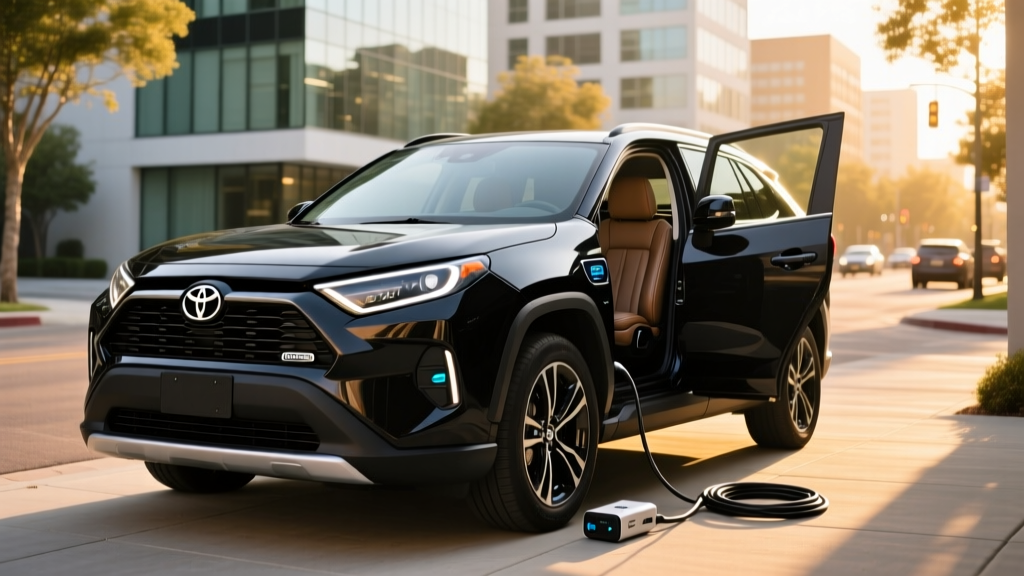
The Toyota RAV4 Hybrid has held its position as America's best-selling hybrid SUV for good reason. With the 2024 model year, Toyota refined an already proven formula: a 2.5-liter four-cylinder paired with three electric motors (on AWD trims), standard electronic all-wheel drive, and a price point that undercuts most plug-in alternatives. If you've been searching for a 2024 RAV4 Hybrid and weighing it against full EVs or conventional gas SUVs, this guide covers the exact numbers you need — EPA MPG by trim, real-world fuel economy observations, powertrain specs, battery longevity, and total ownership cost.
Before we get into the data, a critical distinction: the RAV4 Hybrid (HEV) is a conventional self-charging hybrid. It does not plug in. If you want plug-in capability with 42 miles of electric-only range, Toyota sells the RAV4 Prime (PHEV) separately, which we address in the comparison section below.
2024 RAV4 Hybrid MPG: EPA Ratings and Real-World Results
Fuel economy is the primary reason buyers choose the RAV4 Hybrid over the gas-only RAV4. Toyota publishes EPA estimates via fueleconomy.gov, and the numbers vary slightly by trim due to wheel size and curb weight differences.
| Trim | City MPG | Highway MPG | Combined MPG | Drivetrain |
|---|---|---|---|---|
| LE / XLE / XLE Premium | 41 | 38 | 40 | AWD (eAWD) |
| SE / XSE | 40 | 36 | 39 | AWD (eAWD) |
| Woodland Edition | 38 | 35 | 37 | AWD (eAWD) |
| Limited | 41 | 38 | 40 | AWD (eAWD) |
For comparison, the gas-only 2024 RAV4 AWD achieves 27 city / 34 highway / 30 combined — making the hybrid roughly 33% more efficient overall, with a dramatic 52% improvement in city driving.
Powertrain Specs: Engine, Motors, and Combined Output
The 2024 RAV4 Hybrid uses Toyota's fourth-generation hybrid system, pairing a naturally aspirated 2.5-liter Dynamic Force four-cylinder engine with electric motors front and rear.
| Specification | Value |
|---|---|
| Gas Engine | 2.5L 4-cylinder Dynamic Force (A25A-FXS) |
| Engine Power | 176 hp @ 5,700 rpm / 163 lb-ft @ 5,200 rpm |
| Front Electric Motor | 118 hp / 149 lb-ft |
| Rear Electric Motor (eAWD) | 54 hp / 89 lb-ft |
| Net Combined System Output | 219 hp |
| 0–60 mph | 7.4 seconds (Motor Trend tested) |
| Transmission | eCVT (planetary gearset, not belt-driven) |
| Drivetrain | Electronic AWD (eAWD) — standard on all trims |
| Hybrid Battery | 1.6 kWh nickel-metal hydride (NiMH), sealed |
| Towing Capacity | 1,750 lbs (all trims) |
The eAWD system is worth explaining because it differs from mechanical AWD. There is no driveshaft connecting the front and rear axles. Instead, the rear electric motor engages independently when the system detects front-wheel slip, during hard acceleration, or in cornering. The rear motor operates up to approximately 43 mph in normal conditions and up to 75 mph in Sport mode. This means the RAV4 Hybrid behaves as a front-wheel-drive vehicle in most steady-state cruising, engaging the rear motor only when needed — which contributes to its strong highway fuel economy.
At 219 combined horsepower, the RAV4 Hybrid isn't a performance SUV, but it's adequately quick for merging and passing. The 7.4-second 0–60 time beats the gas-only RAV4 AWD (roughly 8.8 seconds) and feels responsive in daily driving thanks to the electric motors' instant torque delivery from a stop.
HEV vs PHEV: RAV4 Hybrid vs RAV4 Prime
Toyota offers two electrified RAV4 variants, and buyers frequently confuse them. Here's the fundamental difference:
RAV4 Hybrid (HEV)
- No plug required — charges via regenerative braking and the gas engine
- 1.6 kWh battery (NiMH)
- No electric-only driving range — the electric motors assist the engine but cannot propel the vehicle alone at meaningful speeds
- 40 MPG combined
- No federal tax credit
- MSRP from $32,850
RAV4 Prime (PHEV)
- Plugs in to charge the larger battery
- 18.1 kWh battery (lithium-ion)
- 42 miles EPA electric-only range before the gas engine activates
- 94 MPGe combined (electric + gas), 38 MPG gas-only after battery depletion
- May qualify for up to $7,500 federal tax credit (§30D — subject to income, sourcing, and MSRP caps)
- MSRP from $44,215
The RAV4 Prime also produces 302 combined horsepower (significantly more than the Hybrid's 219 hp) and offers 42 miles of pure electric driving — enough for most commutes without burning a drop of gas. However, the Prime carries an $11,365 price premium over the Hybrid LE. Whether the tax credit, fuel savings, and electric range justify that premium depends on your driving patterns and charging access. We cover this decision framework below.
Pricing, Trims, and Tax Credit Eligibility
The 2024 RAV4 Hybrid is available in seven trims. All come standard with electronic AWD — there is no FWD-only hybrid variant, unlike the gas model.
| Trim | MSRP (incl. destination) | Key Features |
|---|---|---|
| LE | $32,850 | Toyota Safety Sense 2.5, 8" touchscreen, wireless CarPlay/Android Auto |
| XLE | $34,300 | Blind-spot monitor, dual-zone climate, smart key, 5 USB ports |
| XLE Premium | $36,690 | SofTex seats, power liftgate, moonroof, 18" alloy wheels |
| SE | $37,045 | Sport-tuned suspension, 19" wheels, paddle shifters |
| XSE | $38,440 | SE features + SofTex, heated front seats, 9" touchscreen |
| Woodland Edition | $37,945 | TRD-tuned suspension, all-terrain tires, roof rack, unique styling |
| Limited | $41,055 | Panoramic moonroof, JBL audio, 360° camera, ventilated seats |
Battery Warranty, Reliability, and Replacement Costs
Hybrid battery longevity remains the top concern for first-time hybrid buyers. Toyota addresses this with one of the strongest hybrid battery warranties in the industry.
2024 RAV4 Hybrid Battery & Powertrain Warranty
- Hybrid Battery: 10 years / 150,000 miles (whichever comes first) — covers capacity loss below a defined threshold and defects
- Hybrid System Components: 8 years / 100,000 miles — includes inverter, transaxle, and control modules
- Powertrain (engine): 5 years / 60,000 miles
- Basic Bumper-to-Bumper: 3 years / 36,000 miles
Toyota's NiMH hybrid battery in the RAV4 Hybrid is a mature, well-proven technology. Unlike lithium-ion packs in full EVs, this 1.6 kWh battery operates in a narrow state-of-charge window (roughly 40–80% SoC), which dramatically reduces degradation stress. The battery rarely cycles fully and is managed by an active thermal system. Real-world data from millions of Toyota hybrids on the road — including Prius models from the early 2000s still running original batteries — shows that NiMH hybrid batteries routinely last 150,000–200,000+ miles before requiring replacement.
If replacement is needed out of warranty, a new OEM RAV4 Hybrid battery from Toyota typically costs between $3,000 and $4,500 including labor at a dealership. Refurbished or reconditioned battery packs are available from third-party suppliers for $1,500–$2,500. Individual battery modules can also be replaced by specialized hybrid repair shops for $500–$1,200 if only a few cells have degraded.
Toyota's reliability reputation is well-earned. The RAV4 Hybrid consistently earns above-average reliability scores from J.D. Power and Consumer Reports. The eCVT transmission, which uses a planetary gearset rather than a traditional belt-and-pulley CVT, is among the most durable transmissions Toyota has ever produced — there are no belts, clutches, or bands to wear out.
RAV4 Hybrid vs Full EV vs Gas: Which Is Right for You?
Choosing between the RAV4 Hybrid, a plug-in RAV4 Prime, a full EV (like the Toyota bZ4X, Tesla Model Y, or Hyundai Ioniq 5), or the gas-only RAV4 depends on your specific situation. Here's a practical decision framework:
Choose the RAV4 Hybrid (HEV) If:
- You cannot install a home charger (apartment, street parking, no garage)
- You want better fuel economy without changing any habits — just fill up with gas
- Your budget is under $40,000 and you need AWD
- You frequently drive in stop-and-go city traffic where the hybrid system excels
- You plan to keep the vehicle 8–10+ years and value Toyota's reliability track record
Choose the RAV4 Prime (PHEV) If:
- You can charge at home (Level 2 or even a standard 120V outlet will work overnight)
- Your daily commute is under 40 miles round-trip (you'll rarely use gas)
- You want the option of electric-only driving but need gas flexibility for road trips
- You qualify for the federal tax credit, narrowing the price gap with the HEV
- You want 302 hp and faster acceleration
Choose a Full EV If:
- You have reliable home charging (Level 2 strongly recommended)
- You want to eliminate gas entirely and reduce maintenance costs (no oil changes, fewer moving parts)
- Your daily driving is predictable and within the EV's range
- You qualify for the full $7,500 federal tax credit on an eligible BEV
- You're willing to plan charging on long road trips
Choose the Gas-Only RAV4 If:
- Your annual mileage is very low (under 8,000 miles) — the hybrid premium won't pay back
- You want the lowest possible upfront price ($29,725 LE AWD)
- You primarily drive long highway stretches where the hybrid advantage narrows
5-Year Ownership Cost Snapshot
To put the fuel savings in perspective, here's a simplified five-year cost comparison assuming 15,000 miles per year, $3.50/gallon regular unleaded, and EPA combined MPG figures:
| Vehicle | Combined MPG | Gallons Used | Total Fuel Cost | Fuel Savings vs Gas RAV4 |
|---|---|---|---|---|
| RAV4 Gas AWD (30 combined) | 30 | 2,500 | $8,750 | — |
| RAV4 Hybrid (40 combined) | 40 | 1,875 | $6,563 | $2,188 |
| RAV4 Prime (38 MPG gas-only after EV range) | 38* | ~1,447** | ~$5,065** | ~$3,685 |
*After electric range is depleted. **Assumes 30% of miles driven on electric-only (plugged in regularly). Actual savings vary significantly based on charging frequency and electricity rates.
The RAV4 Hybrid saves roughly $438 per year in fuel compared to the gas model — enough to recoup the approximately $3,000 hybrid premium over the gas RAV4 LE AWD in about 7 years. However, the hybrid also commands higher resale values, which effectively shortens the payback period. According to Kelley Blue Book, the RAV4 Hybrid retains approximately 58–62% of its value after 5 years, compared to 50–54% for the gas model.
Pros and Cons of the 2024 RAV4 Hybrid
✓ Pros
- 40 MPG combined — best-in-class for compact hybrid SUVs
- Standard eAWD on every trim — no FWD compromise
- 10-year / 150,000-mile hybrid battery warranty
- Proven, mature powertrain with exceptional reliability history
- No charging infrastructure needed — works with existing gas stations
- Strong resale value retention
- Toyota Safety Sense 2.5 standard (pre-collision, lane-trace, adaptive cruise)
- Competitive pricing from $32,850
✗ Cons
- No federal tax credit (HEV, not a plug-in)
- Engine noise under hard acceleration (CVT drone)
- Rear-seat legroom is average for the class (37.8")
- Cargo space slightly reduced vs gas model (37.6 cu ft vs 37.6 — comparable, but no spare tire on most trims)
- Infotainment is functional but not class-leading in screen size or speed
- Woodland Edition sacrifices MPG for off-road styling (37 combined)
- 1,750-lb towing capacity is low for the segment
Frequently Asked Questions
How many MPG does the 2024 RAV4 Hybrid actually get?
The EPA rates most trims at 41 city / 38 highway / 40 combined. In real-world suburban and city driving, many owners report matching or slightly exceeding the combined rating. Highway-only driving at 70+ mph typically yields 34–37 MPG. Cold weather reduces efficiency by 5–10%.
Does the RAV4 Hybrid need to be plugged in?
No. The RAV4 Hybrid is a conventional (self-charging) hybrid. Its small 1.6 kWh battery charges through regenerative braking and the gas engine. You fuel it exclusively at gas stations — no plug, no charging cable, no home charger needed.
How long will the RAV4 Hybrid battery last?
Toyota warranties the hybrid battery for 10 years / 150,000 miles. Based on decades of Toyota hybrid data (Prius, Camry Hybrid, Highlander Hybrid), NiMH hybrid batteries commonly last 150,000–200,000+ miles. The battery operates in a narrow charge window that minimizes degradation.
What does it cost to replace the RAV4 Hybrid battery?
A new OEM battery from Toyota runs $3,000–$4,500 installed. Refurbished packs are available for $1,500–$2,500. Individual module replacement (if only a few cells fail) costs $500–$1,200 at a hybrid specialist.
Does the 2024 RAV4 Hybrid qualify for a tax credit?
The conventional RAV4 Hybrid (HEV) does not qualify for the federal §30D clean vehicle credit — that credit is reserved for plug-in vehicles (BEVs and PHEVs). The RAV4 Prime (PHEV) may qualify for up to $7,500 depending on your income, the vehicle's battery sourcing, and MSRP caps. Check IRS guidelines for current-year eligibility rules. Some states offer separate hybrid incentives.
Is the RAV4 Hybrid AWD system good in snow?
The eAWD system provides competent light-snow and wet-road traction. The rear motor engages automatically when front-wheel slip is detected. It's not a substitute for a dedicated off-road or heavy-snow vehicle, but combined with winter tires, it handles typical winter commuting conditions well. The Woodland Edition's all-terrain tires offer slightly more capability on unplowed roads.
Should I buy the RAV4 Hybrid or the RAV4 Prime?
If you can charge at home and your daily driving is under 42 miles, the Prime's electric-only range means you'll burn almost no gasoline on weekdays, and the potential $7,500 tax credit narrows the $11,365 price gap significantly. If you can't charge at home, drive long distances daily, or want to stay under $40,000, the Hybrid is the more practical and cost-effective choice.