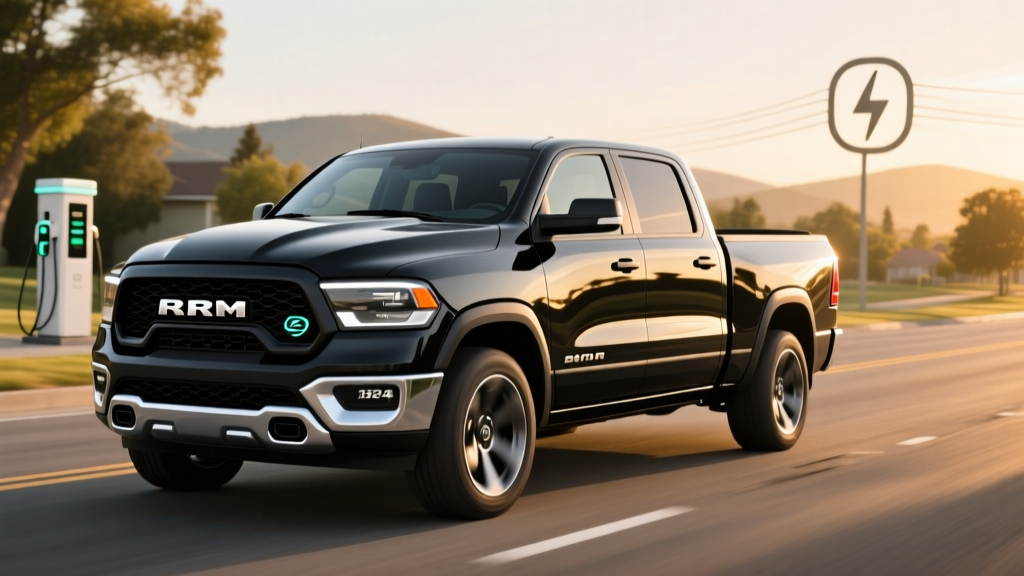
If you've been searching for a 2024 Ram 1500 hybrid, the first thing you need to know is this: Ram's mild-hybrid system, called eTorque, is not a full hybrid like a Toyota Prius or a plug-in hybrid like a RAV4 Prime. It's a belt-driven mild-hybrid system designed to smooth out the V8's stop-start behavior, add a small torque fill off the line, and squeeze out marginally better fuel economy. With the 2025+ Ram 1500 generation dropping the 5.7L HEMI V8 entirely in favor of the Hurricane inline-six turbo, the 2024 model year represents the last chance to get the legendary HEMI with eTorque mild-hybrid assist. Here's everything you need to know about what this system actually delivers in 2026.
What the eTorque Mild-Hybrid System Actually Is
The 2024 Ram 1500 eTorque pairs a 48-volt battery pack and a belt-driven motor-generator with either the 5.7L HEMI V8 or the 3.6L Pentastar V6. Unlike a conventional full hybrid (HEV) such as the Ford Maverick Hybrid or Toyota Tacoma i-FORCE MAX, the eTorque motor cannot propel the truck on electric power alone. It cannot drive the wheels independently. Instead, it:
- Replaces the traditional alternator with a more powerful motor-generator unit
- Provides up to 130 lb-ft of additional torque briefly during acceleration (V8 version)
- Enables smoother, near-instant engine stop-start at traffic lights
- Recovers energy during deceleration to recharge the 48V battery
- Powers accessories (A/C, infotainment) while the engine is off at stops
HEV vs. PHEV vs. Mild Hybrid — Where eTorque Fits
Mild Hybrid (MHEV) — Ram 1500 eTorque: Small 48V battery, no electric-only driving, no plug. Assists the gas engine. Minimal MPG gains (~1-2 mpg combined).
Full Hybrid (HEV) — e.g., Ford F-150 PowerBoost: Larger battery, electric motor can briefly drive wheels, no plug. Significant MPG gains (5-10+ mpg over gas-only).
Plug-in Hybrid (PHEV) — e.g., Jeep Wrangler 4xe: Large battery, 20-40 miles electric-only range, requires plugging in. Qualifies for some tax credits.
The Ram 1500 eTorque is a mild hybrid — the least electrified of the three. Do not confuse it with a full hybrid or PHEV.
2024 Ram 1500 eTorque Fuel Economy: EPA Numbers and Real-World MPG
The most common question from buyers is straightforward: how many MPG does this hybrid get? Here are the official EPA figures and what we've observed in real-world driving.
| Powertrain | City MPG | Highway MPG | Combined MPG |
|---|---|---|---|
| 5.7L HEMI V8 eTorque (2WD) | 15 | 22 | 17 |
| 5.7L HEMI V8 eTorque (4WD) | 15 | 21 | 17 |
| 3.6L V6 eTorque (2WD) | 20 | 25 | 22 |
| 3.6L V6 eTorque (4WD) | 19 | 24 | 21 |
| 5.7L HEMI V8 (no eTorque, 4WD) | 15 | 21 | 17 |
Source: EPA Fuel Economy (fueleconomy.gov)
Real-World MPG vs. EPA Sticker
With a mild hybrid, real-world results don't deviate dramatically from the EPA numbers the way a full hybrid's city MPG can exceed its sticker. In mixed driving (suburban errands, some highway), expect the V8 eTorque 4WD to deliver 16-18 mpg combined. On a pure highway trip at 70-75 mph, you may see 20-22 mpg if you're gentle with the throttle. In heavy city traffic, the eTorque stop-start system shines — it keeps the A/C running while the engine is off and restarts nearly imperceptibly — but you'll still land around 13-15 mpg city because the truck is heavy and the electric motor isn't driving the wheels.
For context, the Ford F-150 PowerBoost full hybrid (3.5L V6 + electric motor) achieves an EPA 23-25 mpg combined — a substantial improvement over the Ram eTorque. If fuel economy is your primary motivation, a full hybrid is a meaningfully different animal.
Powertrain Specs: Horsepower, Torque, and the 48V System
| Specification | 5.7L HEMI V8 eTorque | 3.6L V6 eTorque |
|---|---|---|
| Engine | 5.7L V8 | 3.6L V6 |
| Engine HP | 395 hp | 305 hp |
| Engine Torque | 410 lb-ft | 269 lb-ft |
| eTorque Boost (peak) | +130 lb-ft torque | +90 lb-ft torque |
| Battery | 48V lithium-ion (~0.5 kWh) | 48V lithium-ion (~0.5 kWh) |
| Electric-Only Driving | No | No |
| Plug-In Charging | No (self-charging via regen) | No (self-charging via regen) |
| Transmission | 8-speed automatic | 8-speed automatic |
| Max Towing (properly equipped) | 12,750 lbs | 7,730 lbs |
| 0-60 mph (est.) | ~6.1 sec | ~7.8 sec |
The 48V eTorque battery pack is mounted behind the rear seat in the crew cab configuration. It's compact — roughly 0.5 kWh — because it doesn't need to store enough energy for electric propulsion. It's recharged entirely through regenerative braking and the engine-driven motor-generator. There is no plug, no charging port, and no DC fast charging capability. You never need to plug this truck in.
Pricing and Tax Credit Eligibility for 2024 Models in 2026
The 2024 Ram 1500 is no longer in new production — Stellantis transitioned to the refreshed 2025+ generation with the Hurricane twin-turbo inline-six. However, remaining new 2024 inventory, certified pre-owned (CPO), and used examples are still available at dealerships in 2026.
Original MSRP for 2024 Ram 1500 eTorque trims ranged from approximately:
- Tradesman (V6 eTorque): ~$42,000
- Big Horn / Lonestar (V8 eTorque): ~$48,000-$52,000
- Laramie (V8 eTorque): ~$55,000-$60,000
- Limited / Longhorn (V8 eTorque): ~$65,000-$72,000
Does the 2024 Ram 1500 eTorque Qualify for a Federal Tax Credit?
No. The federal IRS §30D Clean Vehicle Credit applies only to battery electric vehicles (BEVs) and plug-in hybrid electric vehicles (PHEVs) with battery capacities of at least 7 kWh. The Ram 1500 eTorque's ~0.5 kWh 48V battery does not qualify. It is classified as a mild hybrid (MHEV), which is ineligible for the federal EV tax credit — whether purchased new or used.
Some states may offer minor incentives for hybrid vehicles, but these are increasingly rare and typically target PHEVs or BEVs. Check your state's energy office or DMV for current programs.
Reliability, Battery Warranty, and Replacement Costs
Ram eTorque 48V Battery Warranty
Coverage: The eTorque 48V battery and hybrid components are covered under Stellantis' Hybrid/EV component warranty — typically 8 years / 100,000 miles (whichever comes first) for the hybrid-specific parts. The standard powertrain warranty covers the engine and transmission at 5 years / 60,000 miles.
Real-World Reliability: The eTorque system has been in production since the 2019 model year. By 2026, many trucks have accumulated 80,000-120,000+ miles. The 48V battery has proven generally reliable, though some owners have reported issues with the motor-generator unit and the eTorque control module. These are covered under warranty when they fail within the coverage period.
48V Battery Replacement Cost
If the 48V lithium-ion battery pack needs replacement out of warranty, expect a parts-and-labor cost in the range of $1,500 to $3,000. This is dramatically less expensive than a full-hybrid or EV battery replacement because the pack is small (~0.5 kWh). The motor-generator unit, if it fails, is a more significant repair — typically $2,000-$4,000 including labor.
For comparison, a full-hybrid battery replacement (e.g., Ford F-150 PowerBoost's ~1.5 kWh pack) can run $4,000-$6,000, while an EV traction battery replacement can exceed $15,000-$25,000.
Who Should Buy the 2024 Ram 1500 eTorque — and Who Shouldn't
✓ Good Fit If You...
- Want a HEMI V8 and value its sound, feel, and towing capability
- Appreciate smoother stop-start in city traffic
- Don't want to plug in a vehicle or change your fueling habits
- Need a proven truck platform with strong aftermarket support
- Found a well-priced leftover 2024 or CPO example
✗ Look Elsewhere If You...
- Want meaningful fuel economy gains (consider F-150 PowerBoost hybrid)
- Want electric-only driving for short commutes (consider a PHEV)
- Want a federal tax credit (only BEVs and PHEVs qualify)
- Prioritize the latest tech — the 2025+ Ram has a newer platform
- Want the lowest possible operating costs (a BEV or diesel may save more)
Hybrid vs. PHEV vs. Full EV: Which Truck Fits Your Life?
Choose the Ram 1500 eTorque (mild hybrid) if: You want a traditional truck experience with the HEMI V8, you tow frequently, and fuel economy is a secondary concern. The eTorque system is a refinement feature, not an efficiency revolution.
Choose a full hybrid truck (Ford F-150 PowerBoost, Toyota Tundra i-FORCE MAX) if: You want 22-25 mpg combined without plugging in, and you value meaningful fuel savings over the V8 experience.
Choose a PHEV or full EV if: You have home charging, your daily commute is under 40 miles (PHEV) or 250 miles (BEV), you want to eliminate or drastically reduce gasoline use, and you want to take advantage of the §30D federal tax credit (up to $7,500 for eligible new BEVs/PHEVs, subject to MSRP caps, income limits, and battery sourcing requirements).
2024 Ram 1500 eTorque vs. Competitors
| Truck | Hybrid Type | Combined MPG | HP | Tax Credit |
|---|---|---|---|---|
| 2024 Ram 1500 eTorque V8 4WD | Mild (MHEV) | 17 | 395 | None |
| 2024 Ford F-150 PowerBoost | Full (HEV) | 23-25 | 430 | None |
| 2024 Toyota Tundra i-FORCE MAX | Full (HEV) | 20-22 | 437 | None |
| 2025 Ram 1500 REV (BEV) | Full Electric | ~2.0 kWh/mi | 654 | Eligible* |
*Tax credit eligibility depends on MSRP caps, buyer income, and battery sourcing. Verify at fueleconomy.gov and consult a tax professional.
Frequently Asked Questions
How many MPG does the 2024 Ram 1500 hybrid get?
The V8 eTorque 4WD gets an EPA-estimated 15 city / 21 highway / 17 combined. The V6 eTorque 2WD achieves 20 city / 25 highway / 22 combined. Real-world results typically land within 1-2 mpg of these figures, with highway driving potentially reaching 20-22 mpg for the V8 if driven conservatively.
Can the Ram 1500 eTorque drive on electric power only?
No. The eTorque system is a mild hybrid. The electric motor-generator assists the gas engine but cannot drive the wheels independently. There is zero electric-only range. The truck always runs on gasoline when moving.
Do I need to plug in the Ram 1500 eTorque?
No. The 48V battery recharges through regenerative braking and the engine-driven motor-generator. There is no charging port on the vehicle. You fuel it exactly like a conventional gas truck.
Is the 2024 Ram 1500 eTorque reliable, and what does a battery replacement cost?
The eTorque system has been in production since 2019 and is generally reliable. The 48V battery is covered for 8 years/100,000 miles under Stellantis' hybrid component warranty. Out-of-warranty replacement costs approximately $1,500-$3,000 for the battery pack — far less than a full hybrid or EV battery. Some owners have reported motor-generator or control module issues, which are more expensive ($2,000-$4,000) but still covered under warranty.
Does the 2024 Ram 1500 eTorque qualify for any federal tax credit?
No. The IRS §30D Clean Vehicle Credit requires a minimum 7 kWh battery and plug-in capability (BEV or PHEV). The eTorque's 0.5 kWh, non-plug-in mild-hybrid system does not qualify. No federal tax credit is available for mild-hybrid vehicles.
Should I buy the 2024 eTorque or wait for the new Ram 1500 REV electric?
These serve very different needs. The 2024 eTorque is a proven HEMI V8 truck with minimal complexity added — ideal for towing and traditional truck use. The Ram 1500 REV (all-electric) targets buyers ready for full electrification with 350+ miles of range, much lower operating costs, and tax credit eligibility — but at a significantly higher purchase price and with charging logistics to consider. If you tow over 8,000 lbs regularly or lack home charging access, the eTorque remains a practical choice.
What's the difference between eTorque and a full hybrid like the F-150 PowerBoost?
A full hybrid like Ford's PowerBoost uses a larger battery (~1.5 kWh) and a more powerful electric motor integrated into the drivetrain that can briefly propel the truck on electricity alone. This results in 5-8 mpg better combined fuel economy (23-25 mpg vs. 17 mpg for the Ram V8 eTorque). The Ram eTorque system is simpler, lighter, and cheaper, but its efficiency gains are marginal — typically 1-2 mpg over the non-eTorque HEMI.
Always verify current pricing, availability, and tax credit eligibility with your dealer and a qualified tax professional. EPA estimates from fueleconomy.gov. Tax credit rules per IRS.gov. Specifications per Ram Trucks official documentation.