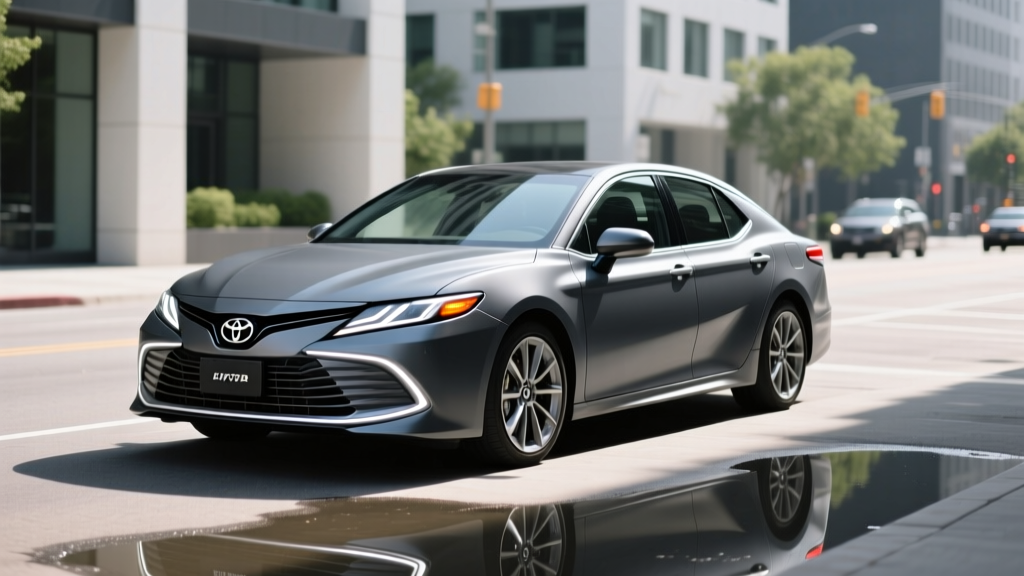
The 2025 Toyota Camry is now offered exclusively as a hybrid. Toyota dropped the gasoline-only four-cylinder and V6 variants entirely, making every new Camry a fifth-generation hybrid electric vehicle (HEV). This is a significant shift for America's best-selling sedan, and it raises practical questions: What real-world fuel economy can you expect? How does the hybrid system work without a plug? Is the battery built to last? This guide breaks down every number that matters for the 2025 Camry Hybrid lineup.
HEV vs PHEV: What "Hybrid Only" Actually Means
Before diving into specs, it's critical to understand what Toyota means by "hybrid only." The 2025 Camry is a conventional hybrid (HEV), not a plug-in hybrid (PHEV). You never plug it in. The car generates electricity through regenerative braking and the gasoline engine, storing energy in a small lithium-ion battery that assists the engine during acceleration and enables low-speed electric-only driving.
| Feature | HEV (2025 Camry) | PHEV (e.g., Prius Prime) | BEV (e.g., Tesla Model 3) |
|---|---|---|---|
| Plug-in charging required? | No | Yes | Yes |
| Electric-only range | ~1 mi at low speed | 30–44 mi typical | 250–350+ mi |
| Battery size | 1.0 kWh (approx.) | 13.6 kWh usable | 50–82 kWh |
| Federal tax credit (§30D) | Not eligible | Up to $7,500 (if sourcing/income rules met) | Up to $7,500 (if sourcing/income rules met) |
| Gas engine | Yes — primary power | Yes — backup + highway | No |
| Home charger needed | No | Recommended (Level 2) | Essential |
If you're looking for electric-only commuting range, the Camry Hybrid isn't the vehicle for you — the Toyota Prius Prime (PHEV) fills that role in Toyota's lineup. The Camry Hybrid is engineered for drivers who want maximum fuel efficiency with zero lifestyle change: no plug, no range planning, no charging apps.
Fuel Economy: EPA Ratings and Real-World MPG
The 2025 Camry Hybrid uses Toyota's fifth-generation hybrid system, pairing a 2.5-liter four-cylinder engine with electric motors. Front-wheel-drive (FWD) models produce a combined 225 horsepower, while all-wheel-drive (AWD) trims add a rear-mounted electric motor for a total of 232 hp.
| Trim | Drivetrain | City MPG | Highway MPG | Combined MPG |
|---|---|---|---|---|
| LE | FWD | 53 | 50 | 51 |
| LE | AWD | 51 | 49 | 50 |
| SE / XLE / XSE | FWD | 48 | 47 | 47 |
| SE / XLE / XSE | AWD | 46 | 46 | 46 |
Source: fueleconomy.gov (EPA)
Real-World MPG vs. EPA Sticker
Toyota hybrids consistently meet or exceed their EPA city ratings in stop-and-go traffic because regenerative braking recaptures energy that gas cars waste as heat. Expect 50–55 MPG in urban driving from the LE FWD.
Highway driving is where hybrids lose their advantage — at sustained 70–80 mph speeds, the gasoline engine does most of the work. Expect 42–46 MPG on the highway in real-world conditions, slightly below the EPA sticker. In cold weather (below 30°F), overall MPG can drop 8–12% as the engine runs more frequently to warm the cabin and battery.
Combined real-world expectation: 46–50 MPG for LE FWD; 43–47 MPG for AWD and sport trims.
With a 13.2-gallon fuel tank, the LE FWD delivers an effective range of approximately 600–660 miles per fill-up — enough for most drivers to visit a gas station once every two to three weeks.
Powertrain and Performance Specs
| Specification | FWD Models | AWD Models |
|---|---|---|
| Engine | 2.5L 4-cyl + 2 electric motors | 2.5L 4-cyl + 3 electric motors |
| Combined horsepower | 225 hp | 232 hp |
| 0–60 mph (est.) | ~7.2 seconds | ~6.9 seconds |
| Transmission | eCVT | eCVT |
| Battery type | Lithium-ion (approx. 1.0 kWh) | |
| Fuel tank | 13.2 gallons | |
| Cargo volume | 15.1 cu ft (trunk) | |
| Towing capacity | Not rated for towing | |
The eCVT (electronically controlled continuously variable transmission) uses a planetary gearset rather than a traditional belt-and-pulley CVT. This design is mechanically simple, durable, and contributes to Toyota's reputation for hybrid powertrain longevity. Acceleration is smooth and linear — not sporty, but entirely adequate for merging and passing.
Pricing, Trims, and Tax Credit Status
The 2025 Camry Hybrid starts at $28,700 (LE FWD, including destination charge) and tops out around $36,000 for the XSE AWD with options.
| Trim | FWD | AWD |
|---|---|---|
| LE | $28,700 | $30,200 |
| SE | $30,990 | $32,490 |
| XLE | $33,490 | $34,990 |
| XSE | $34,990 | $36,490 |
Federal Tax Credit: Not Eligible
The 2025 Camry Hybrid does not qualify for the IRS §30D Clean Vehicle Credit. That credit applies only to plug-in electric vehicles (BEVs and PHEVs) meeting battery sourcing, MSRP caps, and buyer income limits. Conventional hybrids like the Camry are excluded under current law.
However, the Camry Hybrid's lower purchase price and superior fuel economy often offset the lack of a tax credit. At 50 MPG combined and $3.20/gallon gas, a driver covering 15,000 miles annually spends roughly $960/year on fuel — compared to $1,920/year for a comparable 25 MPG gas sedan. That's nearly $5,000 in fuel savings over five years.
Battery Warranty, Reliability, and Replacement Cost
Hybrid battery longevity is the most common concern among first-time hybrid buyers. Toyota addresses this with strong warranty coverage:
- Hybrid battery warranty: 10 years / 150,000 miles (whichever comes first), transferable to subsequent owners
- Hybrid system components (inverter, motor, control module): 8 years / 100,000 miles
- Basic vehicle warranty: 3 years / 36,000 miles
- Powertrain warranty: 5 years / 60,000 miles
Toyota's hybrid batteries are engineered for longevity. The small lithium-ion pack operates within a conservative state-of-charge window (roughly 40–80%), avoiding the deep discharge cycles that accelerate degradation in full EVs. Real-world data from millions of Toyota hybrids on the road shows most original batteries lasting 150,000–200,000+ miles before significant capacity loss.
If replacement is needed: A new OEM hybrid battery for the Camry costs approximately $2,000–$3,500 installed at a dealership. Refurbished or aftermarket options run $1,000–$2,000. Given the 10-year/150,000-mile warranty and typical battery lifespan, most owners will never face this expense.
Toyota's hybrid reliability track record is among the strongest in the industry. The Camry Hybrid carries top ratings from IIHS and benefits from decades of hybrid system refinement since the original Prius in 1997.
Hybrid vs PHEV vs EV: Which Fits Your Situation?
Choose the 2025 Camry Hybrid (HEV) if:
- You lack access to home or workplace charging (apartment, street parking, no garage outlet)
- You want 500+ miles of range with zero planning — just fill up at any gas station
- Your budget is under $35,000 and you don't qualify for (or want to navigate) EV tax credits
- You drive in extreme cold regularly, where EV range loss is significant
- You want a proven, low-risk powertrain with minimal maintenance
Choose a PHEV (e.g., Prius Prime) if:
- You have home charging and a short commute (under 40 miles round-trip)
- You want electric-only daily driving but gas flexibility for road trips
- You want to qualify for up to $7,500 in federal tax credits
Choose a full EV (e.g., Tesla Model 3, Hyundai Ioniq 6) if:
- You have reliable home Level 2 charging
- You want the lowest per-mile fuel cost (electricity vs. gasoline)
- You want to eliminate oil changes and engine maintenance entirely
- Your daily driving is under 250 miles and you're comfortable with charging stops on road trips
Pros, Cons, and the Bottom Line
Pros
- Class-leading 51 MPG combined (LE FWD) in real-world driving
- No plug-in charging required — zero infrastructure change
- 600+ mile total range per tank
- Standard Toyota Safety Sense 3.0 (adaptive cruise, lane-keeping, automatic emergency braking)
- 10-year/150,000-mile hybrid battery warranty
- AWD available across all trims
- Strong resale value and proven reliability
Cons
- No federal tax credit eligibility (HEV exclusion)
- Highway MPG drops below EPA sticker at sustained 75+ mph
- No electric-only commuting range (unlike PHEVs)
- eCVT engine drone under hard acceleration
- Trunk space (15.1 cu ft) is average — no folding rear seats on some trims
- Not rated for towing
Frequently Asked Questions
How many MPG does the 2025 Camry Hybrid actually get?
The EPA rates the Camry Hybrid LE FWD at 53 city / 50 highway / 51 combined. In real-world driving, expect 50–55 MPG in city traffic and 42–46 MPG on the highway. Cold weather and sustained high-speed driving reduce efficiency by 8–12%. Sport trims and AWD drop to 46–47 MPG combined.
Does the 2025 Camry Hybrid need to be plugged in?
No. The Camry is a conventional hybrid (HEV). It charges its small battery through regenerative braking and the gasoline engine. You never plug it in — just refuel at any gas station.
Does the Camry Hybrid qualify for any federal tax credit?
No. The IRS §30D Clean Vehicle Credit applies only to plug-in vehicles (BEVs and PHEVs). Conventional hybrids are excluded. However, the Camry Hybrid's low purchase price and exceptional fuel economy often result in lower five-year ownership costs than gas-only competitors even without a credit.
How long will the Camry Hybrid battery last, and what does replacement cost?
Toyota warranties the hybrid battery for 10 years / 150,000 miles. Real-world data shows most Toyota hybrid batteries lasting 150,000–200,000+ miles. If replacement is needed, expect $2,000–$3,500 for a new OEM battery installed, or $1,000–$2,000 for a refurbished unit.
Is the 2025 Camry Hybrid available with AWD?
Yes. AWD is available on every trim (LE, SE, XLE, XSE) for a $1,500 premium. The AWD system uses a dedicated rear electric motor — no mechanical driveshaft — and adds 7 hp (232 hp total) while reducing fuel economy by 1–2 MPG.
How does the Camry Hybrid compare to the Prius or a full EV?
The Camry Hybrid offers more interior space and a traditional sedan driving experience versus the Prius, with slightly lower MPG (51 vs. 57 combined for Prius). Versus a full EV, the Camry eliminates charging concerns but costs more per mile to fuel and retains engine maintenance requirements. For apartment dwellers or those without home charging, the Camry Hybrid is the most practical high-efficiency option.