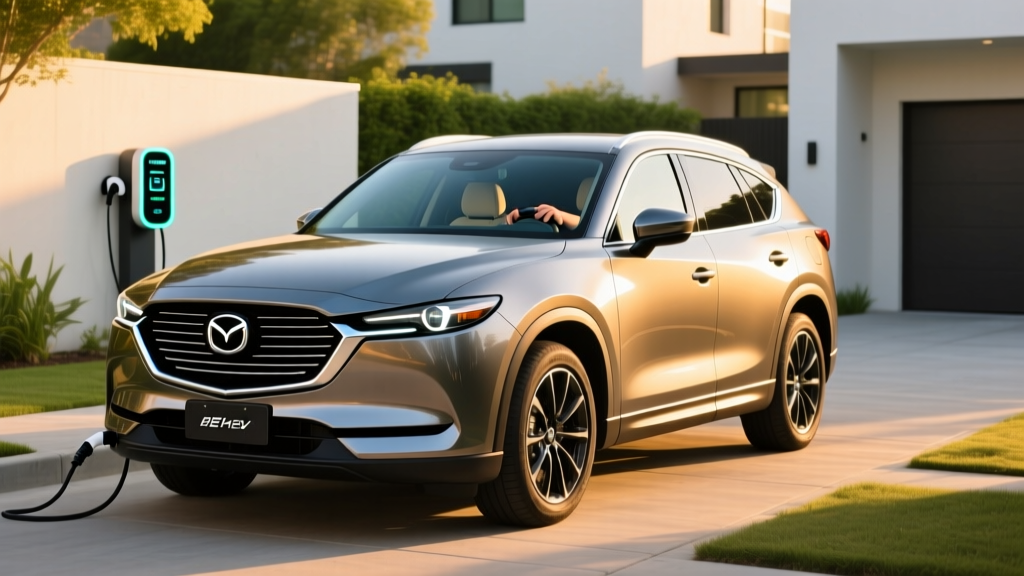
The 2024 Mazda CX-90 PHEV occupies a specific niche: a three-row luxury SUV that can handle most daily commutes on electricity alone while retaining a gasoline engine for road trips. With 26 miles of EPA-rated electric-only range and 327 combined horsepower, it targets families who want EV-like commuting without range anxiety. But does the math work in real-world driving? We break down every number that matters.
2024 Mazda CX-90 PHEV: Core Specifications at a Glance
| Specification | Value |
|---|---|
| Powertrain | 2.5L inline-4 + electric motor |
| Combined Horsepower | 327 hp / 369 lb-ft torque |
| Battery Capacity | 17.8 kWh (usable) |
| EPA Electric-Only Range | 26 miles |
| EPA Total Range (gas + electric) | 490 miles |
| MPGe (electric + gas combined) | 56 MPGe |
| MPG (gas-only, combined) | 25 MPG |
| Level 2 Charge Time (0-100%) | ~3.5 hours at 3.3 kW |
| DC Fast Charging | Not supported |
| Drivetrain | All-wheel drive (standard) |
| 0-60 mph | ~6.3 seconds (est.) |
| Starting MSRP | $49,945 (Preferred) |
| Federal Tax Credit (§30D) | Up to $7,500 (eligibility varies) |
| Battery Warranty | 8 years / 100,000 miles |
Electric-Only Range: 26 Miles EPA, But What About Real-World?
Real-World Expectation: 20-24 miles in mixed driving; 18-22 miles highway or cold weather
The 17.8 kWh battery pack delivers 26 miles of electric-only driving according to the EPA. In practice, expect 20-24 miles during typical suburban commuting with moderate temperatures. Highway driving at 70+ mph or winter conditions below 40°F will reduce that to roughly 18-22 miles.
This range covers most daily commutes. The average American drives 37 miles per day according to FHWA data, meaning many CX-90 PHEV owners will use electricity for 60-70% of their weekly miles while relying on the gasoline engine for longer trips or weekend errands.
The CX-90 PHEV does not support DC fast charging—a notable limitation. You're restricted to Level 1 (120V, ~7 hours for full charge) or Level 2 (240V, ~3.5 hours). This means public fast-charging networks like Electrify America or Tesla Superchargers won't help you top up on road trips.
Fuel Economy: EPA Numbers vs Real-World MPG
| Mode | City | Highway | Combined |
|---|---|---|---|
| Electric + Gas (MPGe) | — | — | 56 MPGe |
| Gas Only (MPG) | 24 | 27 | 25 |
Once the battery depletes, the CX-90 PHEV operates as a conventional hybrid, achieving 25 MPG combined (24 city / 27 highway). This trails competitors like the Toyota Grand Highlander Hybrid (35 MPG combined) but beats non-hybrid three-row SUVs like the Kia Telluride (21 MPG combined).
Real-world MPG reality check: Plug-in hybrids often exceed EPA city estimates when drivers maximize regenerative braking and electric assist. Expect 26-28 MPG in stop-and-go traffic if you're diligent about charging. Highway cruising at 75 mph will drop you closer to 24-25 MPG.
The 56 MPGe figure only applies when you're using both electric and gasoline power within a single trip. If you charge nightly and drive less than 26 miles daily, your effective "MPG" is infinite for those miles—you're burning zero gasoline.
Powertrain Performance: 327 HP with Seamless Transitions
The CX-90 PHEV pairs a 2.5-liter inline-four engine (189 hp) with an electric motor (173 hp) for a combined 327 horsepower and 369 lb-ft of torque. Power delivery feels linear and responsive, with the electric motor providing instant torque from a stop.
Mazda's eight-speed automatic transmission handles gear changes smoothly, and the transition between electric-only and hybrid modes is nearly imperceptible. The all-wheel-drive system is standard, using the electric motor to power the rear axle when needed.
Acceleration to 60 mph takes approximately 6.3 seconds—quick for a 5,000-pound SUV but not sports-car territory. The real benefit is low-speed responsiveness: the electric motor eliminates turbo lag and provides confident merging power.
Charging the CX-90 PHEV: What You Need at Home
The CX-90 PHEV uses a J1772 connector for Level 2 charging. Here's what to expect:
| Charging Level | Power | Time (0-100%) | Use Case |
|---|---|---|---|
| Level 1 (120V) | 1.4 kW | ~7 hours | Overnight (slow) |
| Level 2 (240V) | 3.3 kW | ~3.5 hours | Home/work charging |
A Level 2 home charger is strongly recommended. Installation costs range from $500-$2,000 depending on your electrical panel capacity and distance from the panel to your parking spot. Most CX-90 PHEV owners will plug in nightly and wake up to a full battery.
The lack of DC fast charging is a deliberate trade-off. Mazda prioritized battery longevity and cost over rapid charging capability. For a PHEV with 26 miles of range, this is reasonable—you're unlikely to seek out a fast charger for such a small battery.
HEV vs PHEV vs EV: Which Powertrain Fits Your Life?
| Factor | Conventional Hybrid (HEV) | Plug-in Hybrid (PHEV) | Full EV |
|---|---|---|---|
| Daily commute under 30 miles? | Good | Excellent (electric mode) | Excellent |
| Home charging access? | Not required | Strongly recommended | Required |
| Frequent 400+ mile road trips? | Excellent | Good (gas engine) | Requires planning |
| Upfront cost | Lowest | Moderate | Highest |
| Maintenance complexity | Low | Moderate (two systems) | Lowest |
| Tax credit eligibility | Rarely | Often (§30D) | Often (§30D) |
Choose the CX-90 PHEV if: You have home charging, commute under 25 miles daily, need three rows, and want the flexibility for spontaneous road trips without charging-station planning.
Consider a full EV (like the Kia EV9 or Tesla Model X) if: You drive more than 26 miles daily, have reliable home and workplace charging, and want to eliminate gasoline entirely.
Stick with a conventional hybrid (like the Toyota Grand Highlander Hybrid) if: You lack home charging access, drive unpredictably long distances, or prioritize maximum fuel economy over electric-only capability.
Pricing, Tax Credits, and Total Cost of Ownership
The 2024 Mazda CX-90 PHEV starts at $49,945 for the Preferred trim, rising to $59,950 for the Premium Plus. This positions it between mainstream three-row SUVs and luxury competitors like the BMW X5 xDrive50e.
- Vehicle MSRP must be under $80,000 (CX-90 qualifies)
- Buyer AGI limits: $150K single / $300K married filing jointly
- Battery components and critical minerals must meet sourcing requirements
- Credit amount varies by sourcing compliance ($3,750 or $7,500)
- Point-of-sale transfer available (dealer applies credit at purchase)
Verify current eligibility at IRS.gov before purchase—rules change frequently.
With the full $7,500 credit, the effective starting price drops to $42,445. Factor in fuel savings (electricity costs ~$0.13/kWh nationally, vs $3.50/gallon gasoline), and the CX-90 PHEV can undercut gas-only competitors on five-year total cost despite its higher sticker price.
Battery Warranty, Reliability, and Replacement Costs
Coverage: Defects and capacity loss below 70% of original capacity
Estimated Replacement Cost: $8,000-$12,000 (if out of warranty)
Mazda's hybrid battery warranty covers 8 years or 100,000 miles, whichever comes first. This aligns with industry standards (Toyota, Honda, Hyundai all offer similar terms). The warranty covers both defects and excessive capacity degradation—typically defined as dropping below 70% of original capacity.
Real-world reliability data for the CX-90 PHEV is still emerging (the model launched in 2023), but Mazda's conventional powertrains have strong long-term reliability records according to Consumer Reports. The PHEV system adds complexity but uses proven lithium-ion chemistry.
Battery replacement costs remain a concern for high-mileage owners. Expect $8,000-$12,000 for a replacement pack if needed post-warranty—though most PHEV batteries last 150,000+ miles before significant degradation based on data from earlier models like the Toyota Prius Prime.
Who Should Buy the CX-90 PHEV (and Who Shouldn't)?
- You commute 15-25 miles daily and can charge at home
- You need three rows but don't want a minivan
- You take 4+ road trips per year over 300 miles
- You qualify for the federal tax credit
- You value premium interior materials over maximum efficiency
- You drive 40+ miles daily (you'll rarely use electric mode)
- You lack home charging access
- You prioritize fuel economy over performance (Toyota Grand Highlander Hybrid gets 35 MPG)
- You want DC fast charging for public infrastructure use
- You're ready to go fully electric and don't need gas backup
Pros and Cons: The Honest Assessment
Pros
- 26-mile electric range covers most commutes
- 327 hp provides confident acceleration
- Premium interior with three-row practicality
- Standard AWD with seamless electric/gas transitions
- Eligible for up to $7,500 federal tax credit
- 8-year/100,000-mile battery warranty
Cons
- 25 MPG gas-only trails hybrid competitors
- No DC fast charging capability
- Higher starting price than non-hybrid CX-90
- Real-world electric range drops in cold weather
- Third row is tight for adults on long trips
- Complex powertrain means more potential failure points
Frequently Asked Questions
How many MPG does the 2024 Mazda CX-90 PHEV get?
The CX-90 PHEV achieves 25 MPG combined (24 city / 27 highway) when operating on gasoline alone. When using both electric and gas power, it rates 56 MPGe combined. Real-world city driving with regenerative braking can push gas-only MPG to 26-28.
How far can the CX-90 PHEV go on electric only?
The EPA rates the CX-90 PHEV at 26 miles of electric-only range. Real-world driving typically yields 20-24 miles in moderate conditions, dropping to 18-22 miles on highways or in cold weather below 40°F.
Does the CX-90 PHEV qualify for a tax credit?
Yes, the CX-90 PHEV may qualify for up to $7,500 under the federal §30D clean vehicle credit, subject to buyer income limits ($150K single / $300K married), MSRP caps (under $80,000), and battery sourcing requirements. Verify eligibility at IRS.gov before purchase, as rules change frequently.
Is the CX-90 PHEV reliable, and what does battery replacement cost?
Mazda's hybrid systems have solid reliability records, though the CX-90 PHEV is too new for long-term data. The battery is warrantied for 8 years/100,000 miles. Out-of-warranty replacement costs are estimated at $8,000-$12,000, though most PHEV batteries last 150,000+ miles.
Should I buy the CX-90 PHEV or a full EV?
Choose the CX-90 PHEV if you need three rows, take frequent road trips over 300 miles, or lack reliable public charging infrastructure. Choose a full EV (Kia EV9, Tesla Model X) if you drive more than 26 miles daily, want zero gasoline use, and have home charging access.
Can the CX-90 PHEV use DC fast chargers?
No. The CX-90 PHEV only supports Level 1 (120V) and Level 2 (240V) charging via J1772 connector. DC fast charging is not available, which is typical for PHEVs with smaller battery packs.
What's the difference between the CX-90 PHEV and the regular CX-90?
The standard CX-90 uses a mild-hybrid inline-six engine (280 hp or 340 hp) with no electric-only capability and 24 MPG combined. The PHEV adds a larger battery, electric motor, and 26 miles of electric range but costs ~$7,000 more before tax credits.
The 2024 Mazda CX-90 PHEV delivers on its promise: electric commuting for most daily miles with gasoline backup for flexibility. It's not the most efficient three-row SUV, and the lack of DC fast charging limits public infrastructure use. But for families with home charging who need three rows and road-trip capability, it strikes a practical balance between electrification and real-world usability.