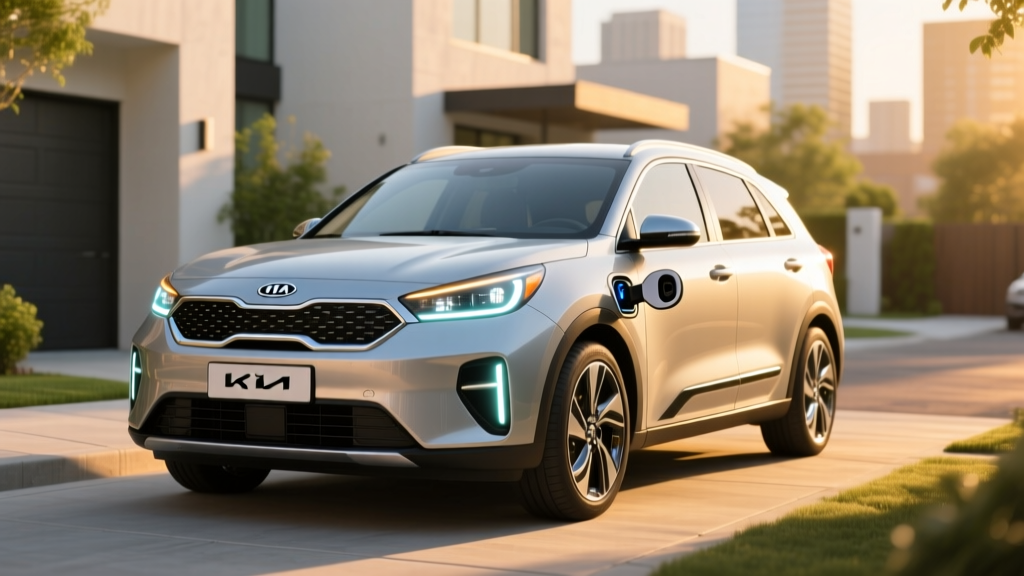
The 2024 Kia Niro Plug-In Hybrid occupies a narrow but valuable lane in the electrified-vehicle market: it offers enough electric-only range to cover most daily commutes without burning a drop of gas, yet retains a gasoline engine for road trips where charging infrastructure remains uncertain. With an EPA-rated 33 miles of zero-emission driving and a combined 48 MPG once the battery is depleted, the Niro PHEV is a pragmatic bridge for buyers not ready to commit to a full battery-electric vehicle.
But specs on paper only tell part of the story. Below, we break down the real-world efficiency, charging logistics, powertrain behavior, tax-credit eligibility, and long-term ownership costs you need to evaluate before signing a purchase agreement.
HEV vs. PHEV: Which Niro Are You Actually Looking At?
Kia sells the Niro in three powertrain variants for the 2024 model year, and confusing them at the dealership is easy. Here is the critical distinction:
| Attribute | Niro HEV (Hybrid) | Niro PHEV (Plug-In Hybrid) | Niro EV (Battery Electric) |
|---|---|---|---|
| Plugs in? | No — self-charging via regen | Yes — Level 1 & Level 2 | Yes — Level 1, 2 & DC fast |
| Electric-only range | ~1 mile at low speed | 33 miles (EPA) | 239 miles (EPA) |
| Combined efficiency | 53 MPG combined | 105 MPGe / 48 MPG gas | 113 MPGe |
| Battery capacity | 1.56 kWh | 11.1 kWh usable | 64.8 kWh usable |
| Starting MSRP | ~$26,940 | ~$34,390 | ~$39,600 |
| Federal tax credit (§30D) | Not eligible | Up to $7,500* | Up to $7,500* |
*Tax credit eligibility depends on MSRP caps, buyer income limits, and battery component/critical-mineral sourcing requirements. See IRS §30D details below.
The conventional Niro HEV never plugs in — it recovers energy through regenerative braking and engine operation to keep its small battery charged. The Niro PHEV, by contrast, has a substantially larger 11.1 kWh battery that you charge by plugging in (Level 1 household outlet or Level 2 home charger). That larger battery is what enables 33 miles of pure electric driving before the 1.6-liter gasoline engine engages.
Electric-Only Range and Total Range: What the Numbers Mean
Real-World Expectation: 26–30 miles in mixed driving; 22–25 miles in cold weather (below 40°F) or sustained highway speeds above 70 mph.
Total Combined Range (EV + Gas): ~430 miles (EPA)
EPA Gas-Only Efficiency (charge-sustaining): 48 MPG combined
The 33-mile EPA electric range is measured under ideal laboratory conditions. In practice, expect to lose 15–25% of that range in cold weather because the cabin heater draws from the traction battery and lithium-ion cells deliver less energy at low temperatures. Highway driving above 65 mph also reduces electric range because aerodynamic drag scales with the square of velocity — the Niro PHEV's modest 83-hp electric motor works harder at speed.
For a commuter with a 20-mile round trip and home charging, the PHEV effectively operates as a daily EV. You may go weeks without the gasoline engine starting. But once the battery depletes to its charge-sustaining threshold (around 15–20% state of charge, which is hidden from the driver to protect battery health), the 1.6L four-cylinder engine seamlessly engages and delivers a credible 48 MPG combined.
Powertrain Specs: Engine, Motor, and Combined Output
| Specification | 2024 Kia Niro PHEV |
|---|---|
| Engine | 1.6L GDI 4-cylinder (104 hp, 109 lb-ft) |
| Electric Motor | Permanent-magnet synchronous (83 hp, 188 lb-ft) |
| Combined System Output | 180 hp / 195 lb-ft torque |
| Transmission | 6-speed dual-clutch automatic (DCT) |
| Drivetrain | Front-wheel drive |
| 0–60 mph | ~7.2 seconds (est.) |
| Battery Chemistry | Lithium-ion polymer (NMC) |
| Battery Capacity | 11.1 kWh usable (13.0 kWh gross) |
| EPA Electric Range | 33 miles |
| EPA MPGe (EV mode) | 105 MPGe combined |
| EPA MPG (gas, charge-sustaining) | 48 combined / 49 city / 47 highway |
| Fuel Tank | 11.1 gallons |
| Towing Capacity | Not rated for towing |
The 6-speed dual-clutch transmission is a deliberate choice by Kia — unlike the continuously variable transmissions (CVTs) used in the Toyota Prius Prime and many competitors, the DCT provides more natural shift feel and avoids the "rubber-band" sensation some drivers dislike. The trade-off is slightly less seamless low-speed creep behavior, though Kia's tuning has largely smoothed this out for the 2024 model year.
The 180 combined horsepower is adequate for merging and passing. In EV mode, the 83-hp electric motor delivers instant torque (188 lb-ft) from a stop, making the Niro PHEV feel punchy in city driving. The gasoline engine adds its 109 lb-ft when needed, though the combined 195 lb-ft means this is not a performance-oriented crossover.
Charging the Niro PHEV: Levels, Times, and What You Need at Home
The 2024 Niro PHEV uses a standard J1772 connector for AC charging. It does not support DC fast charging — a common limitation among plug-in hybrids, since the relatively small battery does not justify the cost and weight of DC fast-charge hardware.
| Charging Level | Power (kW) | Voltage | Time (0–100%) | Notes |
|---|---|---|---|---|
| Level 1 (household outlet) | ~1.4 kW | 120V | ~9 hours | Included portable cord; overnight top-up |
| Level 2 (home/public AC) | ~3.3 kW (onboard charger max) | 240V | ~3 hours | Requires J1772 home station or public AC charger |
| DC Fast Charge | N/A | N/A | N/A | Not supported |
The onboard charger is limited to 3.3 kW, which is the bottleneck for Level 2 charging. Even if you plug into a 7.2 kW or 11.5 kW public Level 2 station, the Niro PHEV will only accept 3.3 kW. This is typical for PHEVs — the smaller battery does not need rapid charging, and a full charge in roughly 3 hours on Level 2 is convenient for workplace or destination charging.
Home charging setup: Most Niro PHEV owners will find a standard 120V outlet (Level 1) sufficient if they drive less than 30 miles daily and park overnight for 8+ hours. For faster turnaround or if your commute drains the full 33-mile buffer, a 240V Level 2 home charger is recommended. Expect to pay $500–$800 for a quality Level 2 EVSE (ChargePoint Home Flex, Emporia Vue, or similar) plus $300–$1,200 for electrician installation depending on panel proximity and local permit requirements.
Fuel Economy: EPA Numbers vs. Real-World MPG
| Driving Mode | EPA City | EPA Highway | EPA Combined | Real-World Expectation |
|---|---|---|---|---|
| EV Mode (MPGe) | 113 MPGe | 97 MPGe | 105 MPGe | 90–110 MPGe (weather & terrain dependent) |
| Gas Mode (charge-sustaining) | 49 MPG | 47 MPG | 48 MPG | 44–52 MPG (hybrids often beat EPA in city) |
One advantage of hybrid powertrains over pure gasoline cars is that they often exceed their EPA city rating in real-world stop-and-go driving, because regenerative braking recovers kinetic energy that a conventional car wastes as heat. On the highway, however, hybrids lose this advantage — there is less braking to harvest energy from, and the gasoline engine operates under steady load.
Based on aggregated owner reports and testing data, the Niro PHEV in charge-sustaining (gas) mode typically delivers 44–52 MPG in mixed driving. Drivers who spend most of their miles in city traffic with frequent stops may see numbers at or above the EPA city rating of 49 MPG. Highway-heavy drivers should expect numbers closer to 44–46 MPG, especially at speeds above 75 mph or in mountainous terrain.
According to fueleconomy.gov, the 2024 Niro PHEV's combined annual fuel cost is estimated at approximately $650 (assuming 15,000 miles/year, 55% highway, and $3.50/gallon regular unleaded) — though this figure assumes the battery starts depleted. If you charge daily and commute within the 33-mile electric window, your gasoline consumption could drop to near zero for months at a time.
Pricing, Trims, and Federal Tax Credit Eligibility
The 2024 Kia Niro PHEV is offered in three trims:
- LX: ~$34,390 MSRP — base trim with 8-inch touchscreen, wireless Apple CarPlay/Android Auto, Smart Cruise Control, Lane Keeping Assist
- EX: ~$37,090 MSRP — adds heated front seats, smart power liftgate, 10.25-inch dual displays, highway driving assist
- SX Touring: ~$40,990 MSRP — adds leather seats, Harman Kardon audio, sunroof, ventilated front seats, 10.25-inch navigation
- MSRP cap: PHEV SUVs/crossovers must have MSRP ≤ $80,000 (all Niro PHEV trims qualify)
- Buyer income cap: Modified AGI ≤ $150,000 (single), $225,000 (head of household), $300,000 (joint)
- Battery sourcing: Critical minerals and battery components must meet phased percentage thresholds that increase annually — verify current-year compliance on IRS.gov qualified vehicle list
- Point-of-sale transfer: As of 2024, buyers may transfer the credit to the dealer for an immediate price reduction at purchase
- Maximum credit: Up to $7,500 if both critical-mineral and battery-component requirements are met; $3,750 if only one is met
Important: Sourcing requirements tighten each year. A vehicle qualifying in 2024 may not qualify identically in later years. Always verify on the IRS qualified-vehicle list before purchasing. Consult a tax professional for your specific situation.
If the full $7,500 credit applies, the Niro PHEV LX effectively drops to roughly $26,890 — pricing that overlaps with the conventional Niro HEV and makes the PHEV a compelling value proposition. However, credit eligibility is not guaranteed for every buyer or every vehicle build date, so confirm before relying on it in your budget.
Battery Warranty, Reliability, and Long-Term Costs
Coverage threshold: Kia warrants the battery against capacity loss below approximately 70% of original capacity during the warranty period
Powertrain Warranty: 10 years / 100,000 miles
Basic Vehicle Warranty: 5 years / 60,000 miles
The 10-year/100,000-mile battery warranty is one of the strongest in the industry and directly addresses the top concern among hybrid buyers: battery replacement cost. For context, a Niro PHEV battery replacement outside warranty currently runs approximately $4,000–$6,500 including labor, though this cost is expected to decrease as battery supply chains mature.
Kia's NMC (nickel-manganese-cobalt) lithium-ion polymer battery is liquid-cooled, which significantly improves longevity compared to passively cooled packs. Real-world data from Kia Niro PHEV owners (model years 2018–2023) suggests typical degradation of 8–12% over the first 5 years and 60,000–80,000 miles — well within the 70% warranty threshold. Most PHEV batteries are engineered for 1,500–2,000 full charge-discharge cycles before reaching 80% capacity, which translates to well over 150,000 miles of electric driving.
Regarding overall reliability, Kia as a brand has shown improvement in recent years, though it still trails Toyota and Honda in long-term dependability surveys. The Niro platform, now in its second generation (2023+), carries over proven powertrain components from the first generation, which reduces the risk of early-model-year issues. The Niro PHEV earned a Top Safety Pick designation from the IIHS for the 2024 model year with acceptable headlight ratings on specific trims.
Who Should Buy the Niro PHEV — And Who Shouldn't
- Your daily commute is under 30 miles round-trip and you can charge at home
- You want to drive electrically most days but need gas flexibility for road trips
- You live in an apartment or area where DC fast-charging access is limited
- You want to reduce gasoline consumption without range anxiety
- The federal tax credit brings the effective price near or below a conventional hybrid
- You cannot install a charger at home or work
- Your daily driving far exceeds 33 miles and you won't benefit from frequent plug-in charging
- You want the lowest purchase price and don't qualify for the federal tax credit
- You have reliable home Level 2 charging and your daily driving is under 200 miles
- You want zero gasoline maintenance (no oil changes, spark plugs, or exhaust system)
- You want the lowest per-mile energy cost and access to HOV lane incentives in your state
- Your annual mileage is very low (under 5,000 miles) — the fuel savings won't offset the higher purchase price
- You regularly tow or haul heavy loads beyond the Niro's capability
- 33 miles electric range covers most commutes
- 48 MPG combined in gas mode is excellent
- 10-year/100,000-mile battery warranty
- Eligible for up to $7,500 federal tax credit
- Comfortable ride quality, spacious cargo area (54.5 cu ft max)
- DCT avoids CVT drone
- No DC fast charging
- 3.3 kW onboard charger limits Level 2 speed
- FWD only — no AWD option
- Electric range drops significantly in cold weather
- Not rated for towing
- SX Touring trim pushes past $40K
Frequently Asked Questions
How many MPG does the 2024 Kia Niro Plug-In Hybrid get?
The EPA rates the Niro PHEV at 48 MPG combined (49 city / 47 highway) when operating on gasoline after the battery is depleted. In electric mode, it achieves 105 MPGe combined. Real-world gas mileage typically ranges from 44–52 MPG depending on driving conditions — city-heavy drivers often exceed the EPA rating thanks to regenerative braking.
How far can the Niro PHEV go on electric only?
The EPA rates the 2024 Niro PHEV at 33 miles of electric-only range. In real-world conditions, expect 26–30 miles in moderate temperatures and mixed driving, dropping to 22–25 miles in cold weather (below 40°F) or at sustained highway speeds above 70 mph.
Does the 2024 Kia Niro PHEV qualify for a federal tax credit?
The Niro PHEV may qualify for up to $7,500 under IRS §30D, but eligibility depends on multiple factors: buyer income (AGI caps of $150K single / $300K joint), MSRP (under $80K cap for SUVs — all trims qualify), and battery component/critical-mineral sourcing requirements that change annually. Always verify current eligibility on the IRS qualified vehicle list before purchasing.
Is the Niro PHEV reliable, and what does battery replacement cost?
The Niro PHEV uses proven powertrain components carried over from the first-generation model. The high-voltage battery is covered by a 10-year/100,000-mile warranty against degradation below ~70% capacity. Out-of-warranty battery replacement costs approximately $4,000–$6,500, though most PHEV batteries last well beyond 150,000 miles based on cycle-life engineering.
Can the Niro PHEV use DC fast chargers?
No. The 2024 Niro PHEV supports only Level 1 (120V, ~1.4 kW) and Level 2 (240V, up to 3.3 kW) AC charging via a J1772 connector. DC fast charging is not available — this is standard for most plug-in hybrids, as the small battery does not require or justify DC fast-charge capability.
How does the Niro PHEV compare to the Toyota Prius Prime?
The Toyota Prius Prime offers 44 miles of electric range (vs. 33 miles for the Niro) and slightly higher combined MPGe. However, the Niro PHEV provides a crossover body style with more cargo space (54.5 cu ft vs. ~27 cu ft in the Prius Prime hatchback), a more upright seating position, and Kia's longer 10-year powertrain warranty vs. Toyota's 8-year hybrid battery warranty. If cargo versatility matters, the Niro wins; if maximum electric range is the priority, the Prius Prime leads.
Do I need to plug in the Niro PHEV every night?
For maximum benefit, yes — plugging in nightly ensures you start each day with a full 33-mile electric buffer. However, the Niro PHEV functions perfectly well as a conventional hybrid if you forget to plug in. The gasoline engine and regenerative braking system handle all driving needs; you simply lose the fuel-cost savings of electric-only commuting.
Sources: EPA fueleconomy.gov, IRS §30D Qualified Vehicles, IIHS Safety Ratings, Kia America official specifications. Pricing and tax credit rules reflect 2024 model year data and are subject to change. Verify current eligibility with your dealer and tax professional.