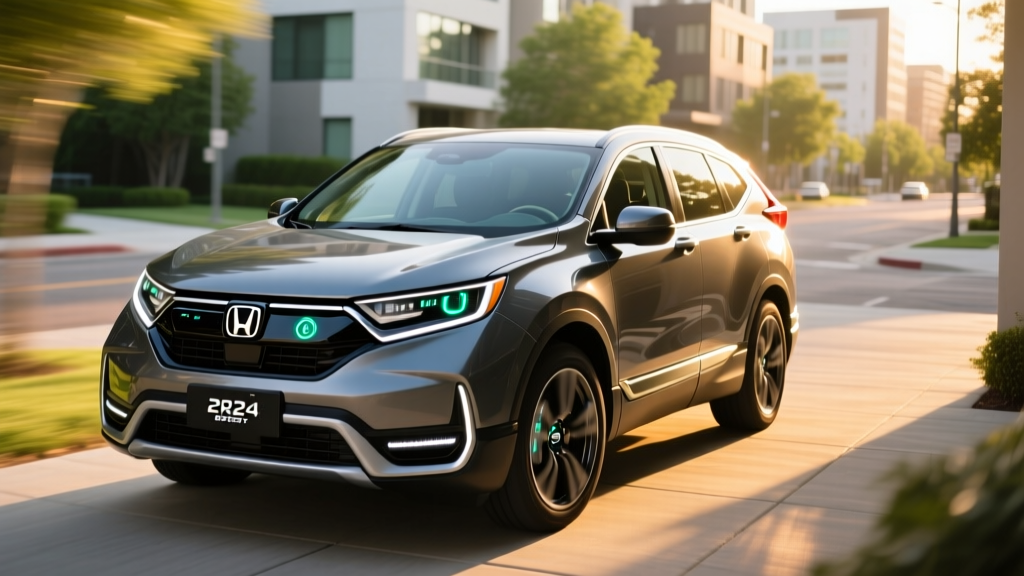
Quick Verdict: The 2024 Honda CR-V Hybrid Sport-L
The 2024 Honda CR-V Hybrid Sport-L occupies a precise niche: a compact SUV that delivers genuine fuel savings without requiring you to plug in, change habits, or install home charging infrastructure. With an EPA-rated 40 MPG combined (43 city / 36 highway) for front-wheel-drive trims, Honda's two-motor hybrid system proves that conventional hybrid technology remains one of the most practical electrified options for buyers who lack reliable charging access or frequently drive longer distances.
At a starting MSRP of $37,695 (including destination), the Sport-L trim adds leather upholstery, a wireless phone charger, and heated front seats over the Sport base hybrid. It's a premium step without crossing into the $40,000+ territory of the Sport Touring Hybrid. But is it the right electrified vehicle for your situation? This guide breaks down every number that matters.
HEV vs. PHEV vs. EV: Where the CR-V Hybrid Fits
Before diving into specs, it's critical to understand what the CR-V Hybrid is — and isn't. Honda sells the CR-V in three powertrain configurations, and conflating them leads to bad purchase decisions.
| Feature | CR-V Hybrid (HEV) | Plug-In Hybrid (PHEV) Example | Battery Electric (EV) Example |
|---|---|---|---|
| Plug in to charge? | No — self-charging via regen & engine | Yes — has a charge port | Yes — charge port required |
| Electric-only range | ~1 mile at low speed | 20–40 miles typical | 200–400+ miles |
| Fuel/energy source | Gasoline only | Gasoline + grid electricity | Grid electricity only |
| Home charging install needed? | No | Recommended (Level 2) | Essential (Level 2) |
| Federal tax credit (§30D) | No — not eligible | Up to $7,500 if eligible | Up to $7,500 if eligible |
| Best for | No home charging, long trips, simplicity | Short commutes + road trips | Home charging + daily driving |
The 2024 CR-V Hybrid is a conventional hybrid (HEV). It has no plug, no usable electric-only range for commuting, and no external charging capability. The small lithium-ion battery (~1.06 kWh) charges itself through regenerative braking and the gasoline engine. This is fundamentally different from a plug-in hybrid like the Toyota RAV4 Prime (42 miles electric-only) or a full EV like the Hyundai Ioniq 5.
Honda does not currently offer a CR-V PHEV in the United States. If electric-only commuting is a priority, you'd need to look at competitors like the RAV4 Prime or the Hyundai Tucson PHEV.
Fuel Economy: EPA Ratings vs. Real-World MPG
The headline number for the 2024 Honda CR-V Hybrid Sport-L is its EPA-estimated fuel economy, which varies by drivetrain:
| Drivetrain | City MPG | Highway MPG | Combined MPG |
|---|---|---|---|
| FWD (Sport-L standard) | 43 | 36 | 40 |
| AWD (optional on Sport-L) | 40 | 34 | 37 |
Source: EPA Fuel Economy
Real-World MPG: What to Actually Expect
Honda's two-motor hybrid system excels in stop-and-go city driving, where the electric motor handles low-speed propulsion and the 1.5L turbocharged engine acts primarily as a generator. In real-world testing by multiple outlets, the CR-V Hybrid routinely matches or exceeds its EPA city rating — a rarity among vehicles. Owners on Fuelly report lifetime averages between 35 and 42 MPG combined, depending on driving mix.
Highway driving is where the hybrid advantage narrows. At sustained 70-80 MPH speeds, the engine drives the wheels directly through a lockup clutch, and you'll see closer to 32–35 MPG in the FWD model. Cold weather (below 40°F) typically costs 2–4 MPG due to increased engine runtime for cabin heat and reduced battery efficiency.
Powertrain: How the Two-Motor Hybrid System Works
The 2024 CR-V Hybrid uses Honda's fourth-generation two-motor hybrid system, which pairs a 1.5-liter turbocharged Atkinson-cycle four-cylinder engine with two electric motors integrated into the transmission housing.
| Specification | Value |
|---|---|
| Engine | 1.5L turbocharged 4-cylinder (Atkinson cycle) |
| Engine power | 145 hp @ 6,000 rpm |
| Drive motor output | 184 hp / 247 lb-ft torque |
| Combined system output | 204 hp / 247 lb-ft torque |
| Transmission | e-CVT (single-speed direct drive w/ lockup clutch) |
| Hybrid battery | ~1.06 kWh lithium-ion (not plug-in) |
| 0-60 MPH | ~7.6 seconds (FWD) |
| Towing capacity | 1,000 lbs (not rated for heavy towing) |
| Fuel tank | 15.3 gallons |
The system operates in three modes seamlessly: EV Drive (motor only, at low speeds and light loads), Hybrid Drive (engine generates electricity for the motor), and Engine Drive (engine directly powers wheels at highway cruising speeds). The transitions are nearly imperceptible — a marked improvement over earlier Honda hybrid systems that suffered from noticeable drone under acceleration.
Compared to the non-hybrid CR-V's 1.5L turbo (190 hp), the hybrid actually delivers more low-end torque (247 lb-ft vs. 179 lb-ft) thanks to the electric motor, making it feel more responsive around town despite similar peak horsepower figures.
Pricing, Trims, and Tax Credit Eligibility
The 2024 CR-V Hybrid is available in three trims. The Sport-L sits in the middle:
| Trim | MSRP (FWD) | MSRP (AWD) | Key Additions Over Base Hybrid |
|---|---|---|---|
| Sport Hybrid | $35,395 | $36,895 | Base hybrid trim — black accents, 18" wheels |
| Sport-L Hybrid | $37,695 | $39,195 | Leather seats, wireless charging, heated front seats, power liftgate |
| Sport Touring Hybrid | $40,495 | $41,995 | Navigation, Bose audio, wireless CarPlay, heated steering wheel |
Prices include $1,345 destination charge. Source: Honda Official
Federal Tax Credit: Not Eligible
Because the CR-V Hybrid is a conventional HEV (not a plug-in vehicle), it does not qualify for the IRS §30D Clean Vehicle Credit, which requires a minimum 7 kWh battery and plug-in charging capability. The §30D credit of up to $7,500 is reserved for PHEVs and BEVs that meet battery sourcing, MSRP caps, and buyer income limits.
However, some states offer rebates or reduced registration fees for hybrid vehicles. Check your state's energy office or the Alternative Fuels Data Center for local incentives. A few utilities also offer time-of-use rates that benefit hybrid owners who shift other electricity usage to off-peak hours, though this is indirect.
Battery Warranty, Reliability, and Replacement Costs
Hybrid battery longevity is the single most common concern among first-time hybrid buyers. Here's what you need to know about the CR-V Hybrid specifically:
The CR-V Hybrid's ~1.06 kWh lithium-ion pack is small and operates within a narrow state-of-charge window (roughly 40–60% SoC), which is far less stressful on cells than the deep cycling seen in full EVs. This shallow-cycling design is a major reason Honda's hybrid batteries have proven durable. Third-generation CR-V Hybrids (2020–2022 models) have not shown widespread battery failure patterns.
Battery Replacement Cost
If the hybrid battery does fail outside warranty, replacement costs for the CR-V Hybrid typically range from $2,000 to $4,000 (parts and labor) at a Honda dealer. Independent hybrid specialists can sometimes source refurbished packs for $1,200–$2,000. Given the shallow-cycling design and 8–10 year warranty, most owners will never face this expense — the battery is designed to outlast the vehicle's typical ownership period.
Overall Reliability
Honda's hybrid powertrain has a strong reliability track record. The e-CVT transmission has no traditional gears, bands, or torque converter — fewer moving parts than a conventional automatic. IIHS awarded the 2024 CR-V a Top Safety Pick+ rating, and the hybrid carries the same structural safety ratings as the gas model.
Who Should Buy the CR-V Hybrid Sport-L (And Who Shouldn't)
Choose the CR-V Hybrid Sport-L if:
- You lack access to home or workplace charging (apartment, street parking)
- Your daily driving exceeds 40 miles round-trip (PHEV electric range wouldn't cover it)
- You want fuel savings without any behavior change — just gas up and go
- You take regular road trips (500+ mile range per tank is a genuine advantage)
- You value the Sport-L's leather and heated seats without paying Sport Touring pricing
- You live in a cold climate where EV range loss is a concern
Look elsewhere if:
- You have a short commute (under 30 miles) and home charging — a PHEV or EV saves more
- You want electric-only driving for zero tailpipe emissions on daily trips
- You want to qualify for the $7,500 federal tax credit (requires a PHEV or BEV)
- You need towing capacity over 1,000 lbs
- You prioritize rapid acceleration (the 7.6-second 0-60 is adequate, not quick)
Decision Framework: Hybrid vs. PHEV vs. EV
- Choose the CR-V Hybrid (HEV) if you can't charge at home, drive 30+ miles daily, or want maximum simplicity with no plug-in logistics.
- Choose a PHEV (e.g., RAV4 Prime) if you can install a Level 2 charger, commute under 40 miles, and want to drive mostly electric on weekdays while keeping gas for weekend trips.
- Choose a full EV (e.g., Ioniq 5) if you have reliable home charging, drive under 250 miles daily, and want the lowest per-mile fuel cost with zero tailpipe emissions.
2024 Honda CR-V Hybrid Sport-L FAQ
How many MPG does the 2024 Honda CR-V Hybrid Sport-L get?
The FWD model is EPA-rated at 43 city / 36 highway / 40 combined. Adding AWD drops that to 40 city / 34 highway / 37 combined. In real-world mixed driving, owners typically see 35–42 MPG combined, with city driving often exceeding the EPA estimate and highway driving falling slightly below it.
Does the CR-V Hybrid need to be plugged in?
No. The CR-V Hybrid is a conventional HEV. It charges its own small battery through regenerative braking and the gasoline engine. There is no plug, no charge port, and no electric-only commuting range. If you want plug-in capability, you'd need to look at a PHEV from another manufacturer.
How far can the CR-V Hybrid drive on electric power alone?
Effectively about 1 mile at very low speeds (parking lots, residential streets under 25 MPH). The hybrid system uses electric drive primarily to assist the engine and enable regenerative braking — not to replace gasoline. This is by design and is normal for all conventional hybrids.
Does the 2024 CR-V Hybrid qualify for any tax credit?
No. The IRS §30D Clean Vehicle Credit applies only to plug-in vehicles (PHEVs and BEVs) with batteries of at least 7 kWh. The CR-V Hybrid's ~1.06 kWh battery does not qualify. Some states may offer minor incentives for hybrids — check your state's energy office or the Alternative Fuels Data Center.
Is the CR-V Hybrid battery reliable, and what does replacement cost?
Honda covers the hybrid battery for 8 years / 100,000 miles (10/150,000 in CARB states). The battery uses shallow-cycling lithium-ion cells designed for longevity. Out-of-warranty replacement typically costs $2,000–$4,000 at a dealer. Widespread premature failures have not been reported in this generation.
Is the Sport-L trim worth the premium over the Sport Hybrid?
The $2,300 step up to the Sport-L adds leather-trimmed seats, a wireless phone charger, heated front seats, and a power liftgate. If you live in a cold climate (heated seats matter) or prefer leather over cloth, the premium is reasonable. The Sport Touring adds another $2,800 for navigation, Bose audio, and a heated steering wheel — worth it only if those features are priorities.
How does the CR-V Hybrid compare to the Toyota RAV4 Hybrid?
The RAV4 Hybrid is rated at 41 city / 38 highway / 41 combined with AWD standard — slightly better highway efficiency. The CR-V Hybrid counters with a more refined powertrain feel, a more upscale interior on higher trims, and more cargo space (36.3 cu ft behind the rear seats vs. 37.5 for the RAV4). Both are strong choices; the decision often comes down to styling preference and dealer pricing in your area.