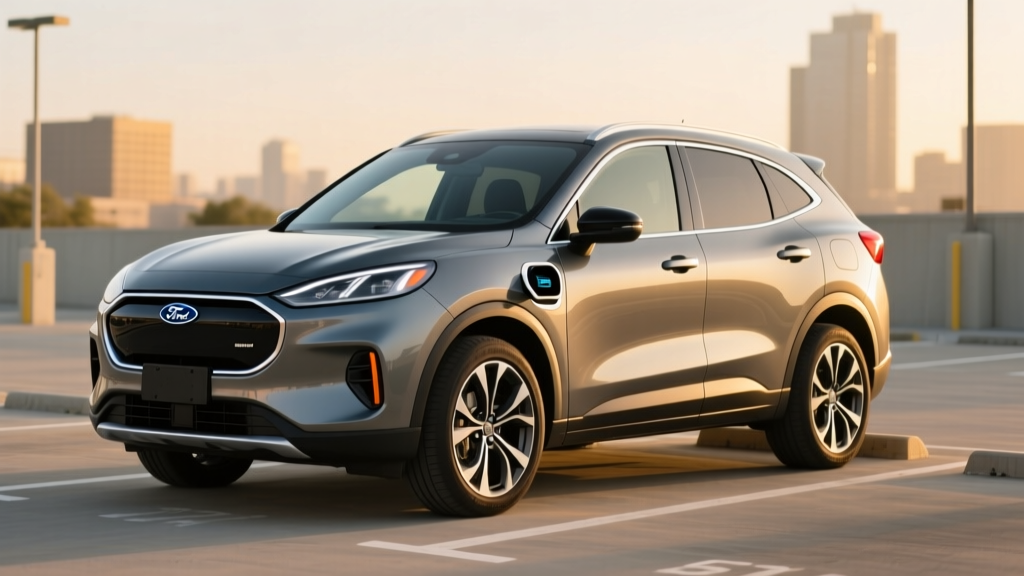
Shoppers researching the 2024 Ford Escape Plug-In Hybrid dimensions — length, width, height — are usually trying to answer two questions at once: will it fit my garage, and does the powertrain actually make sense for my commute? This guide covers every exterior and interior measurement alongside the full PHEV spec sheet, real-world efficiency data, battery warranty details, and tax-credit eligibility so you can make one confident decision.
2024 Ford Escape PHEV Exterior Dimensions at a Glance
Before we get to the powertrain, here are the exact exterior measurements Ford publishes for the 2024 Escape Plug-In Hybrid. These figures apply across all PHEV trims (the PHEV is offered in a single well-equipped trim in the US market).
| Dimension | Measurement |
|---|---|
| Overall Length | 180.1 inches |
| Overall Width (without mirrors) | 74.1 inches |
| Overall Width (mirrors folded) | 77.9 inches |
| Overall Height | 66.1 inches |
| Wheelbase | 106.7 inches |
| Ground Clearance | 6.3 inches |
| Curb Weight (approx.) | 3,917 lbs |
For garage planning, the critical number is the 180.1-inch length (just under 15 feet). The 66.1-inch height clears most standard 7-foot garage doors with room to spare, and the 74.1-inch width (without mirrors) fits comfortably in a standard 8-foot-wide parking space. If your garage is tight, note that mirrors-folded width reaches 77.9 inches — still manageable but worth measuring against any shelving or workbench protrusions.
Interior Dimensions and Cargo Volume
The PHEV's battery pack sits beneath the floor, so cargo and passenger space remain largely unchanged from the gas-only Escape. Here is what you get inside:
| Measurement | Front | Rear |
|---|---|---|
| Headroom | 40.0 in | 39.3 in |
| Legroom | 42.4 in | 38.9 in |
| Shoulder Room | 57.6 in | 56.0 in |
| Hip Room | 55.2 in | 53.3 in |
Cargo volume: 34.4 cubic feet behind the second row; 60.8 cubic feet with the rear seats folded. That is competitive with the Honda CR-V Hybrid and slightly less than the Toyota RAV4 Prime's 33.5 / 63.2 cu ft split — the RAV4 offers a touch more maximum space, but the Escape PHEV holds its own for daily hauling.
HEV vs PHEV: Which Escape Hybrid Is Which?
Ford sells the Escape in two electrified flavors, and confusing them is the most common buyer mistake. Here is the essential distinction:
| Feature | Escape Hybrid (HEV) | Escape Plug-In Hybrid (PHEV) |
|---|---|---|
| Needs to plug in? | No — charges via regen & engine | Yes — plug in to access EV range |
| Battery Size | 1.1 kWh (small buffer) | 14.4 kWh usable |
| Electric-Only Range | ~1 mile at low speed | 37 miles (EPA) |
| EPA Combined MPG / MPGe | 39 MPG combined | 105 MPGe (EV mode) / 40 MPG (gas) |
| AWD Available? | Yes | No — FWD only |
| Combined Horsepower | 198 hp | 210 hp |
| DC Fast Charging? | N/A | No — Level 2 AC only |
The bottom line: The conventional HEV is a self-charging hybrid — you never plug it in, and it returns strong MPG by using a small battery to assist the gas engine. The PHEV has a much larger battery you charge from a wall outlet or public charger, giving you 37 miles of pure electric driving before the gas engine takes over. If you can charge at home and your commute is under 37 miles round-trip, the PHEV effectively operates as an EV on weekdays and a hybrid on road trips.
Fuel Economy, MPGe, and Real-World MPG
The 2024 Escape PHEV's EPA ratings, sourced from fueleconomy.gov, break down as follows:
| Mode | City | Highway | Combined |
|---|---|---|---|
| Electric (MPGe) | 110 MPGe | 99 MPGe | 105 MPGe |
| Gas-Only (MPG) | 42 MPG | 38 MPG | 40 MPG |
Real-world MPG note: Hybrids and PHEVs typically exceed their EPA city rating in stop-and-go traffic because regenerative braking recaptures energy that a gas car wastes as heat. Expect 43-46 MPG in city driving once the battery is depleted. Highway driving at 75+ mph will drop closer to 35-37 MPG, as the electric motor contributes less at sustained high speeds and aerodynamic drag increases. In cold weather (below 30°F), expect a 15-25% reduction in electric-only range — roughly 28-31 miles instead of 37.
Electric-Only Range, Battery, and Charging Specs
The PHEV's 14.4 kWh lithium-ion battery pack (NMC chemistry) delivers an EPA-rated 37 miles of electric-only range. Total combined range — electric plus a full 11.1-gallon gas tank — exceeds 520 miles.
| Spec | Value |
|---|---|
| Battery Capacity (usable) | 14.4 kWh |
| Battery Chemistry | NMC (Nickel Manganese Cobalt) |
| Electric-Only Range (EPA) | 37 miles |
| Total Combined Range | ~520+ miles |
| Level 1 Charging (120V, 12A) | ~10-11 hours (0-100%) |
| Level 2 Charging (240V, 32A) | ~3.5 hours (0-100%) |
| DC Fast Charging | Not supported |
| Charge Port | J1772 (front fender, driver side) |
Critical detail: The Escape PHEV does not support DC fast charging. This is normal for PHEVs — their smaller batteries don't justify the hardware cost, and a 3.5-hour Level 2 top-up overnight covers the use case. If you install a 240V Level 2 home charger (typically $500-$1,200 for equipment plus $300-$800 for electrician labor, depending on panel proximity), you will wake up to a full battery every morning. On a standard 120V household outlet, plan for roughly 10-11 hours — still workable if you plug in when you get home at 6 PM.
Powertrain and Performance
The Escape PHEV pairs a 2.5-liter Atkinson-cycle inline-4 engine with an electric motor integrated into the eCVT transaxle. Combined output is 210 horsepower. Unlike the HEV, the PHEV is front-wheel drive only — Ford does not offer AWD on the plug-in variant.
| Spec | Value |
|---|---|
| Engine | 2.5L iVCT Atkinson-cycle I-4 |
| Electric Motor | Permanent-magnet synchronous (integrated in eCVT) |
| Combined System Horsepower | 210 hp |
| Transmission | eCVT (electronically controlled) |
| Drivetrain | FWD only |
| 0-60 mph (est.) | ~8.5 seconds |
| Towing Capacity | 1,500 lbs (with Class II tow package) |
Acceleration is adequate for merging and passing but not sporty. The eCVT delivers smooth, linear power with no gear-shift jolts. In EV mode, the Escape PHEV is quiet and responsive around town — the electric motor's instant torque makes it feel quicker than the 0-60 number suggests at city speeds.
Pricing, Trims, and Tax Credit Eligibility
The 2024 Escape PHEV is offered in a single trim in the US market, starting at an MSRP of approximately $38,500 (including destination). Well-equipped with standard features like a 13.2-inch touchscreen, wireless Apple CarPlay/Android Auto, Ford Co-Pilot360 assist, and a power liftgate.
Federal §30D Tax Credit — PHEV Eligibility Checklist:
- Credit amount: Up to $7,500 for qualifying new PHEVs — but the Escape PHEV's eligibility has been restricted under 2024-2026 battery sourcing and critical-mineral rules. Check the latest list at fueleconomy.gov before purchasing.
- MSRP cap: SUVs/vans must be under $80,000 — the Escape PHEV qualifies.
- Buyer income cap: AGI must not exceed $150,000 (single) / $300,000 (joint) — per IRS §30D guidelines.
- Point-of-sale transfer: Eligible buyers can transfer the credit to the dealer at purchase for an immediate price reduction (effective Jan 1, 2024).
- Battery sourcing: The credit phases based on percentage of battery components manufactured in North America and critical minerals sourced from FTA partners — verify current-year compliance for the Escape PHEV specifically.
Tax credit rules change frequently. Consult a tax professional and verify on irs.gov before relying on credit eligibility for your purchase decision.
Battery Warranty, Reliability, and Replacement Cost
Hybrid/PHEV Battery Warranty: Ford covers the Escape PHEV's high-voltage battery for 8 years or 100,000 miles (whichever comes first), with a capacity-retention threshold typically set at 70% of original capacity. In California Air Resources Board (CARB) states, hybrid battery emissions warranties can extend to 10 years or 150,000 miles.
Reliability: Ford's 2.5L Atkinson-cycle engine is one of the most proven hybrid powertrains in the industry, sharing architecture with the Fusion Hybrid and Maverick Hybrid. The eCVT has no traditional clutch packs or bands to wear — it is mechanically simple and durable. PHEV battery degradation in the 14.4 kWh pack is expected to be modest; most owners report losing 5-10% of electric range over the first 5 years, which is within the warranty threshold.
Battery replacement cost: If the battery fails outside warranty, a replacement pack for the Escape PHEV currently runs $4,000-$6,500 including labor, depending on the dealer and whether refurbished modules are available. However, out-of-warranty PHEV battery failures remain rare based on historical data from similar Ford hybrid systems now exceeding 150,000+ miles in fleet service.
Who Should Choose the Escape PHEV vs a Full EV or Gas Car?
Choose the Escape PHEV if:
- Your daily commute is under 37 miles round-trip and you can charge at home (Level 1 or 2).
- You take regular road trips and don't want to plan around DC fast-charging infrastructure.
- You want EV-like daily driving without committing to a full battery-electric vehicle.
- You live in an area with limited public charging but have home-outlet access.
Choose a full BEV (like the Ford Mustang Mach-E or Hyundai Ioniq 5) if:
- You have reliable home Level 2 charging and want zero tailpipe emissions.
- Your daily driving exceeds 37 miles and you'd rather not burn gas at all.
- You want lower per-mile fuel costs (electricity at $0.14/kWh ≈ $0.04/mile vs gas at $3.50/gal ≈ $0.12/mile).
Choose the Escape HEV (conventional hybrid) if:
- You cannot charge at home (apartment, street parking, no garage outlet).
- You want hybrid MPG savings with zero behavior change — just fill up and drive.
- You need AWD (the HEV offers it; the PHEV does not).
Pros
- 37-mile EV range covers most commutes gas-free
- 40 MPG combined after battery depletion — excellent for a compact SUV
- No range anxiety — 520+ mile total range
- Quiet, smooth EV-mode driving around town
- Competitive cargo space for the class (34.4 cu ft)
Cons
- FWD only — no AWD option on the PHEV
- No DC fast charging (3.5-hour Level 2 top-up)
- Single PHEV trim limits customization
- Premium over the HEV trim (~$5,000-$7,000 more)
- Electric range drops 15-25% in cold weather
Frequently Asked Questions
How many MPG does the 2024 Ford Escape PHEV get?
The EPA rates it at 40 MPG combined (42 city / 38 highway) once the battery is depleted. In real-world city driving with frequent regenerative braking, many owners see 43-46 MPG. Highway driving at higher speeds typically returns 35-37 MPG.
How far can the Escape PHEV go on electric only?
The EPA rates it at 37 miles of all-electric range. In mild weather at city speeds, you may see 38-40 miles. In cold weather (below 30°F) or at sustained highway speeds, expect 28-32 miles before the gas engine engages.
Does the Escape PHEV qualify for a federal tax credit?
It may qualify for up to $7,500 under IRS §30D, but eligibility depends on current-year battery-component sourcing rules, your income, and the MSRP cap. The Escape PHEV clears the $80,000 SUV cap. Verify the latest status on fueleconomy.gov and consult a tax professional before purchasing.
Is the Escape PHEV reliable and what does battery replacement cost?
Ford's 2.5L hybrid system is well-proven, and the eCVT is mechanically robust. The high-voltage battery carries an 8-year/100,000-mile warranty. Out-of-warranty replacement costs approximately $4,000-$6,500, though premature failures are rare based on long-term fleet data from similar Ford hybrid platforms.
Can I charge the Escape PHEV at a DC fast charger?
No. The Escape PHEV only accepts AC charging — Level 1 (120V) or Level 2 (240V). This is standard for nearly all PHEVs. A home Level 2 charger fully replenishes the battery in about 3.5 hours.
What are the exact dimensions of the 2024 Ford Escape Plug-In Hybrid?
Length: 180.1 inches. Width (without mirrors): 74.1 inches. Height: 66.1 inches. Wheelbase: 106.7 inches. Ground clearance: 6.3 inches. These measurements are identical across all PHEV trims.