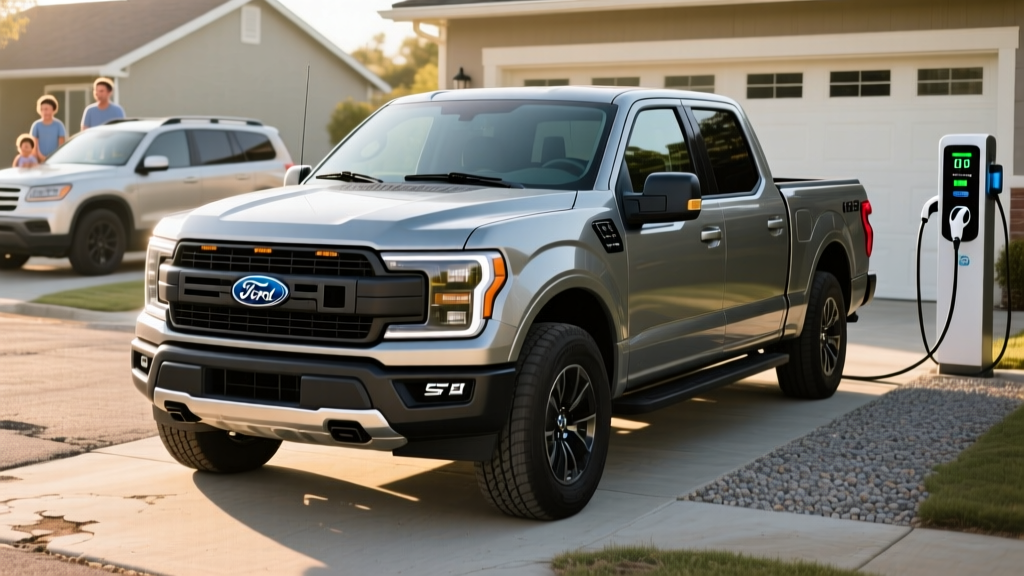
The 2024 F-150 PowerBoost: A Full-Size Truck That Actually Sips Fuel
If you need a full-size pickup but flinch every time you pass a gas station, the 2024 F-150 Hybrid — officially the F-150 PowerBoost — is Ford's answer. It pairs a twin-turbo 3.5-liter V6 with an electric motor sandwiched inside the 10-speed automatic transmission, delivering 430 horsepower and up to 570 lb-ft of torque while squeezing out an EPA-estimated 24 MPG combined. That's a meaningful improvement over the non-hybrid 3.5L EcoBoost (20 MPG combined) and the 5.0L V8 (19 MPG combined).
But the PowerBoost isn't a plug-in hybrid. It's a conventional HEV (hybrid electric vehicle) — meaning you never plug it in. The small battery recharges through regenerative braking and the engine. Let's break down exactly what that gets you, what it costs, and whether it makes sense versus a full EV truck like the F-150 Lightning or a conventional gas model.
2024 Ford F-150 PowerBoost Hybrid — Key Specifications
| Spec | Value |
|---|---|
| Powertrain | 3.5L Twin-Turbo V6 + Electric Motor (HEV) |
| Combined Horsepower | 430 hp |
| Combined Torque | 570 lb-ft |
| Transmission | 10-Speed Modular Hybrid Automatic |
| Hybrid Battery | 1.5 kWh lithium-ion |
| EPA Fuel Economy (4x2) | 25 city / 26 highway / 25 combined MPG |
| EPA Fuel Economy (4x4) | 22 city / 24 highway / 23 combined MPG |
| Max Towing Capacity | 7,210 lbs (4x2, properly equipped) |
| Max Payload | 2,120 lbs |
| 0-60 mph | ~5.8 seconds (est.) |
| Starting MSRP (PowerBoost trim) | ~$57,000 (Lariat 4x2 SuperCrew) |
| Battery Warranty | 8 years / 100,000 miles |
How Many MPG Does the 2024 F-150 Hybrid Actually Get?
Ford quotes the EPA at 25/26/25 MPG (city/highway/combined) for the 4x2 SuperCrew with the 5.5-foot bed and 22 city / 24 highway / 23 combined for the 4x4. Those numbers come from fueleconomy.gov, the official EPA source.
EPA Fuel Economy Breakdown — 2024 F-150 PowerBoost
| Drivetrain | City MPG | Highway MPG | Combined MPG |
|---|---|---|---|
| 4x2 SuperCrew | 25 | 26 | 25 |
| 4x4 SuperCrew | 22 | 24 | 23 |
Real-world note: Hybrid trucks — like hybrid cars — tend to exceed their EPA city estimate because regenerative braking recaptures energy in stop-and-go driving where gas engines are least efficient. Owners on forums and real-world fuel trackers frequently report 26-28 MPG in mixed suburban driving with the 4x2. Highway-only driving at 75+ mph, however, can drop the 4x4 to 20-21 MPG, since aerodynamic drag dominates and the hybrid system can't help as much at sustained speed.
For context, that 23-25 combined MPG translates to roughly 460-500 miles of total range on a single tank (the PowerBoost uses a 26-gallon fuel tank on the SuperCrew). If you drive 15,000 miles per year at $3.50/gallon, you're spending roughly $2,200 annually on fuel with the 4x4 PowerBoost — versus about $2,750 with the standard 3.5L EcoBoost V6 4x4 (20 MPG combined). That's roughly $550 per year in fuel savings.
PowerBoost vs. F-150 Lightning: HEV, PHEV, or Full EV?
Buyers cross-shopping the F-150 PowerBoost often wonder about the F-150 Lightning (full EV) or whether a plug-in hybrid version exists. Let's clarify the categories:
HEV vs. PHEV vs. BEV — What's the Difference?
| Type | Plug In? | Electric-Only Range | F-150 Example |
|---|---|---|---|
| HEV (Conventional Hybrid) | No | Less than 1 mile (low-speed assist only) | F-150 PowerBoost |
| PHEV (Plug-In Hybrid) | Yes | Typically 20-40 miles | No F-150 PHEV offered (as of 2024) |
| BEV (Battery Electric) | Yes (required) | 230-320 miles (EPA) | F-150 Lightning |
The PowerBoost is strictly a conventional hybrid (HEV). There is no plug, no electric-only driving mode for meaningful distances, and no home charging requirement. The 1.5 kWh battery is small — it exists to smooth torque delivery, enable engine stop-start, and recapture braking energy. The electric motor adds 47 hp to the system but cannot propel the truck alone at highway speeds.
Ford does not offer a plug-in hybrid F-150. If you want electric-only commuting capability in a full-size truck, the F-150 Lightning is the only electrified option in Ford's lineup. The Lightning's EPA range spans 230 miles (Standard Range battery) to 320 miles (Extended Range battery), with pricing starting around $55,000 for the base Pro trim.
Which F-150 Powertrain Fits You?
Choose the PowerBoost HEV if: You want 2-4 MPG better fuel economy without changing your refueling habits, you tow frequently and need proven gas-station infrastructure, or you lack home charging access.
Choose the F-150 Lightning (BEV) if: You can charge at home, your daily commute is under 200 miles, you want near-zero maintenance costs, and you value the Lightning's front trunk (frunk), V2L/V2H capability, and instant torque.
Choose the standard 3.5L EcoBoost if: Upfront cost is the priority, you drive mostly highway miles where hybrid advantage shrinks, or you're buying for a fleet where simplicity matters.
Towing, Payload, and Real-World Capability
The PowerBoost's 430 combined horsepower and 570 lb-ft of torque make it one of the most powerful F-150 engine options — trailing only the Raptor's high-output EcoBoost and the supercharged 5.2L in the Raptor R. That electric motor fills in the torque curve at low RPMs, which you feel immediately when pulling away from a stop with a trailer hooked up.
Max towing is 7,210 lbs for a properly equipped 4x2 SuperCrew, which covers most boat trailers, campers under 28 feet, and car-hauler loads. The 4x4 drops slightly to around 6,500 lbs depending on configuration. The standard 3.5L EcoBoost V6 with the Max Trailer Tow Package can actually tow more (up to 13,500 lbs in certain configurations) — so if maximum towing is your primary concern, the hybrid is not the top choice.
Onboard generator: One PowerBoost-exclusive feature is the available Pro Power Onboard system, offering up to 7.2 kW of exportable power through bed-mounted 120V and 240V outlets. This turns the truck into a mobile generator — enough to run power tools at a job site, power an RV's air conditioner, or serve as emergency home backup during an outage. The Lightning offers a similar feature (Pro Power Onboard up to 9.6 kW), but the PowerBoost can run its generator indefinitely as long as you keep the 26-gallon tank full.
Pricing, Trims, and Tax Credit Eligibility
The PowerBoost hybrid powertrain is available on the Lariat, King Ranch, and Platinum trims of the 2024 F-150. It's not offered on the base XL or XLT. Pricing breaks down roughly as follows:
| Trim | Starting MSRP (approx.) | PowerBoost Availability |
|---|---|---|
| Lariat SuperCrew 4x2 | ~$57,000 | Standard or optional depending on package |
| Lariat SuperCrew 4x4 | ~$60,500 | Available |
| King Ranch SuperCrew 4x4 | ~$68,000 | Available |
| Platinum SuperCrew 4x4 | ~$72,000 | Available |
Federal tax credit: The F-150 PowerBoost is a conventional hybrid (HEV), not a plug-in vehicle. Under current IRS §30D rules, the federal clean vehicle credit of up to $7,500 applies only to battery electric vehicles (BEVs) and plug-in hybrids (PHEVs) that meet battery sourcing, critical mineral, MSRP cap, and buyer income requirements. The PowerBoost does not qualify for the §30D federal tax credit.
The F-150 Lightning (BEV) may qualify for up to $7,500 depending on battery component sourcing, your adjusted gross income, and the MSRP cap ($80,000 for trucks). Always verify current-year eligibility with a tax professional and the IRS's official guidance before purchasing.
Battery Warranty, Reliability, and Replacement Cost
2024 F-150 PowerBoost — Hybrid Battery Coverage
Warranty: 8 years or 100,000 miles (whichever comes first) on hybrid-specific components including the 1.5 kWh battery pack, electric motor, and related power electronics.
Capacity threshold: Ford's hybrid warranty covers defects and failures that cause the system to malfunction — unlike BEV warranties, there is no published minimum capacity-retention percentage (e.g., 70% SoH), because the small HEV battery isn't expected to degrade in a way that meaningfully affects fuel economy over the warranty period.
Is the 2024 F-150 Hybrid reliable? The PowerBoost system debuted for the 2021 model year, so there are now several years of real-world data. Ford's hybrid system in the F-150 has been generally well-received, though early 2021-2022 models saw some software-related recalls and complaints about transmission shudder. By the 2024 model year, most of those issues had been addressed through software updates and production refinements. The NHTSA vehicle page lists any active recalls — always check before buying.
Battery replacement cost: If the 1.5 kWh hybrid battery fails out of warranty, replacement costs are estimated at $2,500 to $4,000 for the battery pack itself, plus labor. This is significantly less than a BEV battery replacement (which can exceed $15,000-$25,000) because the HEV battery is small. The electric motor and inverter are also covered under the hybrid warranty and are generally robust components with fewer wear points than a traditional alternator or starter motor — both of which the PowerBoost eliminates.
The 3.5L EcoBoost V6 engine itself is a proven, widely used Ford powerplant with a strong reliability track record across the F-150, Explorer, and Transit lines. The hybrid system adds complexity (electric motor, inverter, battery) but removes other failure-prone components (starter, alternator, accessory belt), roughly balancing out long-term maintenance risk.
Pros
- 23-25 MPG combined — best-in-class for a full-size gas/hybrid truck
- 430 hp / 570 lb-ft — strong acceleration and towing confidence
- No plug-in required — zero change to refueling habits
- Pro Power Onboard up to 7.2 kW — mobile generator capability
- 8-year/100,000-mile hybrid battery warranty
- Lower fuel cost: ~$550/year savings vs. standard 3.5L EcoBoost
Cons
- Not available on base XL/XLT trims — starts at ~$57,000
- Lower max towing than EcoBoost with Max Tow Package (7,210 vs. 13,500 lbs)
- No federal tax credit eligibility (HEV, not PHEV/BEV)
- Highway MPG advantage over gas model shrinks at 75+ mph
- Hybrid system adds weight and mechanical complexity
- 1.5 kWh battery means no meaningful electric-only driving
Who Should Buy the 2024 F-150 PowerBoost — and Who Shouldn't?
The PowerBoost occupies a specific niche: buyers who need a full-size truck for work, towing, or rural use, but who also drive enough daily miles that the fuel savings matter. If you drive 15,000-20,000 miles per year in mixed suburban and highway conditions, the $550-$700 annual fuel savings over the gas V6 will offset the PowerBoost's price premium within 3-5 years.
Best for: Contractors who idle at job sites (the hybrid system shuts off the engine and runs climate/accessories on battery), suburban commuters who want truck utility with sedan-like fuel bills, and anyone who values the 7.2 kW Pro Power Onboard for off-grid or emergency power.
Not ideal for: Buyers who want the lowest possible purchase price (the standard 2.7L EcoBoost starts thousands less), those who tow over 10,000 lbs regularly, or drivers who want zero tailpipe emissions and can charge at home (the F-150 Lightning is the better choice).
If you're considering the PowerBoost, test-drive it back-to-back with the 3.5L EcoBoost and, if possible, the Lightning. The instant low-end torque from the electric motor is immediately noticeable in city driving, and the fuel-economy advantage is real — but only if your driving mix includes enough stop-and-go miles to let the hybrid system do its work.
Frequently Asked Questions
Does the 2024 F-150 Hybrid need to be plugged in?
No. The F-150 PowerBoost is a conventional hybrid (HEV), not a plug-in hybrid. The 1.5 kWh battery charges itself through regenerative braking and the gasoline engine. You refuel exclusively at gas stations, just like a standard F-150.
How far can the F-150 Hybrid drive on electric power alone?
Not far at all. The PowerBoost's electric motor assists the gas engine and enables very low-speed electric-only movement (parking lots, brief stops), but it cannot sustain highway speeds or travel meaningful distances on electricity alone. If you want 20-40 miles of electric-only range, you'd need a PHEV — and Ford does not currently offer a plug-in hybrid F-150.
Does the F-150 PowerBoost qualify for the $7,500 federal tax credit?
No. Under IRS §30D, the federal clean vehicle credit applies only to plug-in electric vehicles (BEVs and PHEVs) meeting specific battery sourcing, MSRP, and income requirements. The PowerBoost is a conventional hybrid and is not eligible. The F-150 Lightning (BEV) may qualify, depending on your individual circumstances.
What is the F-150 Hybrid battery replacement cost?
Out-of-warranty replacement of the 1.5 kWh hybrid battery pack is estimated at $2,500-$4,000 including labor. The battery is covered by Ford's 8-year/100,000-mile hybrid component warranty, so most owners will never face this cost.
Can the F-150 Hybrid tow as much as the gas version?
No. The PowerBoost's maximum towing capacity is 7,210 lbs (4x2, properly equipped). The standard 3.5L EcoBoost V6 with the Max Trailer Tow Package can tow up to 13,500 lbs in certain configurations. If maximum towing is your priority, the non-hybrid EcoBoost is the stronger choice.
Is the 2024 F-150 Hybrid reliable?
The PowerBoost system has been in production since the 2021 model year. Early models had some software and transmission-related complaints, but the 2024 model year reflects multiple rounds of refinement. The 3.5L EcoBoost V6 is a well-established engine. Check NHTSA for any active recalls and review IIHS ratings for crash-test performance.