Quick Verdict: The 2024 Camry Hybrid Still Earns Its Reputation
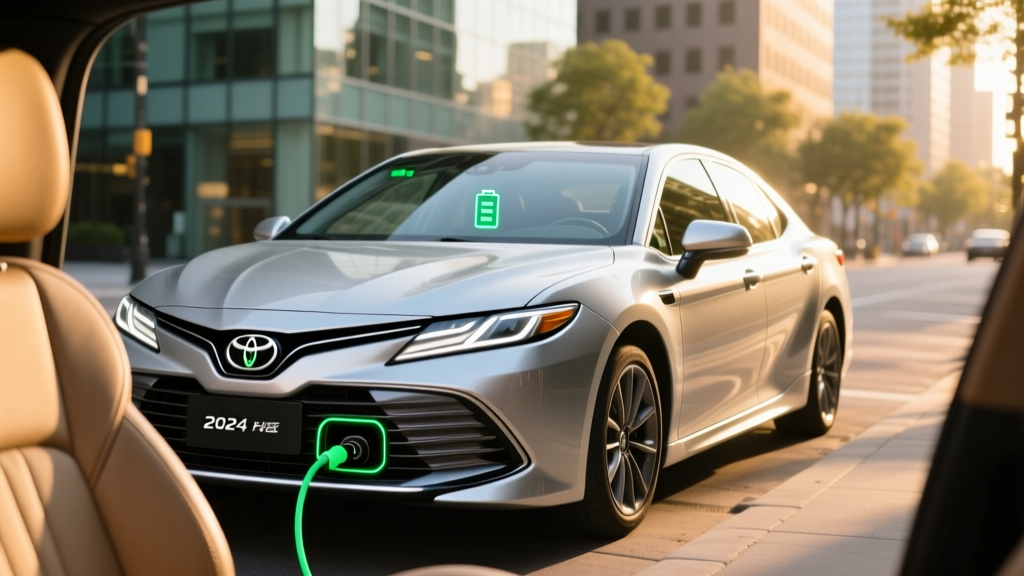
The 2024 Toyota Camry Hybrid is a conventional hybrid electric vehicle (HEV) — not a plug-in — and it remains one of the most efficient midsize sedans you can buy. With an EPA-estimated 52 MPG combined on the LE trim, a proven 2.5-liter four-cylinder hybrid powertrain, and a starting MSRP around $29,490 (including destination), it occupies a sweet spot for buyers who want exceptional fuel economy without ever plugging in.
For 2026 shoppers considering a used or remaining-stock 2024 model, the calculus is straightforward: the Camry Hybrid delivers real-world city MPG that often exceeds its EPA sticker, carries Toyota's 10-year/150,000-mile hybrid battery warranty, and costs thousands less than a comparable plug-in hybrid or full EV. But it also lacks electric-only driving, DC fast charging, and federal tax credit eligibility — trade-offs that matter depending on your commute and priorities.
| Attribute | LE (FWD) | SE/XLE (FWD) | SE/XLE (AWD-e) |
|---|---|---|---|
| Combined HP | 208 hp | 208 hp | 219 hp |
| Engine | 2.5L 4-cyl + 2 electric motors | 2.5L 4-cyl + 2 electric motors | 2.5L 4-cyl + 3 electric motors |
| EPA City MPG | 51 | 44 | 44 |
| EPA Highway MPG | 53 | 47 | 47 |
| EPA Combined MPG | 52 | 46 | 46 |
| Battery Type | Lithium-ion (sealed NiMH on some trims) | Lithium-ion | Lithium-ion |
| Drivetrain | FWD | FWD | AWD-e (electronic rear motor) |
| 0–60 mph | ~7.2 sec | ~7.2 sec | ~6.9 sec |
| Starting MSRP (incl. dest.) | $29,490 | $31,990 | $33,540 |
| Federal Tax Credit | None | None | None |
HEV vs. PHEV: What the 2024 Camry Hybrid Actually Is
Before diving into fuel economy, it's essential to clarify what the 2024 Camry Hybrid is — and what it isn't.
| Feature | 2024 Camry Hybrid (HEV) | PHEV Example: Toyota RAV4 Prime |
|---|---|---|
| Plugs in to charge? | No — charges via regenerative braking and engine | Yes — Level 1 or Level 2 |
| Electric-only range | ~1 mile at very low speeds | 42 miles (EPA) |
| Battery capacity | ~1.6 kWh (small buffer) | 18.1 kWh |
| Federal tax credit (§30D) | Not eligible | Up to $7,500 (if eligible) |
| Best for | Daily commuting, no charging access needed | Short EV commutes + long road trips |
The 2024 Camry Hybrid is a conventional hybrid (HEV). It has a small lithium-ion battery pack that charges entirely through regenerative braking and the gasoline engine. You never plug it in. The electric motors assist the engine during acceleration and enable brief electric-only movement at low speeds (typically under 25 mph for roughly a mile), but the gas engine is always doing the heavy lifting. This is fundamentally different from a PHEV like the RAV4 Prime, which offers 40+ miles of electric-only driving before the engine kicks in.
Fuel Economy: EPA Estimates and Real-World MPG
| Trim / Drivetrain | City MPG | Highway MPG | Combined MPG |
|---|---|---|---|
| LE (FWD) | 51 | 53 | 52 |
| SE (FWD) | 44 | 47 | 46 |
| XLE (FWD) | 44 | 47 | 46 |
| SE (AWD-e) | 44 | 47 | 46 |
| XLE (AWD-e) | 44 | 47 | 46 |
Source: fueleconomy.gov
The LE trim's 52 MPG combined is the headline number and the reason this car dominates efficiency conversations. The 6-MPG gap between the LE and higher trims comes down to weight (larger wheels, more equipment), a sport-tuned suspension on the SE, and aerodynamic differences.
Real-World MPG: What Owners Actually See
Toyota's hybrid system excels in stop-and-go city driving, where regenerative braking recaptures energy constantly. Many owners report city MPG that meets or exceeds the EPA estimate — the LE can return 53–55 MPG in urban driving with moderate acceleration. Highway driving is a different story: at sustained 75–80 mph speeds, expect 44–48 MPG on the LE and 39–43 MPG on AWD-e trims. Cold weather (below 35°F) typically reduces MPG by 5–10% as the engine runs more frequently to heat the cabin and maintain battery temperature.
For a 15,000-mile/year driver averaging the LE's 52 MPG combined, annual fuel consumption is approximately 288 gallons. At $3.50/gallon, that's roughly $1,009 per year in fuel. A comparable gas-only 2024 Camry (32 MPG combined) would consume 469 gallons — about $1,641 annually. The hybrid saves approximately $630/year in fuel at those prices.
Powertrain: How Toyota's Hybrid Synergy Drive Works
The 2024 Camry Hybrid pairs a 2.5-liter Dynamic Force four-cylinder engine (176 hp, 163 lb-ft) with Toyota's Hybrid Synergy Drive system. In FWD trims, two electric motor/generators (MG1 and MG2) sit in the transaxle: MG1 starts the engine and acts as a generator, while MG2 drives the wheels and handles regenerative braking. Combined system output is 208 horsepower.
AWD-e trims add a third electric motor (40 hp) on the rear axle, providing electronic all-wheel drive without a mechanical driveshaft. This bumps total output to 219 hp and improves 0–60 times to approximately 6.9 seconds. The rear motor engages automatically during acceleration from a stop and in slippery conditions up to about 43 mph, then disconnects to preserve efficiency.
The lithium-ion hybrid battery pack is small — approximately 1.6 kWh of total capacity — because it doesn't need to store energy for plug-in driving. It acts as a buffer, absorbing regenerative braking energy and providing electric assist during acceleration. This small size is actually an advantage for longevity: the battery operates in a narrow state-of-charge window (roughly 40–80%), which significantly reduces degradation compared to full EV or PHEV batteries that cycle through wider ranges.
Battery Warranty, Reliability, and Replacement Cost
2024 Camry Hybrid Battery Warranty
- Hybrid Battery: 10 years / 150,000 miles (whichever comes first)
- Hybrid System Components: 8 years / 100,000 miles
- Powertrain (engine, transaxle): 5 years / 60,000 miles
- Warranty coverage: Repair or replacement if battery capacity drops below a functional threshold
Toyota's hybrid battery reliability is among the best-documented in the industry. The Prius, which uses a fundamentally similar hybrid system, has demonstrated battery packs lasting 200,000+ miles with minimal degradation. The 2024 Camry Hybrid's lithium-ion pack benefits from Toyota's conservative charge management — the battery never fully charges or fully depletes, which dramatically extends cycle life.
If replacement is needed out of warranty, a new OEM hybrid battery pack for the Camry Hybrid typically costs between $2,000 and $4,000 (parts only), with labor adding $300–$600. Refurbished packs are available for $1,000–$2,000. This is a fraction of full EV battery replacement costs ($10,000–$20,000+) because the hybrid battery is much smaller.
According to IIHS, the 2024 Camry earned top safety ratings, and Toyota's hybrid system has consistently ranked at the top of J.D. Power and Consumer Reports reliability surveys. The hybrid system has fewer wear components than a conventional gas powertrain — no traditional starter motor, no alternator, and regenerative braking extends brake pad life significantly.
Pricing, Trims, and Tax Credit Reality
The 2024 Camry Hybrid is available in four trims:
- LE: $29,490 — 52 MPG combined, 16-inch wheels, 8-inch touchscreen, Toyota Safety Sense 2.5+
- SE: $31,990 — 46 MPG, sport-tuned suspension, 18-inch black alloy wheels, paddle shifters
- XLE: $33,590 — 46 MPG, leather-trimmed seats, 9-inch touchscreen, wireless CarPlay/Android Auto
- XSE: $34,190 — 46 MPG, sport-luxury blend, 19-inch wheels, ambient lighting
AWD-e adds approximately $1,400 to SE and XLE trims.
Tax Credit Eligibility
The 2024 Camry Hybrid does not qualify for the federal §30D clean vehicle tax credit. Under current IRS rules, the §30D credit applies only to plug-in electric vehicles (BEVs and PHEVs) with battery capacities of at least 7 kWh. The Camry Hybrid's ~1.6 kWh pack falls well short of that threshold.
Some states offer hybrid-specific rebates or HOV lane access, but these vary by jurisdiction and change frequently. Check your state's energy office or DMV for current programs. There is no federal incentive for conventional HEVs at this time.
2024 Camry Hybrid vs. Alternatives: HEV, PHEV, or EV?
Pros
- Up to 52 MPG combined — best-in-class for midsize sedans
- No plug-in charging required — works with any lifestyle
- 10-year/150,000-mile hybrid battery warranty
- Low annual fuel cost (~$1,000/year at 15K miles)
- Strong resale value and Toyota reliability track record
- Competitive starting price under $30K
Cons
- No electric-only driving beyond very low speeds
- No federal tax credit eligibility
- AWD-e trims drop to 46 MPG combined
- CVT-like driving feel lacks engagement
- Infotainment system is functional but not class-leading
- Discontinued after 2024 (replaced by redesigned 2025 Camry)
Which Powertrain Is Right for You?
Choose the 2024 Camry Hybrid (HEV) if: You want maximum MPG without changing your refueling habits, you lack home charging access, your daily commute is longer than 30 miles, or you want the lowest purchase price with proven reliability.
Choose a PHEV (e.g., Toyota Prius Prime) if: Your daily commute is under 40 miles round-trip, you have home Level 2 charging, you want to drive mostly on electricity during the week but need gas flexibility for road trips, and you want to capture the federal tax credit.
Choose a full EV (e.g., Tesla Model 3, Hyundai Ioniq 6) if: You have reliable home charging, your daily driving is under 250 miles, you want zero tailpipe emissions and minimal maintenance, and you qualify for the full $7,500 federal tax credit to offset the higher purchase price.
Who Should Buy the 2024 Camry Hybrid?
The 2024 Camry Hybrid is the right choice for a specific buyer profile: someone who drives 10,000–20,000 miles per year, primarily in mixed city/highway conditions, and who either cannot or does not want to install a home charger. Apartment dwellers, street-parkers, and high-mileage commuters benefit most from the HEV's no-plug-in convenience combined with exceptional efficiency.
It's also a strong pick for buyers in regions with extreme cold (Minnesota, Maine, Alaska) where EV range loss of 20–30% in winter is a genuine concern. The Camry Hybrid's fuel economy drops modestly in cold weather, but it never faces the range reduction that stresses EV drivers in sub-zero conditions.
Note that the 2024 model year was the final year for this generation Camry. Toyota redesigned the Camry for 2025 with an exclusively hybrid lineup and updated styling. If you're shopping in 2026, expect to find the 2024 model on the used market or as remaining dealer stock — which may mean negotiating below MSRP.
Frequently Asked Questions
How many MPG does the 2024 Camry Hybrid get?
The LE trim achieves an EPA-estimated 51 city / 53 highway / 52 combined MPG. SE, XLE, and XSE trims (including AWD-e) are rated at 44 city / 47 highway / 46 combined. Real-world city MPG on the LE often reaches 53–55 in stop-and-go traffic.
Does the 2024 Camry Hybrid need to be plugged in?
No. The Camry Hybrid is a conventional hybrid (HEV). Its battery charges entirely through regenerative braking and the gasoline engine. You fuel it like any other car — with gasoline at a standard station.
Does the 2024 Camry Hybrid qualify for a tax credit?
It does not qualify for the federal §30D clean vehicle credit, which requires plug-in capability and a minimum 7 kWh battery. Some states may offer small hybrid rebates or HOV lane perks — check your state's current programs.
How long will the Camry Hybrid battery last?
Toyota covers the hybrid battery for 10 years or 150,000 miles. Based on long-term data from Toyota's hybrid fleet (Prius, Camry, RAV4 Hybrid), these batteries commonly last 200,000+ miles before needing replacement. The conservative charge window (40–80% SoC) significantly extends lifespan.
What does it cost to replace the hybrid battery?
An OEM replacement hybrid battery for the Camry Hybrid costs approximately $2,000–$4,000 for the part, plus $300–$600 in labor. Refurbished options are available for $1,000–$2,000. This is substantially less than full EV battery replacements.
Is the Camry Hybrid better than a full EV?
It depends on your situation. If you lack home charging, drive high annual miles, live in extreme cold, or want a lower purchase price, the Camry Hybrid is more practical. If you have home charging, a shorter commute, want zero tailpipe emissions, and can capture the $7,500 federal credit, a full EV may offer lower total operating costs over time.
What's the difference between the 2024 Camry Hybrid and the 2025 Camry?
Toyota redesigned the Camry for 2025 with an all-hybrid lineup, updated styling, and a new interior. The 2024 model is the final year of the previous generation. If buying in 2026, the 2024 may offer better value on the used market, while the 2025+ models provide the latest tech and full new-car warranty.