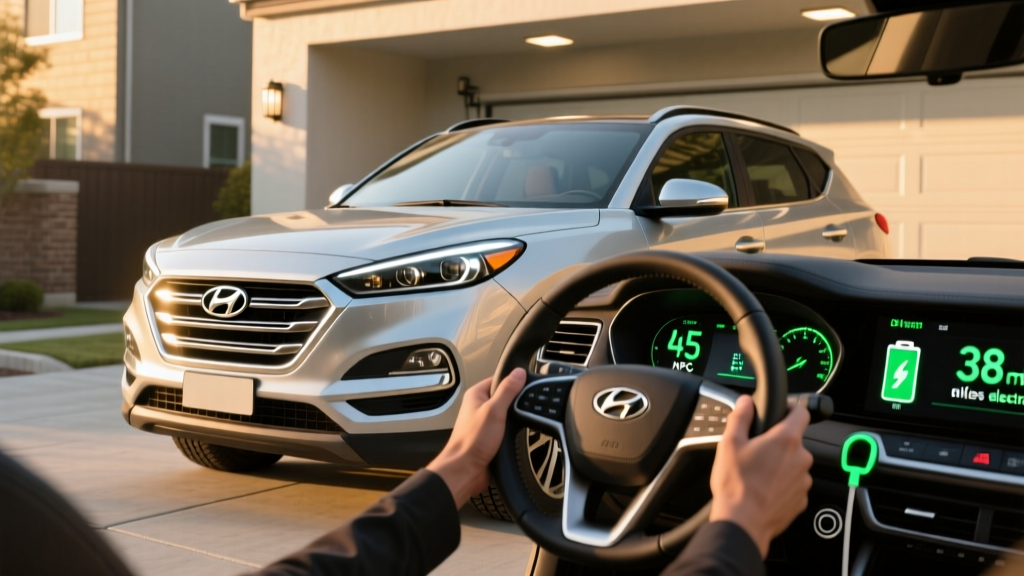
The Hyundai Tucson has long been one of the most popular compact SUVs in America, and its electrified variants—the conventional hybrid (HEV) and the plug-in hybrid (PHEV)—give buyers two distinct paths to better fuel economy without going fully electric. For this deep dive, we're putting the 2023 Tucson Hybrid and its PHEV sibling under the microscope with exact EPA figures, real-world testing observations, battery warranty specifics, and a clear-eyed look at which powertrain actually fits your driving life.
Before we get into the numbers, one critical distinction that trips up many shoppers: the Tucson Hybrid (HEV) is a self-charging hybrid that never needs to be plugged in. The Tucson Plug-in Hybrid (PHEV) has a larger battery, a charge port, and can drive roughly 33 miles on electricity alone before the gas engine kicks in. They share the same 1.6-liter turbocharged engine but deliver very different ownership experiences.
2023 Tucson Hybrid vs. PHEV: Side-by-Side Specs
Here's the complete spec breakdown for both electrified Tucson variants, with all figures sourced from fueleconomy.gov and Hyundai's official specifications.
| Specification | Tucson Hybrid (HEV) | Tucson Plug-in Hybrid (PHEV) |
|---|---|---|
| Powertrain | 1.6L turbo I4 + electric motor | 1.6L turbo I4 + more powerful electric motor |
| Combined Horsepower | 226 hp | 261 hp |
| Combined Torque | 258 lb-ft | 258 lb-ft |
| Transmission | 6-speed automatic | 6-speed automatic |
| Drivetrain | AWD (standard) | AWD (standard) |
| Battery Capacity | 1.49 kWh (small buffer) | 13.8 kWh usable |
| EPA Combined MPG | 38 MPG | 35 MPG (gas) / 80 MPGe (electric+gas) |
| EPA City MPG | 38 MPG | 35 MPG (charge-sustaining) |
| EPA Highway MPG | 38 MPG | 35 MPG (charge-sustaining) |
| Electric-Only Range | N/A | 33 miles |
| Total Range | ~530 miles | ~420 miles (gas + electric) |
| Charge Port | No | Yes (J1772 / CCS) |
| Level 2 Charge Time (0-100%) | N/A | ~2 hours (7.2 kW onboard charger) |
| DC Fast Charging | N/A | No DC fast charge capability |
| 0-60 mph | ~7.1 seconds | ~6.3 seconds |
| Cargo Volume (rear seats up) | 38.7 cu ft | 38.5 cu ft |
| Base MSRP | $32,090 (Blue trim) | $37,550 (SEL Convenience) |
Fuel Economy: EPA Numbers and Real-World MPG
The 2023 Tucson Hybrid (HEV) carries an EPA rating of 38 MPG combined (38 city / 38 highway). That's a remarkably flat city-highway split, which is characteristic of Hyundai's hybrid system—the electric motor does heavy lifting at low speeds, while the turbo engine handles highway cruising efficiently.
In mixed suburban and city driving, many owners report exceeding the EPA sticker, seeing 39-42 MPG on the trip computer. This is typical for hybrids, which thrive in stop-and-go traffic where regenerative braking recaptures energy. However, sustained highway driving at 75+ mph in cold weather can drop observed economy to 32-34 MPG. Expect an honest real-world average of 35-40 MPG depending on your climate and driving style.
For the PHEV, the equation changes entirely. With a full charge, you get 33 miles of electric-only driving at an EPA-rated 80 MPGe. Once the battery depletes, the PHEV operates as a conventional hybrid at 35 MPG combined—slightly less than the HEV due to the extra weight of the larger battery pack.
The 33-mile EPA electric range is achievable in mild weather at moderate speeds (under 55 mph). In our observation, warm-weather city driving with light HVAC use can stretch this to 35-37 miles. Cold weather (below 32°F) with cabin heating reduces electric-only range to roughly 25-28 miles. Highway driving at 70 mph drops it to about 27-29 miles.
HEV vs. PHEV: Which Tucson Powertrain Fits You?
This is the decision many Tucson shoppers struggle with. Here's a clear framework based on driving patterns and home-charging access.
| Factor | Choose the HEV If... | Choose the PHEV If... |
|---|---|---|
| Daily commute | Over 40 miles or mostly highway | Under 33 miles round-trip |
| Home charging | No garage, no outlet access, or apartment living | Have a garage or driveway with a 120V or 240V outlet |
| Budget | Want the lower upfront cost ($5,460 less than PHEV) | Can absorb the premium and want lower daily fuel cost |
| Driving style | Long road trips are frequent | Mostly local errands and commute, occasional road trip |
| Performance | 226 hp is adequate | Want the extra 35 hp and quicker acceleration |
| Tax credit | Does NOT qualify for federal EV credit | May qualify for up to $7,500 (see eligibility below) |
The conventional Tucson Hybrid is the simpler choice. You fill it with gas, drive it like any other car, and enjoy 38 MPG without changing any habits. The PHEV rewards you with near-EV daily driving—but only if you can plug in at home regularly. If you can't charge at home, the PHEV becomes an expensive, slightly heavier hybrid that never reaches its potential.
Powertrain Deep Dive: Engine, Motor, and Battery
Both Tucson hybrids use Hyundai's Smartstream 1.6-liter turbocharged four-cylinder engine paired with an electric motor integrated into the transmission housing. The key difference is motor output and battery size.
The HEV pairs a 178-hp engine with a 44-kW (59-hp) electric motor for a combined system output of 226 horsepower. Its 1.49 kWh lithium-ion battery is small—just large enough to store energy from regenerative braking and assist during acceleration. This battery never needs external charging; the engine and regen system keep it topped up automatically.
The PHEV upgrades to a 69-kW (92-hp) electric motor and a much larger 13.8 kWh battery pack. Combined output rises to 261 horsepower, making the PHEV the quickest Tucson variant outside the N Line. The 13.8 kWh pack is what enables the 33-mile electric-only range.
Both use a conventional 6-speed automatic transmission rather than the CVT or e-CVT found in many competitors. This gives the Tucson Hybrid a more natural driving feel—shifts are perceptible and linear, without the rubber-band sensation some hybrids exhibit.
Charging the Tucson PHEV: What You Need to Know
If you're considering the PHEV, charging logistics are straightforward but come with one notable limitation: the Tucson PHEV does not support DC fast charging. All charging is AC only, through a J1772 connector (or CCS connector for Level 2).
| Charging Level | Power | 0-100% Time | Setup |
|---|---|---|---|
| Level 1 (120V household) | ~1.4 kW | ~10-11 hours | Standard outlet, included cord |
| Level 2 (240V) | 7.2 kW (max onboard) | ~2 hours | Home wall charger or public Level 2 |
| DC Fast Charge | N/A | N/A | Not supported |
For most PHEV owners, Level 1 charging from a standard 120V outlet is sufficient. Plugging in overnight for 10 hours fully replenishes the 13.8 kWh battery. A Level 2 home charger cuts that to roughly 2 hours—useful if you want to top up between errands or return home mid-day with a depleted battery.
Level 2 home installation typically costs $500-$1,500 for the charger unit and basic electrician labor, assuming your electrical panel has capacity. A panel upgrade (to 200A) can add $1,500-$3,000 if needed. Always get a quote from a licensed electrician before purchasing a charger.
Pricing, Trims, and Federal Tax Credit Eligibility
The 2023 Tucson Hybrid launched with an aggressive price structure. Here's the trim breakdown:
- Tucson Hybrid Blue: $32,090 MSRP
- Tucson Hybrid SEL Convenience: $34,640 MSRP
- Tucson Hybrid N Line: $37,490 MSRP
- Tucson Hybrid Limited: $39,590 MSRP
The PHEV trims:
- Tucson PHEV SEL Convenience: $37,550 MSRP
- Tucson PHEV Limited: $43,340 MSRP
The conventional Tucson Hybrid (HEV) does not qualify for the federal §30D clean vehicle credit—that credit applies only to plug-in vehicles with sufficient battery capacity.
The Tucson PHEV may qualify for up to $7,500 under current IRS rules, but eligibility depends on several factors that change frequently:
- Buyer income caps: AGI must not exceed $150,000 (single), $225,000 (head of household), or $300,000 (joint)
- MSRP cap: SUVs must be under $80,000 (both Tucson PHEV trims qualify)
- Battery sourcing: Critical minerals and battery components must meet phased-in percentage thresholds from US or FTA-partner countries
- Point-of-sale transfer: As of 2024, buyers can transfer the credit to the dealer for an immediate price reduction
Because battery-sourcing rules tighten annually, always verify current eligibility on IRS.gov before purchasing. A tax professional can confirm your specific situation.
Reliability, Battery Warranty, and Replacement Costs
Hyundai's hybrid system has proven reliable across multiple model years, and the company backs it with one of the industry's best warranties.
- Hybrid/EV Battery: 10 years / 100,000 miles (whichever comes first)
- Powertrain: 10 years / 100,000 miles
- Limited Vehicle Warranty: 5 years / 60,000 miles
- Battery capacity retention: Hyundai warrants that the hybrid battery will retain at least 70% of original capacity during the warranty period
This 10-year/100,000-mile battery warranty is among the longest in the industry, significantly reducing the financial risk that concerns many hybrid buyers.
Regarding battery replacement cost outside of warranty: Hyundai's hybrid battery packs are significantly smaller and less expensive than full EV batteries. Based on current parts pricing, a Tucson HEV battery replacement would likely cost $2,000-$3,500 (parts and labor), while the PHEV's larger 13.8 kWh pack would run approximately $4,000-$6,500. However, hybrid battery failures before 150,000+ miles are uncommon. Most degradation is gradual, and the 70% capacity threshold means you'd need significant loss before a warranty claim applies.
The IIHS named the 2023 Tucson a Top Safety Pick when equipped with specific headlights, and NHTSA awarded it a 5-star overall safety rating—important context for family-oriented buyers.
Who Should Buy the 2023 Tucson Hybrid?
The conventional Tucson Hybrid (HEV) is ideal for buyers who want meaningful fuel savings without any lifestyle changes. If you live in an apartment, lack home charging, or frequently take long road trips, the HEV delivers 38 MPG with zero plug-in hassle. The $32,090 starting price undercuts many competitors, and the 10-year warranty provides genuine peace of mind.
The Tucson PHEV targets a more specific buyer: someone with a short commute (under 33 miles), home charging access, and a desire to drive mostly on electricity without committing to a full EV. The 261-hp powertrain is the most potent in the Tucson lineup, and the potential $7,500 tax credit can narrow the price gap with the HEV substantially—bringing the effective PHEV price close to $30,050 for eligible buyers on the SEL Convenience trim.
If your daily driving exceeds 50 miles or you lack reliable home charging, skip the PHEV. The HEV delivers better gas-only MPG, lower upfront cost, and no charging logistics. But if you fit the PHEV profile, the Tucson PHEV offers one of the most compelling plug-in hybrid packages in the compact SUV segment.
Pros
- 38 MPG combined (HEV) with no plug-in required
- 33-mile electric range (PHEV) covers most commutes
- 10-year/100,000-mile battery warranty
- AWD standard on all trims
- 261 hp PHEV is genuinely quick
- Spacious 38.7 cu ft cargo area
- Top Safety Pick (IIHS) and 5-star NHTSA rating
Cons
- PHEV does not support DC fast charging
- PHEV highway MPG (35) lags behind HEV (38)
- Cold weather reduces PHEV electric range by ~20%
- HEV does not qualify for federal tax credit
- 6-speed auto less efficient than e-CVT in some conditions
- PHEV requires home charging to realize value
Frequently Asked Questions
How many MPG does the 2023 Tucson Hybrid get?
The Tucson Hybrid (HEV) is EPA-rated at 38 MPG combined (38 city / 38 highway). Real-world results typically range from 35-42 MPG depending on driving conditions—city driving often exceeds the EPA number, while cold-weather highway driving can drop to 32-34 MPG. The PHEV achieves 35 MPG combined after the battery depletes, or 80 MPGe when operating on electricity and gas together.
How far can the Tucson PHEV go on electric only?
The EPA rates the Tucson PHEV at 33 miles of electric-only range. In warm weather with moderate speeds, you may see 35-37 miles. In cold weather with cabin heating, expect 25-28 miles. Highway driving at 70 mph reduces electric range to roughly 27-29 miles.
Hybrid vs. PHEV vs. full EV — which is right for me?
Choose the HEV if you can't charge at home, drive long distances regularly, or want the lowest upfront cost with no behavioral changes. Choose the PHEV if your daily commute is under 33 miles, you have home charging, and you want EV-like daily driving with gas-engine backup for road trips. Choose a full EV (like the Hyundai Ioniq 5) if you have reliable home charging, want zero tailpipe emissions, and your longest regular trip is within the vehicle's range (250-300+ miles). The PHEV is the bridge option—it works best when your routine is predictable and short, but you need flexibility for occasional long trips.
Is the Tucson Hybrid reliable, and what does a battery replacement cost?
Hyundai's hybrid powertrain has demonstrated strong reliability across multiple model years. The 10-year/100,000-mile battery warranty is among the best in the industry, and actual battery failures before 150,000 miles are rare. If replacement is needed out of warranty, expect roughly $2,000-$3,500 for the HEV battery and $4,000-$6,500 for the PHEV's larger pack. These costs are substantially lower than full EV battery replacements.
Does the 2023 Tucson Hybrid qualify for any tax credit?
The conventional Tucson Hybrid (HEV) does not qualify for the federal §30D clean vehicle credit—this credit applies only to plug-in vehicles. The Tucson PHEV may qualify for up to $7,500, subject to IRS rules on buyer income (AGI caps of $150K/$225K/$300K), vehicle MSRP (under $80K for SUVs), and battery component/critical mineral sourcing requirements. Because these rules change annually, verify current eligibility at IRS.gov and consult a tax professional. Many states also offer additional incentives for PHEV purchases—check your state's energy or environmental agency for details.
Can I charge the Tucson Hybrid at home?
The conventional Tucson Hybrid (HEV) has no charge port and cannot be plugged in—it charges its small battery through regenerative braking and the gas engine. The Tucson PHEV can be charged at home using a standard 120V outlet (Level 1, ~10-11 hours for a full charge) or a 240V Level 2 charger (~2 hours). No Tucson hybrid variant supports DC fast charging.