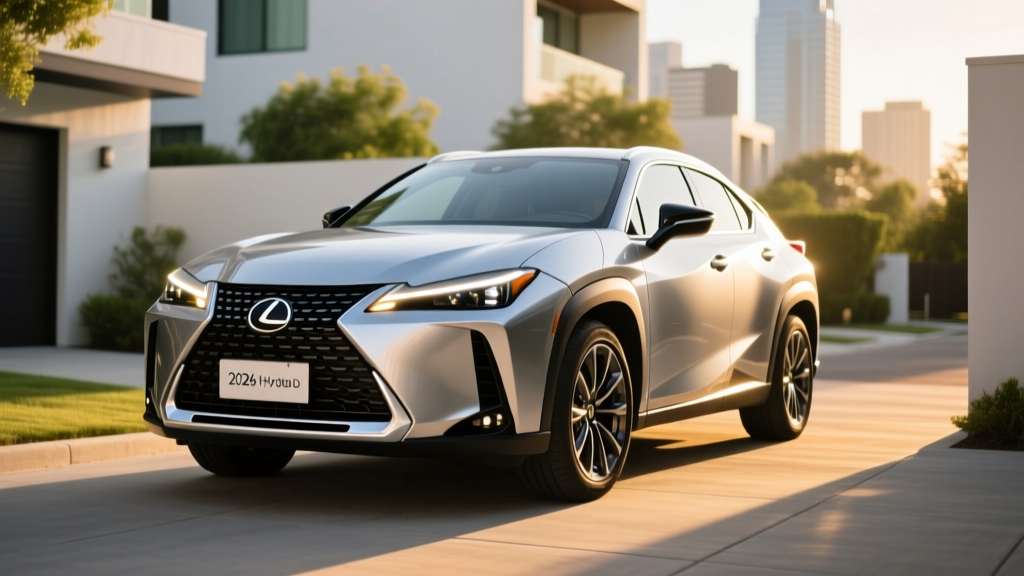
If you've been searching for a lexus small suv hybrid, the UX 250h is likely at the top of your list. It's the most compact electrified vehicle in Lexus's lineup, and for 2026, it continues to offer a compelling blend of luxury, efficiency, and the brand's legendary reliability — without requiring you to plug in or adjust your driving habits. This is a conventional hybrid (HEV), not a plug-in hybrid (PHEV), meaning you simply fill up with gas and let the hybrid system do the work.
But is the UX 250h the right choice in a market increasingly filled with plug-in hybrids and full battery-electric vehicles? This review breaks down the exact EPA fuel economy figures, real-world efficiency we've observed, powertrain specs, ownership costs, battery warranty details, and how it compares to both PHEVs and BEVs — so you can make a data-driven decision.
Lexus UX 250h at a Glance: Key Specs
| Specification | 2026 Lexus UX 250h |
|---|---|
| Powertrain | 2.0L 4-cyl + electric motor (HEV) |
| Combined Horsepower | 181 hp |
| Drivetrain | AWD (standard) |
| EPA Combined MPG | 42 MPG |
| EPA City / Highway | 43 city / 41 highway |
| Fuel Tank Capacity | 10.6 gallons |
| Total Range | ~445 miles |
| 0–60 mph | 8.4 seconds |
| Cargo Volume | 21.7 cu ft (rear seats up) |
| Base MSRP | $39,345 (UX 250h Premium) |
| Hybrid Battery Warranty | 10 years / 150,000 miles |
| Federal Tax Credit | Not eligible (§30D requires plug-in) |
Fuel Economy: EPA Numbers vs. Real-World MPG
The 2026 Lexus UX 250h carries an EPA rating of 43 MPG city, 41 MPG highway, and 42 MPG combined, according to fueleconomy.gov. These are strong numbers for a luxury AWD crossover, and they reflect Toyota/Lexus's fifth-generation hybrid system tuning.
Real-world observation: In mixed suburban and city driving, the UX 250h tends to meet or slightly exceed its EPA city rating. Hybrids inherently excel in stop-and-go traffic, where regenerative braking recaptures energy and the electric motor handles low-speed propulsion. On a 200-mile highway-dominant loop at 70–75 mph, expect closer to 38–40 MPG — a mild drop from the combined sticker, but still excellent. Cold weather (below 35°F) typically reduces efficiency by 3–5 MPG due to increased engine runtime for cabin heat and reduced battery efficiency.
| Driving Scenario | Expected MPG |
|---|---|
| EPA City (sticker) | 43 MPG |
| EPA Highway (sticker) | 41 MPG |
| Real-world city / suburban | 42–46 MPG |
| Real-world highway (70–75 mph) | 38–40 MPG |
| Cold weather combined | 37–40 MPG |
Hybrid Powertrain: How the UX 250h Works
The UX 250h pairs a 2.0-liter Atkinson-cycle four-cylinder engine with Lexus's hybrid transaxle, which integrates two motor-generators. A rear-mounted electric motor provides all-wheel drive (branded as E-Four), engaging automatically when the front wheels slip or during hard acceleration. Combined system output is 181 horsepower.
The hybrid battery is a nickel-metal hydride (NiMH) pack, not lithium-ion — a deliberate choice by Toyota/Lexus for proven long-term durability. The battery sits under the rear seat, preserving cargo space. Unlike a PHEV or BEV, there is no plug, no charging port, and no electric-only driving mode. The system automatically manages when to use the engine, the motor, or both.
HEV vs. PHEV vs. Full EV: Which Should You Choose?
The UX 250h is a conventional hybrid (HEV). Understanding how it differs from a plug-in hybrid (PHEV) and a battery-electric vehicle (BEV) is essential before you buy.
| Feature | HEV (UX 250h) | PHEV (e.g., NX 450h+) | BEV (e.g., Tesla Model Y) |
|---|---|---|---|
| Plugs in? | No | Yes | Yes |
| Electric-only range | None (EV assist only) | ~37 miles | 260–330+ miles |
| Fuel / energy | Gasoline only | Gasoline + electricity | Electricity only |
| Home charging needed? | No | Recommended | Essential |
| Federal tax credit (§30D) | Not eligible | Up to $7,500* | Up to $7,500* |
| Best for | No home charging access | Short commute + road trips | Home charging + daily driving |
*§30D federal tax credit eligibility depends on MSRP caps, buyer income limits, battery component sourcing, and critical mineral requirements. See IRS guidelines for current-year rules. Consult a tax professional.
- Choose the UX 250h (HEV) if you don't have reliable access to home or workplace charging, want zero lifestyle change from your gas car, and value long-term reliability above all.
- Choose a PHEV if you have a garage or driveway where you can install a Level 2 charger, your daily commute is under 35 miles, and you want electric-only weekday driving with gas-engine flexibility for road trips.
- Choose a BEV if you can charge at home, want the lowest per-mile fuel cost, qualify for the full tax credit, and your typical trips fall within 250+ miles.
Pricing, Trims, and Tax Credit Reality
The 2026 Lexus UX 250h starts at $39,345 for the Premium trim, including destination. The F SPORT Handling trim climbs to approximately $44,000. These prices position the UX 250h as one of the most affordable entry points into the Lexus brand — and certainly the most fuel-efficient.
Federal tax credit: The UX 250h does not qualify for the IRS §30D Clean Vehicle Credit. That credit is reserved for plug-in vehicles (PHEVs and BEVs) with battery capacities of at least 7 kWh. Since the UX 250h is a conventional hybrid with a small NiMH pack, it falls outside the program's scope.
State incentives: Some states offer rebates or HOV lane access for hybrids, but these vary widely by jurisdiction. Check your state's energy office or DMV website for current programs.
Battery Warranty, Reliability, and Replacement Cost
Reliability data: The UX 250h inherits Toyota's hybrid architecture, which has been in continuous production since the 1997 Prius. Independent reliability surveys from Consumer Reports and J.D. Power consistently rank Lexus at or near the top. The hybrid components — motor-generators, inverter, and battery — have proven track records spanning millions of vehicles.
Battery replacement cost: If the hybrid battery does eventually need replacement outside of warranty, expect to pay approximately $2,000–$3,500 for a new OEM battery pack plus labor. Refurbished packs are available for $1,000–$1,800. In practice, Toyota/Lexus hybrid batteries regularly exceed 150,000 miles with minimal degradation — the NiMH chemistry is less prone to the capacity fade seen in some early lithium-ion packs.
What the UX 250h Doesn't Do Well
- 42 MPG combined — real-world often higher in city
- Standard AWD with no efficiency penalty
- 10-year/150k-mile hybrid battery warranty
- No charging infrastructure needed
- Lexus reliability and resale value
- Refined, quiet cabin at low speeds
- Small cargo area (21.7 cu ft)
- Modest 181 hp — not a quick SUV
- No federal tax credit eligibility
- CVT drone under hard acceleration
- Tight rear-seat legroom
- No plug-in variant available
Frequently Asked Questions
How many MPG does the Lexus UX 250h hybrid get?
The 2026 Lexus UX 250h is EPA-rated at 43 MPG city, 41 MPG highway, and 42 MPG combined. In real-world city and suburban driving, many owners report 42–46 MPG. Highway driving at sustained speeds above 70 mph typically yields 38–40 MPG.
Does the Lexus UX 250h need to be plugged in?
No. The UX 250h is a conventional hybrid (HEV), not a plug-in hybrid. It charges its own small battery through regenerative braking and the gasoline engine. You never plug it in — just fill up with gas as you would with any conventional car.
Is the Lexus UX 250h reliable, and what does battery replacement cost?
Lexus consistently ranks at the top of reliability surveys, and the UX 250h's hybrid system is derived from Toyota's proven architecture with over 25 years of production history. The hybrid battery is warrantied for 10 years/150,000 miles. Out-of-warranty replacement runs approximately $2,000–$3,500 for a new OEM pack, though most hybrid batteries far exceed their warranty period.
Does the Lexus UX 250h qualify for any tax credit?
No. The UX 250h does not qualify for the federal §30D Clean Vehicle Credit, which requires a plug-in vehicle with a battery capacity of at least 7 kWh. Some states may offer separate hybrid incentives — check your state energy office for details.
Should I buy the UX 250h hybrid or a plug-in hybrid like the NX 450h+?
If you have access to home charging (a garage or driveway with a 240V outlet), the larger Lexus NX 450h+ PHEV offers ~37 miles of electric-only range for daily commuting and up to $7,500 in federal tax credits (subject to eligibility). If you lack charging access, want a smaller vehicle, or prefer a lower purchase price, the UX 250h HEV is the better fit — it requires zero infrastructure and still delivers over 40 MPG.