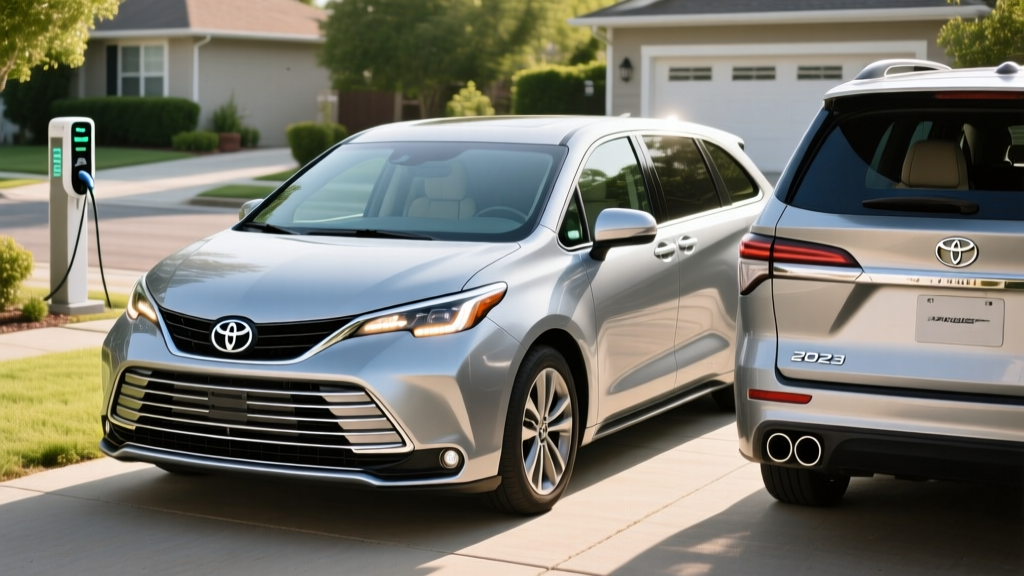
The 2023 Toyota Sienna stands apart in the minivan segment for one reason: it is exclusively a hybrid. While competitors like the Honda Odyssey and Chrysler Pacifica offer conventional gasoline powertrains (with the Pacifica adding a PHEV variant), Toyota committed fully to its fourth-generation hybrid system for the Sienna. The result is a three-row family hauler that delivers mid-30s MPG in a vehicle class where 20 MPG was once the norm.
This review covers the 2023 Sienna hybrid's real-world fuel economy, powertrain details, battery longevity, ownership costs, and how it stacks up against plug-in hybrid and full-electric alternatives for family buyers.
2023 Sienna Hybrid Fuel Economy: EPA vs. Real World
The 2023 Toyota Sienna is rated by the EPA at 36 MPG combined for front-wheel-drive (FWD) trims and 35 MPG combined for all-wheel-drive (AWD) trims. These figures are remarkable for a 4,600-pound, eight-passenger minivan.
| Drivetrain | City MPG | Highway MPG | Combined MPG |
|---|---|---|---|
| FWD (LE, XLE, Limited, Platinum) | 36 | 36 | 36 |
| AWD (all trims) | 35 | 35 | 35 |
Source: EPA Fuel Economy Guide
Real-World MPG: What Owners Actually See
Toyota's hybrid system excels in city driving, where regenerative braking and electric-motor assist maximize efficiency. In real-world use, many Sienna owners report 33–38 MPG in mixed suburban driving, with city-heavy routes occasionally pushing above the EPA estimate to 38–40 MPG. Highway cruising at 75+ MPH tends to drop efficiency to 30–33 MPG, as the gasoline engine carries more of the load without regen assistance.
Cold weather impacts are moderate compared to full EVs. Expect a 2–4 MPG reduction in freezing temperatures as the engine runs more frequently to provide cabin heat and maintain battery temperature. This is far less severe than the 20–30% range loss an EV experiences in winter.
Powertrain: How the Sienna Hybrid System Works
The 2023 Sienna uses Toyota's fourth-generation hybrid powertrain, pairing a 2.5-liter four-cylinder Atkinson-cycle engine with two electric motor-generators (three on AWD models) and a continuously variable transmission (eCVT).
| Specification | Detail |
|---|---|
| Engine | 2.5L 4-cylinder Atkinson-cycle |
| Engine Output | 189 hp / 176 lb-ft torque |
| Front Electric Motor | 134 hp (MG2) |
| Rear Electric Motor (AWD only) | 54 hp (independent rear axle) |
| Net Combined Horsepower | 245 hp |
| Transmission | eCVT (planetary gearset) |
| Hybrid Battery | 1.9 kWh nickel-metal hydride (NiMH) |
| 0–60 MPH | ~7.1 seconds (FWD), ~7.3 seconds (AWD) |
| Towing Capacity | 3,500 lbs |
HEV vs. PHEV: The Sienna Is a Conventional Hybrid
This is a critical distinction for buyers. The 2023 Sienna is a conventional hybrid (HEV), not a plug-in hybrid (PHEV). It cannot be plugged in, has no electric-only driving range beyond brief low-speed assists (~1 mile at most), and does not qualify for the federal §30D EV tax credit.
| Feature | HEV (Sienna Hybrid) | PHEV (e.g., Pacifica Hybrid) |
|---|---|---|
| Plug-in charging? | No — self-charging via regen and engine | Yes — plugs into Level 1 or Level 2 |
| Electric-only range | Negligible (<1 mi at low speed) | 32 miles (Pacifica Hybrid) |
| Battery size | 1.9 kWh NiMH | 16 kWh lithium-ion |
| Federal tax credit | Not eligible | Up to $7,500 (§30D, if eligible) |
| Home charging needed? | No | Yes, for EV-range benefit |
If you want plug-in capability in a minivan, the Chrysler Pacifica Hybrid is currently the only PHEV option. If you want a no-plug, no-compromise hybrid minivan, the Sienna is the sole offering.
Pricing and Trim Levels
The 2023 Toyota Sienna started at an MSRP of $35,385 for the base LE FWD trim and climbed to $52,675 for the Platinum AWD. All trims come standard with the hybrid powertrain — there is no gas-only option.
| Trim | FWD MSRP | AWD MSRP |
|---|---|---|
| LE | $35,385 | $36,140 |
| XLE | $40,085 | $40,840 |
| XSE | $42,135 | $42,890 |
| Limited | $46,735 | $47,490 |
| Platinum | $51,920 | $52,675 |
Tax Credit Eligibility
The 2023 Sienna hybrid does not qualify for the federal §30D clean vehicle tax credit. That credit applies only to plug-in electric vehicles (BEVs and PHEVs) meeting specific battery sourcing, MSRP caps, and buyer income thresholds, as outlined by the IRS. Conventional hybrids like the Sienna are ineligible regardless of price or buyer income.
Some states offer modest incentives for hybrid purchases, but these vary widely by jurisdiction and change frequently. Check your state's energy or environmental agency website for current programs.
Battery Longevity, Warranty, and Replacement Cost
Hybrid battery anxiety is one of the most common concerns among first-time hybrid buyers. The Sienna's 1.9 kWh NiMH battery pack is small, robustly managed, and benefits from decades of Toyota hybrid refinement dating back to the original Prius in 1997.
How Long Do Sienna Hybrid Batteries Last?
Toyota's NiMH hybrid batteries have demonstrated exceptional longevity. Data from high-mileage Prius and Camry Hybrid fleets shows that these battery packs routinely last 150,000–200,000+ miles before significant degradation. The Sienna's battery is managed conservatively — it never charges to full capacity or discharges completely, which dramatically extends cycle life.
The Sienna's NiMH chemistry is less energy-dense than lithium-ion but offers proven thermal stability and a longer calendar life. Toyota chose NiMH specifically for its reliability in hybrid applications where the battery undergoes thousands of shallow charge-discharge cycles daily.
Battery Replacement Cost
If the hybrid battery does fail outside of warranty, replacement costs for a Toyota minivan hybrid battery typically range from $3,000 to $4,500 (parts and labor at a dealership). Independent hybrid specialists often offer refurbished battery packs for $2,000–$3,000. Individual module replacement (only the degraded cells) can reduce costs to $500–$1,500 at a specialist shop.
For context, this is a fraction of a full EV battery replacement ($10,000–$20,000+) because the Sienna's hybrid battery stores only 1.9 kWh of energy versus the 60–100+ kWh in a typical EV.
Reliability and Safety Ratings
The 2023 Sienna earned the IIHS Top Safety Pick+ rating — the institute's highest honor — with Good ratings across all crashworthiness tests. The IIHS noted Good headlight ratings on trims equipped with LED projector lamps (Limited and Platinum).
Standard safety technology includes Toyota Safety Sense 2.0 (TSS 2.0): automatic emergency braking with pedestrian detection, lane departure alert with steering assist, full-speed adaptive cruise control, and automatic high beams. This is a Level 0–1 driver-assistance suite — it provides warnings and momentary intervention but does not offer hands-free or lane-centering driving like Toyota's newer TSS 3.0 found on 2024+ models.
Long-term reliability projections for the Sienna are strong. The hybrid powertrain has been in production since 2021 (current generation) with minimal reported issues. Toyota's hybrid systems consistently rank among the most reliable powertrains in J.D. Power and Consumer Reports data.
Sienna Hybrid vs. Alternatives: Which Minivan Fits You?
- You want maximum fuel economy without plugging in
- You drive 15,000+ miles per year and want to minimize fuel costs
- You want Toyota's proven hybrid reliability and 10-year battery warranty
- You need AWD availability in a hybrid minivan
- You can charge at home and want 32 miles of electric-only school-run driving
- You qualify for the $7,500 federal tax credit (income and sourcing rules apply)
- Your daily driving is under 30 miles round-trip
- You have reliable home Level 2 charging
- Your typical trips are under 250 miles
- You want zero tailpipe emissions and minimal maintenance
- You can absorb a higher purchase price ($54,900+ for the EV9)
5-Year Fuel Cost Comparison
| Vehicle | Combined MPG | Annual Fuel Cost | 5-Year Fuel Cost |
|---|---|---|---|
| 2023 Toyota Sienna Hybrid (FWD) | 36 | $1,458 | $7,292 |
| 2023 Honda Odyssey (gas) | 22 | $2,386 | $11,932 |
| 2023 Chrysler Pacifica Hybrid (PHEV, blended use) | 30 / 82 MPGe | ~$1,200 | ~$6,000 |
The Sienna saves roughly $4,640 in fuel over five years compared to the gas-only Honda Odyssey. The Pacifica PHEV can edge slightly ahead if you charge daily and mostly drive within its electric range, but its advantage disappears without consistent plug-in access.
Pros and Cons of the 2023 Sienna Hybrid
- Best-in-class fuel economy: 36 MPG combined (FWD)
- No plugging in required — zero lifestyle change from a gas car
- Standard hybrid on all trims; no confusing powertrain options
- 10-year/150,000-mile hybrid battery warranty
- AWD available across all trims
- 3,500-lb towing capacity
- IIHS Top Safety Pick+
- Spacious three-row interior with 33.5 cu ft cargo behind third row
- No plug-in option — cannot access federal §30D tax credit
- 245 hp feels adequate but not quick for a loaded family hauler
- eCVT drone under hard acceleration (common to Toyota hybrids)
- Infotainment system (2023 model) is dated vs. competitors; 8-inch screen on lower trims
- No spare tire — uses tire inflator kit (run-flat optional on some trims)
- Higher base price than the gas-only Odyssey (~$35K vs ~$34K, but Odyssey lacks hybrid)
Frequently Asked Questions
How many MPG does the 2023 Sienna hybrid get?
The EPA rates the 2023 Sienna hybrid at 36 MPG city / 36 MPG highway / 36 MPG combined for FWD trims, and 35/35/35 for AWD trims. Real-world mixed driving typically yields 33–37 MPG, with highway-only trips dropping to 30–33 MPG.
Does the Sienna hybrid need to be plugged in?
No. The 2023 Sienna is a conventional hybrid (HEV). It charges its 1.9 kWh battery through regenerative braking and the gasoline engine. There is no plug, no charging cable, and no electric-only driving range to manage.
Is the Sienna hybrid reliable, and what does a battery replacement cost?
Toyota's hybrid systems have an exceptional reliability track record spanning 25+ years. The Sienna's hybrid battery is warrantied for 10 years / 150,000 miles. Out-of-warranty replacement costs $3,000–$4,500 at a dealership, or $2,000–$3,000 from an independent hybrid specialist using refurbished packs.
Does the 2023 Sienna hybrid qualify for any tax credit?
No. The federal §30D clean vehicle credit applies only to plug-in vehicles (BEVs and PHEVs). The Sienna, as a conventional hybrid, does not qualify regardless of trim price or buyer income. Check your state's incentive programs for any local hybrid rebates.
How does the Sienna hybrid compare to the Chrysler Pacifica Hybrid?
The Pacifica Hybrid is a PHEV with 32 miles of electric-only range and an 82 MPGe rating when charged. It qualifies for up to $7,500 in federal tax credits (subject to eligibility). However, without regular plug-in charging, the Pacifica Hybrid's gas-only MPG drops to 30 combined — below the Sienna's 36. The Sienna wins on simplicity and no-plug efficiency; the Pacifica wins for short commutes with home charging.
Can I tow with the Sienna hybrid?
Yes. The 2023 Sienna hybrid is rated to tow up to 3,500 pounds when properly equipped. Expect fuel economy to drop significantly while towing — roughly 20–25 MPG depending on trailer weight and terrain.
Sources: fueleconomy.gov, IIHS, IRS §30D, Toyota Motor Corporation press materials.